
01An Island You Can Walk Onto
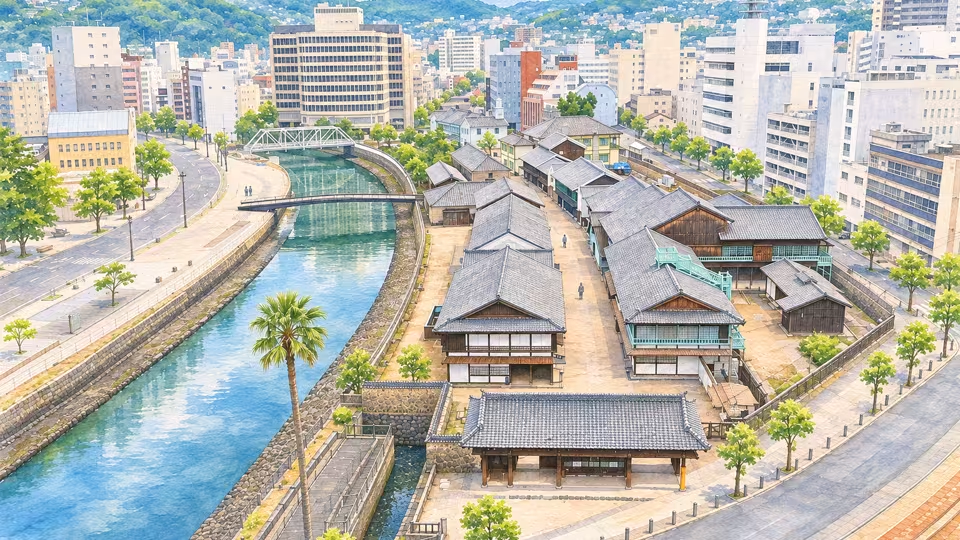
Dejima no longer looks like an island. Tram lines run past it, a river channel borders one side, and city blocks press against the others. Yet for more than two hundred years this small fan-shaped plot of reclaimed land sat in the waters of Nagasaki harbor, joined to the town by a single short bridge. From 1641 to 1859 it was the only place in Japan where Europeans were permitted to live and trade, and nearly everything Japan learned directly from Europe in that period passed through its gate.
The island measured roughly 15,000 square meters, about the size of two football pitches. Its name simply means "projecting island." The buildings you see today are mostly careful reconstructions, put up over the last few decades on the original footprint, but the story they tell is real: of a merchant company that accepted confinement as the price of access, and of a Japanese state that wanted foreign goods and foreign news while keeping foreign religion out.
02Built for the Portuguese
Dejima was not originally meant for the Dutch. Portuguese ships, sailing from their base at Macau, had been coming to Nagasaki since the 1570s; the port itself was laid out in 1571 to receive them. The Portuguese brought Chinese silk, which Japan wanted badly, but they also brought Jesuit missionaries, and by the early seventeenth century Christianity had hundreds of thousands of Japanese converts.
The Tokugawa shogunate (the military government based in Edo, modern Tokyo) banned Christianity outright in 1614 and set about stamping it out. It was not yet ready to give up the silk trade, however. The solution was containment. In 1634 the shogunate ordered the construction of an artificial island, financed by twenty-five wealthy Nagasaki merchants, and in 1636 the Portuguese were moved onto it. They paid the investors a yearly rent, usually recorded as 80 kanme of silver, and were cut off from contact with ordinary Japanese.
The fan shape has prompted a popular story: that the third shogun, Tokugawa Iemitsu, asked what form the island should take and answered by spreading his folding fan. It is a later legend. The curve more likely followed the shoreline and the currents of the harbor.
03Shimabara and the Expulsion
The Portuguese did not stay long. In late 1637 a rebellion broke out on the Shimabara peninsula and the Amakusa islands, driven by famine and harsh taxation but carried on under Christian banners. The shogunate needed months and a huge army to besiege the rebels in the ruined Hara Castle, which fell in 1638. Afterwards the regime regarded Catholicism as an existential threat, and the Portuguese as its carriers.
In 1639 Portuguese ships were banned from Japan. When Macau sent an embassy in 1640 to plead for the trade’s restoration, most of its members were executed. Dejima stood empty, and its Nagasaki owners lost their rental income.
04The Dutch Come From Hirado
The Dutch East India Company, known by its initials VOC, had been trading in Japan since 1609 from a factory (a trading post) at Hirado, an island port in northwestern Kyūshū. The Dutch were Protestants with little interest in missionary work, and they had spent decades persuading the shogunate that they were not like the Portuguese. During the Shimabara siege a Dutch ship even bombarded the rebels’ castle at the shogunate’s request.
Suspicion remained. In 1640 the shogunate’s inspector Inoue Masashige arrived at Hirado and pointed to the date carved on the company’s new stone warehouse, reckoned from the birth of Christ. The warehouse was to be demolished. The head of the factory, François Caron, complied at once, and the company survived. The following year, 1641, the Dutch were ordered to move to Dejima. They would remain there for 218 years.
Chinese merchants, the other foreigners permitted at Nagasaki, were at first free to live in the town. From 1689 they too were confined, in a walled compound called the Tōjin yashiki, the "Chinese quarter."
05Life Behind the Gate
Dejima came under the authority of the Nagasaki bugyō, the shogunate’s governor of the city. Usually only about a dozen to twenty Europeans lived there at any one time. At their head was the opperhoofd, the chief factor, whom the Japanese called kapitan, a word borrowed from Portuguese. Under him were a deputy, clerks, a doctor and warehouse staff, along with enslaved and servant workers brought from the company’s Asian possessions. No European women were permitted.
The island had one main land gate and a water gate for cargo. Japanese guards checked everyone who passed. The Japanese allowed onto the island were limited to officials, laborers, the hereditary interpreters known as tsūji, and courtesans from Nagasaki’s Maruyama pleasure quarter. The interpreters were a closed professional group; they had originally worked in Portuguese and only gradually acquired Dutch, and they became the human channel through which European learning reached Japan.
Within these limits the Dutch built a small world. There were residences, warehouses, a kitchen, a garden, pens for cattle, pigs and chickens, and in later years a billiard table. They celebrated Christmas quietly, under the cover name of a winter-solstice feast, and entertained Japanese officials at Western-style banquets that Nagasaki artists loved to paint. Many residents described the posting as a gilded prison. The company paid rent for the island every year to the Nagasaki owners: 55 kanme of silver, less than the Portuguese had paid.
06What Moved Through Dejima
Ships came from Batavia, the company’s Asian headquarters (modern Jakarta), riding the summer monsoon and leaving in autumn. In the seventeenth century several ships arrived each year; later the shogunate limited the number, and by the late eighteenth century it was often one or two. On arrival, Japanese officials took the ship’s guns and anything religious into custody until departure.
The Dutch imported Chinese raw silk and silk textiles, Indian cottons, sugar, deer and ray skins, sappanwood for dye, spices and medicines, along with European curiosities such as clocks, telescopes, glassware and books. Japan paid at first in silver, of which it was then one of the world’s great producers. When silver exports were curbed, copper became the main export. Camphor, lacquerware and porcelain also went out. In the mid-seventeenth century, when war in China interrupted the supply of Chinese porcelain, the VOC turned to the kilns of Arita in Kyūshū, and Imari ware became a luxury in European palaces.
The shogunate worried constantly about the drain of precious metal. In 1715 the scholar-official Arai Hakuseki introduced the Shōtoku regulations, capping the number of Dutch and Chinese ships and the value of their trade. By the eighteenth century Dejima was much less profitable for the company than it had been, but the VOC held on: it was Europe’s only window into Japan, and no rival could take it.
07Journeys to Edo and Reports From the World
Each year the chief factor traveled to Edo to pay his respects to the shogun and present gifts, a journey known as the Edo sanpu. The round trip took around three months. In Edo the Dutch stayed at the Nagasakiya inn, where scholars, physicians and curious lords crowded in to question them about Western medicine, astronomy and geography. From 1790 the journey was reduced to once every four years.
The factor also had to deliver a news report, the Oranda fūsetsugaki, whenever a ship arrived. The interpreters translated his account of world events and forwarded it to the shogunate, which relied on these reports to follow wars in Europe and events in China. After the Opium War broke out in 1840 the Dutch supplied a more detailed "special report." In 1852 the chief factor warned that the United States was preparing to send a naval expedition to Japan. Commodore Matthew Perry arrived the following year.
08Dutch Learning
In 1720 the eighth shogun, Tokugawa Yoshimune, eased the ban on importing Western books in Chinese translation, provided they had nothing to do with Christianity. Interest in rangaku, "Dutch learning," grew steadily. Its landmark came in 1774 when Sugita Genpaku, Maeno Ryōtaku and their colleagues published Kaitai shinsho (New Book of Anatomy), a translation of a Dutch edition of a German anatomical text. They had compared its illustrations against an actual dissection and found that the Western drawings were accurate where Chinese medical charts were not.
Dejima’s doctors were central to this exchange. They treated interpreters and local physicians, answered questions, and sometimes taught. Medicine was the main field, but botany, astronomy, surveying and gunnery also came through Nagasaki.
09Three Scholars of Dejima
Three company physicians became famous in Europe for what they wrote about Japan.
Engelbert Kaempfer, a German, served at Dejima from 1690 to 1692 and twice made the journey to Edo. His History of Japan, published in English after his death, became Europe’s standard account of the country for more than a century. An appendix discussing Japan’s closed policy was translated into Japanese in 1801 by the former interpreter Shizuki Tadao, who coined the word sakoku, "closed country," which later historians adopted.
Carl Peter Thunberg, a Swedish student of Carl Linnaeus, worked at Dejima in 1775–1776. His Flora Japonica gave scientific names to many Japanese plants.
Philipp Franz von Siebold, a German doctor, arrived in 1823. He was allowed to open a clinic and school at Narutaki on the outskirts of Nagasaki, where he trained a generation of Japanese physicians including Takano Chōei. In 1828, as he prepared to leave, he was found to possess maps of Japan whose export was strictly forbidden; they had been supplied by the shogunate’s astronomer Takahashi Kageyasu. In what became known as the Siebold Incident, Takahashi died in prison and Siebold was expelled in 1829. His daughter by a Nagasaki woman, Kusumoto Ine, became one of Japan’s first women trained in Western medicine. Siebold published his monumental Nippon in Europe and returned to Japan in 1859.
10The Last Dutch Flag
At the end of the eighteenth century the VOC collapsed and was dissolved in 1799. The Netherlands fell under French control and was eventually annexed by Napoleon. Ships from Batavia became rare, and the Dejima factory survived partly by chartering neutral American vessels. For a few years in the 1810s, Dejima was said to be one of the only places in the world, perhaps the only one, where the Dutch flag still flew.
The man who held on was Hendrik Doeff, chief factor from 1803 to 1817, the longest tenure of any head of the factory. He set the interpreters to work on a Dutch–Japanese dictionary, completed only in 1833 after his departure and later known as the Doeff Halma. He also refused to hand Dejima over to the British, who had occupied Java.
The British had already made their presence felt. In 1808 the frigate HMS Phaeton entered Nagasaki harbor under a Dutch flag, seized two Dutch employees as hostages, and demanded supplies before sailing away. The Nagasaki governor, Matsudaira Yasuhide, took responsibility for his helplessness by committing suicide. The affair was an early warning to the shogunate that Western navies could not be kept out by decree.
11Opening and Disappearance
Perry’s visits led to the Treaty of Kanagawa with the United States in 1854. The Netherlands soon concluded its own treaties, and the restrictions on Dejima were lifted. In 1859 Nagasaki opened as a treaty port; the factory was closed and its head became a consul. Dejima’s special role was over.
In the Meiji era the island became part of Nagasaki’s foreign settlement. Harbor improvements and the straightening of the Nakashima River cut into its edges, and land reclamation gradually surrounded it. By the early twentieth century it had become an ordinary city block. In 1922 the site was designated a National Historic Site.
12Rebuilding Dejima
The city of Nagasaki took its first steps in 1951, repairing a collapsing stone warehouse, and in the 1970s added a scale model of the island. As land on the site was gradually bought back, the city adopted a full restoration plan in 1996, based on old plans, paintings, excavations and written records, and aimed at recreating the island as it looked in the early nineteenth century. Five buildings, including the deputy factor’s quarters and the first two warehouses, were completed in 2000. A second phase finished in 2006 brought back the chief factor’s residence and the water gate, and a third phase added six more buildings in 2016. In 2017 a new Omotemon Bridge was built in the original position, so that visitors could once again enter through the front gate from across the water. The city’s long-term goal is to make Dejima an island again.
Most of what you see is therefore reconstruction. The authentic old structures are the stone embankments that survive in places and a pair of Meiji-period Western-style buildings from the settlement era.
13Walking the Island
Cross the Omotemon Bridge and pass through the gate. The most striking building is the Kapitan’s residence. Upstairs, the banquet room is laid with a reconstructed Dutch dinner of the kind served to Japanese officials, and the walls are covered in brightly patterned paper: a Japanese timber building dressed in a European interior.
Nearby are the quarters of the deputy factor and the captain of the first ship of the season, and the rooms of the otona, the Japanese ward officials who managed the island, and of their subordinate officers. The numbered warehouses once held sugar and sappanwood and now house exhibitions on trade goods, with excavated porcelain, gin bottles and clay pipes on display.
A scale model set up in the 1970s shows the whole of Dejima as it was, with its fan-shaped outline, land gate, water gate and the two rows of buildings along its central street. The reconstructed water gate on the western side was where cargo was loaded and unloaded; in the Edo period the sea lapped right outside it.
At the eastern end stand the Meiji buildings: the former Dejima Theological School of 1878, the oldest surviving Protestant seminary building in Japan, and the former Nagasaki International Club of 1903, built as a meeting place for foreign residents and Japanese. They belong to the island’s afterlife as part of the treaty-port city.
Before leaving, walk to the edge and look out over the stone wall. The Dutch who stood here could see Nagasaki’s streets and hills but could not freely enter them. Today the water has gone, and the city has grown right up to the wall.