
01A City Written in Seventeen Syllables
Walk around Matsuyama, the capital of Ehime Prefecture on the island of Shikoku, and you keep running into poems. Stones carved with haiku stand outside stations, temples and hotels. Small boxes marked as haiku post boxes invite passers-by to drop in a verse of their own. Every summer, high-school teams from across Japan come here to compete in a haiku tournament modeled on a baseball championship.
Almost all of this traces back to one man, Masaoka Shiki, born here in 1867 and dead in Tokyo at thirty-four. In a working life of barely ten years, much of it spent flat on his back, he took two inherited forms of Japanese poetry, the seventeen-syllable haiku and the thirty-one-syllable tanka, and argued them into the modern age. The very word "haiku," now used around the world, owes its currency to him.
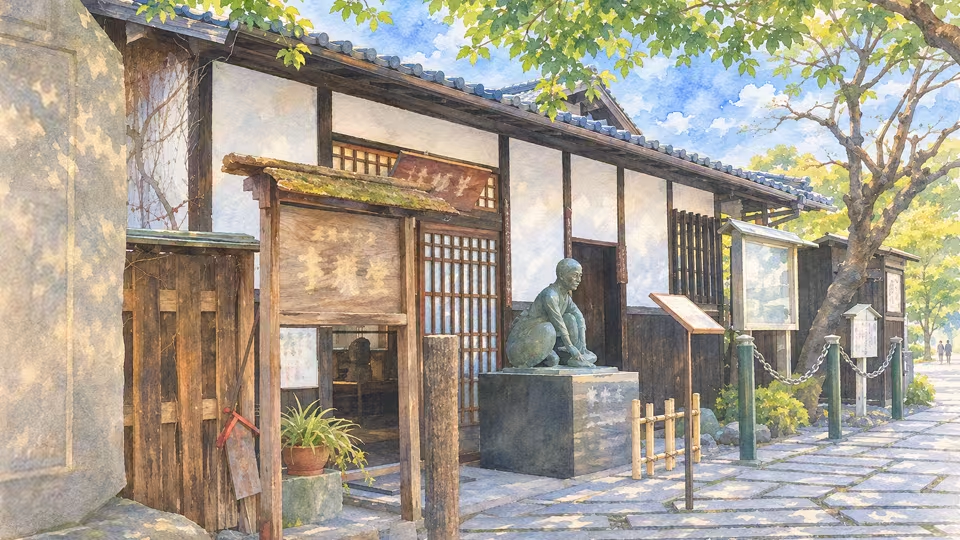
Two places in Matsuyama tell his story. Shiki-dō, in the grounds of Shōshū-ji temple in the city center, is a reconstruction of the house where he grew up. The Matsuyama Municipal Shiki Memorial Museum, beside Dōgo Park near the old hot-spring town, sets out his life, his friends and his literary world. Between them lie Dōgo Onsen and a few autumn weeks in 1895 when Shiki shared a rented house with the novelist Natsume Sōseki.
02A Samurai Son in a Losing Domain
Shiki was born Masaoka Tsunenori on the seventeenth day of the ninth month of Keiō 3, which corresponds to October 14, 1867. As a child he was called Tokoronosuke, later Noboru. His family belonged to the lower ranks of the samurai of the Matsuyama domain, a branch of the Tokugawa establishment that ended up on the wrong side of the Meiji Restoration a few months after his birth.
His father, Tsunenao, died in 1872, when Shiki was four. His mother, Yae, was the daughter of the domain Confucian scholar Ōhara Kanzan, and it was Kanzan who gave the boy his first schooling in the Chinese classics. Shiki grew up with his mother and his younger sister Ritsu in a household of genteel poverty. As a schoolboy he wrote Chinese-style verse, produced hand-copied magazines with his friends, and caught the excitement of the Freedom and People’s Rights Movement, giving political speeches at school.
For an ambitious young man from a former domain that had backed the shogunate, the way up ran through Tokyo. In 1883, at fifteen, Shiki left Matsuyama Middle School and went to the capital, supported by a scholarship connected to the former lords of the domain, the Hisamatsu family, and by his uncle Katō Tsunetada, a diplomat.
03Tokyo, Baseball and Blood
In Tokyo Shiki entered the preparatory course for the university, which later became the First Higher Middle School. Among his classmates was Akiyama Saneyuki, another Matsuyama boy who would become a naval strategist in the Russo-Japanese War. Shiki’s ambitions drifted from politics to philosophy and finally to literature.
He also fell in love with baseball, then a new import. He played it enthusiastically, wrote about it, and is credited with Japanese renderings of several terms for the game. He even played on his childhood name, using the characters for "field" and "ball," read "no-bōru," as a pen name. The standard Japanese word for baseball, yakyū, written with those same characters, was actually coined by someone else, Chūma Kanoe, but Shiki’s enthusiasm earned him a place in the Japanese Baseball Hall of Fame in 2002.
The year 1889 changed his life. Early that year he became friends with a classmate, Natsume Kinnosuke, through a shared love of rakugo, the art of comic storytelling. In May, Shiki coughed up blood, the first sign of the tuberculosis that would kill him. He then took the name Shiki, a literary word for the hototogisu, the lesser cuckoo, a bird which in Chinese and Japanese tradition was said to sing until it coughed blood. That same year, Kinnosuke wrote a commentary in classical Chinese on a manuscript collection of Shiki’s writings and signed it with the name Sōseki. It was the first time he used the name under which he would become Japan’s best-known modern novelist.
04Declaring War on Stale Verse
Shiki entered the Imperial University in 1890 but lost interest in his courses. He tried writing fiction, showed a novel to the established writer Kōda Rohan, received no encouragement, and turned instead to haiku. In 1892 he left the university and joined the newspaper Nippon, run by the nationalist journalist Kuga Katsunan, who became his employer, patron and later his neighbor in Tokyo’s Negishi district.
In the pages of Nippon he began his campaign. The haiku world of his day, he argued, was dominated by what he called tsukinami, literally "monthly," after the routine monthly poetry meetings run by professional masters. The word became his label for verse built from stock phrases, puns and the authority of teachers rather than from experience. He spent years sorting tens of thousands of earlier verses by season word and subject, a huge catalog that gave him the ground to judge his predecessors.
He did not spare Matsuo Bashō. In 1893, the two-hundredth anniversary of Bashō’s death, when the old master was being celebrated everywhere, Shiki published an essay arguing that most of Bashō’s output was mediocre. He promoted instead the eighteenth-century painter-poet Yosa Buson, whose verses he admired for their vivid, painterly clarity.
05Shasei: Sketching from Life
The method Shiki put at the heart of his reform was shasei, "sketching from life," a term he took from painting. His friend the Western-style painter Nakamura Fusetsu introduced him to the idea, and Shiki applied it to verse: write what you actually see, rather than what tradition says you should feel about it. In practice it was less a rule than a discipline of attention, a way of getting fresh observation into a very short poem.
He also drew a firm line around the form itself. Traditionally the seventeen-syllable verse was the hokku, the opening stanza of a linked-verse sequence written by several poets together. Shiki treated it as an independent poem and promoted the name haiku for it, while dismissing linked verse as something less than literature.
Many of his followers came from Matsuyama. The two most important, Takahama Kyoshi and Kawahigashi Hekigotō, had been juniors at his old middle school. After Shiki’s death they would lead the haiku world in sharply different directions.
06War Correspondent and Collapse
In 1895, against the advice of friends worried about his health, Shiki went to the Liaodong Peninsula as a correspondent for Nippon during the Sino-Japanese War. By the time he arrived the fighting was almost over. He spent some weeks around Jinzhou, where he met Mori Ōgai, the army doctor who was also a leading writer.
On the voyage home in May he suffered a severe hemorrhage. He was carried off the ship at Kōbe and hospitalized, close to death, then convalesced at Suma. In August he went home to Matsuyama.
07Fifty-Two Days at Gudabutsu-an
Natsume Sōseki had arrived in Matsuyama in April 1895 to teach English at the prefectural middle school. He rented a detached two-story building behind a house in Nibanchō and called it Gudabutsu-an, "the hermitage of the foolish Buddha," after a pen name he was using at the time.
Shiki moved in at the end of August, taking the ground floor while Sōseki lived upstairs. He stayed until mid-October, about fifty-two days. Members of a local haiku circle, the Shōfūkai, came almost daily to compose and critique verses with him, and the downstairs room was full of noise. Sōseki, at first reading upstairs, began to join in. Over the following years he wrote more than two thousand haiku, and the foundations were laid in these weeks.
Sōseki later recalled, with obvious affection, that Shiki had moved in uninvited, ordered eel on rice for lunch every day and had it charged to Sōseki’s account.
When Shiki left for Tokyo in October, he stopped in Nara. There he wrote what may be the best-known haiku in modern Japanese: kaki kueba / kane ga naru nari / Hōryū-ji ("I bite a persimmon / and a bell rings out / Hōryū-ji"). Scholars have pointed out that a month earlier Sōseki had published a haiku with the same shape, about a bell and falling ginkgo leaves at Kenchō-ji in Kamakura, and many read Shiki’s poem as a reply to his friend. Shiki never returned to Matsuyama.
08Dōgo Onsen
The Shiki Memorial Museum stands a short walk from Dōgo Onsen, and the hot spring belongs in this story. Dōgo is one of the oldest recorded spas in Japan; ancient chronicles describe emperors visiting the hot springs of Iyo, and Prince Shōtoku is said to have come here. The present main building, Dōgo Onsen Honkan, a three-story wooden bathhouse topped by a small drum tower, was completed in 1894 under the local mayor Isaniwa Yukiya. In 1994 it became the first public bathhouse designated an Important Cultural Property.
Shiki knew Dōgo from boyhood and wrote verses about it. In the summer of 1892 Sōseki, still a university student, visited Matsuyama with Shiki, was entertained at the Masaoka home, and met the young Takahama Kyoshi. During his teaching year he became a regular at the baths. In his novel Botchan (1906), the hero, a hot-headed young teacher from Tokyo, goes to the hot spring every day, swims in the big bath and finds a notice forbidding swimming posted the next time. The town in the novel is plainly Matsuyama, and a room on the third floor of the Honkan is now named after Botchan.
09Six Feet of Sickbed
Back in Tokyo, Shiki’s tuberculosis spread to his spine. From 1896 he was largely bedridden, and he spent the remaining years in a small house in Negishi, now known as Shiki-an, nursed by his mother and sister, who had moved from Matsuyama.
These were his most productive years. In 1897 his Matsuyama follower Yanagihara Kyokudō founded a haiku magazine, Hototogisu, named after Shiki’s pen name. The next year it moved to Tokyo under Takahama Kyoshi and became the voice of Shiki’s school. It later serialized Sōseki’s first novel, I Am a Cat.
In 1898 Shiki turned to tanka with a series of newspaper essays, Letters to a Tanka Poet. He called Ki no Tsurayuki, the revered compiler of the tenth-century Kokinshū, a poor poet and the Kokinshū a worthless anthology, and urged poets to go back to the directness of the eighth-century Man’yōshū and the medieval shogun-poet Minamoto no Sanetomo. The tanka circle he led from his sickroom produced Itō Sachio and Nagatsuka Takashi, whose magazine Araragi shaped modern tanka for decades.
His illness itself became material. The essay series A Drop of Ink and A Six-Foot Sickbed ran in Nippon, and his private diary, Stray Notes While Lying on My Back, records his meals, his pain and, at one low point, thoughts of suicide. He painted watercolors and sketched the plants in his small garden, especially the sponge gourds on a trellis outside his window.
Sōseki moved to Kumamoto in 1896 and to London in 1900. Shiki wrote to him there, saying he was finished and asking for more letters. Shiki died early on September 19, 1902, aged thirty-four. The day before, propped up, he wrote three haiku on sponge gourds; one reads, in rough translation, "sponge gourd in bloom / choked with phlegm / a dead man now." His death day is still observed as Hechima-ki, the Sponge Gourd Anniversary. He is buried at Dairyū-ji in Tabata, Tokyo. Sōseki received the news in London.
10Shiki-dō: The Boyhood House
Shiki-dō stands in the grounds of Shōshū-ji, a Rinzai Zen temple in Suehiro-machi, central Matsuyama. The temple’s tie to Shiki goes back to 1904, when its priest, Bukkai, raised a memorial tower over a lock of the poet’s hair on the third anniversary of his death.
Soon after Shiki’s birth his family moved to a house in Minato-machi, where he lived until he left for Tokyo; it was sold when his mother and sister moved to the capital. In 1926 a first Shiki-dō was built beside the temple’s main hall, using timber from the old house and following the layout as remembered by Yanagihara Kyokudō. It burned in a temple fire in 1933 and was rebuilt, then burned again with the whole temple in the American air raid on Matsuyama in 1945. The present building, the third, dates from just after the war and was reconstructed from a plan left by Shiki’s sister Ritsu and from Kyokudō’s memory. Together with the hair tower it was designated a prefectural historic site in 1948. Inside, the main attraction is Shiki’s boyhood study with his desk, along with photographs, manuscripts and personal items.
In the grounds look for the hair tower, which bears a relief portrait of Shiki, and for a second tower nearby that holds the beard of Naitō Meisetsu, a Matsuyama poet and elder of Shiki’s school. By the gate stands an old passenger carriage from the Iyo Railway’s steam trains, the "matchbox" train that Sōseki mocked in Botchan.
11The Shiki Memorial Museum
The Matsuyama Municipal Shiki Memorial Museum opened in 1981 beside the entrance to Dōgo Park, the site of Yuzuki Castle, the medieval seat of the Kōno family who governed Iyo. The permanent galleries follow Shiki’s life from birth to sickbed, set against the history and culture of Dōgo and Matsuyama and the circle of friends and disciples around him: Sōseki, Kyoshi, Hekigotō, Meisetsu, Kyokudō and others. The displays have been refreshed in recent years with video and interactive features. A collection running to tens of thousands of letters, manuscripts, calligraphy and related items makes it a center for Shiki research as well as a museum.
The exhibit many visitors remember is the full-size reconstruction of the ground floor of Gudabutsu-an, the room where Shiki held court. The original house burned in 1945; its site in Nibanchō is now a parking lot with a marker. A replica built in 1982 on the slope behind Bansui-sō, a French-style mansion below Matsuyama Castle, was destroyed by a landslide during heavy rain in July 2010. In July 2026 the city opened a new two-story reconstruction on the grounds of Banchō Elementary School, the former site of the Katsuyama School that Shiki attended as a boy, and lends it out for haiku gatherings. Between the museum room and the new building, it is easy to picture Sōseki upstairs with his books and Shiki downstairs with his noisy haiku friends.
12A Day in Shiki’s Footsteps
Begin in the city center at Shiki-dō, a few minutes’ walk from a tram stop. After the study, take a look at the old railway carriage by the gate and find the hair and beard towers in the temple grounds. If you have time, the Gudabutsu-an site marker and the rebuilt house near Banchō Elementary School are a short walk away in the Nibanchō area.
Then ride the tram to Dōgo Onsen station, where a reproduction of the Botchan train is often parked. Dōgo Park and the museum are a short walk east. Inside, follow the story from Shiki’s birth to his sickbed, and spend a few minutes in the Gudabutsu-an room.
Finish by walking up the shopping arcade to the Dōgo Onsen Honkan. Shiki, the local boy, never came home from his Tokyo sickbed. Sōseki, the Tokyo teacher, stayed only a year and put the town into one of the most widely read novels in Japanese.