
01A Castle Between Lake and Sea
Matsue Castle stands on a low hill near the eastern end of Lake Shinji, in Shimane Prefecture on the Sea of Japan side of western Honshū. The hill, once called Kametayama, rises only a few dozen meters and had once carried a smaller fortification, Suetsugu Castle, but from the top floor of the keep you can see the lake spread out to the west and the Ōhashi River running east toward the brackish lagoon of Nakaumi. The whole town grew up around water, and the castle is still ringed by moats dug in the early seventeenth century. Flat-bottomed tour boats circle them today, and passengers duck as the boats slide under the low bridges.
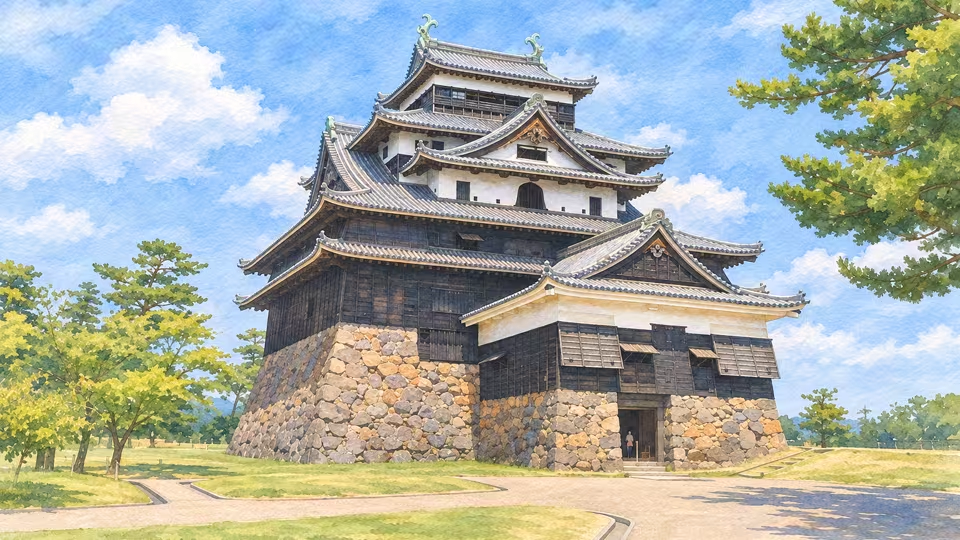
What you came to see is the keep, or tenshu, the tall central tower of a Japanese castle. Matsue’s is dark and heavy-looking, wrapped mostly in black-painted boards. It is one of only twelve castle keeps in Japan that survive from the Edo period or earlier, and since 2015 it has been one of five keeps designated National Treasures, alongside Himeji, Matsumoto, Inuyama and Hikone. The keep you are looking at was finished in 1611, and it survived because of two things: the steady maintenance of the domain lords who lived below it for two and a half centuries, and the intervention of local people when the Meiji government put it up for sale.
02Horio Yoshiharu, an Old Soldier’s Last Project
The castle’s builder was Horio Yoshiharu, a warrior from Owari Province who had served Oda Nobunaga and then Toyotomi Hideyoshi through the wars of unification. He had a reputation as a calm, reliable veteran. In Hideyoshi’s last years, according to Edo-period accounts, he was one of the three chūrō, the "middle elders," who were meant to mediate between the five great regents and the five administrators running the Toyotomi government.
After Hideyoshi died in 1598, the Horio family aligned with Tokugawa Ieyasu. At the Battle of Sekigahara in 1600, Yoshiharu himself was not on the field; his son Horio Tadauji led the family’s troops. Tadauji was rewarded with the provinces of Izumo and Oki, worth about 240,000 koku (a measure of rice yield used to rank domains), and the family moved from Hamamatsu to the San’in coast.
The family first took up residence at Gassan-Toda Castle, the mountain stronghold of the Amago clan, who had dominated this region in the Warring States period. It was a superb defensive site deep in the hills, but a poor place from which to run a large domain or grow a commercial town. Tadauji began looking for a new site. Tradition says he and his father disagreed about where to build, and that Tadauji favored the hill by Lake Shinji. Tadauji died young in 1604, leaving a small boy, Horio Tadaharu, as heir. Yoshiharu, by then in his sixties, came back to run the domain as guardian and carried out his son’s plan.
Work began around 1607 and took about five years. Yoshiharu died in 1611, just as the castle was being completed. The new town below the hill took the name Matsue, and its streets, canals and samurai quarters still shape the city today.
03Reading the Keep from the Outside
From outside, the keep shows four roof tiers; inside there are five floors plus a basement. Architectural historians call this a bōrō-gata, or "watchtower type," keep: a broad lower structure with a hipped-and-gabled roof, with a smaller lookout tower set on top. On the south side an attached annex, the tsuke-yagura, serves as the entrance, so that anyone forcing their way in had to fight through it before reaching the keep itself.
The upper walls are white plaster, but most of the surface is covered in shitamiita-bari, overlapping horizontal boards painted black. This cladding sheds rain and snow well, and it gives the building its sober color. Look for the ishi-otoshi, projecting bays with openings in the floor through which defenders could drop stones or fire down on attackers climbing the stone base, and for the many small loopholes for guns and arrows.
The castle’s nickname is Chidori-jō, "Plover Castle." It is usually explained by the gables of the roof, which spread out like the wings of a plover in flight. The top floor is an open lookout with windows on all four sides.
04Inside: Timber and Improvisation
Inside, the keep is all thick pillars and dark floorboards. Two structural features are pointed out to every visitor.
The first is the use of pillars that run through two floors at once. Rather than relying on a single great central post, the builders staggered these two-story pillars so that each floor was tied to the one above and the one below, spreading the load down through the building. This is regarded as an efficient, advanced framing method for its time.
The second is the tsutsumi-ita, or wrapping boards. Many pillars are sheathed on all four sides with planks held by iron bands and nails. The usual explanation is that the builders could not get enough large, high-quality timber, so they reinforced thinner or flawed posts by cladding them. Walk up close and you can see the boards and the hardware.
In the basement there is a well, a rare feature inside a surviving keep, meant to keep the garrison supplied with water during a siege. The basement also served as a storehouse for rice and salt. Guides often say the staircases were made of paulownia, light enough to be pulled up if enemies broke in; this is a popular explanation rather than a settled fact.
05Two Families That Did Not Last
The Horio family held Matsue for only three generations. Tadaharu ruled in his own right after Yoshiharu’s death, but he died in 1633 without an heir. Under Tokugawa rules a lord who died without a recognized successor forfeited his domain, and the Horio line was ended.
The next lord was Kyōgoku Tadataka. The Kyōgoku were an old and distinguished house from Ōmi; Tadataka’s father, Kyōgoku Takatsugu, had held Ōtsu Castle against the western army just before Sekigahara, and Tadataka himself was married to a daughter of the second shogun, Tokugawa Hidetada. In 1634 he was moved from Obama in Wakasa to Izumo and Oki. He died in 1637, again without a son. The shogunate let the family survive on a much smaller holding elsewhere, but Matsue changed hands for the second time in four years.
06The Matsudaira Lords
In 1638 Matsudaira Naomasa arrived from Matsumoto in Shinano to take Izumo, worth 186,000 koku, along with the administration of Oki. Naomasa was a grandson of Tokugawa Ieyasu: his father was Yūki Hideyasu, Ieyasu’s second son and the first lord of Echizen. As a teenager Naomasa fought at the winter siege of Ōsaka in 1614, in front of the Sanada-maru earthwork. A later story says the enemy commander, Sanada Nobushige (better known as Sanada Yukimura), admired the boy’s courage and tossed him his war fan. It is a legend, but it is still told in Matsue.
Naomasa’s descendants ruled Matsue for ten generations, about 230 years, until the domains were abolished in 1871. As a collateral branch of the Tokugawa, the Izumo Matsudaira house had high standing among the daimyo.
By the mid-eighteenth century the domain was deep in debt. In 1767, in the middle of a reform led by the senior retainer Asahi Tanba, the seventh lord, Matsudaira Harusato, succeeded at the age of sixteen. The reform raised taxes, funded flood-control works and promoted local products such as ginseng and lacquerware. It had some success, but the finances slipped again after Asahi retired, and the domain’s debts were not cleared until the time of Harusato’s grandson. Harusato is remembered above all as a tea master under the name Fumai. He collected famous tea utensils, wrote on the tea ceremony, and gave his name to the Fumai school. Matsue’s lively tradition of tea and Japanese sweets is commonly traced back to him.
The keep needed constant repair. Keeping up a castle was a heavy cost for a domain, and tradition holds that at one point the tower was badly damaged and leaning before major repairs saved it.
07Sold for Scrap, Bought Back
After the Meiji Restoration the domains were abolished in 1871, and castles across Japan became army property. Most were judged useless, and many were torn down. Around 1875 the buildings of Matsue Castle were sold off for demolition; turrets, gates and walls disappeared one after another. The keep was on the list too, and the story goes that a buyer could have had it for about 180 yen, as timber.
A wealthy local landowner, Katsube Motoemon, together with former domain retainer Takagi Gonpachi and others, raised the money to buy the keep back and keep it standing. This is the best-loved episode in the castle’s history, and the reason Matsue still has an original tower.
In 1890 the army sold the castle grounds to the Matsudaira family. In 1927 the family donated the hill to the city, which opened it as Jōzan Park the following year. The keep was repaired again during the Meiji period.
08Repairs, Prayer Tablets and a National Treasure
In 1935 the keep was designated a National Treasure under the National Treasures Preservation Law. When the Law for the Protection of Cultural Properties came into force in 1950, all treasures under the old law became Important Cultural Properties, and Matsue lost its top ranking.
From 1950 to 1955 the keep was completely dismantled and reassembled, with damaged parts repaired or replaced. This Shōwa-era restoration stabilized the building and produced a great deal of information about how it was built.
For decades the city campaigned to have the keep raised to National Treasure again. The sticking point was the lack of firm evidence for its construction date. In 2012, researchers rediscovered two wooden prayer tablets at Matsue Shrine, inscribed with an auspicious day in the first month of Keichō 16, that is, early 1611. The tablets had once been nailed to pillars in the keep’s basement and had been recorded by the architectural historian Kido Hisashi during a survey in 1937, but had since gone missing. Nail holes in the tablets matched marks on the basement pillars, confirming that the keep stood by 1611. In 2015 it was designated a National Treasure once more.
09The Dancing Girl and the Writer
Matsue’s best-known legend concerns the keep’s foundations. The stone walls kept collapsing during construction, the story goes, and the builders decided a human sacrifice, or hitobashira, was needed. They chose the best dancer at a Bon festival dance, a young girl, and buried her alive under the wall. The castle was completed, but whenever people danced the Bon dance in the town afterward, the keep shook, and so the dance was forbidden in Matsue. There is no historical evidence for any of this; it is folklore.
The writer who carried stories like this to readers abroad was Lafcadio Hearn, later known as Koizumi Yakumo. He arrived in Matsue in 1890 to teach English at the local middle school and stayed a little over a year. In Glimpses of Unfamiliar Japan he described the castle, the lake, the bridges and the town’s ghost stories. North of the castle, along the moat street called Shiomi Nawate, the samurai houses still stand, and Hearn’s former residence and the Lafcadio Hearn Memorial Museum are there.
10What Survives and What Has Been Rebuilt
The keep is original, preserved through repeated repairs in the Edo, Meiji and Shōwa periods. Almost all the castle’s other wooden buildings were demolished in the 1870s. In 2001 three turrets in the Ninomaru, or second enclosure, were reconstructed from old plans and photographs: the South Turret, the Middle Turret and the Drum Turret, with the earthen walls that link them.
Most of the stone walls date from the original construction. Some sections are built of rough, barely shaped stones, others of more carefully cut blocks, a mix that reflects both the original work and later repairs. The moats keep much of their Edo-period outline, especially to the north and east.
Near the Ninomaru stands Kōunkaku, a white Western-style wooden building from 1903. It was built as a crafts exhibition hall that could also lodge Emperor Meiji on a hoped-for visit, which never came; instead it hosted Crown Prince Yoshihito, the future Emperor Taishō. Close by is Matsue Shrine, moved into the Ninomaru in 1899. It enshrines Matsudaira Naomasa together with Tokugawa Ieyasu; Horio Yoshiharu and Matsudaira Harusato were added in 1931. Its main hall was originally a shrine to Ieyasu built by Horio Tadaharu in 1628.
11A Walk Through the Castle
Enter Jōzan Park from the Ōte-mae side, past the stone base of the vanished main gate, and climb into the Ninomaru, where the rebuilt turrets stand and you can look down over the town. Continue uphill through the gate sites into the Honmaru, the inner enclosure, and the keep rises in front of you.
You enter through the attached annex on the south side. In the basement, find the well. On the floors above, look at the wrapped pillars and their iron bands, and notice how the long pillars bridge two floors. Displays inside cover the Matsudaira lords and the prayer tablets. The stairs are steep. At the top, the open lookout floor gives a view over Lake Shinji to the west and, on a clear day, of Mount Daisen in the distance.
Afterward, walk down to the north moat and along Shiomi Nawate to see the samurai houses and Hearn’s old home, or take a moat boat and look up at the stone walls from the water, the way the town was designed to be seen.