
01A Place Called "Singing Together"
Upopoy sits on the shore of Lake Poroto in Shiraoi, a small town on the Pacific coast of Hokkaidō about an hour south of Sapporo by train. Its formal Japanese name, Minzoku Kyōsei Shōchō Kūkan, translates roughly as "Symbolic Space for Ethnic Harmony," but almost nobody uses it. The nickname comes from the Ainu language: upopoy means "singing together in a large group," and it was chosen in a public vote in December 2018.
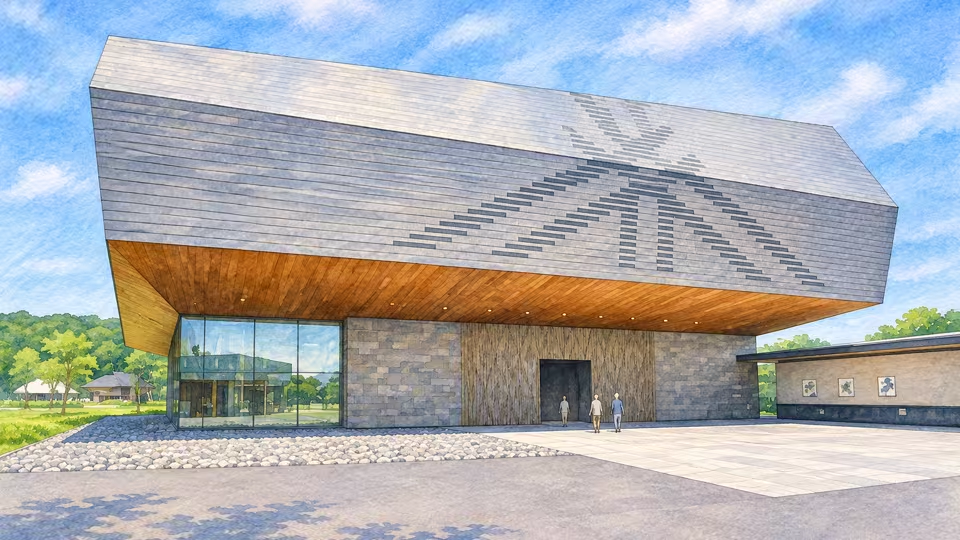
The complex opened in July 2020. At its core are the National Ainu Museum and the National Ainu Park around it; on high ground east of the lake stands a memorial site where the remains of Ainu people once taken for scientific study now rest. It is the first national museum in Japan devoted to the Ainu, and the northernmost national museum in the country.
The first thing a visitor should understand is that the Ainu are not a vanished people. They are the Indigenous people of Hokkaidō, southern Sakhalin and the Kuril Islands, and they live today across Japan, in cities as well as in the countryside. Many of the people who will greet you, dance for you and explain the houses by the lake are Ainu. In the museum, the largest text on every panel is in the Ainu language, and the exhibits speak in the first person: "we," "our language," "our history."
The facility exists because of a law passed in 2019, and that law exists because of a long history. This account follows that history from the beginnings of Ainu culture to the hill of the memorial.
02Who the Ainu Are
People have lived in Hokkaidō for tens of thousands of years. When rice farming spread through Honshū in the first millennium BCE, Hokkaidō took a different path. Archaeologists call the cultures that followed there the Epi-Jōmon and then the Satsumon, while along the Sea of Okhotsk coast a distinct Okhotsk culture, with roots further north, flourished for several centuries. Around the thirteenth century the material record changes: pottery gives way to iron pots imported from Honshū, pit dwellings give way to houses built at ground level, and archaeologists begin to speak of Ainu culture.
Ainu communities were organized into villages, kotan, usually along rivers. People fished for salmon, hunted deer and bear, gathered wild plants and grew some millet. They were also traders. Ainu middlemen carried goods between Honshū and the peoples of Sakhalin and the lower Amur River; Chinese silk brocades reached Japan by this northern route, known in Japanese as the Santan trade. Ainu society was never sealed off from the world around it.
At the center of Ainu belief are the kamuy, beings with spiritual power present in animals, plants, fire, water, tools and natural forces. People and kamuy exist in a relationship of exchange and mutual respect. The best-known ceremony is the iyomante, in which a bear cub raised in the village is sent back to the world of the kamuy with prayers and offerings. The Ainu language had no writing system of its own, and knowledge passed orally, above all in long sung epics called yukar.
03Trade Becomes Domination
Contact between the Ainu and the Wajin, the ethnic Japanese, is old, and so is conflict. By the fifteenth century Wajin had settled along the southern tip of Hokkaidō, then called Ezo. In 1457 an Ainu leader named Koshamain led an uprising against their fortified settlements; he was killed by Takeda Nobuhiro, whose descendants became the Matsumae clan.
Under the Tokugawa shogunate, the Matsumae domain held a monopoly on trade with the Ainu. Matsumae retainers were assigned trading posts, and the terms of exchange grew steadily worse for the Ainu side. In 1669 a chief named Shakushain, from the Shizunai area, led a war that spread across much of Hokkaidō. It ended when Shakushain was killed at a banquet held, supposedly, to make peace. Matsumae control tightened afterward.
During the eighteenth century the trading posts were increasingly leased to merchants from Honshū, who turned them into fisheries worked by Ainu labor. Forced work, abuse and introduced diseases caused severe population decline in many regions. In 1789 Ainu on Kunashiri Island and the facing Menashi coast rose against the merchants’ cruelty; afterward thirty-seven Ainu were executed.
As Russia pushed south in the late eighteenth century, the shogunate took Ezo under direct control, first from 1799 and again from 1855. Northern domains were ordered to garrison the coast. Shiraoi was one of those places: the Sendai domain built a fortified post (jin’ya) here in 1856 on the shogunate’s orders, and its site, now a national historic site, lies not far from Upopoy.
04Hokkaidō, Colonization and Assimilation
In 1869 the new Meiji government renamed Ezo "Hokkaidō" and established the Kaitakushi, the Colonization Commission, to settle and develop it. For the Ainu, the change was drastic. Land they used was treated as unowned and transferred to the state and to settlers. Restrictions on salmon fishing and deer hunting undercut the basis of their livelihood. Women’s tattoos and men’s earrings were banned, and Japanese names and the Japanese language were pressed on Ainu communities. In official registers they were classed as "former natives."
In 1899 the Diet passed the Hokkaidō Former Natives Protection Act. It offered Ainu households plots of farmland and set up schools, but the land was often poor, its transfer restricted, and the schools taught assimilation. Amended several times, the act remained in force for nearly a century, until 1997.
Some Ainu found ways to record their own voices. Chiri Yukie, a young woman from the Horobetsu area, wrote down kamuy yukar, songs of the gods, that she had learned from her grandmother and aunt, in romanized Ainu with her own Japanese translation. She died in 1922 at the age of nineteen, just after finishing the manuscript, and Ainu Shin’yōshū (Ainu Songs of the Gods) was published the next year. Her younger brother Chiri Mashiho became a leading scholar of the Ainu language.
At the same time, the Ainu became objects of study. From the late nineteenth century into the mid-twentieth, anthropologists dug up Ainu graves across Hokkaidō, Sakhalin and the Kurils and took the remains to universities, often without the consent of the families or communities concerned. That history is the reason the memorial on the hill exists.
05Shiraoi and the Business of Showing Culture
Shiraoi has a long history as a place where outsiders came to see Ainu life. The English traveler Isabella Bird passed through Shiraoi in 1878 on her way to Biratori and visited the Ainu village here. From the late Meiji period onward, Shiraoi’s kotan received a stream of visitors, from members of the imperial family to foreign tourists. That attention was double-edged. It gave Ainu families an income and a stage for their culture, and it also exposed them to a gaze that treated them as curiosities.
In 1965 the Ainu village in central Shiraoi was moved to the shore of Lake Poroto as a tourist site, Poroto Kotan. A foundation took over its management in 1976, and in 1984 it opened the Ainu Museum there, a private institution run with deep Ainu involvement. For more than three decades it showed traditional houses, performed dances, and collected tools and clothing. It closed in March 2018; its operating body merged into the foundation designated to run the national facility, and much of its collection and many of its staff moved to the new national facility on the same ground. Shiraoi was chosen for Upopoy partly for its location and transport links, and largely because this experience was already here.
06From Assimilation to Recognition
After the Second World War, Ainu activists organized. The Hokkaidō Ainu Association was founded in 1946; it later took the name Hokkaidō Utari Association, using an Ainu word for "comrades," and returned to its original name in 2009. From the 1980s it campaigned for a new Ainu law to replace the act of 1899. In 1994 Kayano Shigeru, from Nibutani in the Saru River valley, filled a vacant seat in the House of Councillors, becoming the first Ainu member of the National Diet, and he asked questions there in Ainu.
Kayano was also a plaintiff in the Nibutani Dam case. The dam flooded land at the heart of Ainu cultural life in the Saru valley, and on March 27, 1997, the Sapporo District Court ruled that the state had acted unlawfully in expropriating the land without proper regard for Ainu culture, recognizing the Ainu as an Indigenous people. Because the dam had already been built and filled, the court did not annul the expropriation and the dam stood, but the ruling was a first for a Japanese court. In the same year the Diet passed the Ainu Culture Promotion Act and finally repealed the 1899 law. The new act supported language and culture but said nothing about Indigenous status.
In 2007 the United Nations General Assembly adopted the Declaration on the Rights of Indigenous Peoples, with Japan voting in favor. On June 6, 2008, both houses of the Diet unanimously passed a resolution calling on the government to recognize the Ainu as an Indigenous people, and the government accepted it. An expert panel reported in 2009 and proposed a "symbolic space" for ethnic harmony as the core of future Ainu policy, combining exhibition, research, cultural transmission and a dignified resting place for ancestral remains. In 2014 the cabinet adopted a basic policy placing it in Shiraoi.
07The Ainu Promotion Act of 2019
On April 19, 2019, the Diet passed the Act on Promoting Measures to Realize a Society in Which the Pride of the Ainu People Is Respected, usually called the Ainu Promotion Act. It took effect on May 24, replacing the 1997 culture act. It is the first Japanese law to state that the Ainu are an Indigenous people. It prohibits discrimination against Ainu people on the basis of their ethnicity, though without penalties, places responsibility for Ainu policy on national and local government, and creates a grant system to fund local projects in culture, tourism and industry. It allows special consideration for gathering traditional materials in national forests and for catching salmon in rivers for ceremonies. It also provides the legal basis for the management of Upopoy.
The act has been welcomed and criticized. Critics, including many Ainu, point out that it offers no apology or compensation for the taking of land and resources and recognizes no collective rights, such as a right to fish for salmon beyond ceremonial use. In 2020 an Ainu group from Urahoro in eastern Hokkaidō, the Raporo Ainu Nation, sued for the right to net salmon at a river mouth as an Indigenous people. The Sapporo District Court rejected the claim in 2024 and the Sapporo High Court upheld that ruling in 2026, but the wider debate over Indigenous rights continues.
08Opening in a Pandemic
Upopoy was meant to open on April 24, 2020, ahead of the Tokyo Olympics then scheduled for that summer. The COVID-19 pandemic postponed it twice, and it finally opened on July 12, 2020. It is run by the Foundation for Ainu Culture.
The opening was greeted with both enthusiasm and skepticism. Some feared it would turn Ainu culture into a tourist show; others asked whether the exhibits said enough about the history of dispossession. In March 2021 a Nippon TV morning program, right after a segment on a documentary about an Ainu woman, aired a joke using a slur against the Ainu; the broadcasting ethics body later found it a breach of broadcasting ethics, a reminder that prejudice had not disappeared with the opening of a museum. Meanwhile, many of the staff are young Ainu who learn the language, dances and crafts here and then pass them on to visitors. For many visitors, Upopoy is the first time they hear an Ainu person speak about Ainu life.
09The National Ainu Museum
The permanent exhibition, on the museum’s second floor, is organized around six themes: Our Language, Our Universe, Our Lives, Our History, Our Work and Our Exchange. In each, the voice is Ainu.
Our Language lets you hear recordings in several dialects. UNESCO classes Ainu as critically endangered, with very few native speakers left, and revival efforts are under way; you may hear staff greet you with irankarapte, the Ainu "hello." Our Universe explains kamuy and ceremonies. Our Lives shows clothing, food and housing, including robes woven from elm-bark fiber and cotton garments embroidered with bold, symmetrical patterns. Our History runs from archaeology through the conflicts, assimilation policy and rights movement described above. Our Work and Our Exchange cover the many trades Ainu have followed and their contacts with neighboring peoples. Special and thematic exhibitions are held in separate galleries, and the building has large windows looking out over the lake.
10The Park: Kotan, Dance and Craft
Around the museum lies the park. By the lake stands a reconstructed kotan of thatched houses, chise. Inside each is a hearth, home of the fire kamuy, one of the most important beings in Ainu belief. The window on the east side is the sacred window through which kamuy pass, and it is not to be peered into. Staff explain how a household lived and what courtesy the house required.
In the Experience Exchange Hall, staff perform traditional Ainu dance several times a day. Ainu traditional dance was designated an Important Intangible Folk Cultural Property of Japan in 1984 and inscribed on UNESCO’s Representative List of the Intangible Cultural Heritage of Humanity in 2009. You may see the crane dance and the sword dance, and hear the mukkuri, a mouth harp, and the tonkori, a plucked string instrument associated with Sakhalin Ainu. Workshops nearby demonstrate wood carving, embroidery and weaving, and some offer hands-on sessions.
11The Memorial Site
The memorial site stands on high ground east of Lake Poroto, looking toward the Pacific, a little over a kilometer from the center of the park. It is the quietest part of Upopoy and, for understanding what the place means, an essential one.
Starting in the late nineteenth century, the remains of many Ainu were removed from graves and stored at Hokkaidō University, the University of Tokyo, Kyoto University and other institutions. Some excavations were opposed by Ainu at the time. From 2012, descendants sued Hokkaidō University for the return of their ancestors. A settlement was reached in 2016, and that July Hokkaidō University returned twelve individuals to Kineusu in Urakawa, where the community reburied them; further returns, including to Urahoro, have followed.
The facility was completed in September 2019. From that November, remains and grave goods held by Hokkaidō University and other universities that could not yet be returned were brought here, well over a thousand individuals. The site consists of a tomb where the remains are kept, a building for ceremonies, and a monument. It is not an exhibit; the tomb can be seen only from outside. Ainu held the first memorial rite here in December 2019, and the ceremonies continue under Ainu leadership.
The site is contested. Some Ainu say the remains belong back in the kotan they came from, not gathered in Shiraoi; some worry that consolidation keeps open the possibility of further research. The government’s position is that remains whose descendants or home communities can be identified will still be returned, and that the memorial is a place of dignity and rest until then. Returns continue case by case; in recent years remains have gone from here back to Ainu groups in places such as Otaru. Visitors should keep their voices low here and treat the place as a grave.
12Walking the Grounds
Past the entrance building you walk through a long passage between walls three meters high, onto which silhouettes of Hokkaidō’s plants and animals are projected, while the sound of the mukkuri and other instruments plays. It opens onto a broad plaza with the Experience Exchange Hall and the museum close by.
Start with the museum, giving it an hour or two, and stop at one of the windows over the lake. Then see a dance performance in the hall, walk down to the kotan, and step inside a chise to hear the household explained. The workshops along the shore are worth a look on the way.
Finally, go out to the memorial on the high ground east of the lake. It is more than a kilometer from the plaza, and the noise is far behind; from the hill you can see toward the Pacific. This shore has seen a Sendai garrison, a century of tourism, a private museum that lasted more than thirty years, and finally a national institution founded after Japan recognized the Ainu as an Indigenous people. The name asks for people to sing together, and the history above is what that song is sung over.