
01A Wooden Hall Among Office Blocks
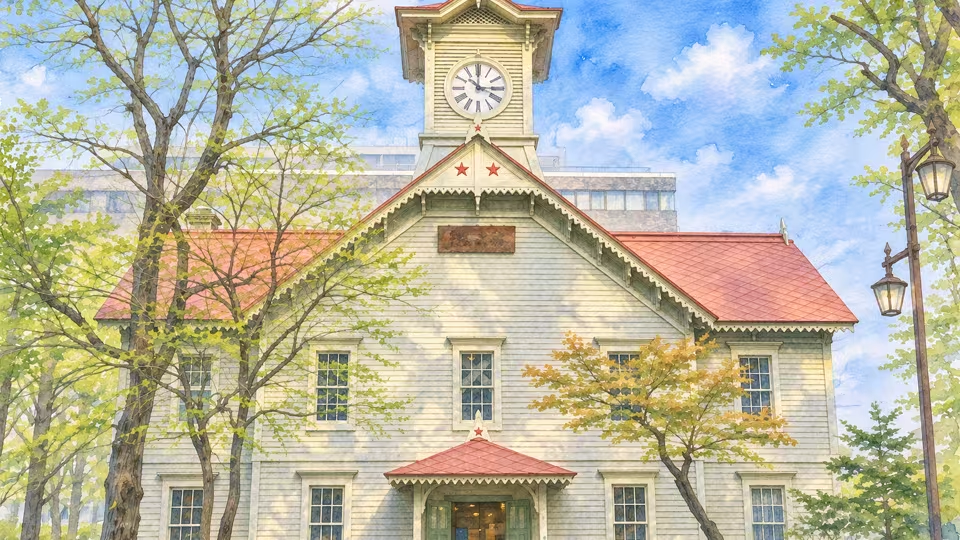
In the middle of downtown Sapporo, hemmed in by office buildings and hotels, stands a two-story wooden building with white clapboard walls, a red roof and a small clock tower. Visitors often find it smaller than they expected, and Japanese guidebook humor has long ranked it among the country’s "three great disappointments." That judgment misses the point. This modest building is the Drill Hall of Sapporo Agricultural College, the school founded in the 1870s to train the people who would turn Hokkaidō, Japan’s northern island, into a modern agricultural frontier. Its American-made clock has been striking the hours since 1881.
Officially the building is called the Sapporo Clock Tower (Sapporo-shi Tokeidai, "Sapporo City Clock Tower"). Its designation as an Important Cultural Property, one of the national government’s protected categories for historic buildings, uses its older name: the Former Sapporo Agricultural College Drill Hall (Kyū Sapporo Nōgakkō Enbujō).
02The Colonization Office and the American Model
In 1869 the new Meiji government renamed the island of Ezo as Hokkaidō and created the Kaitakushi, or Hokkaidō Colonization Office, to develop and defend it. The island was thinly populated, largely the home of the indigenous Ainu, and Russia was pressing south from Sakhalin. The government wanted farms, roads, mines and settlers, and it wanted them quickly.
The driving force at the Kaitakushi was Kuroda Kiyotaka, a former samurai from Satsuma who served first as its vice-director and then as its director. Kuroda looked to the American West for a model. He traveled to the United States and recruited Horace Capron, the U.S. Commissioner of Agriculture, as an adviser. Capron brought a team of American specialists to survey land, plan roads and set up experimental farms, and he urged the Japanese to train their own technicians.
The result was a school. In 1872 the Kaitakushi opened a provisional school in Tokyo, inside the grounds of Zōjō-ji, a large Buddhist temple in the Shiba district. In 1875 the school moved to Sapporo, and in 1876 it was reorganized as Sapporo Agricultural College (Sapporo Nōgakkō). Students received government scholarships and in return were expected to serve the Kaitakushi after graduation. The college is the direct ancestor of today’s Hokkaido University.
03William Smith Clark
To lead the new college, the Kaitakushi sought an American educator and found William Smith Clark, president of the Massachusetts Agricultural College in Amherst. Clark was a chemist and botanist with a German doctorate, a Union army officer in the Civil War, and a forceful promoter of practical scientific education. He took a one-year leave from Massachusetts and arrived in Sapporo in the summer of 1876, bringing two young graduates of his college, William Wheeler and David Penhallow, as fellow instructors.
On paper, the college’s principal was a Japanese official; Clark’s Japanese title was kyōtō, usually rendered as vice-principal, although the college’s first English-language annual report called him President. In practice he ran the place. He transplanted the Massachusetts curriculum more or less wholesale: English, mathematics, chemistry, botany, agriculture, surveying, and military drill, all taught in English.
A well-known story holds that the Kaitakushi had drafted a long list of rules for the students, and that Clark threw them out and replaced them with a single one: "Be gentleman." The anecdote comes from the later recollections of students and has been retold so often that it is now part of the college’s identity.
04The Covenant of Believers in Jesus
Clark was a devout Protestant, and he held that ethics could not be taught without the Bible. Kuroda is said to have been uneasy about Christian instruction in a government school before tacitly allowing it. The ban on Christianity in Japan had only been lifted, in practice, in 1873, so this was a bold step.
In March 1877 Clark drafted the "Covenant of Believers in Jesus," a short statement of faith in English, and under his influence the members of the first class signed it. After Clark left, they passed it on to the second class. Among those who signed were Uchimura Kanzō, Nitobe Inazō and Miyabe Kingo; the surviving document carries the names of sixteen first-class and fifteen second-class students. Several of these young men later founded the Sapporo Independent Christian Church, which refused support from foreign missions and still keeps the covenant, and Uchimura went on to develop his "Non-Church" movement, a form of Japanese Christianity without clergy or denominations.
05"Boys, Be Ambitious"
Clark stayed in Sapporo for only about eight months. On April 16, 1877, his contract finished, he set off for home. Students and staff rode with him to Shimamatsu, a post station some 24 kilometers south of Sapporo, where they said goodbye. According to the story, Clark turned in the saddle and called out, "Boys, be ambitious!" before riding away.
No one wrote the words down at the time. The phrase first appears in reminiscences published years later by members of the first class, notably Ōshima Masatake, and there are competing versions of how the sentence continued, including one that adds "like this old man." Whatever he actually said, the phrase became one of the best-known English sentences in Japan. A monument marks the parting place at Shimamatsu, a bust of Clark stands on the Hokkaido University campus (first erected in 1926, melted down for metal during the war and recast in 1948), and a full-length statue with an outstretched arm, set up in 1976, looks out from the Hitsujigaoka Observation Hill on the edge of the city.
Clark’s later life was unhappy. He resigned the Massachusetts presidency in 1878, and a mining company he joined collapsed in scandal after his partner mismanaged it, damaging his reputation and health. He died in Amherst on March 9, 1886, aged 59, far better remembered in Japan than at home.
06The Students
Clark personally taught only the first class, which included Satō Shōsuke, Ōshima Masatake, Itō Kazutaka and Watase Torajirō. Satō later became the first president of Hokkaidō Imperial University and spent his entire career at the institution.
The second class arrived after Clark had gone and was taught by Wheeler, Penhallow and William Brooks, but its members absorbed what they called the "Clark spirit" from the older students. This class produced an unusual concentration of talent. Uchimura Kanzō became one of the most influential Christian thinkers in modern Japan. Nitobe Inazō wrote Bushido: The Soul of Japan in English, served as an under-secretary-general of the League of Nations, and appeared on the 5,000-yen note. Miyabe Kingo became a leading botanist of the northern flora and stayed in Sapporo for life. Hiroi Isami became a civil engineer whose concrete breakwater at Otaru harbor is still admired by engineers.
These were the young men who drilled, assembled and graduated in the building you are visiting.
07Building the Drill Hall
After Clark’s departure Wheeler took over as vice-principal. Military drill was part of the curriculum, and Sapporo’s winters made an indoor space necessary. The college also needed a hall for entrance and graduation ceremonies. The hall followed Wheeler’s concept and floor plan, while the Kaitakushi’s Industrial Bureau handled the detailed design and construction, with the Kaitakushi builder Adachi Kikō among those responsible; some accounts trace the original idea back to Clark. Work began in June 1878 and the hall opened with a ceremony on October 16 of that year.
The building uses balloon framing, a technique developed in the American Midwest in which walls are built from many slender, standardized studs nailed together rather than from heavy timber posts and beams. The frame was then covered with horizontal clapboard. It was quick and economical, the same kind of construction American settlers used across the frontier, and it suited the Kaitakushi’s habit of importing American methods wholesale. The ground floor was divided into rooms used as classrooms; the upper floor was a single open hall with no interior columns, for drill and assemblies. A record says the exterior was originally painted green, and the interior walls are still a pale green.
When first built, the hall had only a small belfry on the roof, with a bell rung by pulling a rope.
08The Howard Clock
According to the usual account, Kuroda Kiyotaka, attending the opening ceremony, said the hall should have a proper clock, and Wheeler ordered one from E. Howard & Co. of Boston, a well-known maker of tower clocks. When it arrived it proved far too large for the original belfry, so a new, taller tower was designed to hold it. The tower was finished in 1881 and the clock started running on August 12 that year. In 1888 it was officially named Sapporo’s standard clock.
It is a weight-driven pendulum clock with four dials, striking the hours on a bell. The weights, made of stones from the Toyohira River, are still wound up by hand twice a week. The clock has kept running for more than 140 years, with repairs along the way. In 1933 a local watchmaker, Inoue Kiyoshi, found it damaged and, told the city had no budget, offered to repair it for nothing; he looked after it for about half a century, and in 1982 his eldest son, Inoue Kazuo, took over. Since 2009 the staff of the organization that runs the building have maintained it. The same year, the Japan Society of Mechanical Engineers listed it as Mechanical Engineering Heritage, as the oldest tower clock still working in Japan.
Over time the clock defined the building. People stopped calling it the Drill Hall and simply called it the Tokeidai, the clock tower.
09The College Moves On
By the turn of the century the downtown campus was cramped. In 1903 the college moved to a larger site to the north, which is today’s Hokkaido University campus. The Drill Hall stayed behind, reportedly because local people wanted it kept, and the hall and old campus were lent to Sapporo Ward, the municipal body that preceded Sapporo City, for use as a public hall.
In 1906 the ward bought the building and moved it, clock tower and all, about 100 meters to its present site; sources differ slightly on the distance and direction. It then housed a post office and an education association, among other uses, and served longest as a library, from 1911 to 1966. The army requisitioned it from 1943 to 1945. In 1966 the city council decided to preserve it permanently where it stands.
The college itself became the College of Agriculture of Tōhoku Imperial University in 1907 and was made the independent Hokkaidō Imperial University in 1918. After the Second World War it became Hokkaido University.
10Protection and Restoration
In 1970 the building was designated an Important Cultural Property under the name Former Sapporo Agricultural College Drill Hall. By then it was surrounded by modern buildings and had become one of the symbols of the city.
After the library left, the building was repaired in 1967 and from 1978 the whole of it served as a city history museum. From 1995 to 1998 Sapporo City carried out a major conservation project. The building was studied layer by layer, and its exterior and upper hall were returned to something close to their appearance in the college era. Afterward the ground floor became an exhibition space on the history of the college and the clock, and the upper hall was restored as an open assembly space used for concerts and other events. The exterior and roof were repainted in 2018, and the city has recently drawn up a new conservation plan in preparation for further work.
What you see today is, in its fabric, the 1878 Drill Hall with the clock tower added in 1881 and the original 1881 Howard clock. The location is not the original: the building has stood here since its 1906 move. Paint, some timbers and many interior finishes date from the restoration.
11Walking Through
Start across the street, where you can take in the whole façade: white clapboard, red roof, the upper windows, and the clock tower with its four dials and a weathervane above.
Inside, the ground floor exhibition tells the story of the college, Clark and his students, and the building’s move and restoration, drawing heavily on Hokkaido University’s collections.
Upstairs is the old drill hall itself: a wide, column-free room with wooden floors and tall windows. This is where students practiced drill and held ceremonies. A seated statue of Clark, placed here in 2017, occupies a bench, and many visitors sit down beside him for a photograph. The hall also displays a "sister clock" made by E. Howard & Co. with the same weight-winding and pendulum mechanism as the tower clock; since the original in the tower is not normally open to visitors, this is the place to see how it works.
If you can, be here on the hour to hear the bell. Afterward, a walk of about twenty minutes north brings you to Hokkaido University, where Clark’s bust and several buildings from the college’s later years still stand. To find the place where "Boys, be ambitious" was supposedly spoken, travel south to Shimamatsu in the city of Kitahiroshima, where a monument marks the farewell.