
Japanese history has many moments after which nothing was quite the same. The ten events below run in date order from the Asuka court of the seventh century to the fall of the shogunate in the nineteenth. Each earned its place in one of two ways: it changed who held power and where that power sat, or it changed how Japan dealt with the world beyond its shores. Each also set the terms for what came after it.
The ten fall roughly into pairs: two remakings of the ancient court, two steps that established warrior rule in Kamakura, the collapse of the Muromachi order and the arrival of a new weapon, the Tokugawa settlement and its control of the sea, and finally foreign pressure and the return of authority to the court. Several of these "turning points" were named as such only in hindsight, so each section also notes what the sources can and cannot tell us.
01The Isshi Coup of 645
In the sixth month of 645, at a Korean tribute ceremony in the Itabuki Palace in Asuka, Prince Naka no Ōe and Saeki no Komaro cut down Soga no Iruka. The next day his father Emishi burned the court histories and is generally understood to have killed himself. The Isshi Coup ended the Soga main line, which had dominated the court for about a century and four generations. Empress Kōgyoku abdicated, the first living sovereign to do so in the Nihon shoki, and Prince Karu became Emperor Kōtoku. The new regime proclaimed Japan’s first era name, Taika, and moved the capital to Naniwa, opening what later ages called the Taika Reform. Its makers were Naka no Ōe, the future Emperor Tenji, and Nakatomi no Kamatari. The catch is that nearly every detail comes from the winners’ side, and the Reform Edict was at least rewritten later. Nor did the coup bring quick stability: Naka no Ōe became sovereign only in 668.
02The Move to Heian-kyō, 794
Emperor Kanmu, of the new Tenji line, took the throne in 781 and moved the court to Nagaoka in 784. Ten years later he tried again. In the tenth month of 794 he entered a new capital, and an edict the next month named it Heian-kyō. The court’s move to Heian-kyō left behind Nara and its great temples; inside the new city only two official temples were allowed, Tō-ji and Sai-ji. After Retired Emperor Heizei’s order of 810 to return to Heijō failed, no one proposed moving again, and the gridded city, today’s Kyoto, stayed the capital until the start of the Meiji era, the longest-lived capital in Japanese history. It is the city that Kamakura’s armies entered in 1221 and that the Ōnin War burned. Yet it was accepted unfinished: in 805 Kanmu himself halted the building, and the western half long remained thinly settled. The official histories never say why Nagaoka was abandoned.
03Yoritomo Becomes Shogun, 1192
Minamoto no Yoritomo, after twenty years of exile in Izu, rose in 1180 and entered Kamakura with no warrant from Kyoto at all. Recognition came piece by piece: a decree in 1183, permission to appoint shugo and jitō in 1185, the post of major captain of the Right Inner Palace Guards in 1190. Go-Shirakawa died in the third month of 1192, and in the seventh month Yoritomo received the title seii taishōgun. The year matters less for what happened in it than for what the title later became. After Ashikaga Takauji in 1338 and Tokugawa Ieyasu in 1603 took the same title, later generations looked back and dated the Kamakura shogunate to 1192. Most historians now see Kamakura rule taking shape gradually between about 1180 and 1190. Extracts from the Sankaiki introduced in 2004 suggest Yoritomo had asked only to be "great general," though they survive in a late Edo copy.
04The Jōkyū War, 1221
The title did not take Kyoto out of the game. From 1198 Retired Emperor Go-Toba ruled from the cloister with wealth, his own warriors and the power to command. In the fifth month of 1221 he ordered the provinces to hunt down Hōjō Yoshitoki. Hōjō Masako rallied the vassals in Kamakura, and the eastern armies entered Kyoto the next month. After the Jōkyū War three retired emperors were exiled, Go-Toba to Oki, Juntoku to Sado and Tsuchimikado to Tosa; the child emperor was deposed; over three thousand holdings were confiscated and given to eastern warriors; and the shogunate set up a permanent office at Rokuhara to watch the court. This is the year warrior rule truly took its lasting form. No retired emperor could again challenge it by force until Go-Daigo rose more than a century later. Go-Toba’s surviving orders name Yoshitoki alone, and recent research suggests he aimed to remove him rather than abolish the shogunate.
05The Ōnin War Enters Kyoto, 1467
The Ōnin War was fought in Kyoto for eleven years. In the first month of 1467 Hatakeyama Masanaga occupied the Kami-Goryō Shrine, in today’s Nishijin–Kamigoryō Ōnin War Historic Area. In the fifth month Hosokawa Katsumoto's side struck first, and the city split into an Eastern Army and a Western Army aligned with Yamana Sōzen. Ashigaru raids, arson and looting left much of Kyoto in ashes before the Western Army dissolved in 1477. The war belongs here because it broke the Muromachi system, in which provincial governors lived in the capital and the shogun and his deputy balanced the great houses. Afterward many governors went home and ruled by their own strength, and later writers came to treat the war as the start of the Warring States period. The capital-centered order through which the shogun held the provincial governors together stopped holding. The old story of Hino Tomiko starting it all for her son comes from the Ōninki, a chronicle that took final shape much later, and most historians no longer accept it.
06Firearms Arrive at Tanegashima, 1543
Firearms arrived at Tanegashima in the long wars that followed Ōnin. According to the Teppōki, in the eighth month of 1543 a ship carrying more than a hundred people drifted to the south of Tanegashima. The next month Tanegashima Tokitaka, sixteen by traditional count, tested the guns and bought two. The following year Kinbei Kiyosada learned from a smith on a foreign ship how to close the breech with a threaded plug, and within a little more than a year the island had made several dozen guns. They spread to Negoro-ji, Sakai and the capital region, and one had reached Kyoto before 1549. Guns made ashigaru the core of armies, castles began to be built for firing and against shot, and imports of saltpeter and lead tied lords more closely to Portuguese and Chinese traders. The first exchange between Japanese and Portuguese went through a Ming scholar aboard, Gohō, writing Chinese characters in the sand. Portuguese sources date the first arrival to 1542, and historians still divide between the two years.
07Sekigahara, 1600
After Hideyoshi died in 1598, Tokugawa Ieyasu moved into Ōsaka Castle the next year as the Toyotomi regime’s effective head. In the seventh month of 1600 Ishida Mitsunari rose against him, and both sides claimed to act for Hideyori. In the middle of the ninth month the armies met on what is now the Sekigahara Battlefield; Kobayakawa Hideaki’s defection and the Mōri’s inaction broke the western army. Sekigahara was not Tokugawa against Toyotomi but a civil war inside the Toyotomi government. What makes it a turning point is the settlement: confiscations and reductions reached roughly a third of the country’s assessed yield. Toyotomi-affiliated lords who gained land were mostly moved west or far away, while the Tōkaidō and the Kantō went to Tokugawa kin and hereditary vassals, the basic layout of the Edo period. The power that had scattered after Ōnin, first drawn together under the Toyotomi, was now rearranged around the Tokugawa. In 1603 Ieyasu became shogun, the title from section 3. Familiar episodes such as the toi-deppō volley come largely from Edo-period chronicles.
08The Portuguese Ban, 1639
Early Tokugawa Japan traded busily by sea. After Portuguese traders reached Tanegashima around 1543, their ships carried Chinese silk from Macao in exchange for Japanese silver, and the Dutch in 1609 and the English in 1613 opened posts at Hirado. In 1635 the shogunate forbade all Japanese ships and people to go overseas. After the Shimabara–Amakusa uprising, it announced in the seventh month of 1639 that Portuguese ships could no longer come. In 1641 the Dutch post moved to Dejima. The Portuguese ban completed a system that lasted more than two centuries: among Europeans only the Dutch could trade, at Nagasaki, while Tsushima, Satsuma and Matsumae handled relations with Korea, Ryūkyū and the Ainu, every channel under the shogun’s authority. The word sakoku was coined only in 1801. Historians now stress control of trade and diplomacy rather than a sealed country, though ordinary Japanese could not travel abroad, and in some ways the limits were stricter than in contemporary China or Korea.
09Perry and the Shogunate’s Consultation, 1853
More than two centuries later, that system met a direct challenge. In the sixth month of 1853 Matthew C. Perry arrived off Uraga with four "black ships" and handed over President Fillmore’s letter at Kurihama, today’s Uraga and Kurihama. The shogun Tokugawa Ieyoshi died the same month. The senior councilor Abe Masahiro put the letter before the gosanke and all the daimyo, then retainers and even some commoners, and received between 700 and 800 responses. Perry’s arrival and the consultation belongs here because of that consultation. Sharing a diplomatic letter with every daimyo and inviting proposals had no precedent in more than two hundred years. Many historians argue that it gave outside lords, collateral houses and lower samurai a legitimate voice, made "public deliberation" a central political language, and loosened the shogunate’s monopoly on policy. Others caution that Abe mainly wanted consensus and shared responsibility. The Treaty of Kanagawa followed in the third month of 1854.
10Yoshinobu Returns Governing Authority, 1867
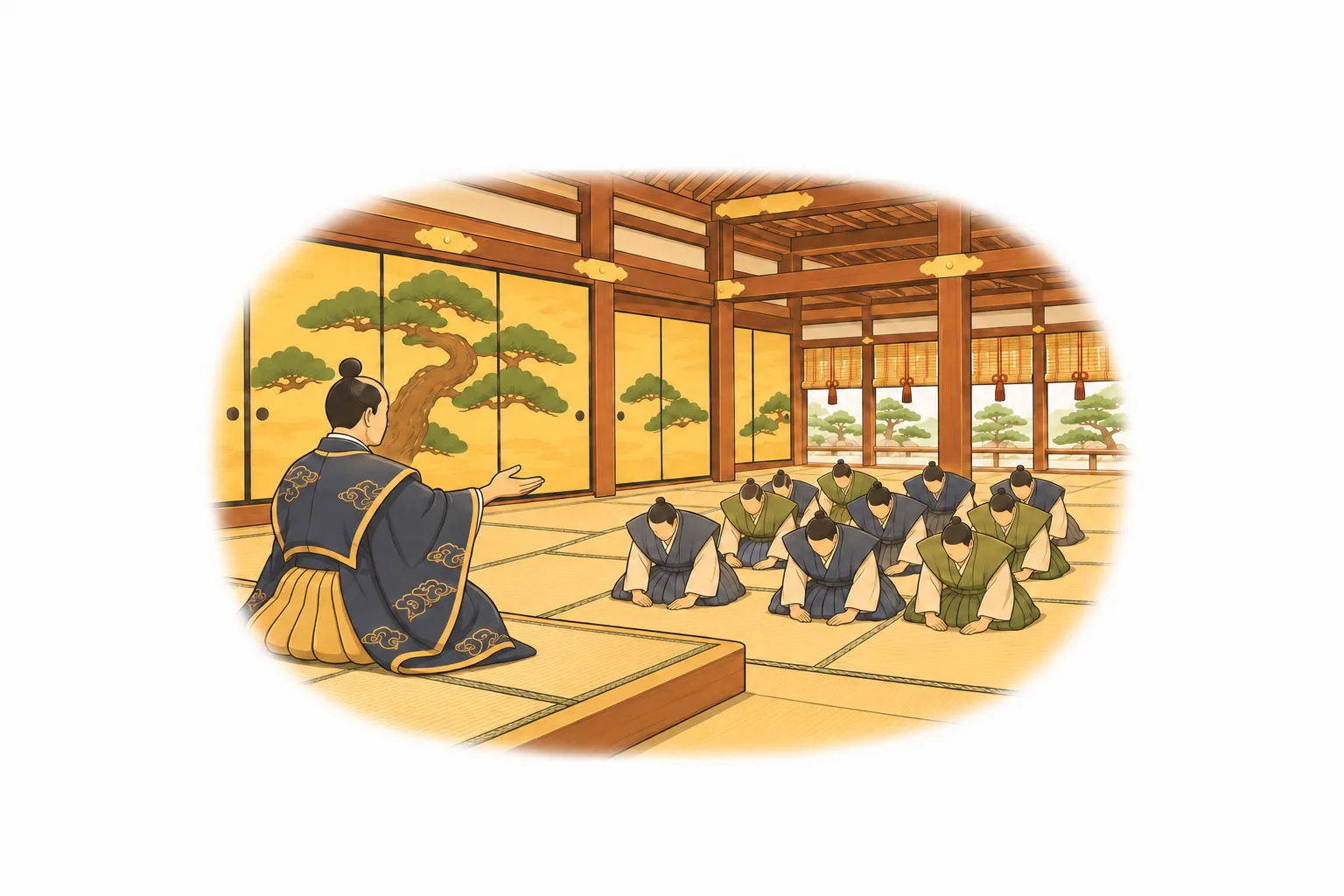
Early in the tenth month of 1867 Tosa submitted its petition. Tokugawa Yoshinobu consulted domain representatives at Nijō Castle, submitted his memorial the next day, and the court accepted it. The familiar image of the shogun addressing the assembled domains in the great hall owes much to a museum re-creation and a commemorative mural; a historian working from participants’ records has shown that Yoshinobu met only six of the men in person. The return of governing authority formally ended the arrangement, dating back to Kamakura, in which warrior governments ruled by commission from the court, closing the story that sections 3 and 4 began. But Yoshinobu gave up authority in name only. The Tokugawa kept roughly four million koku and the largest modernized army, and Nishi Amane’s draft plan imagined an assembly government headed by the Tokugawa. The restoration coup of the twelfth month shut Yoshinobu out, and war followed the next month. The domains themselves were dismantled only through the return of registers and abolition of domains: in the seventh month of 1871 the government abolished 261 domains at a stroke, giving Japan its first administration run by centrally appointed officials.
11Closing
Few of these turning points happened in a day. Naka no Ōe waited more than twenty years after the coup to take the throne, Heian-kyō became the capital half-built, the meaning of 1192 was assigned later, and the return of authority needed a coup, a war and the abolition of the domains before a new order settled. Two threads run through the ten. One is the movement of power among the court, warrior governments and the provinces: reorganized in 645, fixed in warrior hands in 1221, scattered in 1467, rearranged around the Tokugawa in 1600, and handed back in 1867. The other is Japan’s sea gates: a drifting ship at Tanegashima in 1543, every gate taken into the shogun’s hands in 1639, and black ships off Uraga in 1853. The people and places named in each section are good next steps.