
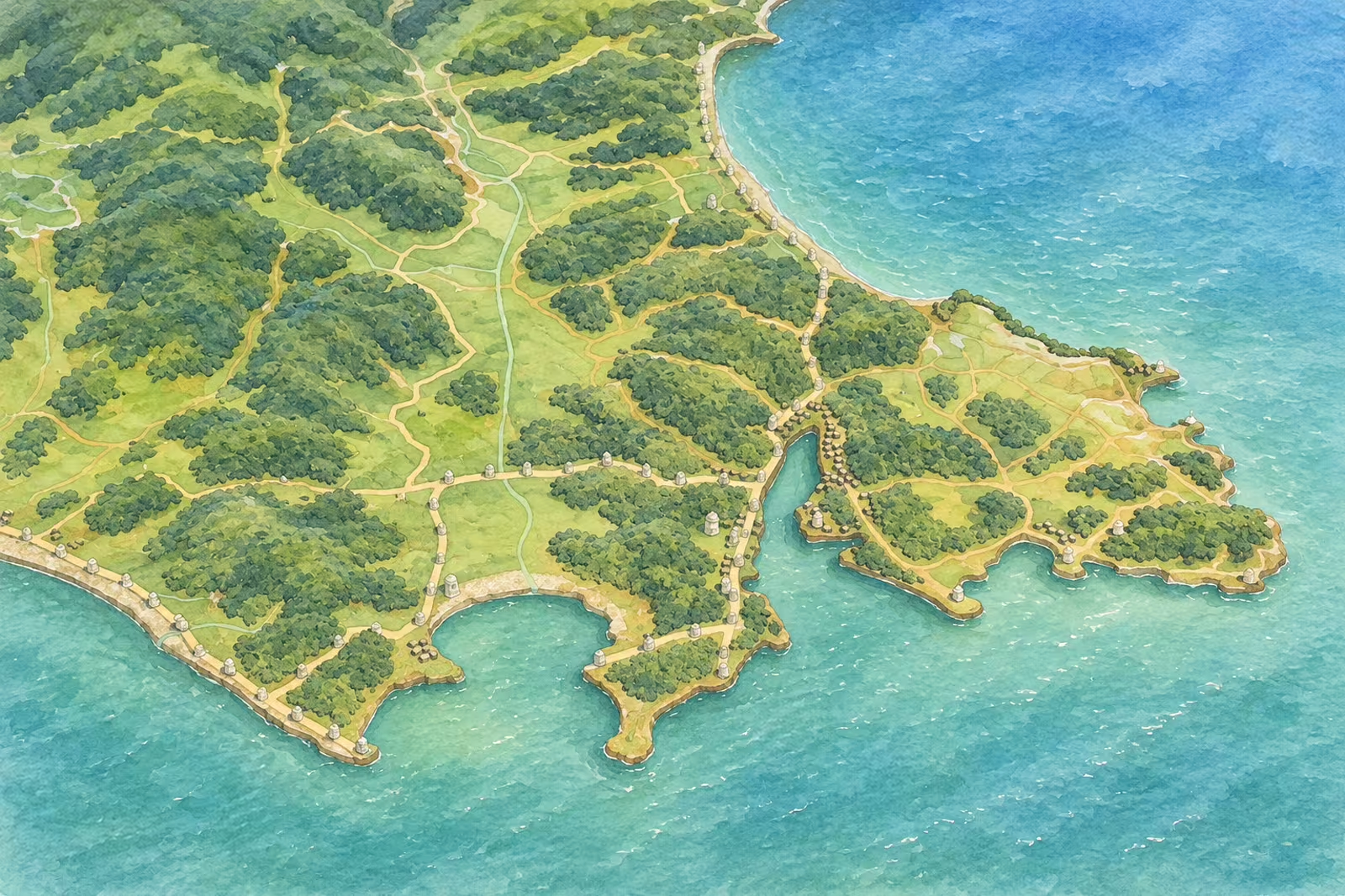
Uraga and Kurihama lie in Yokosuka, Kanagawa Prefecture, on the southeastern shore of the Miura Peninsula, facing the Uraga Channel that leads into Edo Bay. In 1853 Commodore Matthew Perry’s squadron anchored off Uraga and then landed at Kurihama to deliver a letter from the American president, the start of the process that ended Japan’s seclusion. The two places are close together: one was the shogunate’s coastal defense and negotiating post, the other the beach where the letter was handed over.
01Gateway to Edo Bay
Uraga is a natural harbor. In 1720 the shogunate moved the magistracy that inspected ships entering and leaving Edo Bay from Shimoda to Uraga, creating the Uraga magistracy (Uraga bugyōsho) to check shipping and guard the coast. From then on, foreign vessels approaching Edo usually met shogunal officials near Uraga first; in 1837 the American merchant ship Morrison was fired upon in these waters.
02The Black Ships of 1853
In July 1853 Perry anchored off Uraga with four warships, two of them steamers. Officials of the Uraga magistracy, including Nakajima Saburōsuke and Kayama Eizaemon, went aboard to negotiate; according to the records, Kayama passed himself off as the magistrate because Perry insisted on dealing only with senior officials. The shogunate finally agreed to receive the letter at Kurihama. On July 14 Perry landed with several hundred officers and men and, in a temporary reception hall, handed President Millard Fillmore’s letter to the Uraga magistrates Toda Ujiyoshi and Ido Hiromichi. The squadron left a few days later, promising to return for an answer; when Perry came back in 1854, the treaty was signed at Yokohama.
After the Black Ships, Uraga became a place where the shogunate learned Western shipbuilding, completing the Western-style sailing ship Hōō Maru there in 1854. In 1860 the Kanrin Maru set out from Uraga to cross the Pacific. From the Meiji period, the Uraga Dock company built ships here for close to a century until it closed in 2003.
03What Can Be Seen Today
Perry Park in Kurihama has a monument to Perry’s landing erected in 1901, its inscription written by Itō Hirobumi, and the Perry Memorial Hall in the park explains the visit with models and documents. Nothing remains of the Uraga magistracy buildings beyond a marker on the site. A ferry still crosses between the east and west sides of the harbor, and outside the east side stands Tōmyōdō, an Edo-period lighthouse whose present structure is a recent reconstruction. The old dry dock of the Uraga Dock company survives in the harbor, one of the few brick-built docks of its kind.
Uraga and Kurihama
01The Gate of Edo Bay
Uraga sits on the eastern shore of the Miura Peninsula, south of Yokosuka, facing the Uraga Channel (Uraga Suidō), the strait that joins the Pacific to what was then called Edo Bay and is now Tokyo Bay. Across the water lies the Bōsō Peninsula of Chiba. Every ship sailing to Edo, the shogun’s capital, had to pass through this channel. That simple geographic fact explains almost everything that happened here.
The harbor itself is a long, narrow inlet that bends inland between steep green hills, sheltered from wind and swell. Two towns grew up facing each other across the water, Higashi-Uraga (East Uraga) and Nishi-Uraga (West Uraga). A small ferry still crosses between them, as boats have for centuries, and the crossing takes only a few minutes.
Kurihama lies just over the hill to the southwest: an open, sandy bay that was a modest fishing village in the Edo period (1603–1868). It owes its place in history to a single morning in July 1853, when Commodore Matthew C. Perry of the United States Navy came ashore here and handed over a letter from the President of the United States.
02The Uraga Magistrate’s Office
At the end of 1720 the Tokugawa shogunate decided to move its ship-inspection post from Shimoda, at the tip of the Izu Peninsula, to Uraga, and the move took effect early the next year. Edo had become one of the largest cities in the world, fed by an enormous coastal trade in rice, sake, soy sauce, timber and everyday goods. Inspecting that traffic at the mouth of the bay made more sense than doing it further away at Shimoda.
The new office was the Uraga bugyōsho, or magistrate’s office, headed by the Uraga bugyō, a magistrate drawn from the shogun’s direct retainers (hatamoto). Under him served yoriki (mounted officials) and dōshin (lower constables). Their main job was funa-aratame, the inspection of ships: checking cargo and crew bound for Edo, and keeping out weapons and suspect persons. Ships heading up the bay stopped at Uraga first.
All this inspection traffic made Uraga prosperous. Shipping agents, wholesalers and sailors filled the town. Uraga also became a center of the trade in hoshika, dried sardines used as fertilizer for cotton and other cash crops, and for a long time its wholesalers held a leading position in that business in the Kantō region.
The magistrate’s office stood in Nishi-Uraga, between the hills and the harbor. None of its buildings survive. For many decades the site held company housing for the shipyard; it was later donated to Yokosuka City, which has carried out archaeological excavations there. An information board marks the spot.
From the late eighteenth century, Russian and British ships began appearing off Japan’s coasts, and the role of the Uraga magistrate shifted. Ship inspection remained, but coastal defense became the more urgent task. The shogunate built gun batteries around Uraga and assigned domains such as Kawagoe, Oshi, Hikone and Aizu to guard the shores of Sagami, Awa and Kazusa.
03Ships Before Perry
Perry was not the first Westerner to arrive at Uraga with a request.
In 1837 the American merchant ship Morrison sailed into the waters off Uraga carrying several Japanese castaways. Its owners hoped that returning them would open the way to trade. But under the Edict to Repel Foreign Ships, issued in 1825, coastal defenders were ordered to fire on any foreign vessel. The Uraga batteries opened fire, and the Morrison withdrew to Kagoshima in Satsuma, where it was fired on again. It left Japan with the castaways still aboard. When the incident became known, scholars of Western learning such as Watanabe Kazan and Takano Chōei criticized the policy and were punished in the purge known as the Bansha no goku.
After news arrived of China’s defeat in the Opium War, the shogunate softened its stance in 1842, allowing fuel and water to be supplied to foreign ships in distress, though still refusing trade.
In 1846 Commodore James Biddle of the U.S. East India Squadron anchored off Uraga with two warships and formally asked for trade. The shogunate refused. During the exchange Biddle was shoved by a Japanese guard, and he left without pressing the matter. In Washington the episode was seen as a humiliation, and Perry studied it closely. He concluded that politeness and patience had gotten Biddle nowhere.
04Four Black Ships
On the afternoon of July 8, 1853 (the third day of the sixth month of Kaei 6 in the Japanese calendar), four American warships appeared off Uraga and dropped anchor. Two of them, the flagship Susquehanna and the Mississippi, were steam-powered paddle frigates. The other two, the sloops Plymouth and Saratoga, were sailing ships, towed in by the steamers. With their tarred black hulls and coal smoke pouring from their funnels, they became known in Japan as the kurofune, the "black ships."
Matthew Calbraith Perry came from a celebrated naval family; his brother Oliver Hazard Perry was a hero of the War of 1812. Matthew was a champion of steam power in the U.S. Navy. He carried a letter from President Millard Fillmore requesting friendship, trade, coaling stations, and protection for shipwrecked American sailors. American whaling ships worked the North Pacific in large numbers, and steamships on the planned route to China would need coal.
Perry had read everything he could find about earlier Western dealings with Japan, and he drew firm rules for himself. He would not go to Nagasaki, the only port where the shogunate dealt with foreigners. He would deal only with officials of high rank. He would not allow Japanese guard boats to surround his ships. And he would keep himself out of sight, so that his own appearance would carry weight when it finally came.
As soon as the ships anchored, Japanese guard boats swarmed around them. The Americans waved them off, letting only a few officials approach.
05The Officials Who Went Aboard
The first Japanese official to board the Susquehanna was Nakajima Saburōsuke, a yoriki of the Uraga magistrate’s office, accompanied by the Dutch interpreter Hori Tatsunosuke. According to the American account, Hori called up from his boat in English, "I can speak Dutch," and the negotiations that followed passed through Dutch.
Told that the Americans would speak only to a high official, Nakajima presented himself as the vice-governor of Uraga. He urged the squadron to go to Nagasaki. The Americans refused and insisted that the letter be received by a suitably senior representative of the shogun. Otherwise, they said, they would take it to Edo themselves.
The next day another yoriki, Kayama Eizaemon, came aboard presenting himself as the governor of Uraga. He too was standing in for his superior. Kayama saw the elaborate boxes holding the President’s letter and reported back that the Americans would not be turned away.
Meanwhile Perry sent armed boats to survey the bay, sounding its depths. One survey party, escorted by the Mississippi, pushed well up the bay toward Edo, a pointed reminder of how close the warships could come to the capital.
There were two Uraga magistrates at the time, one stationed at Uraga and one in Edo. The magistrate at Uraga, Toda Ujiyoshi, sent reports to Edo, where the senior councillor Abe Masahiro led the shogunate’s deliberations. The shogun, Tokugawa Ieyoshi, was gravely ill. The council’s choice was uncomfortable: refusing the letter might mean war, while accepting it at Uraga broke the rule that foreign affairs were handled at Nagasaki. They decided to accept the letter as a temporary measure, give no answer, and promise a reply the following year.
06Why Kurihama
The shogunate chose not Uraga harbor itself but the beach at Kurihama, a short distance away. The wide sands offered room for a large landing and for Japanese troops to be deployed, while the magistrate’s office was close by.
On the beach the Japanese built a temporary reception hall, screened by cloth curtains printed with family crests, its floor spread with red felt. All four domains charged with defending the bay, Kawagoe, Hikone, Aizu and Oshi, sent troops, and it is said that their objections to Uraga as a place that was hard to defend were what moved the landing to Kurihama. Contemporary Japanese pictures of the scene show the red banners of the Hikone men prominent along the beach. The official American narrative records that the governor of Uraga put the Japanese force at five thousand, and adds that it looked larger than that.
07The Landing of July 14, 1853
On the morning of July 14, 1853 (the ninth day of the sixth month), Perry came ashore at Kurihama with sailors, marines and a band, carried in a flotilla of boats. The landing party is usually given as about three hundred men, though some accounts say around 250. It was the first time he had shown himself to the Japanese.
To the sound of the band, Perry walked up to the reception hall. Two boys carried the rosewood boxes holding the President’s letter and Perry’s credentials, flanked by two tall Black sailors serving as guards. Inside, the two Uraga magistrates, Toda Ujiyoshi and Ido Hiromichi, received the documents. They said almost nothing. A receipt was handed over, and the ceremony was soon over.
Perry announced that he would leave in a few days and return in the spring for an answer, with a larger force.
He did not leave at once. Instead he took the squadron further up the bay, surveying the waters off what is now Yokohama, before sailing away on July 17 for the Ryūkyū Islands and China.
A popular piece of comic verse is often quoted as the Japanese reaction: it puns on jōkisen, a fine brand of tea whose name sounds like "steamship," and says four cups were enough to rob the land of its long, peaceful sleep. Historians now generally regard the verse as a later composition rather than a genuine piece of 1853 street wit.
08After the Ships Left
Ten days after Perry’s departure, the shogun Ieyoshi died. Abe Masahiro then did something unprecedented: he circulated translations of the American letter to the daimyo, and even to some lower officials, asking for their opinions. It was an attempt to build consensus, but it also broke the shogunate’s monopoly on foreign policy and drew the imperial court and the great domains into national politics, with consequences that would unfold over the next fifteen years.
The shogunate hurried to strengthen its defenses. Gun batteries (daiba) were built in the sea off Shinagawa, and the long-standing ban on large ocean-going ships was lifted. The Uraga magistrate’s office was ordered to build a Western-style vessel, and in 1854 it completed the Hōō Maru, generally regarded as the first Western-style warship built in Japan. Nakajima Saburōsuke was one of the officials in charge of building it.
Perry returned in February 1854, earlier than promised, with a larger squadron that eventually numbered nine ships. This time he sailed past Uraga and anchored off Kanagawa. Talks were held at the village of Yokohama, and on March 31, 1854, the two sides signed the Treaty of Peace and Amity, known as the Treaty of Kanagawa, opening the ports of Shimoda and Hakodate to American ships. The treaty was signed at Yokohama, not Uraga, but the story of Japan’s opening is usually told from the moment the four ships anchored off this harbor.
09Uraga in the Last Years of the Shogunate
Uraga remained an important port for the shogunate’s new navy. In early 1860 the Kanrin Maru sailed from Uraga across the Pacific to San Francisco, escorting the embassy sent to exchange ratifications of the 1858 commercial treaty with the United States. On board were Kimura Yoshitake, the commissioner of warships; Katsu Kaishū, in command of the ship; the interpreter Nakahama Manjirō (John Manjirō); and a young Fukuzawa Yukichi. A monument marking the Kanrin Maru’s departure stands in Atagoyama Park above Nishi-Uraga. At Higashi-Kanō Shrine in East Uraga, tradition holds that Katsu fasted and prayed before the voyage.
Nakajima Saburōsuke, the first Japanese official to board a black ship, went on to train at the Nagasaki Naval Training Center and became one of the shogunate’s naval specialists. In the Boshin War (1868–69) he sailed north with Enomoto Takeaki’s fleet of former shogunate ships and was killed at the Chiyogaoka battery in Hakodate on June 25, 1869, aged forty-eight by Western reckoning. His two elder sons died in the same fighting that day. A memorial to him also stands in Atagoyama Park.
After the Meiji Restoration of 1868 the new government took over the magistrate’s office and soon abolished it. Ship inspection ended, and with it Uraga’s role as the gatekeeper of the bay.
10Uraga as a Shipbuilding Town
In 1897 the Uraga Dock Company (Uraga Senkyo) was founded, and Uraga became a shipbuilding town. The yard traced its roots back to the shogunate’s shipbuilding ground where the Hōō Maru had been built. Its brick dry dock, completed in 1899, survives today and is one of only a handful of brick-built dry docks still existing anywhere in the world.
Through the twentieth century the yard built merchant ships, ferries and naval vessels, including destroyers. In 1969 the company, by then called Uraga Heavy Industries, merged with Sumitomo Machinery to form Sumitomo Heavy Industries, and the yard operated as its Uraga works until it closed in 2003. The great sheds and slipways still line the western side of the harbor.
11A Monument That Fell and Rose Again
In 1901 a monument was erected at Kurihama to mark the landing site, promoted by the Japan-America friendship society Beiyū Kyōkai. Its inscription, in the hand of former prime minister Itō Hirobumi, reads in classical Chinese: "Monument to the Landing of Commodore Perry of the United States of North America." The idea is said to have come from Lester Beardslee, an American naval officer who had sailed with Perry as a young man and, revisiting Kurihama, regretted that nothing marked the spot. The unveiling was held on July 14, the anniversary of the landing, with Prime Minister Katsura Tarō and Beardslee among those present.
During the Pacific War the monument, as a tribute to an American, was pulled down in February 1945 and replaced with a wooden marker. After Japan’s surrender it was set up again in November of the same year.
The landing site is now Perry Park, with a small Perry Memorial Hall, opened in 1987, that tells the story of the black ships through models, pictures and documents. A ceremony held at the monument on July 14, 1947, for the ninety-fifth anniversary grew into the Kurihama Perry Festival, held every July.
12Walking the Sites
Begin at Uraga harbor. From either shore you can see how the narrow inlet bends between the hills, and why it made such a good anchorage. Taking the little ferry between East and West Uraga is the easiest way to feel the old shape of the port town.
In Nishi-Uraga, the site of the magistrate’s office is marked by a board. Climb up to Atagoyama Park for the Kanrin Maru monument, the memorial to Nakajima Saburōsuke, and a view over the harbor. On the western side of the harbor you can see the remains of the old Uraga Dock, including the brick dry dock.
The two Kanō shrines, Nishi-Kanō and Higashi-Kanō, face each other across the water. Toward the harbor mouth on the western side stands Tōmyōdō, a Japanese-style lighthouse from the Edo period, rebuilt in modern times on its old site.
Then cross the hill to Kurihama. Perry Park lies along the beach, with the 1901 monument at its center and the memorial hall beside it. Stand on the sand facing the mouth of the bay and picture the morning of July 14, 1853: four smoking ships offshore, boats full of American sailors pulling toward the beach, and thousands of samurai waiting behind the curtains.