
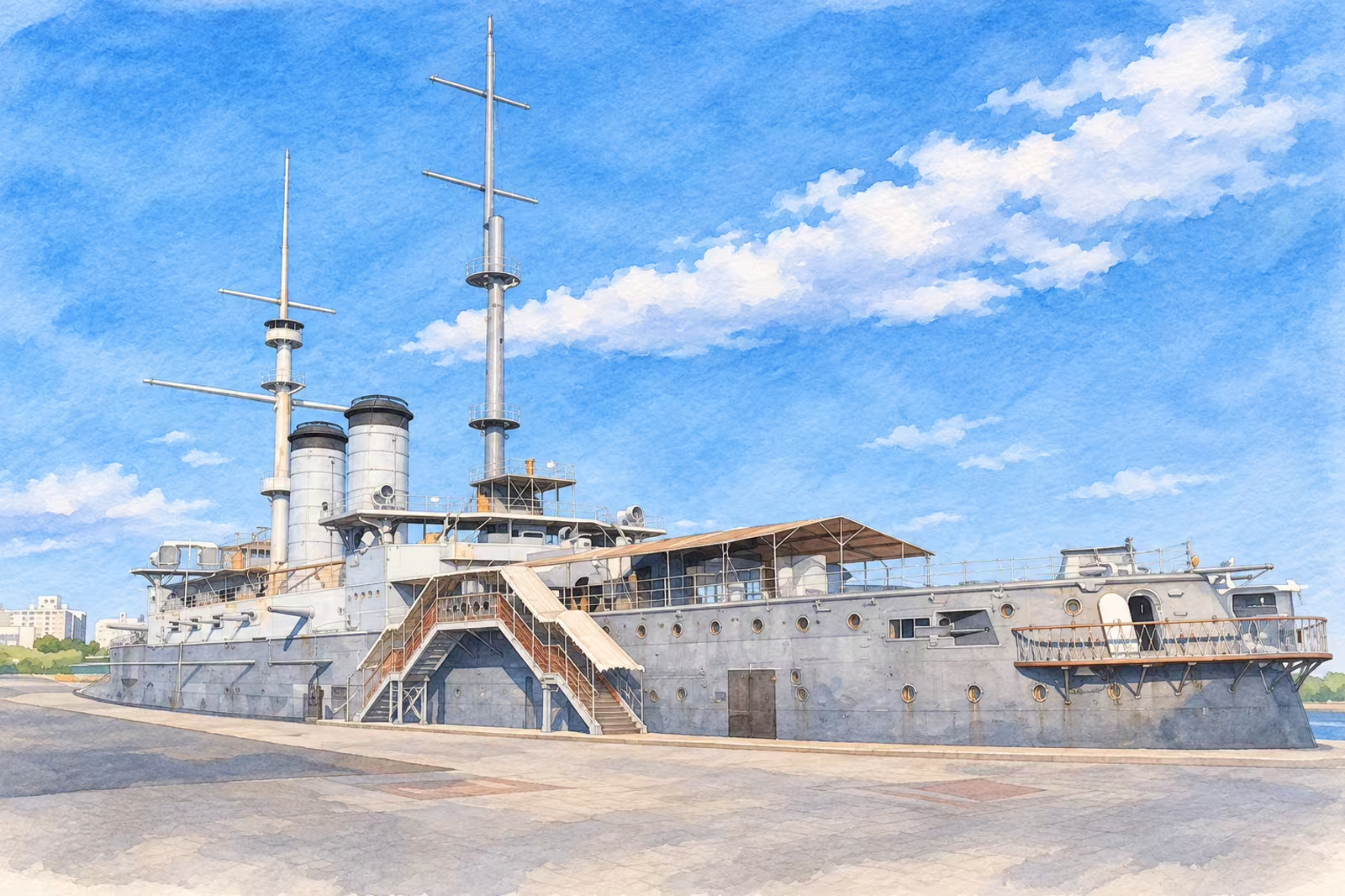
Yokosuka, on the eastern shore of the Miura Peninsula in Kanagawa Prefecture, has been one of Japan’s most important shipbuilding centers and naval ports since the end of the Edo period. Two layers of history meet here: the Yokosuka ironworks begun by the shogunate in 1865, which grew into a naval arsenal and naval district headquarters, and the memorial ship Mikasa in Mikasa Park, flagship of the Combined Fleet in the Russo-Japanese War. Together they record the rise of the modern Japanese navy, its expansion, and how it was reinterpreted after defeat.
01From Ironworks to Naval Port
In 1865 the shogunate, led by the finance magistrate Oguri Tadamasa and with the French engineer Léonce Verny in charge of design, began building the Yokosuka ironworks, a shipbuilding complex with docks and workshops. After the shogunate fell, the Meiji government took over the project, renaming it the Yokosuka Shipyard in 1871, the year Dry Dock No. 1 was completed. In 1884 the Yokosuka Naval District was established here as the navy’s base for eastern Japanese waters. After the Second World War the US forces took over the former arsenal; today it is US Fleet Activities Yokosuka, home port of the Seventh Fleet.
02The Story of Mikasa
Mikasa was built by Vickers at Barrow-in-Furness in Britain and delivered to Japan in 1902. In the Russo-Japanese War she was the flagship of Tōgō Heihachirō, fighting at the Battle of the Yellow Sea and leading the Combined Fleet at the Battle of Tsushima on 27–May 28, 1905, when the Russian Baltic Fleet was almost entirely destroyed. In September that year Mikasa sank in Sasebo harbor after a magazine explosion; she was raised, repaired and returned to service. After the Washington Naval Treaty of 1922 she was struck off as a warship, moved to Yokosuka for permanent preservation in 1925, and dedicated as a memorial ship in 1926.
After the Second World War her masts, funnels, gun turrets and other upper works were removed under the occupation, and the hull was for a time put to commercial use. In the late 1950s, appeals from both Japanese and Americans led to a restoration, completed in 1961.
03What Can Be Seen Today
Mikasa sits fixed at the edge of Mikasa Park, her lower hull set in the ground so that she cannot float. Most of the upper works are the 1961 restoration, and the interior is a museum on the Russo-Japanese War. Verny Park on the waterfront looks out over the naval port, and its Verny Memorial Hall displays a steam hammer bought from the Netherlands at the end of the Edo period. The early stone dry docks are still in use inside the US base and are generally closed to the public.