A rice field, a green bowl and a medical book seem to belong to different stories. Each can lead us across the sea—and back to the people who made a journey useful, profitable or possible.
Japan’s islands lay beside the Korean peninsula and the coast of China. Water separated communities, but ships also connected them.
Follow a few crossings through 1912. Some carried learning and trade. Others brought invasion or forced people from home.
8 short chapters26 reading unitsNo prior knowledge needed
Begin with the crossings—and the people who made them possible.
02 / 26
A sea between neighbours
Selected voyage · 1323
Kyūshū 九州 · Hakata 博多
Look west from northern Kyūshū, the southwestern part of Japan’s main island chain. The Korean peninsula lies across the straits; China’s coast lies farther across the East China Sea.
These positions offered possibilities, not a timetable. Weather, sailing knowledge and political permission helped decide which journeys could happen.
In 1323, one trading ship set out from Ningbo for Hakata. It sank off Korea instead. Even a planned connection could end somewhere else.
Three locations that must not be merged
North-up physical geography; modern GSHHG coastline without political boundaries. Regional locators, not historical harbour footprints or navigation instructions.
1 · Ningbo
Chinese departure port, called Qingyuan in Yuan-period records.
2 · Hakata
Intended Japanese destination of the 1323 ship.
3 · Sinan wreck
Where this ship was found off Korea—not a planned stop.
The water between
Geography offers possible connections, not a timetable or a guarantee of arrival.
03 / 26
Cargo does not load itself
A trading voyage · 1323
That ship needed more than a destination. Someone assembled the cargo, someone financed purchases, and sailors had to move the vessel through unfamiliar or dangerous water.
Wooden tags recovered from the wreck link parts of its cargo to Japanese temples. The goods were not simply drifting from one culture into another.
Merchants, religious institutions and the people working aboard belonged to a chain of practical arrangements. Break one link, and a voyage might never begin.
A crossing rests on work done before departure
A functional chain, not the organisation chart of every investor aboard the Sinan ship.
Actual evidence
Wooden cargo tags include the names of Japanese religious institutions.
Do not overread
An institutional name does not identify every passenger, its nationality or the sole purpose of the ship.
Work that remains
Goods still need handling and a vessel still needs sailing.
A person could bring skills that a finished object could not explain. A merchant could carry bowls without teaching anyone how to fire them. A written text could arrive without a reader able to understand it.
Keep these differences in view. Moving a thing and making use of it were separate achievements.
The next chapters follow farmers and craftspeople, monks and merchants, interpreters and officials. Their connections sometimes overlapped, but they did not all travel for the same reasons.
Crossing the water and becoming useful are different stages
A craftspersonPractical experience travels with a personLocal materials and a place to work are still needed
A finished bowlA usable object travelsIts arrival does not teach the full firing process
A written textWords and images travelA reader may still need instruction or translation
Parallel cases, not three stages in a single inevitable sequence.
Ask about the missing step
What must happen after arrival?
Japan Across the Seas
Chapter 2 / 8
People, fields and skills
An arrival was a beginning, not a finished transformation.
05 / 26
Rice needed more than seed
Northern Kyūshū · early Yayoi period
Itazuke 板付
Wet-rice farming reached northern Kyūshū through contacts with the Korean peninsula. It did not spread across every island at once.
At Itazuke, near today’s Fukuoka, excavations reveal early rice fields with channels, banks and devices for managing water. Farming meant reshaping ground and organizing work, not merely planting a new crop.
The fields make the crossing tangible. Knowledge had to become something people could do together in a particular place, with its own soil and water.
The crop depends on the shape of the ground
Interpretive early-Yayoi water-management fragment informed by Itazuke evidence. Not a measured site reconstruction or the later moat.
Feeder channel
Water has an organised path toward the growing area.
Opening
A controlled connection admits it to the shallow field.
Raised banks
Earth separates and retains water in plots.
Timber support
Maintaining the bank is part of keeping the system usable.
A different skill arrived in the fifth century: techniques for making the hard, grey pottery called Sue ware, closely connected with the Korean peninsula.
A finished pot could travel easily enough. Reproducing one required much more—preparing clay, shaping a vessel and managing the heat and atmosphere inside a kiln.
Craftspeople carried practical knowledge, while workshops established in Japan developed their own production. Adoption was work with local materials, not a single moment of copying.
The firing process depends on connected spaces
Interpretive cutaway of a single-chamber hillside kiln used for Sue ware. Not a measured excavated kiln, prescribed vessel loading or complete firing recipe.
Low end
Wood is fed into the combustion area.
Uphill
The enclosed chamber carries heat past the vessels.
High end
A passage allows smoke to escape.
Another stage
Closing the openings later limits air. Knowing when and how to manage a firing cannot be learned from the finished pot alone.
Consider a Sue-ware cup made around 500. It stands on a tall, pierced foot and once had a lid. Its shape resembles cups made on the Korean peninsula.
This is a specific object, not a portrait of a population. It helps us recognize a shared craft world and ask how skilled people and workshop practices crossed the water.
The resemblance cannot tell us the identity of its maker—or the ancestry of everyone living nearby.
Look at the foot, openings and mouth
Sue-ware footed cup, Japan, about 500. The Met, 2002.447.8 · Public Domain. Full object photograph; original 757 px retained.
Raised foot
The cup does not rest directly on its bowl.
Pierced openings
The support has deliberately open spaces.
At the mouth
A lid once belonged here; it is not recreated in this photograph.
A bounded inference
Form can support a craft comparison. It cannot identify the maker’s ethnicity.
Ships carried books. Learning also required people.
08 / 26
One ship, different purposes
Kūkai’s journey · 804–806
Kūkai 空海
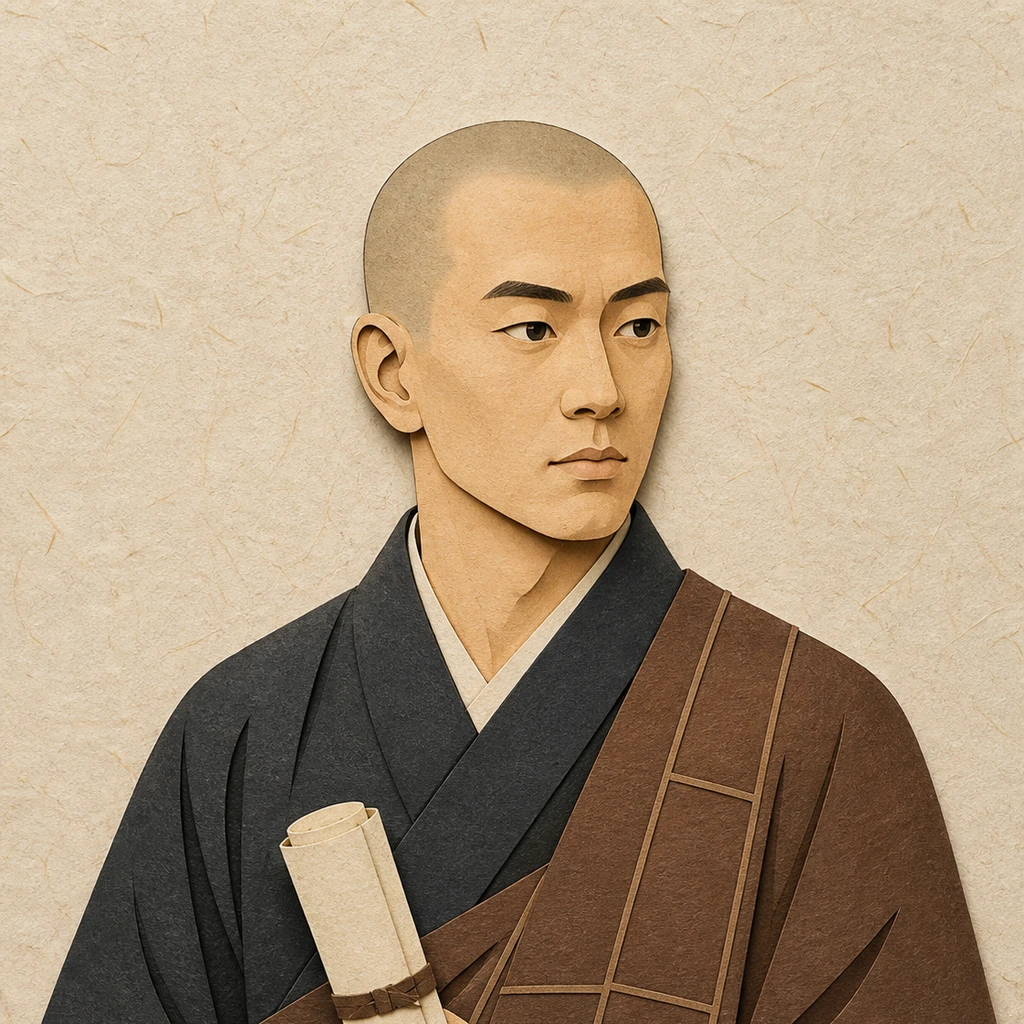
In 804, the monk Kūkai sailed with an official Japanese mission to Tang China. The embassy represented a government; he was seeking religious instruction.
In Chang’an, the Tang capital, he studied with a teacher and gathered texts and ritual materials. He returned to Japan in 806.
The distinction matters. Official travel could create an opportunity for an individual learner. What came back depended on that person’s questions, teachers and choices—not simply on what a foreign court offered.
One official journey can support a different personal purpose
Relationships and selected dates, not a sailing route, ship manifest or invented encounter.
Government mission
Representing a court.
Individual study
Seeking instruction and making choices about what to bring home.
Buddhism originated in India and spread far beyond it. The Chinese monk Ganjin belonged to that wider religious world; he did not found a new religion when he reached Japan.
He landed in Japan in 753 and arrived in Nara the following year. His particular contribution was training in Buddhist discipline and ordination, the process of formally entering the monastic community.
Tōshōdai-ji, established in 759, gave this teaching a lasting home. A crossing became an institution.
Landing, teaching and a lasting institution have different dates
753Ganjin reaches JapanThe sea crossing is completed
754He arrives in NaraOrdination and discipline become local teaching work
759Tōshōdai-ji is establishedTeaching acquires an institutional home
Selected milestones, not the invention of Buddhism or the date of every surviving temple building.
The change of scale
An individual journey can establish a continuing practice with pupils and support.
A book could outlast a voyage, but only if someone preserved and reproduced it. Records from Nara’s eighth-century sutra-copying offices reveal the organized work behind Buddhist manuscripts.
Paper, ink, brushes and trained hands turned a religious text into another usable copy. Careful reading mattered as much as careful writing.
Alongside monks and teachers stood the workers who made knowledge durable. The arrival of a teaching was only one stage in its life in Japan.
A teaching needs a durable physical carrier
Retained Nara manuscript-making study: joining paper into a roll. The sheet is deliberately blank, not a forged sutra page.
At the seam
Material has to be aligned and joined.
At the roll
Separate sheets become something that can be handled and stored.
Beyond assembly
Copying and checking the words require additional trained work.
Institutional support
The paper, ink and labour have to be supplied; arrival by sea is not the last step.
Japan Across the Seas
Chapter 4 / 8
Ports had local networks
A medieval cargo and a later island connection show how trade was organized.
11 / 26
A port is not a route
Hakata and the Sinan shipwreck · 1323
Hakata 博多
Hakata was a port on northern Kyūshū. The shipwreck found off Sinan, on Korea’s southwestern coast, offers a glimpse of one particular journey towards it.
Evidence from the wreck points to departure from Ningbo in China in 1323, with Hakata as the intended destination. The ship never completed that crossing.
A map needs both facts: where the ports were, and what this vessel was trying to do. One voyage does not describe all medieval trade.
An intended destination is not an accomplished voyage
North-up physical geography; modern GSHHG coastline without political boundaries. Regional locators, not historical harbour footprints or navigation instructions.
1 · Ningbo
Chinese departure port, called Qingyuan in Yuan-period records.
2 · Hakata
Intended Japanese destination of the 1323 ship.
3 · Sinan wreck
Where this ship was found off Korea—not a planned stop.
Among the wreck’s cargo were green-glazed ceramics made at Longquan in China. Bowls and other vessels could serve meals, tea or ritual uses far from the kilns that produced them.
Their journey connected makers with buyers, merchants with shipping, and religious institutions with commercial activity. Temples were not always outside the trading world.
A beautiful object on a table was the last visible step in a longer arrangement. The price of moving it mattered too.
Separate a material comparison from a wreck find
Longquan bowl, late thirteenth century, The Met 2007.204 · Public Domain. This individual object is not claimed as Sinan cargo.
Glazed surface
The green finish belongs to a particular ceramic production tradition.
Rim and foot
A shaped vessel has uses beyond being a trade statistic.
Actual wreck evidence
Longquan wares form part of the documented 1323 cargo.
A social route
Makers, merchants, transport and buyers connect; some institutional cargo owners were temples.
Jump forward to 1663, when five drydocks were completed at Ofunae on Tsushima. Ships could enter at high tide and rest on the exposed ground for repair when the water fell.
Tsushima’s Sō lords controlled a privileged trade connection with the separate kingdom of Joseon Korea, including its port of Busan.
This was not just another harbour following identical rules. Local rulers, specialist arrangements and ship maintenance helped sustain a relationship between different political communities.
Use the tide to change what supports the hull
A functional section, not the measured Ofunae plan, an exact vessel design or a claim that four surviving embankments mean four original docks.
1663
Five docks completed.
High water
Ships can enter or leave.
Falling water
Ground support exposes the hull for maintenance; no mechanical pump is implied.
Local power
The Sō lords’ privileged Korea trade needed working ships.
Invasion and forced movement were not simply another kind of exchange.
14 / 26
A shore to defend
Northern Kyūshū · 1274 and 1281
Return to the thirteenth century. Forces of the Mongol-led Yuan empire attacked northern Kyūshū in 1274 and again in 1281. Ships now brought an invading army, not a trading cargo.
Between the invasions, defenders built a stone wall along much of Hakata Bay. Organizing labour and maintaining defences became urgent local tasks.
The coast was still a place of connections. But a community facing invasion had very different concerns from merchants waiting for a ship.
A sea connection can create work on the shore
Imazu-type defence wall, explanatory partial cutaway. Built after 1276 between the invasions of 1274 and 1281; not one uniform construction around the whole bay.
Stone faces
A physical obstacle confronts landing forces.
Inside
Fill and construction require material and labour.
Cutaway
The opening lets us read structure; it does not depict battle damage.
Different purpose
A coast receiving an attack is not merely another commercial harbour.
15 / 26
Whose home became a battlefield?
Hideyoshi’s invasions of Korea · 1592–1598
Toyotomi Hideyoshi 豊臣秀吉
In 1592, Toyotomi Hideyoshi sent armies from Japan into Korea. A second invasion followed in 1597. Joseon forces resisted, with military help from Ming China; the war ended in 1598.
For Korean residents, these were years of destruction, displacement and demands on food and labour. Homes and livelihoods stood in the path of armies.
The story cannot be told only as a Japanese ruler’s ambition. The people living where the fighting took place belong at its centre.
Put the invaded country at the centre
Physical locator, no invented army tracks, front lines or present-day Korean division.
1592 / 1597
Two Japanese invasions under Hideyoshi.
Resistance
Joseon forces, assisted by Ming China, fought the invaders.
1598
The war ends.
Civilian geography
The same land contains homes, fields and livelihoods—not only strategic targets.
Korean potters and Japanese workshops · late sixteenth–early seventeenth century
During these invasions, Korean potters were forcibly taken to Japan. Their knowledge contributed to new ceramic production there, including workshops in Kyūshū.
A later bowl may be admired for its beauty, but that does not turn its maker’s forced removal into a voluntary study trip. Skill and suffering can belong to the same history.
When we follow something across the sea, we need to ask who could choose the journey—and who could not.
The direction of movement cannot tell us whether it was chosen
A relationship from the invasions, not a complete migration history, individual biography or claim that every potter arrived in the same circumstances.
Keep both facts
Technical contribution and coercion belong in the same explanation.
Do not romanticise
An admired later object does not undo the loss of choice.
Japan Across the Seas
Chapter 6 / 8
Restricted, not disconnected
Control narrowed some crossings while preserving others.
17 / 26
Rules at the harbour
Tokugawa Japan · 1630s–eighteenth century
Nagasaki 長崎 · Dejima 出島
The Tokugawa government tightened controls on overseas movement during the 1630s. Japanese people were forbidden to sail abroad or return from overseas, and Christianity faced severe restrictions.
Yet regulated trade continued. In 1641, Dutch traders were moved to Dejima, an enclosed trading post at Nagasaki, where their movements were supervised.
The familiar label “closed country” can mislead. The government was restricting and channelling connections, not removing Japan from every exchange of goods, news and knowledge.
Different controls can operate at the same time
Overseas movementJapanese departures and returns restrictedRules concern who can cross the boundary
Dutch trade1641: traders moved to DejimaContact continues at a supervised location
Religious activityChristianity severely restrictedCommercial permission is not freedom of religion
Selected Tokugawa controls, not a claim that all foreign channels or every period had identical rules.
In 1771, Japanese physicians compared a Dutch anatomy book with what they saw at a dissection. The illustrations helped convince them that the book was worth translating.
The group’s work became Kaitai Shinsho, published in 1774. Finding Japanese expressions for unfamiliar anatomical terms took years of effort, not a quick exchange of one set of words for another.
Dutch-language books entered through a restricted channel. Making their contents useful depended on Japanese readers’ observation, argument and patient collaboration.
Look at the work between the picture and its labels
Kaitai shinsho, Edo, 1774: complete selected hand-and-forearm spread. Courtesy of the National Library of Medicine · catalogue Public Domain.
Across the fold
The extended hand and forearm form one anatomical study.
Printed labels
Visual information had to be made usable in Japanese.
More than one source
NLM links the final hand and foot illustrations to Bidloo’s 1690 book; not every image comes from Kulmus.
Evidence boundary
This is a 1774 printed page, not an image of the Japanese dissection of 1771.
Nagasaki and Tsushima · seventeenth–early nineteenth century
Nagasaki’s supervised trade included Chinese merchants as well as the Dutch. Dejima was therefore only part of the picture, even within that port.
Tsushima served a different relationship. Between 1607 and 1811, Korean diplomatic missions travelled through the island under arrangements managed by its rulers; the final mission met its Japanese hosts on Tsushima itself.
Trade, diplomacy and movement were regulated through different places and institutions. “Open” and “closed” are too blunt to describe all of them.
Dejima is part of one port—not a name for every connection
Institutional comparison, not port footprints or a diagram implying all missions travelled on to Edo.
1607–1811
The sequence of Korean missions considered here.
1811
The last mission met Japanese hosts on Tsushima itself.
Do not merge
A Dutch commercial post and Korean diplomacy are not the same relationship.
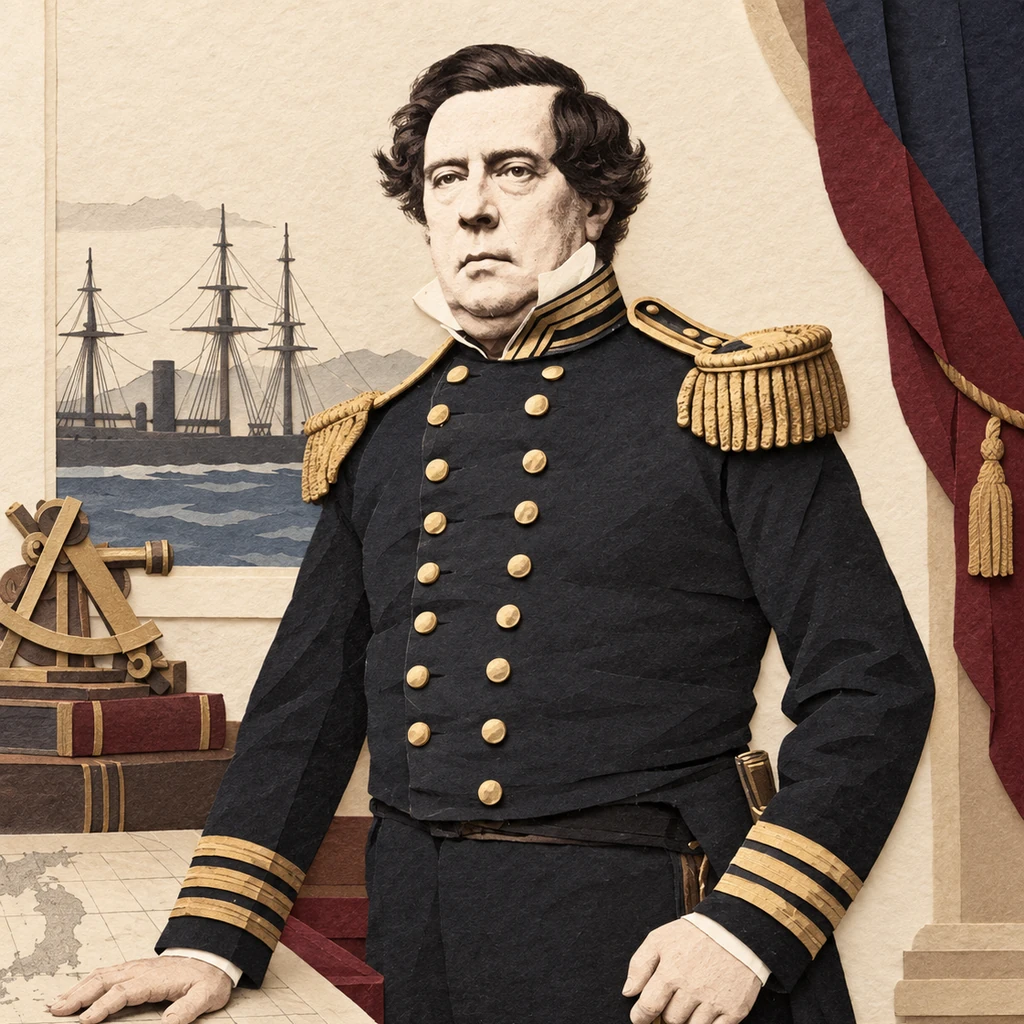
Japan already had foreign contacts when the American naval commander Matthew Perry arrived with warships in 1853. His demands came with an unmistakable threat of force.
The 1854 agreement provided access to supplies and assistance at designated ports. The commercial treaty of 1858 went much further, permitting trade and giving Americans consular jurisdiction—putting them under their own officials’ courts.
“Opening” was not a first discovery of the outside world. It changed the terms on which outsiders could enter.
Force changes the terms of a connection
Retained 1850s side-wheel steam-frigate study based on Susquehanna sources. Not an exact 1853 vessel plan.
Sails and steam
The vessel combines older and newer means of movement.
1853
Perry’s demands arrive with naval force.
1854
Access to supplies and assistance.
1858
Commercial access and American consular jurisdiction—more than permission to replenish a ship.
21 / 26
Going abroad to look closely
The Iwakura mission · 1871–1873
Iwakura mission 岩倉使節団
The new Meiji government sent the Iwakura mission to the United States and Europe in 1871. Its work combined diplomacy with investigation of institutions abroad.
Delegates observed political systems and kept detailed records; students travelled overseas alongside the mission. Such journeys required translators, arrangements and sustained study, not simply a willingness to admire unfamiliar things.
Returning with information was different from deciding what to adopt. Foreign examples became material for choices and arguments about how Japan should change.
Returning with information is not the same as importing a system
A learning process, not a complete itinerary or claim that every observation became a Japanese institution.
Diplomacy
Negotiating relationships between governments.
Investigation
Learning how institutions work.
Choice at home
An example is material for debate, not a ready-made command.
Japan’s expanding overseas power also brought colonial rule. Taiwan came under Japanese control in 1895 after war with Qing China. Japan forcibly annexed Korea in 1910.
Taiwan passed from Qing to Japanese imperial rule; Korea lost its sovereignty. Residents faced colonial authority rather than simply new opportunities to trade or study. Resistance met colonial force.
By 1912, Japanese engagement with the world included both learning from others and ruling over them. These activities require different explanations—and attention to different people.
A loss of sovereignty is not an exchange of knowledge
Taiwan · 1895Qing rule gives way to Japanese colonial ruleControl established against resistance
Korea · 1910Japan forcibly annexes KoreaThe country loses sovereignty
Through 1912Japan also studies institutions abroadLearning and colonial rule need different explanations
Two distinct colonial histories; neither is represented as a voluntary choice by the governed.
Whose perspective?
An expanding state’s power and residents’ experience must both remain visible.
Japan Across the Seas
Chapter 8 / 8
Looking back from 1912
The same sea held different kinds of relationship.
23 / 26
Connections did not all mean the same thing
The cases so far
Put the rice field beside the manuscript, the trading bowl beside the captive potter. All belong to histories of movement, but the similarities should not erase their differences.
Some journeys depended on invitation, some on profit, some on official permission. Others depended on the power to compel someone to leave home.
Across the centuries, the important question is not whether Japan was connected. It is how a connection worked, who sustained it and whose choices it allowed.
Compare on the same three questions
StudyLearning travels with teachers, readers or studentsAsk who can teach, interpret and support it
TradeObjects move through purchases and shippingAsk who pays, works and benefits
CoercionPeople can be moved against their willAsk who has power and whose choice is removed
Analytical distinctions, not exclusive boxes: one historical connection can involve more than one.
Do not flatten the cases
A shared sea crossing does not give the journeys a shared moral or institutional meaning.
24 / 26
Three routes, three arrangements
Selected connections · 804–806 / 1323 / 1663
Kūkai’s journey of 804–806 used an embassy to make a course of religious study possible. The ship of 1323 aimed to carry a commercial cargo from Ningbo to Hakata, but ended at a wreck site.
By 1663, drydocks on Tsushima were maintaining ships within a privileged trading relationship with Korea.
Read the dates with the arrows. They describe particular arrangements, not one permanent network or a ladder leading automatically from early travel to modern power.
Keep each arrangement attached to its dates
804–806Kūkai uses an embassy connectionReligious study and a return with learning
1323Ningbo → intended HakataCommercial cargo; wreck off Sinan instead
1663Docks completed on TsushimaShip maintenance within privileged Korea trade
Separate episodes, not a permanent route network or equally spaced progression toward empire.
An arrow needs a verb
Studies, attempts to carry, or maintains—not simply connects.
25 / 26
Questions to take to the next story
Looking more closely
When another history introduces an imported object, ask what travelled with it. Was it a set of instructions, a skilled person, or only the finished thing?
When a port appears, ask who controlled access and who did the work. When a journey is praised, ask whether everyone involved had chosen it.
These questions make a temple, a workshop or a treaty easier to understand. They keep the people doing the crossing—and those receiving its consequences—in the picture.
An object gives you a place to begin—not a complete answer
Sue cupYou can see a pierced foot and related formYou cannot read its maker’s ancestry from that form
Green bowlYou can compare material and shapeYou still need evidence for its particular journey
Medical bookYou can inspect a printed pageYou still need the history of observation and translation
Evidence limits are part of the explanation, not a reason to avoid looking closely.
Follow the missing work
Ask who made the crossing possible and who could refuse it.
Japan Across the Seas / Closing page
The sea, with people in it
A rice field, a green bowl and a medical book led us across the sea—and back to work on land. Their histories involved very different kinds of movement.
Keep the difference between study, trade and coercion in view. A crossing becomes understandable when we know what moved, who sustained it and what it meant on either shore.
A crossing matters when it changes work on the ground
Return to the same early-field study; unchanged reuse is not counted as another new illustration.
Water
A possibility becomes a maintained local system.
People
Learning, trade and compulsion create different relationships.
Next time you read a crossing
Follow both shores, not just the arrow between them.