
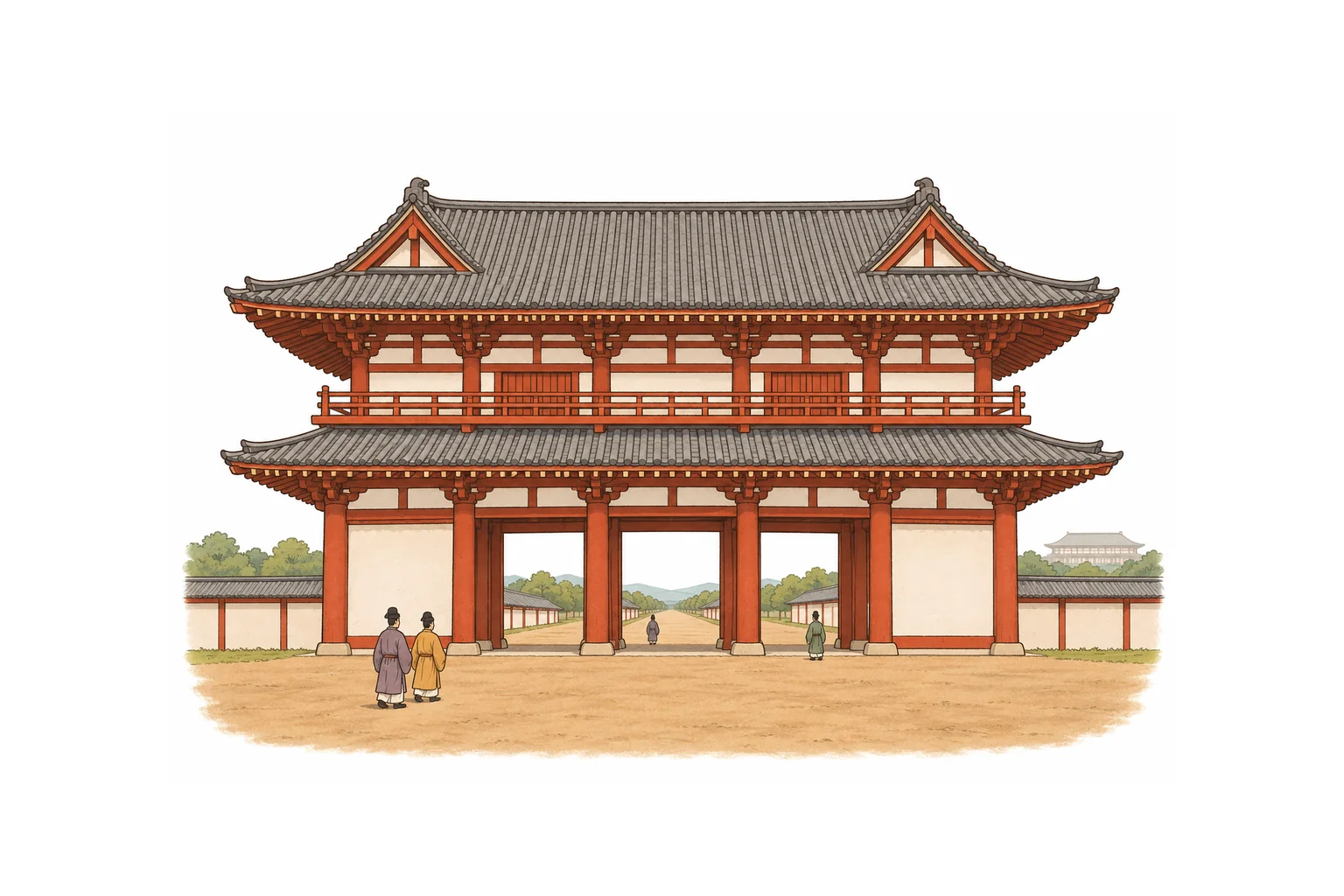
This period in brief
The Nara period runs from 710 to 794. It opens when the court moved into Heijō-kyō, a newly built capital at the northern end of the Nara basin, and it closes when Emperor Kanmu settled the court at Heian-kyō, the city now called Kyoto. The name comes from the place: for most of those eighty-four years the government of Japan sat in Nara. The last decade is an untidy appendix, since the court actually left Nara in 784 for a short-lived capital at Nagaoka, but convention folds those ten years into the Nara period.
Read the introductionabout 4,100 words · 10 chaptersMichiyo never held an office of state in the sense that men did, and her influence worked through marriage, child-rearing and service in the palace.
Crown Prince Motoi基王Motoi did nothing himself; he mattered because of where he stood.
Crown Prince Osabe他戸親王Osabe left no deeds of his own; his importance lies in his position.
Dōkyō道鏡Dōkyō is almost unique in Japanese history: a monk who rose to the highest office in the realm and received the title of Dharma King, with the perquisites of a…
Emperor Junnin淳仁天皇Junnin matters mainly because his fate exposed a gap in the Nara-period monarchy.
Emperor Kōnin光仁天皇Kōnin’s own achievements were modest; his importance lies in his position.
Empress Genmei元明天皇Genmei’s accession and her abdication served one purpose: to keep the throne in the line running from Tenmu and Jitō through Kusakabe to her grandson Obito aft…
Empress Genshō元正天皇Genshō was a necessary link in keeping the throne within Kusakabe’s line.
Empress Jitō持統天皇Jitō turned the programs begun under Tenmu into working institutions: the Asuka Kiyomihara Code was put into force, household registers and field allocation we…
Empress Kōken / Shōtoku孝謙天皇・称徳天皇She was the only female sovereign who had first been formally designated heir, the only sovereign who ruled as an ordained nun, and the second to reign twice.
Empress Kōmyō光明皇后Kōmyō was the first empress born a subject rather than a royal, legend aside.
Empress Suiko推古天皇During Suiko’s thirty-six-year reign Asuka became the seat of royal power, Buddhism moved from a single clan’s faith to a religion backed by the throne, the ca…
Fujiwara no Fuhito藤原不比等Fuhito was one of the main builders of the Japanese ritsuryō state.
Fujiwara no Fusasaki藤原房前Fusasaki’s own career was not dazzling: he spent twenty years as a councilor, never served as minister and left no recorded policy.
Fujiwara no Hirotsugu藤原広嗣Hirotsugu’s rising was part of the reshuffling of power after the four Fujiwara brothers died.
Fujiwara no Maro藤原麻呂Maro was one of the four brothers who carried the Fujiwara through their first rise to power.
Fujiwara no Miyako藤原宮子Miyako’s importance lies almost entirely in her position.
Fujiwara no Momokawa藤原百川Momokawa mattered because of where he stood.
Fujiwara no Muchimaro藤原武智麻呂Muchimaro matters because he carried his father’s program into the next generation.
Fujiwara no Nagate藤原永手Nagate matters for where he stood at a few turning points.
Fujiwara no Nakamaro藤原仲麻呂Nakamaro was the most powerful subject at the mid-Nara court.
Fujiwara no Umakai藤原宇合Umakai was the Fujiwara brother most often sent away from the capital and given military command: vice-envoy to the Tang, provincial governor and inspector, ge…
Ganjin鑑真Ganjin’s main contribution was institutional.
Genbō玄昉Two of Genbō’s achievements are secure.
Gyōki行基Gyōki matters because he joined popular Buddhist devotion to practical public works.
Kibi no Makibi吉備真備The clearest thread in Makibi’s life is the exchange of learning for position.
Prince Asaka安積親王Asaka left almost no record of his own; his importance lies in where he stood.
Prince Nagaya長屋王Nagaya led the Council of State for most of a decade after Fuhito’s death, saw the transition from the empresses Genmei and Genshō to Emperor Shōmu, and presid…
Prince Shiki志貴皇子Shiki won no battles, held no high office and was caught up in none of the famous conspiracies of his age.
Prince Shioyaki氷上塩焼Shioyaki matters less for anything he did than for where he stood.
Prince Umayado / Prince Shōtoku厩戸皇子(聖徳太子)Umayado matters because he stood near the center of Suiko’s court.
Princess Inoe井上内親王Inoe stood at a turning point in the Nara succession.
Princess Kibi吉備内親王Kibi mattered because of where she stood.
Rōben良弁Read through the reliable sources, Rōben was an organizer.
Emperor Shōmu聖武天皇Shōmu’s twenty-five years on the throne saw a run of crises: the destruction of Prince Nagaya, the smallpox epidemic, Hirotsugu’s rebellion and a long uncertai…
Tachibana no Moroe橘諸兄Moroe led the Nara court for close to twenty years after the epidemic of 737.
Tachibana no Naramaro橘奈良麻呂Naramaro’s conspiracy was the largest challenge to Fujiwara no Nakamaro’s rise under Empress Kōken.
Wake no Hiromushi和気広虫Hiromushi held no great political office.
Wake no Kiyomaro和気清麻呂Kiyomaro is remembered first for the Usa oracle affair.
Ōtomo no Yakamochi大伴家持About 470 of the Man’yōshū’s roughly 4,500 poems are by Yakamochi, and Books 17 to 20 are close to his dated poetic diary; he is generally thought to have play…
Abe no Nakamaro阿倍仲麻呂Abe no Nakamaro went further inside the Tang state than any other Japanese student of his era.