
This period in brief
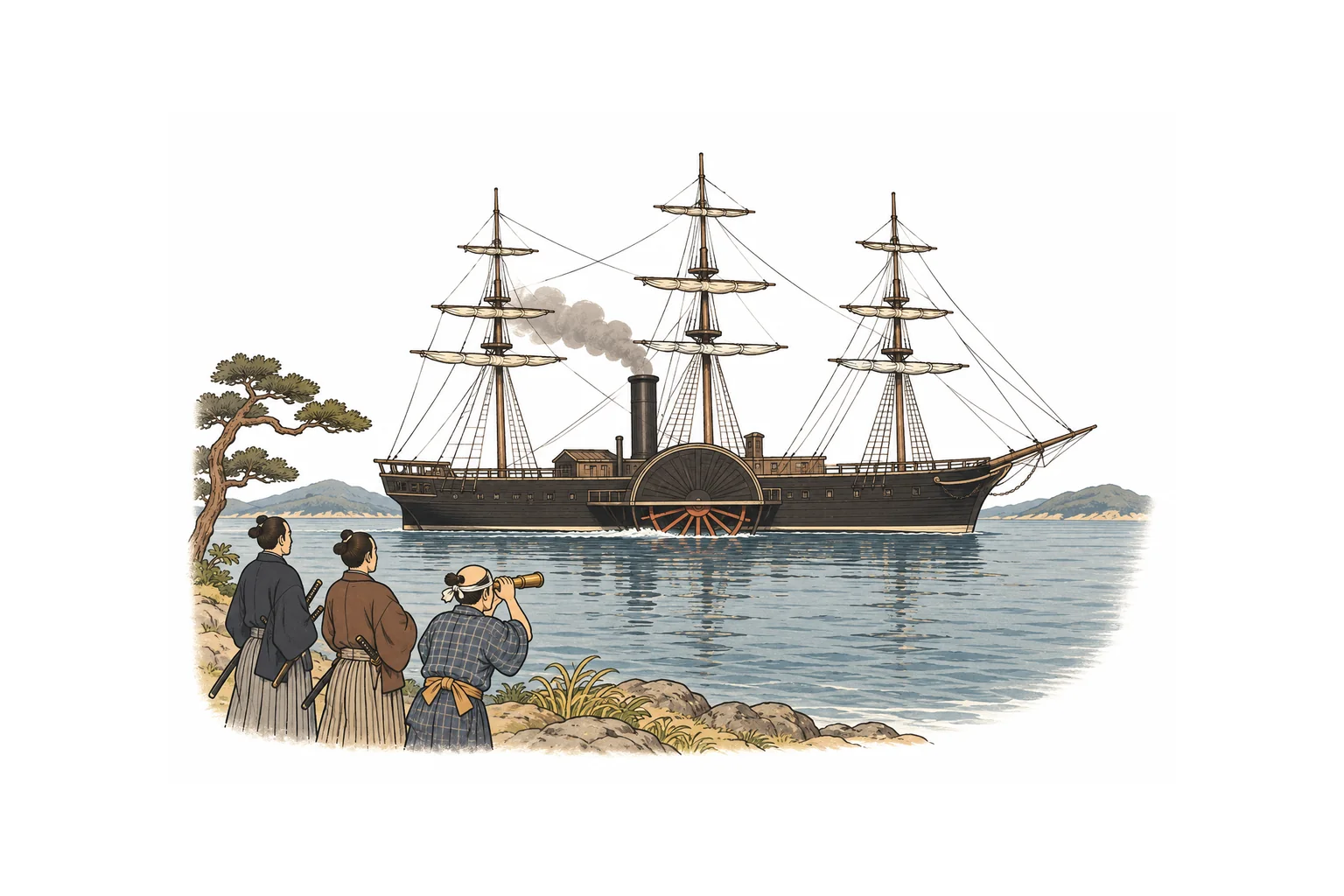
Bakumatsu is a contraction of two Japanese words: bakufu, the shogun's government, and matsu, "the end." It names the closing years of the Tokugawa shogunate, the military government that had ruled Japan from Edo (today's Tokyo) since 1603. By convention the period opens in July 1853, when four American warships anchored at the mouth of Edo Bay, and closes in 1868, when the shogunate was gone and a new government ruling in the emperor's name proclaimed the Meiji era. It is not a dynasty or an era name. It is the label later generations gave to the last fifteen years of the Edo period, because those years moved so differently from the two and a half centuries before them.
Read the introductionabout 4,000 words · 10 chaptersAbe Masahiro led the shogunate for about a decade around Perry’s arrival, the first Tokugawa statesman to face Western pressure to open Japan directly.
Emperor Kōmei孝明天皇Kōmei reigned for about twenty-one years, almost the whole of the late Tokugawa period, and was the first emperor in centuries to carry real political weight.
Enomoto Takeaki榎本武揚Enomoto was one of the few men of his generation with a real scientific and naval education, gained in the Netherlands.
Gotō Shōjirō後藤象二郎Gotō’s lasting achievement belongs to a few months in 1867.
Ii Naosuke井伊直弼Naosuke stood at a turning point of the late Tokugawa period.
Imperial Princess Kazunomiya / Seikan’in和宮親子内親王(静寛院宮)Kazunomiya’s marriage was the most visible product of the kōbu gattai policy.
Katsu Kaishū勝海舟Two achievements anchor Katsu’s reputation.
Kusumoto Ine楠本イネIne was among the first Japanese women to be trained in Western medicine and to make a living by it.
Matsudaira Katamori松平容保Katamori was one of the central figures of Kyoto politics in the last years of the shogunate.
Matthew C. Perryマシュー・C・ペリーPerry was a well-prepared, stubborn, and ceremonious naval officer.
Philipp Franz von Sieboldフィリップ・フランツ・フォン・シーボルトSiebold matters because he moved knowledge in both directions between Japan and Europe.
Sakuma Shōzan佐久間象山Sakuma Shōzan was among the first in late Tokugawa Japan to argue systematically that the country must master Western technology to survive.
Shimazu Hisamitsu島津久光Hisamitsu mattered because he controlled Satsuma’s troops and money and was willing to use them on the national stage.
Shimazu Nariakira島津斉彬In just over seven years as lord, Nariakira turned a remote domain that had only just recovered its finances into one of the first places in Japan to adopt Wes…
Thomas Blake Gloverトーマス・ブレーク・グラバーGlover mattered because he stood at the right place at the right moment.
Tokugawa Iemochi徳川家茂Iemochi held office for about eight years, from age twelve to twenty, across the stretch in which the bakufu went from apparent strength to collapse: the treat…
Tokugawa Nariaki徳川斉昭Nariaki matters because he carried the political vocabulary of Mito learning, born of a single domain’s history project, onto the national stage.
Tokugawa Yoshinobu徳川慶喜Yoshinobu was the last Tokugawa shogun.
Yoshida Shōin吉田松陰Most of Shōin’s plans failed and he took part in no actual political upheaval.
Takasugi Shinsaku高杉晋作Takasugi mattered at a few decisive points.
Nakaoka Shintarō中岡慎太郎Nakaoka mattered as a connector.
Hijikata Toshizō土方歳三Hijikata was a commoner from rural Tama who became the man actually running the Shinsengumi: its organization, its inspectors and its brutal internal disciplin…
Kondō Isami近藤勇Kondō Isami commanded the Shinsengumi, and his career is a concrete case of the Tokugawa status order loosening in its last years.
Tenshōin (Atsuhime)天璋院(篤姫)Tenshōin matters because she stood at the junction of a marriage alliance between the Shimazu and the shogun’s house.
Sakamoto Ryōma坂本龍馬Ryōma mattered less for any power he held than for where he stood.