
This period in brief
The Bakumatsu
Fifteen Years That Ended the Shogunate
1What the Word Means
Bakumatsu is a contraction of two Japanese words: bakufu, the shogun's government, and matsu, "the end." It names the closing years of the Tokugawa shogunate, the military government that had ruled Japan from Edo (today's Tokyo) since 1603. By convention the period opens in July 1853, when four American warships anchored at the mouth of Edo Bay, and closes in 1868, when the shogunate was gone and a new government ruling in the emperor's name proclaimed the Meiji era. It is not a dynasty or an era name. It is the label later generations gave to the last fifteen years of the Edo period, because those years moved so differently from the two and a half centuries before them.
Three actors need introducing. The shogunate governed from Edo and held about a quarter of the country's farmland, counting the fiefs of its own bannermen. The rest was divided among some 260 daimyo, hereditary lords whose domains (han) kept their own armies, treasuries, and laws. In Kyoto lived the emperor and his court nobles, honored as the source of all legitimate rank but shut out of government and living on a modest income granted by the shogun. In 1853 the first of these three made every decision that mattered. By 1868 the second and third had combined to remove it.
One practical note: Japan used a lunar calendar until 1873, running roughly a month behind the Western one. Dates here are Western unless marked otherwise.
2Before the Black Ships
The shogunate had been worried about foreign ships for sixty years before Perry. Since the 1630s it had confined Western trade to a small Dutch post at Nagasaki, alongside regulated contact with China, Korea, and the Ryūkyū kingdom. From the 1790s Russian and then British ships began testing this arrangement, and in 1825 Edo ordered coastal batteries to fire on any foreign vessel that approached. How nervous officials had become showed in 1828, when Philipp Franz von Siebold, a German physician at the Dutch post, was found to be carrying detailed maps of Japan in his luggage. He was expelled, and the official astronomer who had supplied the maps died in prison. Siebold left behind in Nagasaki a daughter, Kusumoto Ine, who grew up to become one of the first Japanese women trained in Western medicine.
Then came the news, carried by Dutch and Chinese ships, that Britain had defeated Qing China in the Opium War of 1840–42. If the great empire across the water could be forced to cede territory and open ports, Japan's coastal guns were not going to help. In 1842 the shogunate quietly withdrew the shoot-on-sight order and allowed foreign ships in distress to be given water and fuel.
Things were strained at home as well. A run of failed harvests in the 1830s caused famine and riots. The senior councillor Mizuno Tadakuni launched the Tenpō Reforms in 1841, cracking down on luxury and trying to pull the land around Edo and Ōsaka under direct shogunal control; the reforms offended nearly everyone and he fell within about two years. Two outlying domains in the southwest did better with their own reforms. Satsuma, in southern Kyūshū, restructured a crushing debt and profited from a sugar monopoly. Chōshū, at the western tip of the main island, put its finances in order and earned money from shipping through the Shimonoseki strait. Both were "outside" domains whose lords had submitted to the Tokugawa only after losing a war in 1600, and both now had cash to spend.
3Perry and the First Treaties
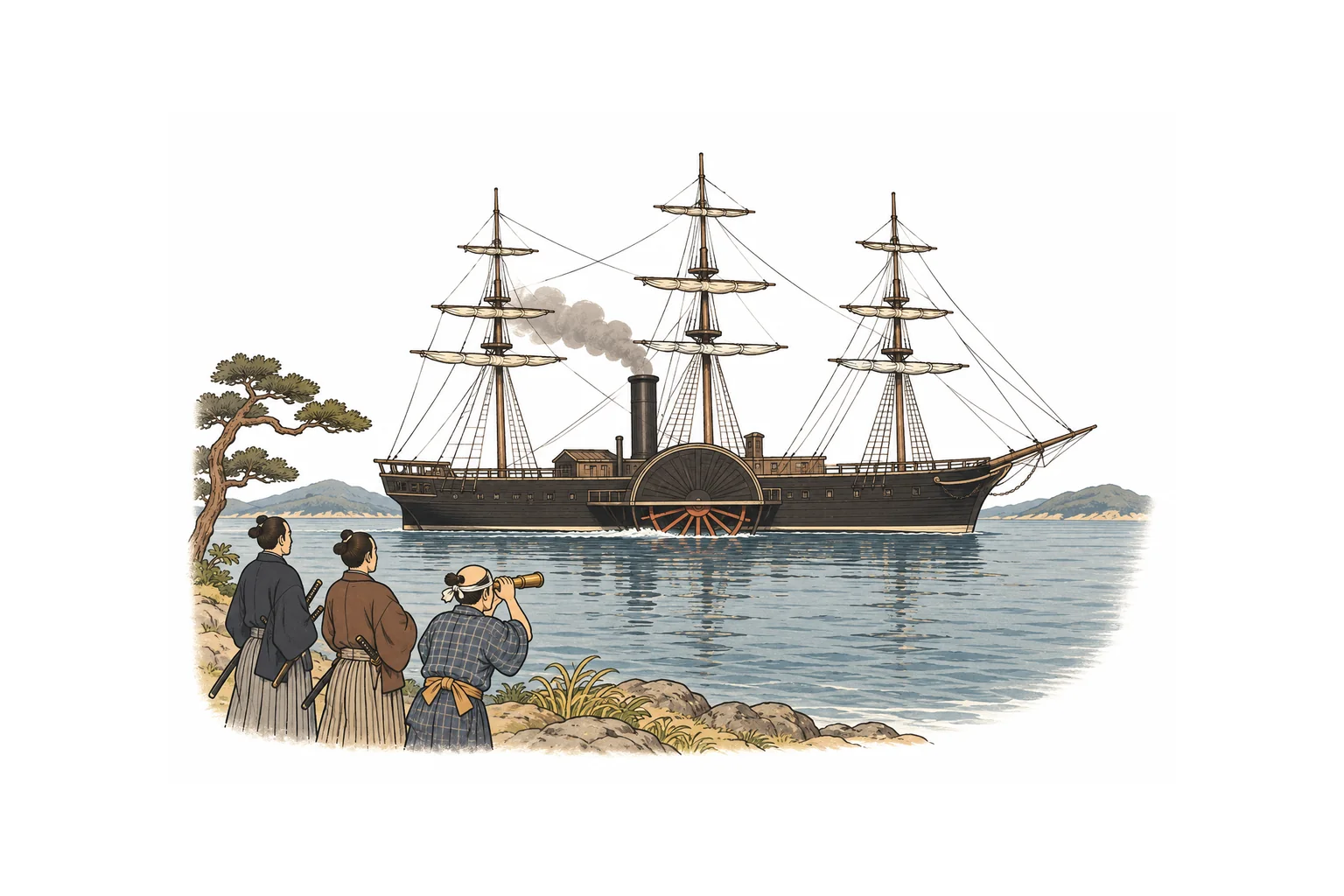
On July 8, 1853, Commodore Matthew C. Perry of the United States Navy arrived off Uraga with two steam frigates and two sailing sloops. The hulls were tarred black and the steamers poured out coal smoke, and the Japanese called them kurofune, black ships. The flagship displaced well over two thousand tons; Japan's largest cargo vessels were perhaps a hundred and fifty. Perry carried a letter from President Millard Fillmore asking for ports where American ships could take on coal and provisions, and for decent treatment of shipwrecked sailors. Told to go to Nagasaki, he refused and sent boats to survey the bay toward Edo. Officials accepted the letter in a ceremony on the beach at Kurihama, and Perry left promising to return for an answer the next year.
Within days the shogun Tokugawa Ieyoshi died, leaving an invalid heir, Iesada. The man in charge was Abe Masahiro, head of the rōjū, the council of four or five senior ministers who ran the government. Abe did something no predecessor had done. He circulated the American letter to all the daimyo and to shogunal officials, and asked what should be done. Several hundred replies came in. Most said to refuse or to stall; few said how. A minor shogunal retainer named Katsu Kaishū submitted a memorial arguing for trade, a navy paid for by trade, and schools to train its officers, and it got him noticed. The scholar Sakuma Shōzan, who had been teaching Western gunnery under the motto of Eastern ethics joined to Western technique, went down to the coast to inspect the squadron for himself.
The consultation was meant to build consensus. Its lasting effect was to tell lords who had never had a voice in national policy that they now had one. Tokugawa Nariaki of Mito, a combative senior member of the shogun's own extended house, and Shimazu Nariakira, the technically minded lord of Satsuma, became regular participants in politics.
Perry returned in February 1854 with a larger squadron, and on March 31 the two sides signed the Treaty of Kanagawa. It opened Shimoda and Hakodate for supplies, promised help for castaways, allowed an American consul at Shimoda, and granted most-favored-nation treatment. It did not mention trade. Britain, Russia, and the Netherlands soon obtained similar agreements; the Russian treaty also drew a border in the Kuril Islands between Etorofu and Uruppu.
A young Chōshū samurai, Yoshida Shōin, tried to use Perry's second visit to see the world. He rowed out to the American ships at Shimoda at night and asked to be taken along. Perry's officers sent him back, and he turned himself in. Eventually confined to his family's house in the castle town of Hagi, he taught a small private school for little more than two years. Its pupils included Takasugi Shinsaku, Kusaka Genzui, Itō Hirobumi, and Yamagata Aritomo.
Abe used the breathing space well. He built gun batteries on artificial islands in Edo Bay, lifted the old ban on building ocean-going ships, opened a naval school at Nagasaki with Dutch instructors, and founded an office in Edo for translating Western books. He died in 1857, not yet forty.
4The Trade Treaty and the Purge
The consul promised by the treaty, Townsend Harris, arrived at Shimoda in 1856 with instructions to negotiate trade. His argument was blunt: Britain and France were at war with China again, and when they finished they would bring their fleets to Japan; better to sign moderate terms with the United States first. Abe's successor Hotta Masayoshi agreed that trade could not be avoided, but the daimyo were divided, so he looked for cover. In 1858 he went to Kyoto to ask Emperor Kōmei to approve the treaty. No shogun had sought imperial sanction for a policy decision in over two centuries, and the result was a shock. Kōmei, who detested the idea of foreigners on Japanese soil, declined.
A second dispute ran alongside the first. Iesada had no son. One faction wanted his heir to be Hitotsubashi Yoshinobu, Nariaki's son, an adult with a reputation for ability; its backers were the reforming lords who wanted the great domains to share in government. Shimazu Nariakira had even married his adopted daughter Atsuhime to Iesada, partly in the hope that she could press Yoshinobu's case inside the castle. The other faction, made up of the hereditary vassal lords who traditionally staffed the government, wanted the closer blood relative, a boy not yet in his teens from the Kii branch of the family.
In June 1858 the vassal lords' candidate for strong leadership, Ii Naosuke of Hikone, was made tairō, or great elder, an office above the council that was filled only in emergencies. Ii settled both questions fast. On July 29 his negotiators signed the Treaty of Amity and Commerce with Harris without imperial approval. The Kii boy was named heir, and when Iesada died weeks later he became the fourteenth shogun, Tokugawa Iemochi. Treaties on the same pattern with the Netherlands, Russia, Britain, and France followed before the year ended. They opened Kanagawa, Nagasaki, Niigata, and Hyōgo to trade in addition to Hakodate, admitted foreign residents to Edo and Ōsaka, placed foreigners accused of crimes under their own consuls' jurisdiction, and fixed customs duties by agreement so that Japan could not raise them alone. The last two provisions are why they came to be called the unequal treaties, and revising them took the Meiji government decades.
Ii's opponents accused him of defying the emperor. The court sent a letter of complaint directly to Mito, bypassing Edo altogether. Ii answered with the Ansei Purge, named for the era. Nariaki was confined for life; Yoshinobu and other reforming lords were forced into retirement; more than a hundred officials, nobles, and activists were punished, and eight were put to death. One of them was Yoshida Shōin, who had volunteered under questioning that he had plotted to waylay a senior councillor. He was beheaded in Edo in late 1859, at twenty-nine.
On the snowy morning of March 24, 1860, as Ii's palanquin approached the Sakurada Gate of Edo Castle, seventeen masterless samurai from Mito and one from Satsuma rushed the procession. The guards had wrapped their sword hilts against the wet and were slow to draw. Ii was pulled out and beheaded within sight of the shogun's walls. The government's ability to command by fear did not recover.
5Life After the Ports Opened
Trade began in July 1859. The shogunate, wanting foreigners off the main coastal highway, built their settlement not at Kanagawa but at a fishing village across the inlet called Yokohama. Within a few years it was the busiest port in the country. Raw silk made up the bulk of exports, followed by tea. Imports were woolens and cotton cloth, and later arms and ships. Most of the business was British. A Scot named Thomas Blake Glover landed at Nagasaki that first year, barely twenty-one, and moved from tea into selling steamers and rifles to whichever domain could pay.
The effects reached people who never saw a foreigner. Silk bought up for export left Kyoto's weavers short of thread. Goods went straight to Yokohama, cutting out the Edo wholesalers on whom the old distribution system rested. Worst was the currency. Inside Japan gold exchanged for silver at roughly one to five; abroad the ratio was about one to fifteen. Foreign merchants brought in silver dollars, bought gold coins, and shipped them out at triple value. To stop the drain the shogunate reminted its gold coins in 1860 at about a third of the former gold content. The outflow stopped, and prices climbed. Over the next several years rice, salt, and cotton multiplied in cost. Lower samurai on fixed stipends and the urban poor were hit hardest, and they knew whom they blamed.
That gave an old scholarly slogan a street following. Jōi, "expel the barbarians," turned into attacks on foreigners. Harris's interpreter Henry Heusken was cut down in Edo in January 1861; that summer swordsmen broke into the British legation at Tōzen-ji.
The same years sent Japanese abroad. In 1860 the shogunate dispatched an embassy to Washington to ratify the Harris treaty and sent its own warship, the Kanrin Maru, as escort, captained by Katsu Kaishū. It was the first Pacific crossing by a Japanese-operated steam vessel, though the American naval officers aboard did much of the work in heavy weather. Among the passengers was Fukuzawa Yukichi, whose book Seiyō jijō (Conditions in the West) later became a bestseller. Yokohama acquired newspapers, photography studios, and missionary doctors, and Edo printmakers sold bright pictures of the foreigners and their brick houses.
6Court, Shogunate, and the Loyalists
After Ii's death the shogunate tried conciliation. The policy was called kōbu gattai, the union of court and military, and its centerpiece was a marriage between the young shogun and Emperor Kōmei's half-sister, Princess Kazunomiya. She was already betrothed and unwilling, and the emperor agreed only after Edo promised to undo the treaties within some years. Her enormous procession traveled the inland highway to Edo in late 1861.
The great domains pushed further in. In 1862 Shimazu Hisamitsu, father of Satsuma's lord and the domain's real ruler, marched to Kyoto and then escorted an imperial envoy to Edo with a list of demands. The shogunate gave way. Yoshinobu was released from retirement and made the shogun's guardian. The alternate attendance system, which had obliged every daimyo to spend every other year in Edo and leave his family there as hostages, was cut back drastically. A new post, Protector of Kyoto, went to Matsudaira Katamori, the young lord of Aizu, who took about a thousand men to the imperial capital.
On his way home Hisamitsu's column met four British riders at the village of Namamugi near Yokohama. Satsuma swordsmen, judging that the riders had failed to give way, killed a merchant named Charles Richardson and wounded two others. Britain demanded reparations. The shogunate paid; Satsuma would not, and in August 1863 a British squadron bombarded Kagoshima. Part of the town burned and the British flagship lost its captain. Satsuma drew the practical conclusion, settled the claim, and began buying British ships and sending students to London.
Kyoto, meanwhile, had filled with activists who joined expulsion to another slogan, sonnō, "revere the emperor." Many had left their domains without permission and so were ronin, masterless men. Backed by Chōshū and by sympathetic court nobles, they assassinated people they considered collaborators and steered the court toward confrontation. In spring 1863 Iemochi came to Kyoto, the first shogun to do so in 229 years, and under pressure agreed to a date for expulsion: June 25. Edo meant to negotiate. Chōshū took the date literally and opened fire on an American merchant ship in the Shimonoseki strait, then on French and Dutch vessels. American and French warships quickly struck back. Given the task of rebuilding Chōshū's defenses, Takasugi Shinsaku formed the Kiheitai, a rifle unit that accepted commoners alongside samurai.
Emperor Kōmei hated the treaties but trusted the shogunate and distrusted the radicals speaking in his name. On September 30, 1863, Aizu and Satsuma troops sealed the palace gates overnight and drove Chōshū's men and seven radical nobles out of the city. Patrolling Kyoto for Aizu from that year was a band of swordsmen recruited largely from the countryside around Edo, the Shinsengumi, led by Kondō Isami and Hijikata Toshizō.
7Chōshū's Worst Year
In July 1864 the Shinsengumi raided the Ikedaya inn in Kyoto and killed or captured a group of loyalist plotters. Enraged, Chōshū's hardliners sent troops to the capital. On August 20 they attacked the gates of the imperial palace and were beaten back by Aizu, Satsuma, and Kuwana forces. Kusaka Genzui killed himself; fires spread through tens of thousands of houses. Having fired toward the palace, Chōshū was declared an enemy of the court. About a week earlier Sakuma Shōzan, summoned to Kyoto as an adviser and known as an advocate of opening the country, had been cut down in the street.
In September seventeen British, French, Dutch, and American warships arrived at Shimonoseki, destroyed Chōshū's batteries in a few days, and carried off the guns. Takasugi negotiated the truce. Then the shogunate assembled a punitive army from the western domains. Its chief of staff was a Satsuma officer, Saigō Takamori, who preferred a settlement to a war. Chōshū's conservatives ordered three senior retainers to commit ritual suicide in apology, and the army went home without fighting.
In Kyoto, Yoshinobu had taken command of the palace defenses and worked in tandem with Katamori of Aizu and Katamori's brother, the lord of Kuwana. With Kōmei's confidence, the three ran politics in the capital, often at odds with the councillors back in Edo.
Chōshū recovered with startling speed. In January 1865 Takasugi rose at the temple of Kōzan-ji with about eighty men; the mixed units joined him and overthrew the conservatives within weeks. The new leadership under Kido Takayoshi dropped talk of expulsion, hired the military scholar Ōmura Masujirō to reorganize the army on Western lines, and prepared to resist Edo. Satsuma and Chōshū had each been shelled by Western fleets, and each had concluded that the answer was Western weapons and a different government.
8The Alliance and the Failed War
The two domains had spilled each other's blood. Bringing them together took go-betweens, chiefly two ronin from Tosa on the island of Shikoku: Sakamoto Ryōma and Nakaoka Shintarō. Ryōma had studied under Katsu Kaishū and helped at Katsu's naval training center in Kōbe until it was shut down in 1865 for harboring men like him. He moved to Nagasaki and, with Satsuma money, set up a small shipping and trading company.
As an enemy of the court, Chōshū could not buy arms openly. In 1865 Ryōma's company purchased thousands of rifles and a steamer from Glover in Satsuma's name and passed them on. In March 1866 Kido met Saigō at a Satsuma residence in Kyoto, with Ryōma present, and they agreed on six points. The terms were conditional: if the shogunate attacked Chōshū again, Satsuma would move troops to the Kyoto area and work at court to clear Chōshū's name. It was not yet a pact to overthrow the Tokugawa.
The attack came that summer, with Iemochi directing from Ōsaka Castle. Satsuma refused to take part. The shogunal coalition was large, mixed in equipment, and unenthusiastic. Chōshū, fighting on four fronts with modern rifles and open-order tactics, won on all of them and crossed the strait into Kyūshū. On August 29 Iemochi died in Ōsaka at twenty; days later the isolated Kokura domain burned its own castle and withdrew, and the campaign was called off. One domain had beaten the national government.
The mobilization pushed rice prices to new heights in a year of poor harvests. Crowds wrecked rice dealers' and pawnbrokers' shops in Ōsaka and Edo, and a large rural uprising near Edo demanded yonaoshi, a setting-right of the world.
Yoshinobu became the fifteenth shogun in January 1867. Three weeks later Emperor Kōmei died of smallpox at thirty-five. Rumors of poison circulated at once and some historians have taken them seriously, but the surviving record of his illness is generally thought to support a natural death. His successor was his teenage son, the future Emperor Meiji.
Yoshinobu was a capable reformer. Advised by the French minister Léon Roches, he brought in French officers to train a modern army, pressed on with an ironworks and dockyard at Yokosuka, and reorganized the council into something like ministries. He sent his younger brother to the Paris Exposition of 1867, where, awkwardly, Satsuma exhibited separately. The British minister Harry Parkes, for his part, cultivated Satsuma and Chōshū.
9The Return of Power
By 1867 Satsuma and Chōshū, working with the court noble Iwakura Tomomi, intended to destroy the shogunate by force. Tosa offered another way. Its retired lord, Yamauchi Yōdō, felt loyalty to the Tokugawa and wanted no war. His minister Gotō Shōjirō proposed that the shogun voluntarily return governing authority to the emperor, after which a council of lords and able men would decide national affairs, with the head of the Tokugawa house as its most powerful member. Tradition says Ryōma dictated the outline to Gotō aboard a ship as an eight-point plan. No original of that document survives and its authenticity is doubted, though Ryōma's support for a deliberative assembly is attested in other writing from the same year.
Yoshinobu accepted. On November 8 he announced his decision to senior retainers of some forty domains at Nijō Castle in Kyoto, and on November 9, 1867, he submitted it to the court. He calculated that a court with no administrators, no army, and no revenue would have to lean on the house that had all three. In the same two days Iwakura's circle delivered to Satsuma and Chōshū a secret imperial order to punish Yoshinobu. Its form was irregular and its authenticity has long been questioned; in any case the shogun's move left it without a target.
A month later, on December 10, assassins climbed to the upper floor of the Ōmiya, a soy merchant's house in Kyoto, and killed Ryōma. Nakaoka died of his wounds two days afterward. The attackers are usually identified as members of a shogunal patrol unit, the Mimawarigumi, although other theories persist.
Satsuma and Chōshū would not accept a settlement that left Yoshinobu in power. On January 3, 1868, troops from Satsuma and four other domains took over the palace gates, and the young emperor proclaimed the restoration of imperial rule. The offices of shogun and imperial regent were abolished and a new three-tier council was created. That night, over Yōdō's protests, the council voted that Yoshinobu must give up his court rank and his lands. He withdrew to Ōsaka Castle and received the foreign ministers there as though still head of state.
Through those same months, towns from the Pacific coast to Kyoto and Ōsaka were seized by a carnival. Shrine amulets were said to be falling from the sky. Crowds in costume, men dressed as women, danced through the streets chanting ee ja nai ka, roughly "why not?", and pushed into rich men's houses to eat and drink. Whether the frenzy was encouraged by anti-shogunal agents or was a release after years of high prices is still argued.
10Toba–Fushimi and the Surrender of Edo
Saigō had ronin stir up arson and robbery in Edo to provoke a reaction, and in January 1868 shogunal forces burned Satsuma's Edo residence. When word reached Ōsaka, Yoshinobu's men could not be held back. On January 27 some 15,000 of them marched on Kyoto and ran into 4,000 to 5,000 Satsuma and Chōshū troops at Toba and Fushimi, south of the city. The smaller force had better guns and better leadership, and on the second day the court granted it brocade banners identifying it as the emperor's army. That made the Tokugawa side rebels, and domains along the road changed sides. On the night of January 30 Yoshinobu slipped out of Ōsaka Castle with Katamori and a few others and sailed for Edo. His army dissolved. The civil war that began here is called the Boshin War, after the calendrical name of the year.
Imperial columns advanced on Edo, a city of about a million people, and set a general assault for early April. Yoshinobu shut himself in the temple of Kan'ei-ji at Ueno as a sign of submission and left matters to Katsu Kaishū. Katsu met Saigō twice just before the deadline and agreed to hand over the castle, ships, and weapons in exchange for Yoshinobu's life and the survival of the Tokugawa house. Two women who had married into that house, Atsuhime (now the widow Tenshōin) and Kazunomiya, wrote to the Satsuma command and the court to plead for it. The castle was surrendered without a battle on May 3. Yoshinobu went into a retirement that lasted until his death in 1913.
Resistance continued. Former retainers calling themselves the Shōgitai held Ueno until Ōmura Masujirō's artillery broke them in one day in July. Kondō Isami had already been captured and beheaded. A league of northern domains fought on; Aizu surrendered in the autumn after a month-long siege. Enomoto Takeaki took the shogunal fleet to Hakodate, where Hijikata Toshizō was killed in June 1869, shortly before the last garrison gave up.
By then the new order had its name. In September 1868 Edo was renamed Tokyo, and in October the era was changed to Meiji, with the rule that each emperor would have a single era name. The men who had won, mostly lower-ranking samurai from Satsuma, Chōshū, Tosa, and Hizen, inherited everything that had brought the shogunate down: 260 separate domains, treaties they could not alter, and an empty treasury. What they did about it is the story of the Meiji period.