
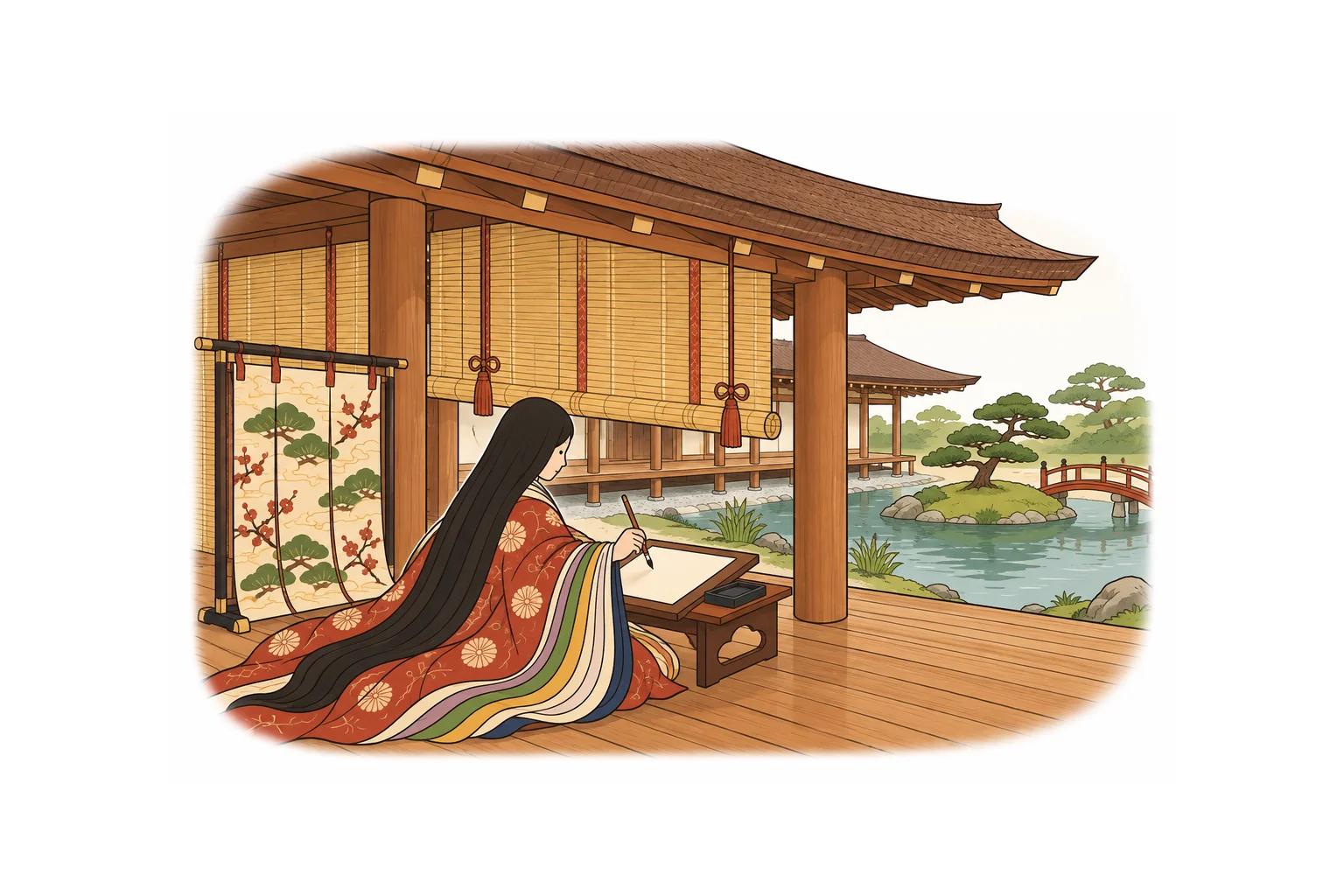
This period in brief
The Heian period takes its name from Heian-kyō, the "capital of peace and tranquility," the city we now call Kyoto. Emperor Kanmu moved his court there in 794, and the period is usually closed in 1185, when the Taira family was destroyed in a sea battle at Dan-no-ura and a warrior government in the east began to share power with the court. Some historians prefer 1192, the year Minamoto no Yoritomo received the title of shogun; 1185 is the more common choice today.
Read the introductionabout 3,900 words · 12 chaptersWith the resources of a regional family, Sadatō held off a governor who was also commander of the northern frontier for more than five years, beat him in open …
Aterui阿弖流為(阿弖利為)Aterui matters as the figure around whom Emishi resistance in Isawa formed.
Emperor Antoku安徳天皇Antoku left almost no trace of himself as a person; his importance is that his short life runs straight through the rise and destruction of the Taira.
Emperor Go-Sanjō後三条天皇Go-Sanjō reached the throne through a gap in the regents’ system.
Emperor Kanmu桓武天皇Kanmu came from a side branch of the royal house and had a mother of Baekje descent, and almost nobody expected him to rule.
Emperor Saga嵯峨天皇Saga defended his father’s capital and policies against his brother’s challenge in 810, and kept the government working as the older legal order loosened, thro…
Emperor Seiwa清和天皇Seiwa left little trace of personal action; his importance lies in two things.
Emperor Shirakawa白河天皇Shirakawa is remembered as the founder of insei, rule by a retired emperor.
Emperor Sutoku崇徳天皇Sutoku matters above all as the clearest loser of the insei system, in which a retired emperor could govern only as the father or grandfather of the reigning e…
Emperor Toba鳥羽天皇Emperor for sixteen years and governing retired emperor for twenty-eight, Toba consolidated the rule by retired emperors that Shirakawa had improvised.
Emperor Uda宇多天皇Uda was the only emperor in Japanese history who had been reduced to commoner status and then returned to the imperial family to take the throne, and his life …
Fujiwara no Kiyohira藤原清衡Kiyohira founded the Northern Fujiwara.
Fujiwara no Michinaga藤原道長Michinaga marks the high point of Fujiwara regency government.
Fujiwara no Mototsune藤原基経Mototsune took the position his adoptive father Yoshifusa had created and made it more explicit and more forceful.
Fujiwara no Shōshi藤原彰子(上東門院)Shōshi’s life covers almost exactly the high point of Fujiwara regency government.
Fujiwara no Tadamichi藤原忠通Tadamichi served as sesshō or kanpaku for thirty-seven years under Toba, Sutoku, Konoe and Go-Shirakawa, one of the longest tenures in the history of the regen…
Fujiwara no Tamako / Taikenmon’in藤原璋子(待賢門院)Taikenmon’in stood where the lines of insei politics crossed.
Fujiwara no Tanetsugu藤原種継Tanetsugu’s time at the center of history lasted only four or five years, and his place rests almost entirely on two things: building Nagaoka-kyō and being mur…
Fujiwara no Teishi藤原定子Teishi’s life shows how Fujiwara regency politics actually worked: an empress’s security rested on her family’s power, not on the emperor’s affection.
Fujiwara no Tokihira藤原時平Tokihira reached the summit of the Heian court very young, carried there by his father’s standing and the favor of successive emperors.
Fujiwara no Yorimichi藤原頼通Yorimichi held the offices of regent and kanpaku for some fifty years, longer than anyone else in Japanese history, and his line, through Morozane, became the …
Fujiwara no Yorinaga藤原頼長Yorinaga was the last great minister of the old court order to stake everything on learning and law.
Fujiwara no Yoshifusa藤原良房Yoshifusa is usually treated as the starting point of Fujiwara regency.
Kūkai空海Kūkai matters because, in little more than a year in Chang’an, he obtained the full esoteric transmission of the leading master Huiguo, and then, through liter…
Minamoto no Yoshiie源義家Yoshiie’s importance rests above all on his skill at arms.
Minamoto no Yoshitomo源義朝Yoshitomo matters because he pulled the Kawachi Genji back into the center of politics.
Minamoto no Yoshitsune源義経Yoshitsune matters first as the commander who decided the Genpei War.
Murasaki Shikibu紫式部Murasaki Shikibu wrote The Tale of Genji, a fifty-four-chapter tale in kana prose interwoven with waka, whose attention to the inner lives of its characters ha…
Prince Sawara早良親王Sawara’s political career was short; his importance lies mostly in what happened after his death.
Saichō最澄Saichō mattered as a builder of institutions.
Sakanoue no Tamuramaro坂上田村麻呂Tamuramaro matters as the most successful agent of Emperor Kanmu’s war in the north.
Sei Shōnagon清少納言Sei Shōnagon wrote The Pillow Book, some three hundred passages of lists, anecdotes and reflections on court life, the seasons and human likes and dislikes, us…
Sugawara no Michizane菅原道真Michizane was the leading Chinese-language poet and scholar of early Heian Japan.
Tachibana no Kachiko橘嘉智子(檀林皇后)Kachiko matters because she broke the rule about who could be empress.
Taira no Tokuko平徳子Tokuko’s importance came less from anything she decided than from what she was: the link between Kiyomori and the imperial line, and the mother through whom An…
Taira no Masakado平将門Masakado seized provincial headquarters and openly proclaimed himself emperor, going further than almost any provincial rebel.
Abe no Seimei安倍晴明Seimei mattered because he turned astronomy, calendrical calculation, divination and ritual into a service the Heian court could rely on.
Ono no Komachi小野小町Komachi matters because of her poems.
Ki no Tsurayuki紀貫之Tsurayuki was a mid-ranking official who made his place at court through words.
Emperor Ichijō一条天皇Ichijō reigned for twenty-five years inside the marriage politics of the northern Fujiwara: his accession, both his empresses and his final choice of heir were…
Shinzei信西(藤原通憲)Shinzei matters because, without lineage or troops, he ran the court after 1156 on the strength of learning, a command of law and precedent, and his personal b…
Minamoto no Yoshinaka源義仲(木曾義仲)Yoshinaka broke the main Taira army in the north and drove the Taira, with their emperor and regalia, out of the capital, a turning point in the Genpei war.