
This period in brief
The Heian Period
Four Centuries of a Court in Kyoto, 794–1185
1A long age named for a city
The Heian period takes its name from Heian-kyō, the "capital of peace and tranquility," the city we now call Kyoto. Emperor Kanmu moved his court there in 794, and the period is usually closed in 1185, when the Taira family was destroyed in a sea battle at Dan-no-ura and a warrior government in the east began to share power with the court. Some historians prefer 1192, the year Minamoto no Yoritomo received the title of shogun; 1185 is the more common choice today.
Nearly four hundred years is a long time, and the Japan of 1185 looked very different from the Japan of 794. At the start, the court was still trying to run the country through a Chinese-style system of law codes, census registers, and state-allotted rice land. By the end, most land was organized into private estates, provincial fighting men had become the decisive force in politics, and the court's finest achievements were written in Japanese rather than Chinese. The story of the period is how one became the other, and it happened slowly, without anyone ever abolishing the old order.
2Kanmu builds a capital and fights in the north
Kanmu came to the throne in 781. His mother, Takano no Niigasa, belonged to a family descended from immigrants from the Korean kingdom of Baekje, a modest background by the standards of a court obsessed with maternal pedigree. He wanted to leave Nara, where the great Buddhist temples had become deeply entangled in politics, and in 784 he moved the court to Nagaoka-kyō, a few miles southwest of modern Kyoto.
The move went badly. In 785 the official in charge of construction, Fujiwara no Tanetsugu, was shot dead with arrows at night. The investigation implicated the crown prince, Kanmu's own brother Prince Sawara, who was stripped of his title and died on the way to exile in Awaji, reportedly after refusing food. In the following years Kanmu's mother and consort died, his new heir fell ill, and floods damaged the city. Diviners blamed Sawara's angry spirit. After only ten years Nagaoka was abandoned, and in 794 the court moved again.
Heian-kyō was laid out on the grid plan of the Tang capital Chang'an: about 4.5 kilometers east to west and 5.2 north to south, with a broad central avenue, Suzaku Ōji, leading north to the palace compound. The Nara temples were not invited to follow. At first only two official temples, Tō-ji and Sai-ji, were permitted inside the city.
Kanmu's other great project was war in the northeast. The court called the people of northern Honshū who lived outside its control Emishi. In 789 an Emishi leader named Aterui routed a large government army in the Isawa region of what is now Iwate Prefecture. The court then turned to Sakanoue no Tamuramaro, who in 797 was given the title seii taishōgun, "great general for subduing the barbarians" — the same title later shoguns would bear. In 802 Tamuramaro built Isawa Castle, and Aterui surrendered. Tamuramaro brought him to the capital and argued that he should be spared; the court nobles refused, and Aterui was executed.
Building a city and fighting a war at once strained the country badly. In 805 Kanmu had two councilors debate the state of the realm in his presence, and the younger, Fujiwara no Otsugu, said plainly that the people were suffering from "the army and the building works." Kanmu halted both. He died the next year, leaving his capital unfinished.
3Saga's court and two monks back from China
In 810 the capital was nearly lost. The retired emperor Heizei, who had abdicated because of illness and gone to live in Nara, ordered the court to move back there, urged on by his favorite Fujiwara no Kusuko and her brother. His younger brother, the reigning Emperor Saga, sent troops to block the roads. Heizei took Buddhist vows and Kusuko killed herself. The capital question was never raised again.
To keep his orders secret during the crisis, Saga created a private secretariat, the Chamberlains' Office, and one of its first heads was Fujiwara no Fuyutsugu of the family's Northern House. It was the first of several new offices that had no place in the old law codes; another was the Imperial Police, which took over law and order in the city. Saga's court was strongly Chinese in taste. The emperor was a famous calligrapher, and official anthologies of Chinese verse by Japanese courtiers appeared one after another. His consort, Tachibana no Kachiko, was remembered as a devout patron of Buddhism.
Two monks who sailed with the embassy to Tang China in 804 set the direction of Japanese Buddhism for centuries. Saichō, already well regarded at court, studied Tiantai teachings and returned the next year to found the Tendai school on Mount Hiei, northeast of the capital. Kūkai, then obscure, went to Chang'an, studied esoteric Buddhism under the master Huiguo, and came home in 806 to found the Shingon school. In 816 he received permission to establish a monastery on remote Mount Kōya, and in 823 Saga entrusted him with Tō-ji in the capital. Saichō spent his last years petitioning for the right to ordain monks on Mount Hiei, independent of the Nara temples; approval came seven days after his death in 822. Kūkai died on Mount Kōya in 835, and a belief later grew up there that he had not died but entered eternal meditation.
Both schools built in the mountains and both offered elaborate rituals for the protection of the state and the health of its patrons, which made them welcome at court. Enryaku-ji on Mount Hiei became the country's leading center of Buddhist learning, and also, in time, a military power in its own right.
4The Fujiwara regents
From the mid-ninth century the Northern House of the Fujiwara rose above all rivals by two methods: marrying daughters to emperors so that the next emperor would be a Fujiwara grandson, and using political incidents to remove competitors.
In 842, two days after the retired emperor Saga died, several officials were arrested for plotting, the crown prince was deposed, and a nephew of Fujiwara no Yoshifusa took his place. This was the Jōwa Incident. In 858 Yoshifusa's grandson became Emperor Seiwa at the age of nine by traditional count, the youngest emperor yet, and Yoshifusa governed for him. In 866, after a fire at a palace gate led to the downfall of the old Tomo family, Seiwa formally commissioned Yoshifusa to conduct the government — the first regent (sesshō) who was not a member of the imperial family.
Yoshifusa's adopted son Mototsune went further. He removed one emperor and installed another, and he continued to manage affairs for adult rulers, the role that came to be called kanpaku, usually translated chancellor or regent for an adult emperor. When Emperor Uda took the throne in 887, the edict confirming Mototsune used an elegant Chinese title, akō. A scholar advised that the title carried no actual duties, and Mototsune stopped work. After months of deadlock the emperor had to back down. The Akō Dispute showed which of the two could less afford to do without the other.
After Mototsune died, Uda promoted a scholar, Sugawara no Michizane, as a counterweight. In 894 Michizane was named ambassador to Tang China and promptly asked the court to reconsider, citing disorder in China and the dangers of the voyage. The mission never sailed, and no more were sent, though merchants and monks kept crossing. In 901 Michizane, by then Minister of the Right, was accused by the faction of Fujiwara no Tokihira of plotting to change the succession and was sent to a nominal post at Dazaifu in Kyūshū, where he died in 903. Tokihira died young in 909; an imperial prince died; in 930 lightning struck the palace and killed several nobles. The court concluded that Michizane's spirit was responsible, restored his rank, and eventually enshrined him at Kitano in Kyoto. He is still worshipped as Tenjin, the patron of scholarship.
By 969, when the last serious non-Fujiwara rival was exiled, the regency had become a permanent fixture. The contests that mattered were now between Fujiwara brothers, uncles, and nephews.
5Governors, estates, and the first warriors
While the capital fought over offices, the foundations of the state were shifting in the provinces. The old system depended on counting people and allotting them land. By the tenth century registers were full of fictions — households listing almost nothing but women, who paid less tax — and the last recorded land allotment dates to 902.
The court adapted. It stopped trying to tax individuals and taxed land instead, and it stopped supervising provincial administration closely, asking only that the governor who actually went to his province, called the zuryō, deliver a fixed quota. Whatever he collected beyond that was his. Governorships became a route to wealth for middle-ranking nobles, and abuses were common. In 988 the district officials and farmers of Owari Province sent the court a petition listing thirty-one charges against their governor, Fujiwara no Motonaga; he was replaced the next year, and the document survives.
Local landholders looked for protection from such men. Many commended their fields, on paper, to a great noble house or temple in the capital, which could obtain exemption from taxes and from entry by provincial officials; the original holder stayed on as manager. Land held this way was a shōen, a private estate. Estates multiplied from the eleventh century, each one supporting a ladder of people, from Kyoto aristocrats down to the local manager, who took shares of the same harvest.
The same conditions produced the warrior. The conscript army had long since been given up, and provincial disputes over land and water were settled by men skilled with horse and bow. Their leaders were often descendants of emperors or nobles who had taken provincial posts and stayed. The two most famous lines were the Taira, descended from Kanmu, and the Minamoto, descended from Seiwa.
In 939 Taira no Masakado, after years of fighting his own relatives in the Kantō plain, seized the provincial headquarters of Hitachi and then of neighboring provinces, and called himself the "New Emperor." At almost the same time a former official, Fujiwara no Sumitomo, was leading pirate fleets in the Inland Sea. The court was badly frightened, but Masakado was killed in 940 by other Kantō warriors, his cousin Taira no Sadamori and Fujiwara no Hidesato, not by an army from the capital. The lesson was that warriors could only be handled by warriors. The descendants of the victors became hereditary military houses and took service with the nobility as guards. The word samurai comes from a verb meaning "to serve."
6Michinaga
The regency reached its height under Fujiwara no Michinaga. As a fifth son he had little prospect of leading the family, but in 995 an epidemic swept the capital. His eldest brother, the regent Michitaka, died that spring (of a long-standing illness, by most accounts), and the next brother died within days of succeeding him. Michinaga's sister, the mother of Emperor Ichijō, pressed his claim over that of Michitaka's son Korechika, and Michinaga was given the right to review documents before the emperor. Korechika was banished the following year after his men shot arrows at a retired emperor.
Ichijō already had an empress: Teishi, Michitaka's daughter. In 999 Michinaga sent his own daughter Shōshi, twelve by traditional count, into the palace, and in 1000 had her named empress as well, an arrangement without precedent. Teishi died in childbirth at the end of that year. In 1008 Shōshi bore a prince, and later another; both became emperors. In 1016 the elder took the throne as Go-Ichijō, and Michinaga became regent for his grandson. He handed the post to his son Yorimichi the next year and went on ruling from behind. In 1018 a third daughter was made empress, and at the banquet Michinaga composed a poem saying that this world seemed his own, like a full moon with nothing missing. We know it because another noble at the party, Fujiwara no Sanesuke, copied it into his diary.
The regents did not replace the government. Senior nobles still deliberated in council and the emperor still issued the decisions. What the regent controlled was appointments, above all the lucrative governorships, and the gifts of grateful governors made his household rich. Michinaga took Buddhist vows in 1019 and died in 1027 in the temple he had built, facing statues of the Buddha Amida.
7Kana, Genji, and the Pure Land
Michinaga's age was also the high point of Heian court culture. After a century of close imitation of Tang models, the tenth and eleventh centuries produced forms that suited Japanese tastes and the Japanese language.
The base was kana, phonetic scripts simplified from Chinese characters, which for the first time let people write Japanese as it was spoken. In 905 Ki no Tsurayuki and three colleagues compiled the Kokin Wakashū at imperial command, the first official anthology of Japanese verse; its poets include the celebrated Ono no Komachi. Chinese remained the language of men's official business, so kana prose was at first largely a women's medium, and women wrote most of the period's best literature.
Court politics helped. A family that wanted its daughter to hold an emperor's attention surrounded her with accomplished ladies-in-waiting. Sei Shōnagon, who served Teishi, wrote The Pillow Book, a collection of quick, opinionated observations on seasons, manners, and people. Murasaki Shikibu, who served Shōshi, wrote The Tale of Genji, fifty-four chapters following the "shining prince" Genji and his descendants through love affairs and disappointments. Her own diary shows that it was being read at court by 1008. Neither woman's personal name is known.
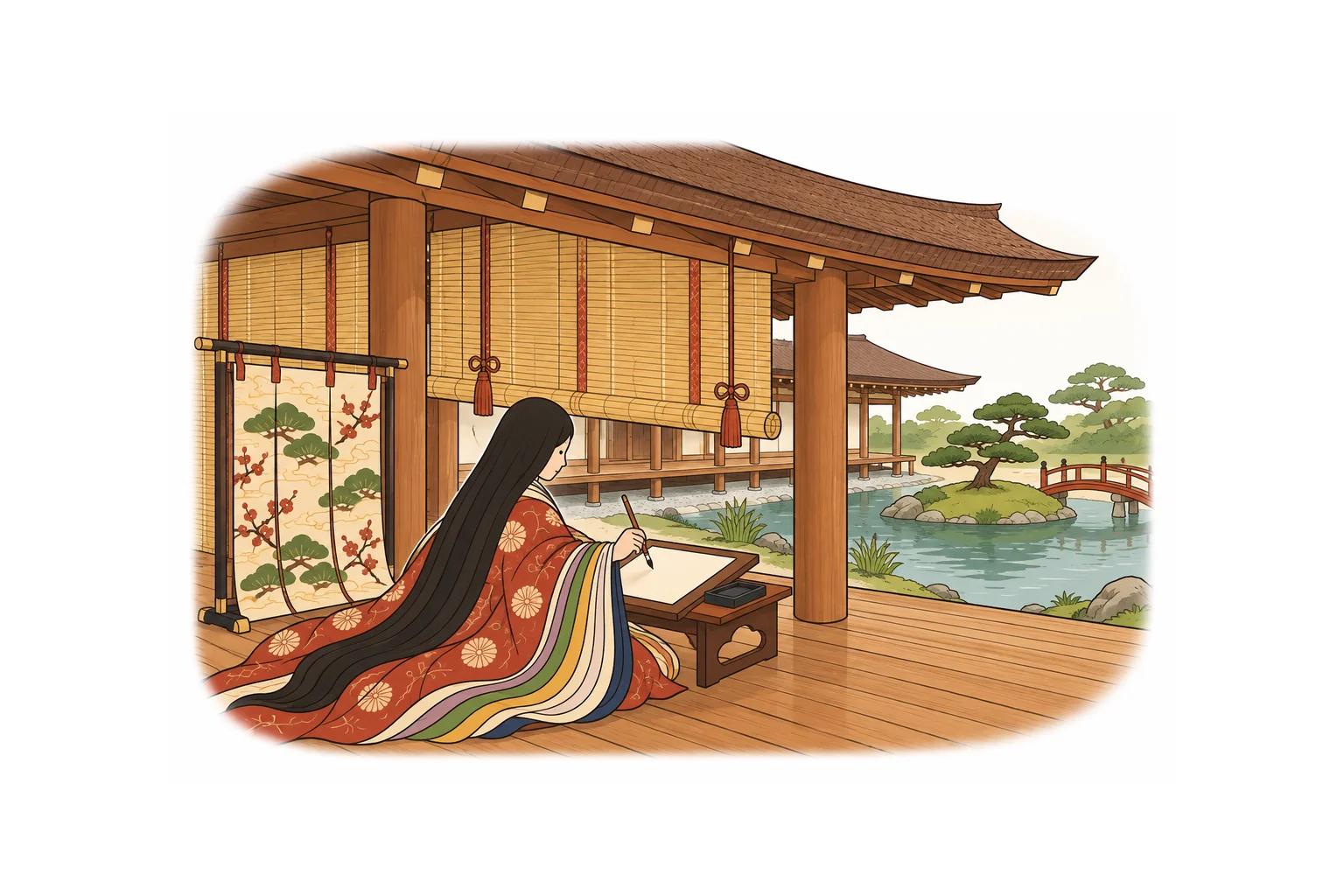
Nobles lived in airy mansions built around a south-facing hall and a garden with a pond, the interiors divided by screens and curtains rather than walls. Screens were painted with Japanese landscapes in the style called yamato-e. Daily life was hemmed in by taboos: unlucky directions had to be avoided, and specialists in divination and the calendar were in demand. Abe no Seimei was one of these, though the stories of his magic are later inventions.
Outside the mansions was another city. The low, damp western half of Heian-kyō was already emptying out by the late tenth century. Commoners lived in plank houses and faced fire, robbery, and recurrent epidemics; bodies were left on the banks of the Kamo River. The twelfth-century collection Konjaku Monogatarishū preserves more than a thousand tales full of governors, warriors, thieves, and townspeople who never appear in Genji.
In such a world, hope for the next life grew stronger. The monk Kūya preached in the markets, chanting the name of Amida, and in 985 Genshin of Mount Hiei wrote Ōjōyōshū, with vivid descriptions of the hells and of Amida's Pure Land. Many believed that the world would enter the "latter days of the Buddhist law," an age of decline, in 1052. That year Yorimichi turned his villa at Uji into the temple Byōdō-in; its Amida hall, the Phoenix Hall, completed in 1053 with a statue by the sculptor Jōchō, was meant to show paradise on earth.
8Wars in the north and an emperor without a Fujiwara mother
In the far north of Honshū the Abe family had stopped sending taxes. From 1051 the court's commander, Minamoto no Yoriyoshi, fought them on and off for over a decade, suffered at least one disastrous defeat, and won in 1062 only with help from the Kiyohara family of neighboring Dewa; the Abe leader Sadatō was killed. This is the Former Nine Years' War. Two decades later the Kiyohara fell out among themselves, and Yoriyoshi's son Yoshiie intervened in the Later Three Years' War (1083–1087). The court called it a private quarrel and gave no rewards, so Yoshiie rewarded his men from his own property, which only raised his standing among eastern warriors. The survivor who benefited, Fujiwara no Kiyohira, settled at Hiraizumi and founded a northern dynasty rich in gold and horses. The gilded Golden Hall of his temple Chūson-ji still stands.
In Kyoto, Yorimichi's daughters produced no imperial heir. Emperor Go-Sanjō, who succeeded in 1068, was the first ruler in about 170 years whose mother was not a Fujiwara. He was in his thirties and owed the regents nothing. In 1069 he set up an office to examine the documents of every estate, including those of the regent's house, and confiscated those without proper title. He reigned less than five years, but the regents never recovered their former grip.
9Rule by retired emperors
Go-Sanjō's son Shirakawa abdicated in 1086 in favor of his eight-year-old son (by traditional count), mainly to secure the succession for his own line. He then outlived that son and went on directing affairs through a grandson and great-grandson until his death in 1129. This arrangement is called insei, "cloister government," after the retired emperor's residence.
Its logic was simple. A regent's authority came from being the emperor's maternal grandfather or uncle; a retired emperor was the head of the emperor's own paternal family. Free of court precedent, he surrounded himself with middle-ranking nobles, many of them wealthy former governors, and kept a guard of warriors at his residence, which brought Taira and Minamoto men into the center of politics. Estates now flowed to the retired emperor and his circle.
Shirakawa and his successors Toba and Go-Shirakawa were lavish Buddhist patrons and made repeated pilgrimages to the Kumano shrines. But the great temples had become unruly powers with armed monks, who marched into the capital carrying sacred objects to force their demands. The Tale of the Heike has Shirakawa complain that only three things defied his will: the waters of the Kamo River, the fall of the dice, and the monks of Mount Hiei. Whether he said it or not, the court needed warriors to face them.
Under Toba, resentments accumulated. Emperor Sutoku, son of Toba's consort Fujiwara no Tamako, was made to abdicate for a half brother, and when that emperor died young the throne went to Sutoku's brother Go-Shirakawa rather than to Sutoku's son. The regent's house was split as well, between Fujiwara no Tadamichi and his younger brother Yorinaga.
10Hōgen, Heiji, and the house of Taira
Toba died in the summer of 1156, and within days the two sides were gathering troops. Sutoku and Yorinaga had Minamoto no Tameyoshi; Go-Shirakawa and Tadamichi had Tameyoshi's son Yoshitomo and Taira no Kiyomori. Go-Shirakawa's side attacked before dawn, set fire to the enemy's palace, and won in a few hours. Yorinaga died of an arrow wound, Sutoku was exiled to Sanuki on Shikoku, and Tameyoshi was executed, on orders carried out by his own son. This was the Hōgen War. The monk Jien, writing some sixty years later, dated "the age of warriors" from this year.
The victors soon quarreled. In the last weeks of the lunar year 1159 — January 1160 by the Western calendar — Yoshitomo and a courtier ally seized the palace while Kiyomori was away on pilgrimage, and Go-Shirakawa's chief adviser, the learned monk Shinzei, was driven to suicide. Kiyomori hurried back, extracted the emperor and retired emperor from the rebels' hands, and crushed them. Yoshitomo was murdered in flight. His thirteen-year-old son Yoritomo (by traditional count) was spared and exiled to Izu, and an infant son, the future Yoshitsune, was later placed in a temple. This was the Heiji War.
The Taira were now the only military house that counted. In 1167 Kiyomori became chancellor of the realm, the highest office at court and one no warrior had held. His relatives filled the senior ranks and collected provinces and estates. He promoted trade with Song China, improving the harbor at Ōwada, near modern Kōbe, so that Chinese ships could sail up the Inland Sea, and imported Chinese copper coins began to circulate widely in Japan. He also rebuilt the shrine at Itsukushima on the plan it still keeps, with its halls standing over the water.
In other respects he followed the Fujiwara pattern. His daughter Tokuko entered the household of Emperor Takakura in 1171 and bore a son in 1178. But Taira dominance squeezed Go-Shirakawa and his circle. In 1177 a group of the retired emperor's intimates was caught plotting at a villa at Shishigatani in the eastern hills and punished. In 1179, after Go-Shirakawa confiscated Taira lands, Kiyomori marched troops into the capital, dismissed dozens of officials, and confined him. In 1180 Tokuko's son, three years old by traditional count, was enthroned as Emperor Antoku.
11The Genpei War
The coup turned resentment into revolt. In the spring of 1180 Prince Mochihito, a son of Go-Shirakawa, issued a call to arms against the Taira. He was killed within weeks, but copies of his call reached the scattered Minamoto. That summer Kiyomori abruptly moved the court to his base at Fukuhara on the Inland Sea, then moved it back in the winter amid general complaint.
In the eighth month Yoritomo rose in Izu. He was beaten at Ishibashiyama and escaped by boat, but warriors across the Kantō rallied to him, and by autumn he had made Kamakura his headquarters. A Taira army sent east withdrew from the Fuji River without fighting — startled at night, according to The Tale of the Heike, by a flock of waterfowl taking wing. Yoritomo did not pursue. He stayed in Kamakura, confirming his followers' landholdings and judging their disputes, which was exactly the security that eastern warriors wanted from a lord. At the end of the year a Taira force burned the great Nara temples Tōdai-ji and Kōfuku-ji, which had sided with the rebels.
Kiyomori died of a fever early in 1181. Drought and famine in western Japan then slowed the fighting; Kamo no Chōmei's Hōjōki records over 42,300 dead counted in part of the capital in two months. In 1183 Yoritomo's cousin Minamoto no Yoshinaka destroyed a Taira army at Kurikara Pass in the Hokuriku region, and the Taira fled Kyoto with the child emperor and the imperial regalia. Yoshinaka's troops behaved badly in the capital and he fell out with Go-Shirakawa, who turned to Yoritomo and recognized his authority in the east. Early in 1184 Yoritomo's brothers Noriyori and Yoshitsune took the city, and Yoshinaka was killed.
Yoshitsune then drove the war to its end. At Ichi-no-Tani, on the coast near Fukuhara, he is said to have led horsemen down a cliff behind the Taira camp. In early 1185 he crossed to Shikoku in a storm and surprised the Taira base at Yashima. The last battle was fought by boat on the 24th day of the third month, April 25, 1185, in the strait at Dan-no-ura between Honshū and Kyūshū. The tide is said to have turned against the Taira, and some of their allies changed sides. Kiyomori's widow took Antoku, eight years old by traditional count, in her arms and leapt into the sea. Of the three regalia, the mirror and jewel were recovered; the sword was lost. Tokuko was dragged from the water alive, became a nun, and lived out her life at Jakkō-in in the hills north of Kyoto.
12What ended and what did not
Within months Yoritomo and Yoshitsune were enemies, and at the end of 1185 Yoritomo used the hunt for his brother to obtain the court's permission to place his own officers, constables in the provinces and stewards on estates, across the country. The court did not vanish. Kyoto remained the capital, emperors and nobles kept their ranks, and the estate system went on. But the government of the realm was now divided between the old court and a warrior regime at Kamakura, and with that division the Kamakura period begins.