
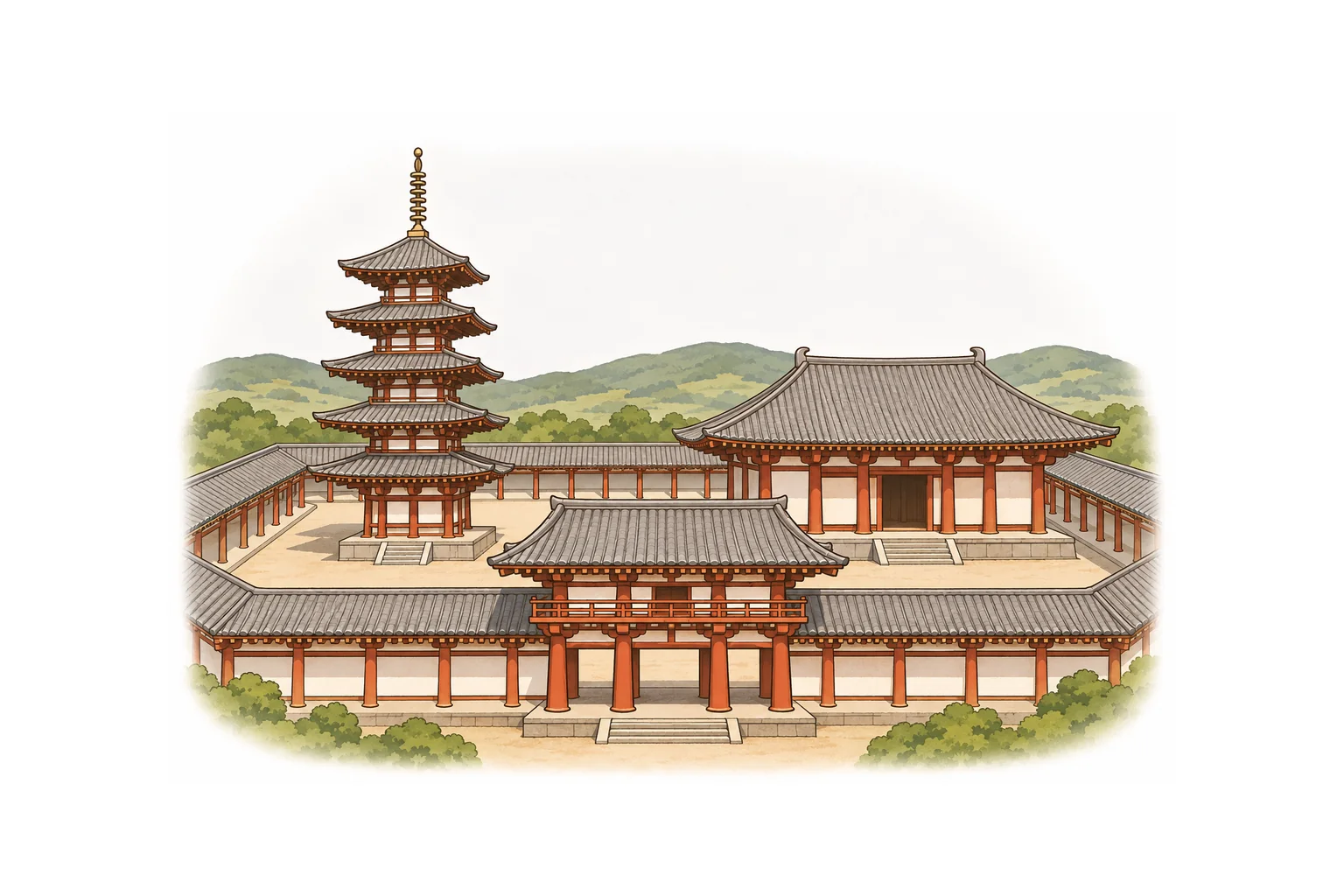
This period in brief
Asuka is a pocket of flat land in the southeastern corner of the Nara Basin, hemmed in by low hills and crossed by a modest river. You can walk across it in an hour or two. Between the end of the sixth century and the end of the seventh, most of the rulers of the Yamato court built their palaces here, each new reign putting up a new timber hall a short distance from the last. Historians borrow the name of the valley for the whole stretch of time.
Read the introductionabout 4,000 words · 10 chaptersAbe no Hirafu carried out the Saimei court’s effort to extend its influence into the north.
Buyeo Pung扶余豊(豊璋)Buyeo Pung matters because of where he stood.
Emperor Kinmei欽明天皇Kinmei reigned for about three decades, longer than any other sixth-century ruler, and his reign saw the Ōtomo fade and the court come to turn on the rivalry b…
Emperor Kōtoku孝徳天皇Kōtoku’s decade is the core of what historians call the Taika Reform.
Emperor Monmu文武天皇Monmu reigned for about ten years, the years in which the institutions of Japan’s code-based state took settled form.
Emperor Sushun崇峻天皇Sushun matters mostly for how he died.
Emperor Tenji天智天皇For nearly thirty years Naka no Ōe stood at the center of every major event at the Yamato court.
Empress Kōgyoku / Saimei皇極天皇/斉明天皇She took the throne twice when no one else could take it smoothly, and her reigns span the Soga at their height, the coup of 645, the Taika reforms, and the wa…
Hyeja (Eji)慧慈Hyeja matters because of where he stood.
King Seong of Baekje百済聖王(聖明王)Seong matters because of where he stood between China and Japan.
Mononobe no Moriya物部守屋Moriya was ōmuraji under Bidatsu and Yōmei, and probably already at the end of Kinmei’s reign, a man who controlled troops and held authority in ritual.
Nakatomi no Kamatari中臣鎌足(藤原鎌足)Kamatari matters first because of the coup of 645.
Prince Kusakabe草壁皇子Kusakabe matters less for anything he did than for where he stood.
Prince Ōtomo大友皇子Ōtomo matters because he stood at a turning point in seventh-century succession.
Prince Ōtsu大津皇子Ōtsu matters as the most conspicuous casualty of the succession after Tenmu’s death.
Prince Takechi高市皇子Takechi’s life had two high points.
Princess Ōku大来皇女(大伯皇女)Princess Ōku matters in two ways.
Princess Tōchi十市皇女Tōchi matters because of where she stood.
Soga no Iname蘇我稲目Iname is the first great minister whose existence is reasonably secure, and for more than thirty years under Senka and Kinmei he ran the practical business of …
Soga no Iruka蘇我入鹿Iruka matters because he stood at a turning point.
Soga no Umako蘇我馬子For more than fifty years, under four rulers, Umako stood at the center of power at the Yamato court.
Tori Busshi鞍作鳥(止利仏師)Tori is the first maker of Buddhist images in Japan whose name has survived.
Emperor Tenmu天武天皇Tenmu’s life divides at the war of 672: before it he was his brother’s deputy, after it a ruler who had taken the throne by force.
Ono no Imoko小野妹子Ono no Imoko is the first envoy to Sui whose name is recorded.
Soga no Emishi蘇我蝦夷Emishi kept the Soga hold on the office of Great Minister for nearly twenty years and shaped two contested successions.
Kakinomoto no Hitomaro柿本人麻呂Hitomaro is the central poet of the Man’yōshū.