
This period in brief
The Asuka Period
How a League of Clans Became a State Called Japan
1A Small Valley and a Long Century
Asuka is a pocket of flat land in the southeastern corner of the Nara Basin, hemmed in by low hills and crossed by a modest river. You can walk across it in an hour or two. Between the end of the sixth century and the end of the seventh, most of the rulers of the Yamato court built their palaces here, each new reign putting up a new timber hall a short distance from the last. Historians borrow the name of the valley for the whole stretch of time.
By the usual convention the Asuka period opens in 592, when a woman later known as Empress Suiko took the throne, and closes in 710, when the court moved to a new capital at Heijō-kyō, the city now called Nara. Some writers start the clock a little earlier, with the arrival of Buddhism in the mid-sixth century. For the final sixteen years the court actually sat in Fujiwara-kyō, a planned city just north of the valley, but that city is counted as part of the same story.
The story is one of the largest transformations in Japanese history. At the beginning, the country that Chinese records called Wa was held together by a paramount king and a handful of powerful clans, each with its own lands and its own dependent workers. At the end there was a written law code, a nationwide census, a grid-plan capital, a monarch styled tennō (the word usually translated "emperor"), and a new name for the country: Nihon, Japan. None of this unfolded according to a plan. It took an assassination in the palace, a military disaster overseas, and a civil war. One note on names: the title tennō and the familiar reign names such as Suiko and Tenji were applied later, and are used here only for convenience.
2A Foreign God and the Rise of the Soga
The opening act begins with a gift. In the mid-sixth century the Korean kingdom of Baekje, hard pressed by its neighbors Silla and Goguryeo, wanted Wa as an ally. King Seong of Baekje sent the Yamato ruler Kinmei a gilt-bronze image of the Buddha and some scriptures. The official chronicle, the Nihon shoki (completed in 720), dates this to 552; another group of early texts says 538, and that earlier date is now generally preferred.
The court split over what to do with the statue. Soga no Iname, the minister who managed the court's finances and worked closely with immigrant specialists from the peninsula, argued that every country to the west worshipped the Buddha and Wa should not stand apart. The Mononobe, a clan of military men, and the Nakatomi, hereditary ritualists, replied that the king's duty was to the native gods, who would be offended. Kinmei let Iname try the new worship privately. When an epidemic followed, the Mononobe blamed the statue and had it thrown into a canal. The chronicle presents the quarrel as a matter of religion, but behind it lay a contest over who would run the court and whose grandsons would be king.
It was settled by force in 587. Iname's son, Soga no Umako, gathered an army of princes and allies and destroyed Mononobe no Moriya at his residence. A temple tradition has Prince Umayado, then fourteen by the traditional count,, the future Prince Shōtoku, carving images of the Four Heavenly Kings and vowing a temple in return for victory, which is given as the origin of Shitennō-ji in Ōsaka; it is a legend, though the temple is certainly early.
Umako then placed his nephew on the throne as King Sushun and began building Asuka-dera, the first full-scale Buddhist monastery in the islands, with carpenters, tile makers, and painters sent from Baekje. Sushun resented being managed. According to the Nihon shoki, when a wild boar was presented to him he remarked that he wished he could cut off the head of a man he hated as easily as that boar's. Umako heard of it, and in late 592, on the pretext of a tribute ceremony, had the king killed by a retainer. No one was punished for ordering it. Sushun is usually cited as the only ruler the official histories plainly say was assassinated on a subject's orders.
3Suiko, Prince Shōtoku, and a Letter to China
Umako's next choice was his niece, the widow of an earlier king. Suiko reigned for thirty-six years and is the first female sovereign whose existence is not in doubt. Beside her stood her nephew Prince Umayado, whose parents were both of Soga descent, and Umako himself. For three decades the three of them governed together.
Later generations made the prince into a saint, and "Shōtoku," meaning roughly "sagely virtue," is a posthumous title. Stories that he could listen to ten petitioners at once belong to that later devotion. Modern scholars have questioned how much of the reign's achievement was really his. What can be said is that a wealthy, devout prince of that name did live at Ikaruga, some twenty kilometers from Asuka, where he founded the temple of Hōryū-ji, and that the court of his day made a serious attempt to reorganize itself.
Two measures stand out. In 603 the court introduced a system of twelve cap ranks, marked by caps of different colors and named for Confucian virtues. Until then a man's standing was fixed by his clan and inherited. The caps went to individuals and could be raised for merit. The system had limits: the Soga minister himself received no cap, because he stood above it. In 604 came the so-called Seventeen-Article Constitution, which is not a constitution in the modern sense but a set of admonitions to officials. It opens by saying that harmony is to be valued, tells officials to revere Buddhism, to obey royal commands, to come to work early and leave late, and not to conscript farmers during the growing season. Whether the prince wrote it, or whether the text as we have it was polished or even composed by the chroniclers a century later, has been debated since the early twentieth century. The more common view today accepts that some such document existed in Suiko's time.
The pressure behind these reforms came from abroad. In 589 the Sui dynasty reunified China after nearly three centuries of division, and every state in East Asia had to reckon with it. The Chinese Book of Sui records an embassy from Wa in 600, which the Japanese chronicle leaves out. When Emperor Wen asked about their customs, the envoys explained that their king regarded Heaven as his elder brother and the sun as his younger, held court before dawn, and stopped when the sun rose. The emperor found this senseless and told them to change it.
In 607 the court tried again, sending Ono no Imoko, a man of modest birth. The letter he carried, as quoted in the Book of Sui, began: "The Son of Heaven in the land where the sun rises sends this letter to the Son of Heaven in the land where the sun sets. We hope you are well." Emperor Yang was displeased and told his officials not to show him such discourteous letters from barbarians again. The offense was probably less the sunrise and sunset than the claim that there could be two Sons of Heaven. But Yang was preparing a war against Goguryeo and did not want Wa on the other side, so he sent an envoy, Pei Shiqing, back with Imoko. When Pei returned home, Imoko went with him again, taking a group of students and monks. Some of them stayed in China for twenty or thirty years and watched the Sui collapse and the Tang rise. They came home as the best-informed men in the country.
4Temples in the Valley
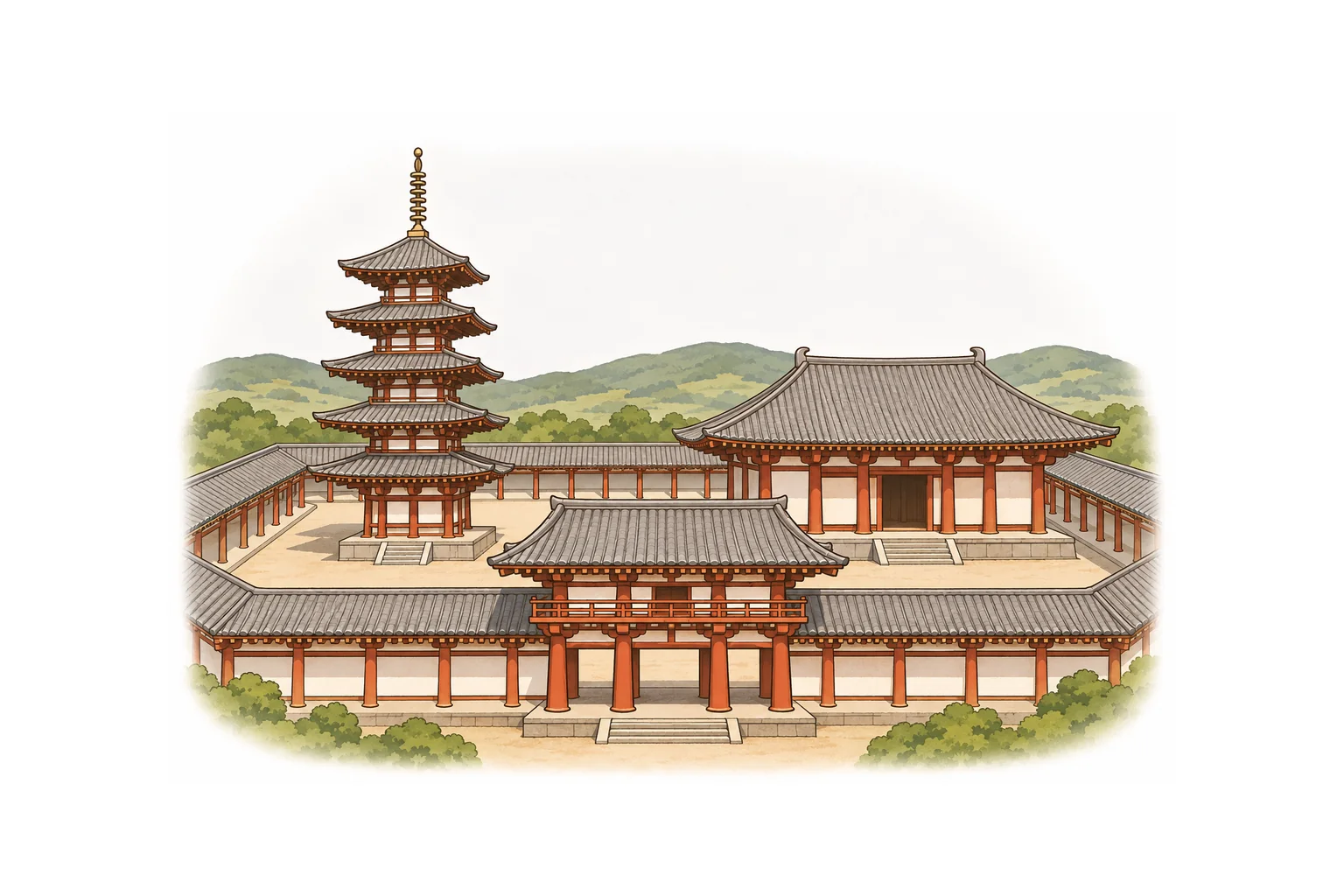
In Suiko's time Asuka was a building site. Asuka-dera was finished around 596, a pagoda surrounded by three image halls. Monks from Goguryeo and Baekje lived there, among them Hyeja, known in Japanese as Eji, who was the prince's teacher. Around 606 a seated bronze Buddha nearly three meters tall was installed. Much repaired after fires, it still sits on the same spot.
Its maker was Kuratsukuri no Tori, usually called Tori Busshi, "Tori the Buddha-maker," whose immigrant family had been saddlers. His other famous work is the Shaka Triad in the main hall of Hōryū-ji, which an inscription dates to 623 and dedicates to the prince, who had died the year before. The long faces, almond eyes, faint smiles, and flat symmetrical drapery follow a style that came from northern China by way of the Korean peninsula. Hōryū-ji itself, the chronicle says, burned to the ground in 670. The present western precinct is generally thought to have been rebuilt between then and the early eighth century, which still makes its buildings the oldest wooden structures standing anywhere.
Temples concentrated the newest skills: firing roof tiles, casting bronze, setting pillars on stone bases. Royal palaces, by contrast, were still built in the old way, with posts sunk in the ground and roofs of thatch or board. Great clans stopped building the huge keyhole-shaped tomb mounds of earlier centuries and built temples to advertise their standing instead. The exposed stone chamber of the Ishibutai tomb in Asuka, its earthen mound long gone, is traditionally said to be Umako's grave.
Most people saw little of this. They lived in pit dwellings, grew rice, wove cloth, and owed produce and labor to whichever clan or royal household they were attached to. They traded rice and cloth at markets on the edge of the valley. Coins were not yet in use.
5The Coup of 645 and the Taika Reforms
The prince died in 622, Umako in 626, Suiko in 628. Umako's son Soga no Emishi set aside the prince's son, Prince Yamashiro, and chose a different candidate. Under that king the first embassy to Tang China sailed in 630. In the next reign, that of Empress Kōgyoku, Emishi's son Soga no Iruka went further. In 643 he sent troops against Prince Yamashiro, who killed himself with his entire family. The Nihon shoki adds that the Soga built mansions on a hill overlooking the palace and called their children princes. The account was written by the winners and may exaggerate, but there is little doubt that the Soga main line frightened the royal family and the other clans alike.
Among the frightened were the empress's son, Prince Naka no Ōe, and Nakatomi no Kamatari. The chronicle tells a well-known story of how they met: during a game of kickball under a zelkova tree beside Asuka-dera, the prince's shoe flew off, and Kamatari picked it up and returned it on his knees. The anecdote has a literary look. What matters is that the two won over a Soga cousin who disliked Iruka.
On the twelfth day of the sixth month of 645, during a court ceremony at the Itabuki Palace, that cousin read out a memorial while the assassins waited for their cue. In the chronicle's telling they lost their nerve; the reader began to tremble and sweat; Iruka asked him why; he said it was awe at being so near the throne. Then Naka no Ōe, not yet twenty, rushed forward himself and cut Iruka down. The next day Emishi set fire to his mansion and died in it. The event is called the Isshi Incident, after the name of the year in the sixty-year calendar cycle.
Kōgyoku abdicated, the first recorded abdication, in favor of her brother Kōtoku. Naka no Ōe became crown prince, Kamatari a close minister, and two of the students who had returned from China were made state scholars. The court adopted its first era name, Taika, "Great Change," and moved to Naniwa, on the coast at modern Ōsaka.
On New Year's Day of 646, the chronicle says, a four-part reform edict was issued: private lands and dependent workers held by clans and princes were to be abolished and made public; the country was to be divided into provinces and districts; households were to be registered and rice land allotted by head; and a uniform tax system was to be set up. This program is known as the Taika Reforms.
Whether the edict is authentic is among the oldest disputes in the study of early Japan. The text uses a character for "district" that, as excavated wooden tablets now show, did not come into use until 701; before that date a different character was written without exception. So the wording was at least updated by eighth-century editors. Yet the reforms were not invented. Excavation at Naniwa has uncovered a palace of unprecedented scale that is generally assigned to this reign, and the older district units do appear around the country from about this time, with local chieftains appointed to run them. A balanced reading is that Kōtoku's court began to pull land and people away from the clans, and that the registers and land allotments described in the edict took another fifty years to become real.
The new regime soon quarreled with itself. The Soga cousin was accused of treason and killed himself in 649. A few years later Naka no Ōe led most of the court back to Asuka, leaving Kōtoku to die at Naniwa in 654. Kōgyoku returned to the throne under a second name, Saimei. She is remembered for vast earthworks and canals in Asuka, mocked at the time as "the mad canal," and for dispatching the commander Abe no Hirafu with a fleet up the Sea of Japan coast, where he made contact with the Emishi peoples of the far north.
6Defeat at Baekgang
In 660 the Tang empire and Silla together overran Baekje. Loyalists kept fighting and appealed to Yamato for troops and for the return of Buyeo Pung, a Baekje prince who had long lived at the Japanese court. Ties with Baekje went back more than two centuries, and Buddhism, writing, and much else had come through it. The court agreed.
Saimei, in her late sixties, traveled west to Kyūshū in person in 661 and died there. Naka no Ōe carried on without formally taking the throne. Prince Pung was escorted home and several waves of troops followed. In the eighth month of 663 the Yamato fleet met Tang and Silla forces at the mouth of the Geum River, the Baekgang of Korean history, called Hakusukinoe in Japan. The Japanese had many ships but no unified command; each contingent belonged to a different clan. The Nihon shoki admits that the commanders simply assumed the enemy would give way if they charged. The Tang ships closed in from both sides. A Chinese account speaks of four hundred vessels burned, the sky filled with smoke and the sea red. Prince Pung fled to Goguryeo. The survivors sailed home, carrying with them a large number of Baekje nobles, officials, and craftsmen.
For several years the court expected an invasion. Signal fires and frontier guards were posted on the islands of Tsushima and Iki and along the Kyūshū coast. A great earth rampart more than a kilometer long, the Mizuki or "water fortress," was thrown up in front of the regional headquarters at Dazaifu, and Baekje exiles directed the building of hilltop forts in the peninsular style from Kyūshū along the Inland Sea to Yamato. In 667 Naka no Ōe moved the capital inland to Ōtsu on Lake Biwa, in Ōmi Province, an unpopular step often explained by defense. He was enthroned there the next year as Emperor Tenji.
The invasion never came. After Goguryeo fell in 668, Silla and Tang turned on each other, and both sent envoys to keep Japan quiet. But the lesson of the defeat remained. An army of clan levies could not fight a modern empire; the court needed direct control of every household. In 670 Tenji ordered the first countrywide household register.
7The Jinshin War
Kamatari died in 669. On his deathbed Tenji granted him a new family name, Fujiwara, which his descendants would make the most powerful in the land. Tenji's own succession was less tidy. His younger brother, Prince Ōama, had long been the expected heir, but Tenji wanted his son Prince Ōtomo, and in 671 raised him to the highest office in the government. When Tenji fell ill that winter he summoned Ōama and offered him the realm. Ōama, warned to be careful, declined, shaved his head as a monk the same day, and withdrew with his wife and a few followers into the mountains of Yoshino. A courtier is said to have remarked that this was like giving a tiger wings and letting it go.
Tenji died at the end of 671. In the sixth month of 672, hearing that the Ōmi court was gathering men, Ōama moved first. He left Yoshino with some twenty men and a dozen women and marched east through the night, over the hills into Ise. His aim was the eastern provinces, where he held estates and where local magnates could raise troops. His agents sealed the pass at Fuwa, cutting the Ōmi court off from the east. His son Prince Takechi, still in his teens, escaped from Ōtsu, joined him, and was given command at the front. The court's own appeals for troops in the west met refusals. In the seventh month Ōama's armies advanced on two fronts, broke the Ōmi forces at the Seta Bridge, and Prince Ōtomo took his own life the next day. The whole war lasted about a month. It is named Jinshin after the cyclical year, and it was the largest civil conflict of ancient Japan.
8Tenmu and Jitō Build the State
Ōama returned to Asuka and reigned as Emperor Tenmu. The great clans that had backed Ōmi were broken, and he owed his throne to his own victory. He appointed no chief ministers and filled the top posts with his wife and sons. A court poem of the time begins, "Our lord, being a god."
It was probably in this reign that the ruler began to be called tennō; a wooden tablet bearing the word has been excavated in Asuka from a Tenmu-era context, though some scholars place the title as early as Suiko. The country name Nihon was settled in roughly the same decades. The same site yielded bronze coins called fuhonsen, apparently cast under Tenmu and older than the coinage long thought to be Japan's first, although how far they circulated is unclear.
Tenmu's program was to turn clan chiefs into salaried officials. He abolished the last privately held dependent groups, reranked every clan under eight new hereditary titles in 684, and declared that military affairs were the essence of government, ordering officials to train with weapons and horses. In 681 he commissioned a law code, and in the same year a compilation of royal genealogies and ancient traditions, the project that eventually produced the Kojiki and the Nihon shoki. He also raised the standing of the shrine at Ise, sending his daughter Princess Ōku to serve there.
He died in 686 with the work unfinished. Within a month his gifted son Prince Ōtsu was charged with treason and put to death. Ōtsu was the chief rival of the empress's own son, Prince Kusakabe, and suspicion has always fallen on her, without proof. Princess Ōku's laments for her brother survive. Then Kusakabe died too, in 689, leaving a small boy. So in 690 the empress took the throne herself, as Jitō. She was Tenji's daughter and Tenmu's widow, and had crossed the mountains with him in 672.
Jitō finished what her husband had begun. Tenmu's code of administrative law was put into force in 689. A new register in 690 began a regular six-year cycle, which made it possible to allot rice fields by household. And in 694 the court moved into Fujiwara-kyō. In 697 she abdicated in favor of her grandson, Emperor Monmu, then in his mid-teens, and went on governing beside him as retired sovereign.
9Fujiwara-kyō and the People Who Paid for It
Fujiwara-kyō was the first Chinese-style city in Japan. Earlier palaces were single compounds, abandoned at each reign, with officials commuting from their home districts. Here the streets were laid out first, in a grid, and nobles and officials were given lots and expected to live in them. The palace stood in the center, between three small hills, and its great audience hall was the first palace building with a tiled roof on stone footings. Excavation suggests the city measured roughly five kilometers on a side, larger than either Nara or Kyoto would be.
Conscripted laborers built it. A poem in the Man'yōshū, the earliest anthology of Japanese verse, describes workers standing in the river to lash cypress logs into rafts for the palace. Shipping tags found at the palace site record salt, abalone, and seaweed sent in by named individuals from named villages across the country.
For an ordinary farming family, the new order meant being written down in a register, receiving an allotment of rice land for each member aged six or over, and owing a great deal in return. The rice tax was light, around three percent of the harvest, but there were also levies of cloth and local products, weeks of labor for the provincial office, and military service. Men from the eastern provinces were sent for three years at a time to guard the coast of Kyūshū, and the poems attributed to these frontier guards, collected later, speak mostly of the parents and wives they left behind.
The art of these decades, known as Hakuhō culture, looks more directly to early Tang China than the art of Suiko's time, and its figures are rounder and fuller. Yakushi-ji, vowed by Tenmu when his wife was ill, belongs to it, as do the wall paintings of Hōryū-ji and the painted tomb chambers of Takamatsuzuka and Kitora in Asuka, with their guardian animals, star charts, and court ladies in pleated skirts. At court the poet Kakinomoto no Hitomaro composed long elegies for Kusakabe and Takechi and a famous poem on the ruined capital at Ōmi, giving Japanese verse a scale it had not had before.
10The Taihō Code and the Move to Nara
In 701 a committee headed by Prince Osakabe and Fujiwara no Fuhito, Kamatari's son, completed a full set of penal and administrative laws. The year was given the era name Taihō, and era names have run without a break ever since. The Taihō Code followed Tang models but adjusted them: alongside the Council of State, for instance, it set a separate office for the worship of the native gods. It defined the ministries, the provinces and districts, the ranks and salaries of officials, and the obligations of subjects. The official chronicle remarks of that year's New Year ceremony that the outward forms of a civilized state were now complete.
In 702 the first embassy to China in over thirty years set out under Awata no Mahito. Asked on landing where they came from, the envoys answered that they were from Nihon, or so the chronicle reports under 704, the year Awata came home. They also learned, to their surprise, that China was at that moment called Zhou and ruled by a woman, Empress Wu. Jitō died at the end of that year and was cremated, the first sovereign to be so, and her ashes were placed in Tenmu's tomb.
The envoys' reports had consequences. In the Tang capital at Chang'an the palace lay at the northern end of the city, the emperor facing south over his subjects. Fujiwara-kyō, designed from books, had put the palace in the middle. Its site also sloped the wrong way, draining toward the palace, and the new bureaucracy was outgrowing it. Monmu died young in 707, and his mother succeeded him as Empress Genmei. In 708 her court issued new copper coins and ordered a new capital at the northern end of the Nara Basin. In 710 the court moved to Heijō-kyō, taking much of Fujiwara's timber and tile with it.
The Asuka period ends with that move. The Nara period that followed would test how the system drafted in Asuka worked in practice.