
This period in brief
The Nara Period
A Chinese-Style Capital, a Bronze Buddha, and the State That Paid for Both
1Eighty-four years with a fixed address
The Nara period runs from 710 to 794. It opens when the court moved into Heijō-kyō, a newly built capital at the northern end of the Nara basin, and it closes when Emperor Kanmu settled the court at Heian-kyō, the city now called Kyoto. The name comes from the place: for most of those eighty-four years the government of Japan sat in Nara. The last decade is an untidy appendix, since the court actually left Nara in 784 for a short-lived capital at Nagaoka, but convention folds those ten years into the Nara period.
Before 710 the court had moved often, sometimes with each new reign. Rulers of the preceding Asuka period had spent a century borrowing from Sui and Tang China: a written law code, a bureaucracy ranked by grade, a census, a tax system, Buddhism as a religion of state. The Taihō Code of 701 put all of this on paper. Such a system is usually called the ritsuryō state, after the ritsu (penal law) and ryō (administrative law) that defined it. The task of the Nara period was to make the paper real, and the first requirement was a proper capital that would stay where it was.
It is a short period, and a crowded one. Within three generations the court built a city for perhaps a hundred thousand people, registered the population, compiled the country's first histories, struck coins, lost a large share of its subjects to smallpox, cast one of the largest bronze statues in the world, and came closer than at any other time to handing the throne to someone outside the imperial family. Four of the eight reigns in these years belonged to women, and two of those were the same woman reigning twice.
2The city on the grid
The move was decided by Empress Genmei. Her son, Emperor Monmu, had died in 707 at twenty-four, leaving a six-year-old boy, Prince Obito, as heir. (Ages here follow the modern Western count; the court's own records counted a child as one at birth, so their figures run a year higher.) Genmei took the throne herself to hold it for her grandson, and within a year announced a new capital. The existing one, Fujiwara-kyō, was barely fifteen years old, but it sat awkwardly at the south end of the basin and, as envoys returning from China are generally thought to have reported, did not much resemble the Tang capital it was supposed to echo.
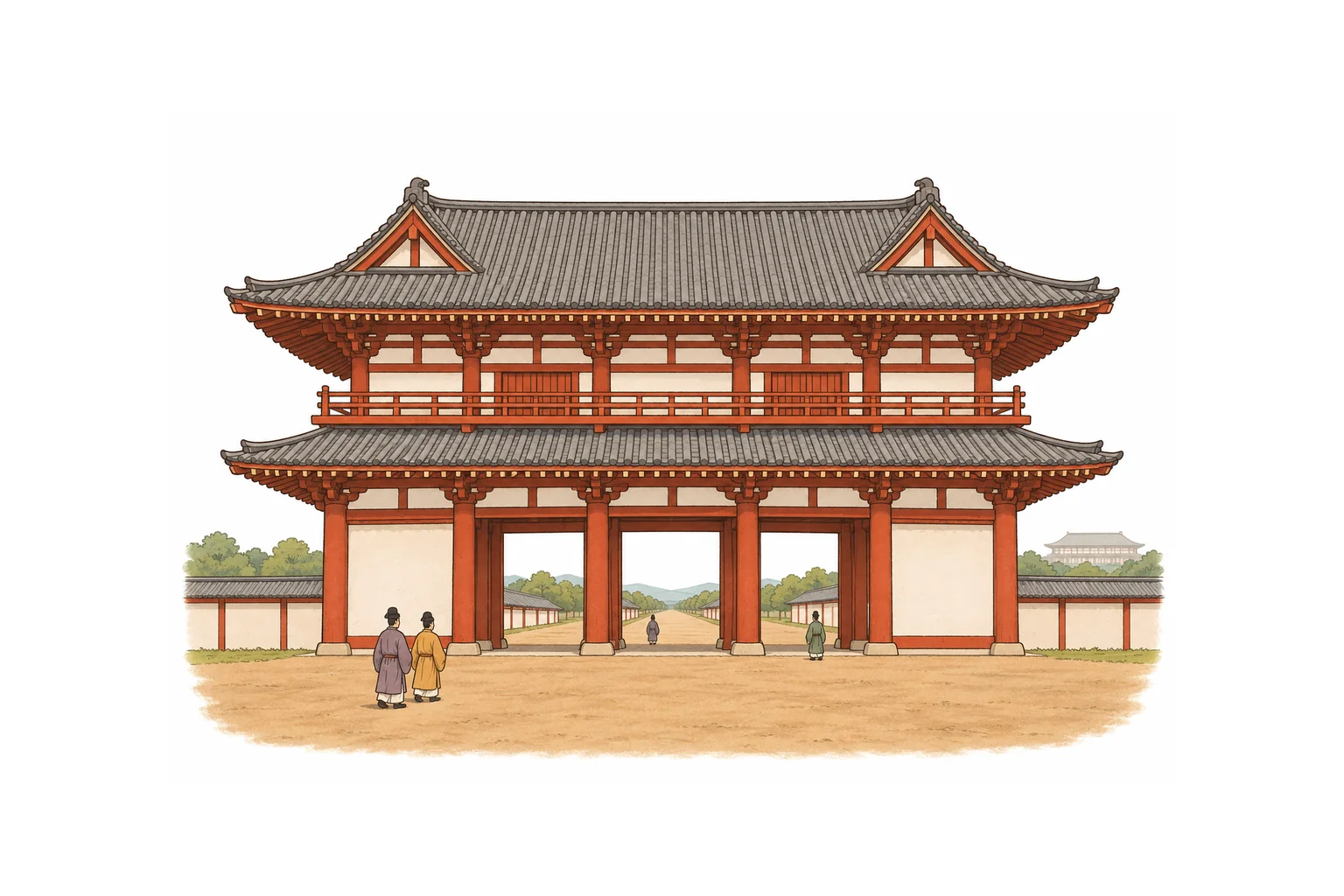
Heijō-kyō did. It was laid out on the model of Chang'an: a rectangle about 4.3 kilometers east to west and 4.8 north to south, with an extra block of streets, the Outer Capital, attached to the east side. Suzaku Avenue, some 74 meters wide, ran from the main gate in the south straight to the palace compound in the north. Streets crossed at right angles and divided the city into regular blocks. The palace enclosure, roughly a kilometer square with an extension on its east side, held the emperor's residence, the audience hall for great ceremonies, and the offices of government. Two official markets, east and west, sold goods under state supervision.
Recent estimates of the population range from 50,000 to 100,000; older ones ran as high as 200,000. A little over a hundred men held the fifth court rank or higher, which was the line that separated the true aristocracy from everyone else, and they received large residential lots near the palace. Several thousand lesser officials lived on small plots far to the south and walked to work before dawn. The great temples moved to the new city as well. Kōfuku-ji, the family temple of the Fujiwara, took the high ground in the Outer Capital; Yakushi-ji, Gangō-ji, and Daian-ji followed.
Much of what is known about daily life comes from mokkan, thin wooden slips used for memos, shipping tags, and writing practice because paper was expensive. They were shaved and reused, then thrown into ditches, where the wet soil preserved them. In the late 1980s, construction work in Nara turned up more than thirty thousand of them from the household of Prince Nagaya, a grandson of Emperor Tenmu. They record a household with its own administrative office, deliveries of abalone and vegetables from estates around the country, ice brought from the family's icehouses in summer, rice issued to feed a nursing dog, and, reportedly, milk deliveries and the keeping of cranes.
3A government of registers
Outside the capital the country was divided into some sixty provinces, each run by a governor sent from the center for a term of several years. Beneath the provinces were districts, administered by local magnates whose families had been powerful long before the codes were written.
Every six years officials compiled household registers listing each person by name, age, and status. On that basis the state allotted rice land: a fixed amount to every free male from the age of six, two-thirds as much to every female. The land returned to the state at death. In exchange, cultivators owed a grain tax, which was light, at around three percent of the harvest. The heavy obligations fell on adult men: a tax in local products such as cloth, silk, salt, or dried seafood; another payment in cloth in place of labor service at the capital; up to sixty days a year of work for the provincial governor; and military service, which for some meant three years guarding the coast of northern Kyūshū as sakimori, frontier guards, most of them drafted from the eastern provinces. Taxpayers carried their tax goods to the capital on their own backs and at their own expense.
To move goods and orders, the court built straight official roads with relay stations stocked with horses. In 708, after copper was presented from Musashi province, it issued a copper coin, the Wadō kaichin, and paid construction workers with it. Coins circulated around the capital; in most of the country rice and cloth remained the money that mattered.
The state also wrote its own past. In 712 a courtier named Ō no Yasumaro presented the Kojiki, a record of myths and ancient reigns that he had set down from the recitation of Hieda no Are. In 720 a committee under Prince Toneri completed the Nihon shoki, thirty volumes in classical Chinese arranged year by year, the formal history a civilized state was expected to have. Provinces were ordered in 713 to report on their place names, products, and old stories; the surviving reports are known as fudoki.
The reach of the registers had limits. In southern Kyūshū the people the court called Hayato killed a governor and rose in 720. In the northeast, the people it called Emishi lived outside the census altogether. The court advanced by building stockades, resettling farmers, and granting ranks to chiefs who cooperated; Taga Castle, in what is now Miyagi Prefecture, was the forward base. In 780 one such chief, Korehari no Azamaro, turned on the government and burned it, and the fighting that followed lasted into the next period.
4The Fujiwara, Prince Nagaya, and a commoner empress
Court politics in the first half of the period turned on one family. Fujiwara no Fuhito, son of the man who had helped engineer the coup of 645, had been a leading figure in drafting the Taihō Code and pushed for the move to Heijō-kyō. He had also married one daughter, Miyako, to Emperor Monmu, which made him grandfather to Prince Obito, and then married another daughter, Kōmyōshi, to Obito himself. Kōmyōshi's mother, Agatainukai no Michiyo, was a senior palace attendant trusted by Empress Genmei, and she was as useful to the family's fortunes as her husband.
Fuhito died in 720. The throne had by then passed from Genmei to her daughter Genshō, and only in 724 did Obito, now twenty-three, succeed as Emperor Shōmu. The senior minister at his accession was Prince Nagaya, whose bloodline was impeccable and whose wife, Princess Kibi, was a daughter of Genmei. Fuhito's four sons, Muchimaro, Fusasaki, Umakai, and Maro, held posts below him. The four later branches of the Fujiwara house descend from these brothers.
In 727 Kōmyōshi bore a son, who was named crown prince within weeks of his birth, an unprecedented step. He died before his first birthday. In 728, the year the infant died, another consort, Agatainukai no Hirotoji, bore Shōmu a son, Prince Asaka. The brothers' answer was to have their sister made empress, a position that carried real authority and, in past practice, a possible claim to rule. But empresses had always been women of royal birth, and Prince Nagaya was the man most likely to object.
In the second month of 729 two informers accused Nagaya of practicing black magic to overthrow the state. Troops under Umakai surrounded his mansion that night. Two days later the prince took his own life, and Princess Kibi and their sons died with him. Within months Kōmyōshi was proclaimed empress, the first from outside the imperial family. The official chronicle of the period, the Shoku Nihongi, later describes the accusation as false.
5Smallpox and a wandering emperor
The brothers had eight years. In 735 smallpox landed in northern Kyūshū, the gateway for traffic with the continent. It faded, then returned in 737 and reached the capital. Between the fourth and eighth months all four Fujiwara brothers died, along with much of the senior nobility. No total was recorded. One influential estimate, based on surviving provincial account books, puts the loss at a quarter to a third of the population. Fields went untended and the court canceled taxes.
Government passed to Tachibana no Moroe, the empress's half-brother by their mother's first marriage. He relied on two men who had come back from China in 735 after some seventeen years there: the scholar Kibi no Makibi and the monk Genbō, who had also won favor by curing the emperor's long-ailing mother. To the younger Fujiwara this looked like usurpation. In 740 Fujiwara no Hirotsugu, a son of Umakai posted to the government headquarters at Dazaifu in Kyūshū, demanded the removal of both men and raised some ten thousand troops. A government army of seventeen thousand put the rebellion down in about two months, and Hirotsugu was executed.
Shōmu did not wait for the outcome. He left Heijō-kyō while the fighting continued, traveled east, and then, instead of returning, ordered a new capital at Kuni, north of Nara. Two years later he began a palace at Shigaraki in the hills of Ōmi province. In 744 he declared Naniwa, on the coast at modern Ōsaka, the capital. In 745 he was back at Shigaraki, and only after forest fires and earthquakes there did he return to Heijō-kyō. The chronicle gives no explanation. Historians generally point to the shock of epidemic and rebellion, a wish to get away from the Fujiwara stronghold, and the search for a site for the project that now occupied him.
6The Great Buddha
That project was religious. Buddhism at the Nara court was understood, among other things, as a technology for protecting the realm: the right scriptures, properly copied and chanted, would ward off plague, famine, and revolt. In 741 Shōmu ordered every province to build a monastery with a seven-story pagoda and twenty monks, and a nunnery with ten nuns. These provincial temples, the kokubunji, put a tall and unmistakable symbol of the center beside each provincial headquarters.
In 743, at Shigaraki, he announced something larger: a colossal gilt-bronze image of Vairocana, the cosmic Buddha of the Flower Garland Sutra. The edict is frank about power. The wealth of the realm is mine, the emperor says, and so is its authority; with these I could easily make the image, but that would miss the point. He asks that anyone willing to bring even a twig or a handful of earth be allowed to help.
To turn that invitation into labor, the court turned to a monk it had once condemned. Gyōki had spent decades preaching outside the temples, which the law forbade, and leading crowds of followers in building bridges, dikes, irrigation ponds, and shelters for travelers. An edict of 717 had denounced him by name. Now he was enlisted to raise contributions, and in 745 he was given the highest title in the official clergy.
When Shōmu returned to Nara the work moved with him, to the foot of the hills east of the city, at the temple that became Tōdai-ji. The statue was cast in eight stages. It stood about sixteen meters high and took roughly five hundred tons of copper. Gyōki died early in 749 without seeing it finished. That same year gold was found in Mutsu province in the far northeast, the first ever reported in Japan, and just in time for the gilding. Shōmu went before the unfinished image, called himself a servant of the Three Treasures, and soon afterward abdicated in favor of his daughter, who reigned as Empress Kōken.
The eye-opening ceremony took place on the ninth day of the fourth month of 752. An Indian monk, Bodhisena, painted in the pupils with a brush tied to long cords, and the retired emperor, Kōmyō, and the reigning empress held the other ends. Some ten thousand monks are said to have attended. The brush and cords still exist.
The cost was enormous. The Tōdai-ji yōroku, a temple record compiled in the early twelfth century, counts about 2.6 million people in all for the statue and its hall, donors of timber and metal together with conscripted laborers. The figure is the temple's own cumulative tally and cannot be checked against other sources. When a conspirator named Tachibana no Naramaro was interrogated in 757, one of the grievances he gave was the suffering that building Tōdai-ji had caused the people.
7Envoys, a blind monk, and a storehouse
The culture of these years is called Tenpyō, after the era name of Shōmu's reign, and its reference point was Tang China. Embassies sailed roughly once every fifteen or twenty years, usually in four ships carrying four or five hundred people: diplomats, students, monks, physicians, craftsmen. The crossing of the East China Sea was dangerous, and many did not come back.
Abe no Nakamaro meant to come back and never did. He went in 717 with Makibi and Genbō, entered the Tang civil service under a Chinese name, and rose high under Emperor Xuanzong. He counted the poets Li Bai and Wang Wei among his friends. Permitted at last to sail home in 753, he was blown to the coast of what is now Vietnam; Li Bai, believing him drowned, wrote an elegy. He made his way back to Chang'an and died there in 770.
Another ship in that returning fleet carried the Chinese monk Jianzhen, known in Japan as Ganjin. Japan had monks in plenty but no properly constituted ordination, and the court, which wanted control over who could claim clerical status, had sent two monks to recruit a master of the monastic rules. They met Ganjin at Yangzhou in 742 and he agreed to come. Five attempts failed over the next eleven years, to official obstruction, storms, and shipwreck. By the sixth, according to the traditional account, he had lost his sight. He landed in southern Kyūshū at the end of 753, in his mid-sixties, and the following year set up an ordination platform in front of the Great Buddha Hall, where the retired emperor, Kōmyō, and Kōken received the precepts from him along with several hundred others. In 759 he founded Tōshōdai-ji in the western part of the capital and died there in 763.
Relations with the Korean kingdom of Silla were frequent and prickly. Envoys went both ways, but the two courts held different views of their relative standing, and disputes over protocol repeatedly soured the exchange. From 727 a new partner appeared: Balhae, a state stretching from what is now northeastern China to the Russian coast, whose missions crossed the Sea of Japan with furs and continued to come for two centuries.
The objects that these contacts brought survive in an unusual way. When Shōmu died in 756, Kōmyō gave more than six hundred of his possessions to the Great Buddha on the forty-ninth day after his death, and added more later. They were stored at Tōdai-ji in the Shōsōin, a raised log storehouse, with the temple's ritual goods. The collection includes Tang musical instruments, mirrors, and game boards, glass from Sasanian Persia, and Japanese pieces made in imitation of them. They never went into the ground.
Kōmyō is remembered for more than that donation. She sponsored a dispensary and a refuge for the poor and orphaned, and commissioned the set of dry-lacquer figures at Kōfuku-ji that includes the three-faced, boyish Ashura, made in memory of her mother.
The great literary monument is the Man'yōshū, an anthology of about 4,500 poems in twenty books. Its poets range from emperors to frontier guards and anonymous easterners. Japanese had no script of its own yet, so the compilers used Chinese characters for their sounds. The latest datable poem was written at New Year 759 by Ōtomo no Yakamochi, a provincial governor from an old military family, who is generally thought to have given the collection its final shape.
8Farmers, flight, and private land
One poem in the anthology shows the other side of the capital's splendor. Yamanoue no Okura, who had been to China and served as a governor in Kyūshū, wrote a "Dialogue on Poverty" in which a family huddles on straw in a sagging hut, the cooking pot cold and cobwebbed, while the village head stands at the door with his whip. It is an official's imagining, but it shows that officials knew what the system demanded.
Farmers responded by leaving. Some abandoned their registered homes and drifted elsewhere; some attached themselves to nobles and temples as laborers; some took the tonsure without permission, since monks paid no tax. Others falsified the registers. The practice spread from the late eighth century, and surviving registers from the Heian period list implausible numbers of women and old people, who owed none of the heavy taxes.
There was also not enough land to allot. In 723 the court offered an incentive: fields opened with new irrigation works could be held for three generations. As the term approached its end, holders let the land go. So in 743, the year of the Great Buddha edict, a new law made reclaimed land the permanent private property of whoever opened it, within limits set by rank. Such land still paid the grain tax. But the people able to reclaim on a large scale were those with labor and iron tools, meaning nobles, district magnates, and great temples such as Tōdai-ji, which staked out tracts in the Hokuriku region and settled runaway farmers on them. The principle that land belonged to the state and was shared out by head count had been breached, and the private estates of the Heian period grew from that opening.
9The empress and the monk
After Shōmu's abdication, power lay with Kōmyō and her nephew Fujiwara no Nakamaro, a son of Muchimaro. He ran the empress dowager's private office, which came to outrank the regular Council of State. When Naramaro and a group of older families plotted against him in 757, the leaders died under torture and more than four hundred people were punished. In 758 Kōken abdicated in favor of Nakamaro's protégé, who reigned as Emperor Junnin. Nakamaro rose to the highest office in the government, renamed the ministries in Tang fashion, put into force the revised code his grandfather Fuhito had drafted, and for a time prepared an invasion of Silla that was never launched.
Kōmyō's death in 760 removed his protection. Soon afterward the retired empress fell ill, and a monk named Dōkyō, skilled in healing rites, attended her. When Junnin objected to her reliance on him, she broke with the emperor. In 762 she told the assembled court that he would handle minor matters while she herself decided great affairs of state, rewards, and punishments.
In the autumn of 764 Nakamaro tried to mobilize troops. Kōken moved first, seizing the seals and relay bells needed to issue orders. Nakamaro fled toward his power base in Ōmi with a rival prince he had proclaimed emperor. The court's strategy was directed by Kibi no Makibi, now sixty-nine, who had the roads blocked ahead of him. Within days Nakamaro was caught on the western shore of Lake Biwa and killed with his family. Junnin was deposed and exiled to Awaji island, where he died the next year. Kōken took the throne again, as Empress Shōtoku.
She had by then taken Buddhist vows, and reasoned that a sovereign who was a nun should have a minister who was a monk. Dōkyō became chancellor and, in 766, "Dharma King," with honors approaching the emperor's own. She built Saidai-ji, the Great Western Temple, as a counterpart to Tōdai-ji, and ordered one million miniature wooden pagodas, each holding a printed Buddhist charm. These charms are among the oldest printed texts in the world that can be dated.
In 769 word came from the Usa Hachiman shrine in Kyūshū that the god had declared the realm would be at peace if Dōkyō were made emperor. Shōtoku meant to send Wake no Hiromushi, a nun in her service, to confirm it; the journey was judged too long for her, and her brother Wake no Kiyomaro went instead. He returned with a different oracle: since the founding of the state the distinction between ruler and subject had been fixed, no subject had ever been made ruler, and the throne must go to one of the imperial line. Furious, she gave him an insulting new name and banished him to the far south, and exiled Hiromushi as well, to Bingo province. But the idea was dropped. Every account of the affair was written after Dōkyō's fall, and historians disagree about who inspired the first oracle and what the empress herself intended.
Shōtoku died in 770 at fifty-two, unmarried and without a named heir. Dōkyō was sent to a temple in distant Shimotsuke province and died there two years later. No woman would occupy the throne again for more than eight centuries.
10Leaving Nara
The senior nobles, led by Fujiwara no Nagate and Fujiwara no Momokawa, chose a sixty-one-year-old prince who reigned as Emperor Kōnin. He was a grandson of Emperor Tenji. Since the civil war of 672 the throne had belonged to the descendants of Tenji's brother Tenmu, but decades of purges had left almost no adult males in that line. Part of Kōnin's appeal was his wife, Princess Inoe, a daughter of Shōmu, whose son Prince Osabe united both lines.
That arrangement lasted less than two years. Inoe was accused of cursing the emperor and stripped of her title, and Osabe was removed as crown prince; mother and son died in confinement on the same day in 775. The new heir was Kōnin's eldest son, Prince Yamabe, whose mother came from an immigrant family that claimed descent from the royal house of Baekje. Momokawa and his branch of the Fujiwara are generally thought to have arranged the change.
Yamabe took the throne in 781 as Emperor Kanmu. He owed nothing to Shōmu's line and had no attachment to Shōmu's city. In 784 he ordered a new capital at Nagaoka, about thirty kilometers to the north-northwest in a straight line, and moved before the year was out. The usual explanations are that a new dynasty wanted a new seat, that Nagaoka had river access to the sea which Nara lacked, and that the court wished to put distance between itself and the great Nara temples. The temples were not invited to follow.
Nagaoka went badly. In 785 Fujiwara no Tanetsugu, the official in charge of construction, was shot with arrows at night and died. The investigation implicated members of the Ōtomo family, including the recently dead poet Yakamochi, who was posthumously stripped of rank, and reached the crown prince, Kanmu's brother Prince Sawara. Sawara refused food and died on the way to exile. In the following years Kanmu's mother and his principal consort died, the new crown prince fell ill, and the city flooded twice. Diviners attributed the misfortunes to Sawara's angry spirit. In 793 Kanmu chose another site a short distance to the northeast, and in the tenth month of 794 the court moved to Heian-kyō.
Heijō-kyō was dismantled. Its palace buildings were carted off and its blocks reverted to rice fields within a few generations. The temples stayed, and around them grew the smaller town that later ages called the Southern Capital. The codes, the registers, the roads, and the provincial temples remained in place as well, some still working and some already hollow, for the Heian court to inherit.