
This period in brief
The Yayoi Period
Rice Paddies, Bronze Bells, and a Queen Named Himiko
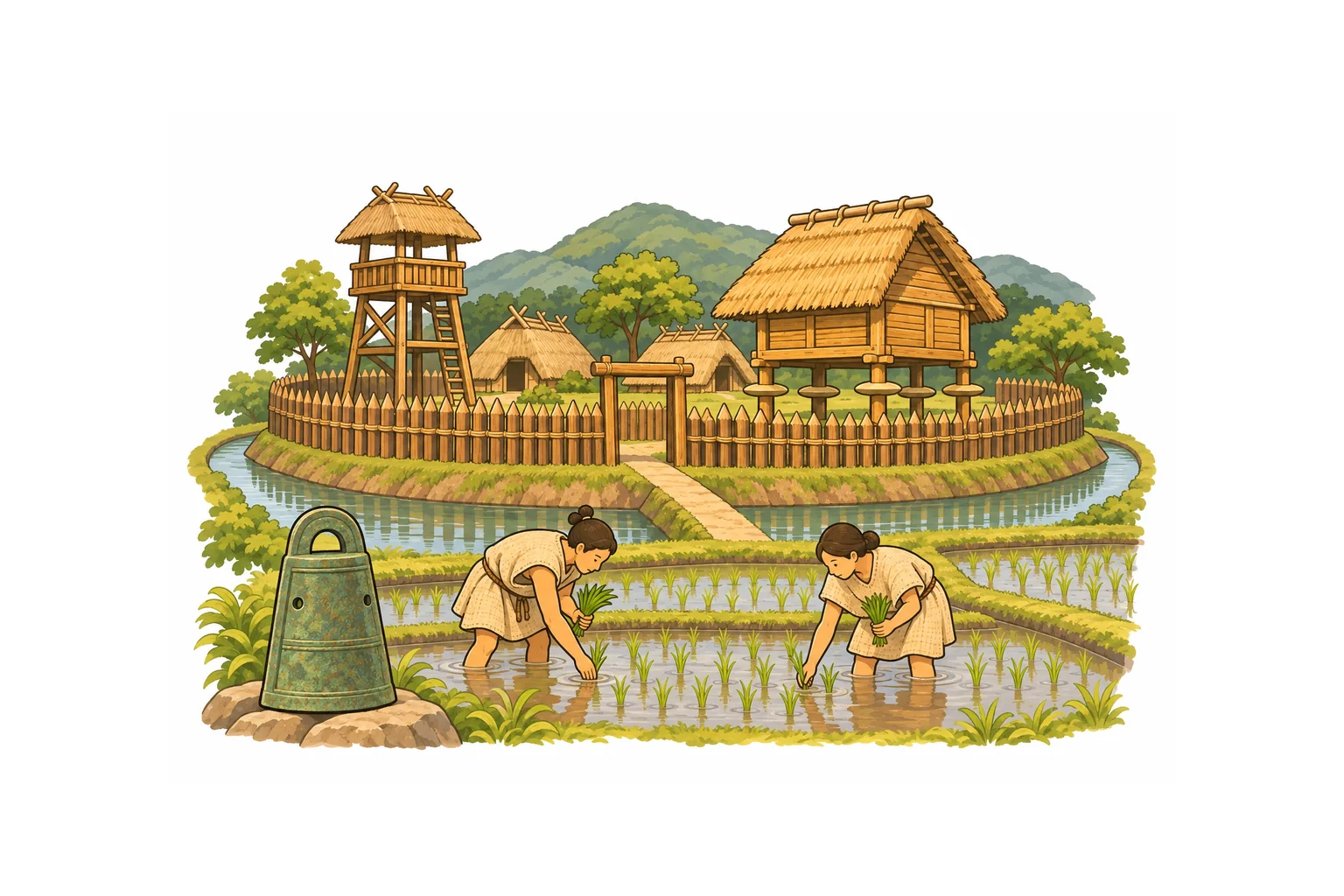
1A period named after a Tokyo side street
In March 1884 a few students from the University of Tokyo and its preparatory school were poking around a shell mound in Yayoi-chō, a neighborhood beside the campus, when they picked up a clay jar unlike the prehistoric pottery they knew. The familiar ware of ancient Japan, called Jōmon, was thick, dark, and covered in cord impressions and sculpted ridges. This jar was thin-walled, reddish, smooth, and almost plain. As similar pots turned up around the country, archaeologists began calling them "Yayoi-type" after the find spot, and the name eventually attached itself to a whole era.
Today the Yayoi period is no longer defined by its pots. It is defined by a way of life: it begins when people in the Japanese islands started growing rice in flooded paddies and organizing their lives around that work. It ends in the middle of the third century CE, when enormous keyhole-shaped burial mounds began to be built and the following Kofun period opened.
The starting date is the one real quarrel over chronology. By the end of the twentieth century, the usual date for the arrival of paddy rice was the fifth or fourth century BCE, and older textbooks said around 300 BCE. In 2003 a research team announced radiocarbon dates, obtained by accelerator mass spectrometry from soot and food crusts on the earliest paddy-farming pottery of northern Kyūshū, that pushed the beginning back roughly five centuries, to about the tenth century BCE. Critics objected that marine carbon might have skewed the samples and that the new dates sat awkwardly with the known history of iron on the continent. After two decades of further testing, an earlier start is accepted by a good many researchers, but how much earlier is not settled: some follow the tenth-century date, others would go back only to about the eighth century, and some remain skeptical of the dating method itself. This essay provisionally follows the longer chronology, under which the period lasted some twelve hundred years.
2Rice comes ashore
Rice was domesticated along the middle and lower Yangtze River many thousands of years before it reached Japan. How it crossed the sea has been debated: directly from the Yangtze delta, northward through the Ryūkyū island chain, or around by way of the Shandong peninsula and the southern Korean peninsula. The last route has by far the strongest support, because the stone tools, pottery, and village layouts of the earliest farmers in northern Kyūshū closely match those across the strait in southern Korea.
The oldest known paddies lie on the coast of northern Kyūshū facing the Korean peninsula, at sites such as Nabatake in Saga Prefecture and Itazuke in the city of Fukuoka. What is striking is how complete they are from the start. There are irrigation and drainage channels, small weirs to control the water level, and ridges between the plots reinforced with stakes and boards, a mature technology brought by people who already practiced it. At Itazuke the footprints of the farmers were still pressed into the mud. With the fields came a full toolkit: wooden hoes and spades, polished stone axes for woodworking, and crescent-shaped stone knives for reaping.
Who those people were, and how many came, is one of the oldest questions in Japanese anthropology. At Doigahama, on the western tip of Honshū, a sand dune preserved about three hundred skeletons of early to middle Yayoi date. They are a few centimeters taller than Jōmon people, with longer, flatter faces. From finds like these the anthropologist Kanaseki Takeo argued that a substantial number of migrants crossed from the continent by way of the Korean peninsula and intermarried with the existing population. Hanihara Kazurō later built this into the "dual structure" model: a Jōmon-descended base population, an incoming group that entered through northern Kyūshū and spread east, and a blending of the two that produced the later population of Honshū, Shikoku, and Kyūshū, with Hokkaidō in the north and Okinawa in the south retaining more of the older ancestry. Genetic studies in recent years broadly support the idea of mixture, while estimates of the number of migrants and the timing of their arrival vary widely.
The archaeology shows that it was not a simple replacement. In the first farming villages the cooking pots are still made in the late Jōmon manner, chipped stone tools remain in use, and houses are still the old pit dwellings, with a floor dug slightly below ground and a thatched roof above. Newcomers and locals lived side by side, and many locals took up farming themselves.
From northern Kyūshū, paddy farming moved east along the Inland Sea and the Sea of Japan coast. A distinctive pottery style, called Ongagawa ware, marks the villages of this first expansion and reaches as far as the shores of Ise Bay, near present-day Nagoya. Beyond that the advance slowed; the southern Kantō plain around modern Tokyo did not see widespread paddies until the middle of the period. Yet there were surprising leaps. In Aomori, at the far northern end of Honshū, the Sunazawa and Tareyanagi sites have small, neatly gridded paddies of early and middle Yayoi date. Rice had reached the cold north remarkably soon, though farming there was later abandoned for a time.
Two regions never joined in. In Hokkaidō people went on fishing, hunting, and gathering in what archaeologists call the Epi-Jōmon culture. In Okinawa and the southern islands, life continued to center on reef fishing. Neither was cut off from the farming world. Large tropical shells from the southern seas were cut into bracelets and traded north to adorn the arms of chiefs and ritual specialists in Kyūshū, and a few traveled as far as Hokkaidō.
3A farming village
Wet-rice farming set a new rhythm for the year. In spring the channels were cleared and the fields turned with hoes and spades of oak, at first without any metal edge. In summer there was water to manage and weeding to do. In autumn the harvesters did not cut the stalks; they went through the field plucking individual ears with a stone knife held in the palm, since the plants in one plot did not ripen together. The ears were dried and stored, and rice was hulled as needed by pounding it in a wooden mortar with a long pestle.
The storehouse was the most conspicuous building in any village. Its floor stood a meter or two off the ground on posts, to keep the grain dry, and each post was fitted near the top with a flat wooden collar that rats could not climb past. The best-known picture of such a village comes from Toro, in the city of Shizuoka, a late Yayoi settlement discovered in 1943 during construction of a wartime factory and excavated on a large scale from 1947. The dig uncovered paddies edged with wooden planks, house floors, raised storehouses, and broad wooden clogs worn to keep from sinking into the mud.
People did not live on rice alone. Yields were modest, and acorns, chestnuts, millet, fish, shellfish, deer, and wild boar all remained on the menu. Pig bones at some sites suggest that pigs were being raised. The three basic shapes of Yayoi pottery reflect the kitchen: a deep pot for boiling, a narrow-necked jar for storage, and a pedestaled dish for serving. For clothing, people spun hemp and wove it on simple looms. A Chinese account says that women wore a single width of cloth with a hole cut for the head. Fragments of silk in burials in northern Kyūshū show that silkworm raising had arrived as well.
Stored grain fed more mouths. One often-cited estimate puts the population of the islands at under a hundred thousand at the end of the Jōmon period and at around six hundred thousand in the Yayoi period. Such figures are extrapolated from site counts and indicate no more than an order of magnitude, but the direction of the change is not in doubt.
4Bronze and iron, arriving together
In much of the world a long bronze age came before iron. Japan had no such sequence. Bronze and iron arrived from the continent at nearly the same time, and for centuries stone, bronze, and iron tools were all in use together.
The two metals soon went separate ways. Iron, hard and sharp, became the working metal: axes, chisels, knives, edges for hoes, and weapons. By the late Yayoi period stone axes and reaping knives had largely vanished from western Japan. The raw iron, however, had to be imported. A Chinese history notes that the southern Korean peninsula produced iron and that the people of Wa, as the Chinese called the inhabitants of the Japanese islands, came there to obtain it. Whoever controlled the sea lanes to that iron had leverage over everyone farther inland, which is one reason the small coastal polities of northern Kyūshū stayed powerful for so long.
Bronze became the metal of ritual. Swords, spearheads, and halberds came in as real weapons, but local casters made them ever broader and thinner until they could neither cut nor stab. The bronze bells called dōtaku changed even more. Their ancestor was a small Korean bell. Early Japanese examples are perhaps twenty centimeters tall, with a clapper inside, and were meant to be rung. Later ones swelled into thin-walled showpieces more than a meter high, the largest about 134 centimeters, that were plainly made to be looked at. Many carry line drawings cast into the surface: deer, herons, dragonflies, a hunter with a bow, people pounding rice, a raised storehouse. They are generally understood as instruments of agricultural ritual, used in prayers for a good harvest.
These bronzes seldom appear in graves. Instead they were buried in groups on hillsides away from the villages. In 1984, on a slope at Kōjindani in Shimane Prefecture, excavators uncovered 358 bronze swords laid out in four neat rows, more than had been found in all of Japan up to that time. The next year six bells and sixteen spearheads turned up a few meters away. In 1996, at nearby Kamo-Iwakura, thirty-nine bells were found in a single pit. Why communities put such treasures in the ground is unknown. They may have been stored there between festivals, offered to the spirits of the land, or hidden in an emergency.
5Moats, arrowheads, and chiefs
Leveling fields and digging channels took many hands and someone to direct them. Good land and water were limited, and stored grain was worth stealing. Skeletons from the Jōmon period seldom show wounds from weapons. In the Yayoi period they are common: stone arrowheads and the tips of bronze swords lodged in bone, bodies buried without heads. At Aoya-Kamijichi in Tottori Prefecture, a ditch held the remains of more than a hundred people of late Yayoi date, men, women, and children; 110 of the bones, from about ten individuals, bear cut and stab wounds. Arrowheads themselves grew larger and heavier, designed now for human targets.
Villages changed shape in response. People dug deep ditches around their settlements, sometimes two or three rings of them, and lined them with palisades. The moated village had appeared earlier in southern Korea, came to Kyūshū with rice, and spread as far east as the Kantō plain. Around the Inland Sea and in the Kinki region, the area around present-day Ōsaka, Nara, and Kyoto, some communities even moved up onto inconvenient hilltops far from their fields, apparently for lookout and defense.
The most famous moated settlement is Yoshinogari in Saga Prefecture. Excavation began in 1986 ahead of a planned industrial park. When the press reported in 1989 that the site resembled a Chinese description of the queen Himiko's residence, visitors arrived in huge numbers, the industrial park was canceled, and the site was preserved. Yoshinogari grew from a small early village into a late Yayoi center of about forty hectares, enclosed by an outer ditch some 2.5 kilometers long and V-shaped in section. Inside were two further enclosures with large buildings and the postholes of watchtowers, thought to be the residence of the chiefs and the place of ritual.
The dead at Yoshinogari tell the story of rank. In northern Kyūshū people were buried in pairs of large pottery jars set mouth to mouth. Thousands of these jar burials lie in long rows outside the settlement, some holding skeletons without skulls, one with ten arrowheads in the abdomen. But on the north side stands an artificial mound containing just over a dozen jar burials, and from these came bronze swords with cast hilts and bright blue glass beads. Members of the same community were no longer equal in death.
The same trend appears everywhere, in different forms. Near Fukuoka, at Sugu-Okamoto, a middle Yayoi jar burial under a great stone slab held about thirty bronze mirrors made in Han dynasty China, together with bronze weapons and glass discs. A comparable grave was found at Mikumo-Minamishōji a short distance west. These are usually regarded as the graves of local kings. By the late Yayoi period, large mounds were being raised for individual leaders across western Japan. The Tatetsuki mound in Okayama Prefecture, a round mound with a projection on either side, measures about eighty meters overall, with standing stones on its summit and tall ceremonial pottery stands set before the grave. In the Izumo region on the Sea of Japan coast, chiefs were buried in square mounds with four projecting corners. Each region had its own leaders and its own funeral customs.
6The land of Wa in Chinese records
Yayoi people left no writing of their own. What we know of their politics comes from the official histories of China.
The earliest reliable notice is one sentence in the Book of Han: in the sea beyond Lelang live the people of Wa, divided into more than a hundred countries, who come at regular seasons with tribute. Lelang was a commandery that the Han empire established in 108 BCE in the northwest of the Korean peninsula, near modern Pyongyang, and it served as the empire's window on the east. The "countries" were small, each probably a plain or valley with a large moated village at its center.
The Book of Later Han adds three episodes. In 57 CE the country of Na in Wa sent an envoy to the court, and the emperor Guangwu granted a seal. In 107 a king of Wa, whose name is usually read Suishō, presented 160 seikō, generally thought to be slaves. And in the later second century, it says, Wa fell into great disorder, with years of fighting and no ruler.
The seal of 57 CE appears to have survived. In 1784 a farmer named Jinbei, repairing a ditch on Shikanoshima, a small island at the mouth of Hakata Bay in what is now Fukuoka, found a gold seal under a stone. It is about 2.3 centimeters square, weighs about 108 grams, has a knob in the form of a coiled snake, and bears five characters usually read as "King of Na of Wa, [vassal of] Han." Na was a small polity on Hakata Bay, and the royal grave at Sugu-Okamoto lies within its territory. Because the circumstances of the discovery are known only from statements taken at the time, suspicions of forgery have never quite gone away. The case for authenticity rests on later finds in China, especially a gold seal of a Han prince unearthed in Jiangsu in 1981 that closely matches the Shikanoshima seal in size, script, and carving. Most scholars today accept the seal as genuine.
For a chief on Hakata Bay, sending tribute across the sea made practical sense. A Han seal and Han mirrors were things no rival could obtain, and the route to Lelang was also the route to iron.
7Himiko
The fullest account of Yayoi Japan is a passage of about two thousand characters in the Records of the Three Kingdoms, compiled by Chen Shou in the late third century. It appears in the section on the kingdom of Wei and is known in Japan as the Gishi Wajinden, the "Account of the Wa People in the History of Wei." It draws on the reports of Wei officials who actually traveled to the islands.
The account opens with an itinerary. From Daifang, a commandery carved out of southern Lelang in the early third century, one sails down the Korean coast, crosses to the island of Tsushima, then to Iki, and lands in northern Kyūshū at a place called Matsuro, around modern Karatsu. Overland lies Ito, on the Itoshima peninsula west of Fukuoka, where an official stationed by the queen kept watch over the northern countries and where envoys from Daifang stayed. Then come Na, Fumi, Toma, and at last Yamatai, "where the queen has her capital." (Surviving editions actually write the name with a character read ichi, usually taken as a copyist's slip for the similar character tai.)
Next the text describes customs. The men tattoo their faces and bodies. The climate is warm; people eat raw vegetables in winter and summer and go barefoot. Society is divided into upper and lower ranks, and a commoner meeting a superior on the road steps aside into the grass and kneels to speak. Bones are scorched to tell fortunes. There are markets, taxes, and granaries. When a ship sails for China, one man is chosen to go unwashed, uncombed, and without meat or women for the voyage; if all goes well he is rewarded, and if there is illness or disaster he is held responsible. Some of this matches the archaeology, and some reflects the conventions Chinese historians used for distant peoples.
Then comes the queen. The country, the text says, formerly had a man as ruler. After seventy or eighty years there was disorder and warfare for many years, until the people agreed to set up a woman as ruler. Her name was Himiko. She "occupied herself with the way of spirits and held the people under her spell." She was mature in years and unmarried, and her younger brother helped her govern. After she became ruler few people saw her. A thousand women attended her, while a single man brought her food and drink and carried her words in and out. She lived in a palace with towers and stockades, guarded by armed men. About thirty countries acknowledged her. The phrase about spirits is not explained and is generally taken to mean some form of shamanic practice. The important word is the one for how she came to power: she was "jointly set up." Chiefs who could not defeat one another agreed on a religious figure to stand above them all.
In the sixth month of the year the text gives as 238, though many scholars emend it to 239, Himiko sent an envoy named Nashime to Daifang, asking to present tribute to the Wei emperor. The gifts were meager: ten slaves and a small quantity of cloth. The response was lavish. The emperor named Himiko "Ruler of Wa, Friendly to Wei," granted her a gold seal with a purple ribbon, and sent brocades, gold, two long swords, "one hundred bronze mirrors," and fifty catties each of pearls and red lead, a lead-based red pigment (some scholars read the word for "pearls" here as cinnabar). Wei was at war with the rival kingdom of Wu in the south, and in Chinese geographical thinking Wa lay somewhere off the southeastern coast, a potentially useful friend. In 240 officials from Daifang carried the edict and seal to Wa.
Himiko's last years were troubled. To the south lay the country of Kuna, ruled by a king who did not submit to her, and in 247 she reported the fighting to Daifang. The commandery sent an official, Zhang Zheng, with an imperial proclamation and a yellow military banner. The text then says, in four characters, that Himiko died. It does not say how. A great mound was raised for her, "more than a hundred paces across," and over a hundred attendants were buried with her.
A man took the throne, but the country would not accept him, and more than a thousand people were killed in the fighting that followed. Peace returned only when a girl of thirteen from Himiko's family was made queen. Her name is written in a way that can be read Iyo or Toyo. She sent envoys to escort Zhang Zheng home, and a mission from Wa that reached the new Jin court in 266 is usually attributed to her. After that, Chinese records say nothing about Wa for well over a century.
8Where was Yamatai?
The Chinese account leaves a puzzle that has occupied Japanese scholars for three hundred years. The route is clear as far as northern Kyūshū. After that the text says to go south by water for twenty days to Toma, and then south, ten days by water and a month by land, to Yamatai. Taken literally, this puts the queen's capital in the open ocean south of Kyūshū. Something has to be corrected, and the question is what.
One school corrects the direction. Read "south" as "east," and the journey leads along the Inland Sea to the Nara basin in the Kinki region, the later heartland of the Japanese state, whose old name, Yamato, sounds very like Yamatai. The other school keeps the direction and adjusts the distances, or reads the later stages as each starting from Ito instead of following one after another, which keeps Yamatai inside Kyūshū.
The dispute goes back to the Edo-period scholars Arai Hakuseki and Motoori Norinaga. It took its modern form in 1910, when Shiratori Kurakichi in Tokyo argued for Kyūshū and Naitō Konan in Kyoto for Kinki. More than the location of a lost capital is at stake. If Yamatai was in Kinki, then a league stretching from central Honshū to Kyūshū existed in the early third century and led directly into the later Yamato kingship. If it was in Kyūshū, Himiko headed a regional power, and the Yamato kingship arose separately or through some later movement eastward.
Since the text cannot settle the matter, archaeology has become the main evidence. Supporters of Kyūshū point out that iron, Chinese mirrors, and silk are far more abundant in late Yayoi Kyūshū than in Kinki, and that sites like Yoshinogari fit the description of towers and stockades. Supporters of Kinki point to Makimuku, a site at the foot of Mount Miwa in Nara Prefecture. It appeared abruptly around the beginning of the third century, sprawled over a large area with no moat, yielded few farming tools, and contained pottery carried in from regions across central and western Japan. A row of large buildings aligned on a single axis suggests a planned political and ritual center. Within the site stands Hashihaka, a keyhole-shaped mound about 280 meters long. It was once dated to around 300 CE, but a good many archaeologists now place it in the middle or the second half of the third century, close to the time of Himiko's death, and some suggest that it is her tomb. Others still hold to a date near 300, and the dating itself remains disputed.
Among archaeologists the Kinki theory currently has more adherents. Decisive proof, such as the gold seal of the "Ruler of Wa, Friendly to Wei," has not been found, and the Kyūshū theory retains serious defenders. The question remains open.
9Toward the age of great tombs
The developments described here belong mainly to western Japan. Villages in the Kantō and Tōhoku regions stayed small, with modest graves, while Hokkaidō and Okinawa followed their own paths.
In the late Yayoi period each region still had its own form of chiefly tomb and its own sacred objects. Soon after the middle of the third century a new type of tomb appeared in the southeastern Nara basin and spread quickly: a huge mound, square at the front and round at the back, with a long wooden coffin and many bronze mirrors. Its elements were borrowed from several regions, including the ceremonial pottery stands of Okayama, which developed into the clay cylinders called haniwa that line the later mounds. When chiefs from Kyūshū to the Kantō plain began building the same kind of tomb, they were declaring membership in one political order centered on Yamato. At about the same time the bronze bells ceased to be made, and some were broken up and thrown away.
Archaeologists mark the end of the Yayoi period at that point. The next three centuries take their name, Kofun, from the tombs themselves, and since Chinese records fall silent after 266, it is those tombs and their contents that carry the story forward.