
This period in brief
The Sengoku Period
How Japan Broke Apart and Was Put Back Together
1An age named for a condition
Most periods of Japanese history are named for the place where power sat: Nara, Heian, Kamakura, Edo. The Sengoku period is named for a state of affairs. Sengoku means "warring states," a phrase borrowed from the era of ancient Chinese history before the Qin unification, and people living through the sixteenth century already used it of their own time. The warlord Takeda Shingen wrote in one article of his house law that "since the realm is at war" his vassals were to put everything else aside and keep their weapons ready.
Because the name describes a condition and not a regime, its dates are a matter of convention. The usual starting point is 1467, when the Ōnin War broke out in Kyoto; many historians now prefer 1493, when a shogun was deposed by his own deputy. For the end, one can choose 1573 (the last Ashikaga shogun driven out), 1590 (the whole country under one overlord), 1603 (Tokugawa Ieyasu named shogun) or 1615 (the fall of Ōsaka Castle). This account takes the broadest common span, 1467 to 1603. The first century of it overlaps with the Muromachi period, the age of the Ashikaga shoguns. The last three decades are often given their own name, Azuchi–Momoyama, after the castles of the two men who did most of the unifying.
The story has a simple shape. An old order collapsed from the center outward. In its place rose scores of regional rulers who held land because they could defend it, not because anyone had appointed them. They fought until there were fewer of them, and then three men in succession, Oda Nobunaga, Toyotomi Hideyoshi and Tokugawa Ieyasu, forced the survivors into a single structure that would last for more than two and a half centuries.
2Eleven years of war in the capital
The Ashikaga shogunate had never been a strong central government. The shogun ruled in Kyoto with and through a handful of great military houses whose heads served as shugo, military governors of one or more provinces, and who mostly lived in the capital. Everything depended on balance among them.
In the 1460s several quarrels fused into one. The shogun Ashikaga Yoshimasa, having no son, had named his brother as heir; then his wife, Hino Tomiko, bore a boy. Two of the leading shugo houses, the Hatakeyama and the Shiba, were split by succession disputes of their own. Each claimant looked for a patron, and the patrons turned out to be the two most powerful men in Kyoto: Hosokawa Katsumoto and Yamana Sōzen. In 1467 their armies began fighting in the streets. The Hosokawa side held the eastern part of the city and the Yamana the west; the weaving district of Nishijin, "the western camp," still carries the name.
The war lasted until 1477. Both commanders died of illness in 1473 and the fighting went on without them, ending not in a victory but in exhaustion as the provincial armies drifted home. Most of Kyoto burned, along with temples, aristocratic mansions and their libraries. Much of the burning was done by ashigaru, lightly armed foot soldiers hired in bulk, whom the courtiers' diaries describe with horror.
The lasting damage was done in the provinces. While the governors camped in Kyoto for a decade, the deputies they had left behind and the local warrior families took over the real business of collecting revenue and settling disputes. Some governors went home to find there was no place for them. The shogun's writ stopped running much beyond the capital region, and the imperial court, which lived on income from distant estates, became poor. When Emperor Go-Tsuchimikado died in 1500 the funeral was delayed for more than forty days for lack of funds, and his successor waited twenty-one years for an enthronement ceremony.
In 1493 Hosokawa Masamoto, the shogun's chief deputy, waited until the shogun was away on campaign and installed a different Ashikaga in his place. After that the shogunate survived mainly as a prize for whoever controlled Kyoto.
3The low overcome the high
Contemporaries had a word for what followed: gekokujō, "those below overturning those above."
Some of the overturning was done by commoners. In 1485 the warriors and farmers of southern Yamashiro, just outside Kyoto, banded together, ordered two feuding Hatakeyama armies out of their district, and ran it themselves for eight years. In 1488 in Kaga province, on the Sea of Japan coast, followers of the Hongan-ji branch of True Pure Land Buddhism besieged the governor in his castle and drove him to suicide. Such sworn leagues were called ikki; those of the True Pure Land faithful were called Ikkō ikki. Kaga was governed by the sect's priests and local adherents for nearly a century and was spoken of as "a province held by the commoners."
More of it was done by warriors. Hōjō Sōun, long remembered as a masterless adventurer, is now generally thought to have come from a branch of a family of shogunal officials; either way, in the 1490s he seized Izu province and then Odawara, and his descendants ruled the Kantō plain for almost a hundred years. Saitō Dōsan, by legend an oil seller, took over Mino province; recent research suggests the climb was the work of two generations, his father's and his own. In the west, Mōri Motonari began as a minor landholder squeezed between two great houses, the Ōuchi and the Amago. In 1555 he destroyed the general who had usurped the Ōuchi domain at the battle of Itsukushima, and over the next decade swallowed the lands of both former masters. The story that he taught his three sons unity by showing that three arrows bound together cannot be snapped is a later legend, though it rests on a real letter of advice.
Not every warlord rose from obscurity. The Takeda of Kai, the Imagawa of Suruga and the Shimazu of Satsuma were old governor families who adapted. Uesugi Kenshin of Echigo was born into a deputy's house and was later adopted into the name of his nominal superiors. What these rulers had in common was the source of their authority. Historians call them Sengoku daimyo: lords whose position rested on their own ability to hold territory and keep followers, with no appointment from above required. Lineage did not protect those who failed. Ōuchi Yoshitaka, the grandest lord of western Japan, was forced to kill himself by his own retainer in 1551.
4Running a domain, living in one
A Sengoku daimyo's territory was a small state. Many issued law codes for their domains, among them the Imagawa, the Date and the Takeda. A provision found in several is that when retainers fight each other, both parties are punished regardless of who was in the right. The point was to end the old warrior habit of settling quarrels by force and to make the lord's court the only place where disputes could be resolved.
War was expensive, and the rulers who lasted were those who managed their resources. They surveyed land, registered what villages owed, and assigned military obligations to vassals in proportion to their holdings. Takeda Shingen is credited with embankments that tamed the rivers of the Kōfu basin. Mines mattered enormously. The Iwami silver mine in western Honshū was opened by a merchant from Hakata in the 1520s, and after a refining technique known as cupellation was introduced from the continent, output soared and the method spread to other mines. By the later sixteenth century Japan was one of the world's major sources of silver, much of it flowing to China in exchange for silk.
Daimyo gathered their vassals, merchants and craftsmen below their castles, creating castle towns; a number of present-day prefectural capitals began this way. Other towns answered to no lord. Sakai, a port on Ōsaka Bay grown rich on overseas trade, was run by a council of wealthy merchants and ringed by moats, and a Jesuit missionary compared it to Venice. In Kyoto the townspeople rebuilt their neighborhoods block by block and in 1500 the Gion festival, suspended for more than thirty years, was revived, with the neighborhoods providing the floats.
In the countryside, villages had become self-governing bodies. They managed irrigation and woodland in common, paid their dues collectively, wrote their own rules and often did their own policing. They also bore the cost of war. Passing armies took food and labor, cut standing crops, and carried off people to be sold. Villages paid commanders for written guarantees that troops would leave them alone. The sixteenth century was a cold one with frequent famines, and some historians argue that many campaigns into neighboring provinces were in part expeditions for food.
The best-known rivalry of these decades was between Takeda Shingen and Uesugi Kenshin, who met five times between 1553 and 1564 at Kawanakajima in northern Shinano. The fourth encounter, in 1561, was a bloodbath in which the Takeda lost several senior commanders, among them Shingen's brother Nobushige. The famous scene of Kenshin riding alone into Shingen's headquarters while Shingen parries his sword with an iron war fan comes from later war tales and should be taken as legend. Neither man won, and the stalemate kept both from marching on the capital.
5Guns and missionaries
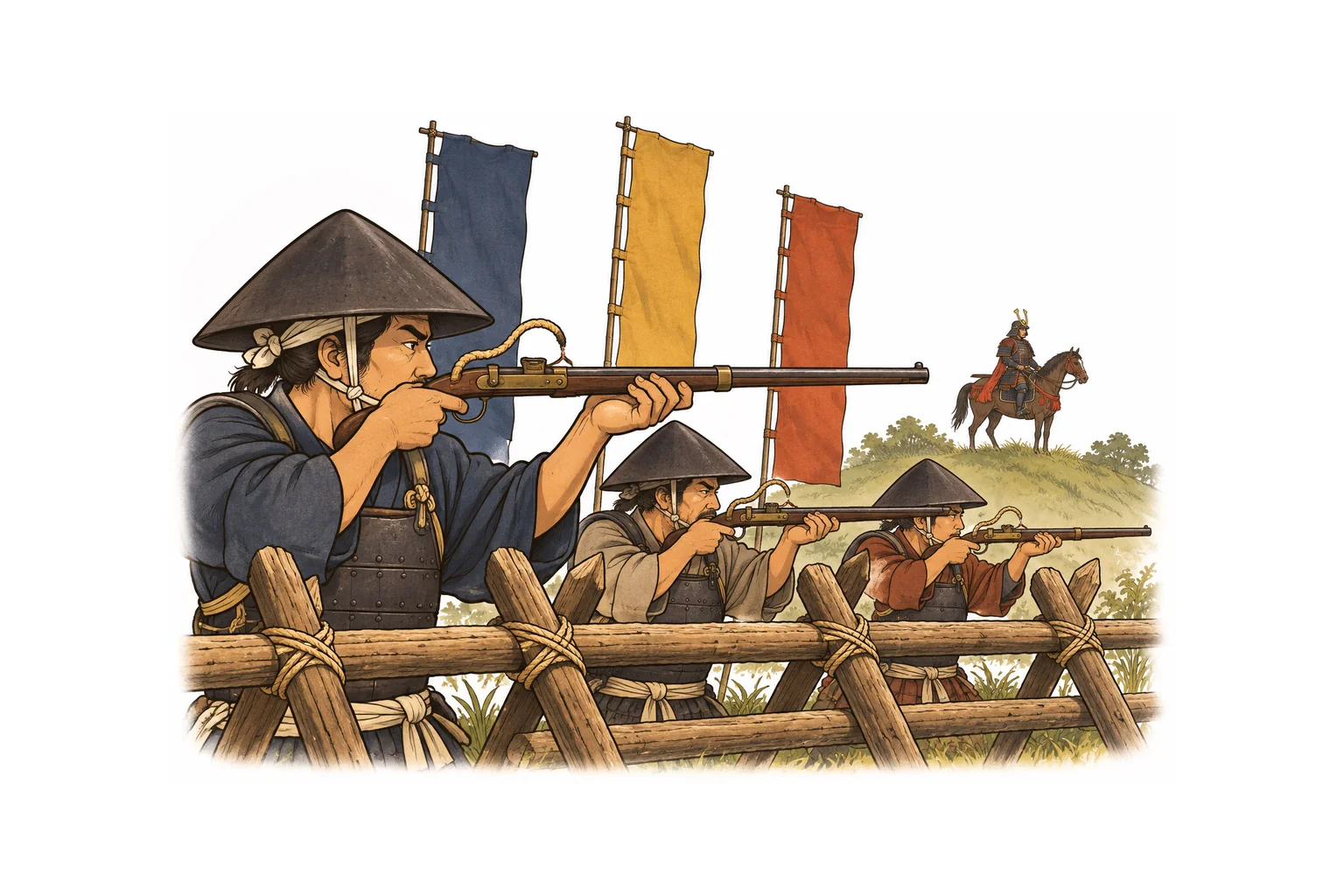
In 1543, or by some accounts 1542, a Chinese junk was blown ashore on Tanegashima, a small island south of Kyūshū. Aboard were Portuguese traders carrying matchlock guns. The young lord of the island bought two and set his swordsmith to copying them. Within a generation gunsmiths at Sakai, at Kunitomo in Ōmi province and elsewhere were turning them out in quantity, and Japanese armies fielded firearms on a scale that surprised European observers.
The gun changed how wars were fought. A foot soldier with a few weeks of drill could bring down a mounted warrior who had trained since childhood, so armies grew larger and more heavily made up of infantry. Fortifications changed too, from earthworks on hilltops to great castles with high stone walls and wide moats. Guns and gunpowder cost money, and the advantage went to lords who controlled ports and commerce.
Christianity came by the same sea route. The Jesuit Francis Xavier landed at Kagoshima in 1549 and spent a little over two years in Japan. Others followed, and several lords in Kyūshū accepted baptism. The first was Ōmura Sumitada in 1563, who later handed the new harbor of Nagasaki over to the Jesuits. Conviction and calculation are hard to separate here. The Portuguese ships that carried silk from China, and saltpeter for gunpowder, tended to call where the missionaries were welcome. By the early 1580s the Jesuits themselves reckoned their Japanese converts at well over a hundred thousand. In 1582 four boys from Christian families of Kyūshū were sent as envoys to Rome; they returned eight years later to a country that had changed.
The Japanese called these Europeans nanban, "southern barbarians," since they arrived from the south. Their ships appear on painted folding screens of the time, and some of what they brought stayed in the language: the Japanese words for bread, for buttons and for playing cards all come from Portuguese.
6Oda Nobunaga
Oda Nobunaga was born in 1534 in Owari province, around modern Nagoya, into a family that served the provincial deputies, its own kinsmen, as stewards. In 1560 Imagawa Yoshimoto, master of three provinces to the east, marched west with an army said to number over twenty thousand. Nobunaga had a few thousand. He caught Yoshimoto's headquarters at rest at a place called Okehazama, attacked, and killed him. The Imagawa never recovered. One of their hostages, a young lord from Mikawa, took the opportunity to become independent. He would later be known as Tokugawa Ieyasu, and the alliance he made with Nobunaga held for twenty years.
In 1567 Nobunaga conquered Mino, moved his seat there, renamed it Gifu, and began sealing documents with the motto tenka fubu, "the realm under military rule." The following year he marched into Kyoto escorting Ashikaga Yoshiaki, a wandering claimant, and had him made the fifteenth shogun. The partnership soured quickly. Yoshiaki resented being managed and wrote to every power that might oppose his patron. For several years Nobunaga was ringed by enemies: the Azai and Asakura to the north, the Takeda to the east, and the Hongan-ji, whose fortified temple stood at Ōsaka.
He dealt with them one at a time and without restraint. In 1571, after the monks of Enryaku-ji on Mount Hiei had sheltered his enemies, he burned the mountain's temples and killed large numbers of clergy and laypeople. In 1573 he drove Yoshiaki out of Kyoto, which is the conventional end of the Muromachi shogunate, and destroyed the Azai and Asakura in the same year. Takeda Shingen died of illness that spring while on campaign.
In 1575 Nobunaga and Ieyasu met Shingen's heir, Takeda Katsuyori, outside Nagashino Castle in Mikawa. They built palisades across the field and shot down the Takeda as they charged. The tradition that three thousand gunners fired in three rotating ranks comes from a later account and is doubted by most specialists today, and the number of guns may have been closer to one thousand. That massed gunfire behind fieldworks decided the day is not in doubt.
The Hongan-ji proved harder. Its abbot, Kennyo, called out the sect's followers across central Japan, and the war dragged on from 1570 to 1580 before the court brokered a withdrawal from Ōsaka. Nobunaga's suppression of the leagues at Nagashima in Ise and in Echizen involved the killing of tens of thousands.
From 1576 he built a new seat at Azuchi on the shore of Lake Biwa. Its central tower rose several stories above stone ramparts and was decorated inside with paintings on gold by Kanō Eitoku and his workshop. In the town below he declared a free market, exempt from the dues and guild monopolies that governed trade elsewhere, and he abolished toll barriers in his territories. He received the Jesuits kindly and let them build in Kyoto and Azuchi.
In the spring of 1582 his armies destroyed the Takeda. On June 21 of that year he was lodging at Honnō-ji, a temple in Kyoto, with a small escort. One of his generals, Akechi Mitsuhide, who had been ordered west with reinforcements, turned his column around and surrounded the temple before dawn. Nobunaga killed himself. His heir Nobutada died the same morning nearby. Why Mitsuhide did it has been argued over ever since, with grudge, ambition and hidden instigators all proposed, and no explanation has won general agreement.
7Toyotomi Hideyoshi
The general who profited was not Mitsuhide. Hashiba Hideyoshi, born in Owari probably in 1537 to a family at the very bottom of the warrior order or below it, had risen in Nobunaga's service from errand runner to army commander. When the news from Kyoto reached him he was besieging a castle of the Mōri far to the west. He made peace on the spot, marched his army back at remarkable speed, and beat Mitsuhide at Yamazaki eleven days after Honnō-ji. Mitsuhide was killed while fleeing.
Having avenged his lord, Hideyoshi outmaneuvered the other Oda generals. In 1583 he defeated the most senior of them, Shibata Katsuie, at Shizugatake; Katsuie retreated to his castle and died there with his wife, Nobunaga's sister. Maeda Toshiie, who changed sides during that campaign, became one of Hideyoshi's most trusted lords. The same year Hideyoshi began an enormous castle at Ōsaka on the site the Hongan-ji had vacated. In 1584 he fought Ieyasu at Komaki and Nagakute, came off worse in the field, and won the peace by detaching Ieyasu's ally. Ieyasu eventually acknowledged him as overlord.
A man of Hideyoshi's birth could not plausibly become shogun, so he took his legitimacy from the imperial court. In 1585 he had himself appointed kanpaku, imperial regent, an office held for centuries only by the highest court nobility, and the next year the emperor granted him a new surname, Toyotomi. Speaking as regent, he ordered all lords to cease private warfare and submit boundary disputes to him. Those who refused were attacked in the emperor's name: the Chōsokabe of Shikoku in 1585, the Shimazu of Kyūshū in 1587, and in 1590 the Hōjō of Odawara, who gave up after a siege of about three months by an army of some two hundred thousand. Date Masamune, the young lord who had just made himself master of much of the northeast, came to the siege camp to submit and lost part of his conquests. With that, every daimyo in Japan was Hideyoshi's vassal. He moved Ieyasu into the former Hōjō lands in the Kantō, where Ieyasu chose a modest castle called Edo as his base.
8Counting the land, disarming the village
Hideyoshi's most durable work was administrative. His officials went through the country measuring every field with a standard rod, grading it, and recording its expected yield in koku of rice, a koku being roughly what one person eats in a year. The registers also named the cultivator responsible for the tax on each plot. For the first time a village, a district or a daimyo's whole domain could be expressed as a single number. Lords owed military service in proportion to that number and could be moved from one territory to another of equivalent value. The overlapping claims that had lain on the land since the medieval estate system were swept away.
In 1588 came the "sword hunt," an order confiscating swords, spears and guns from farmers, on the pretext that the metal was needed for a great Buddha hall. Further edicts in 1591 forbade warriors to become townsmen or farmers, and farmers to abandon their fields for trade. The effect was to pull apart two groups that had long shaded into each other. Fighting men lived in the castle town on stipends; cultivators stayed in the village and paid tax. That separation became the foundation of society under the Tokugawa.
Toward Christianity Hideyoshi was at first as tolerant as Nobunaga. Then in 1587, having seen in Kyūshū how much influence the Jesuits had acquired, he abruptly ordered the missionaries to leave and took Nagasaki under his own control. Since he wanted the trade to continue, the order was loosely enforced. A harsher turn came after a Spanish galleon was wrecked on the coast of Shikoku in 1596. Early the next year twenty-six Christians, foreign friars and Japanese converts, were crucified at Nagasaki.
Patronage of the arts was part of how these rulers displayed power. Castles and palaces were filled with screens of pines, lions and flowers against gold leaf. Hideyoshi owned a portable tearoom covered in gold. Yet he also employed Sen no Rikyū, a merchant of Sakai who had brought to its extreme a very different style of tea: a tiny thatched room, rough bowls, a single flower in a bamboo holder. Tea gatherings were where lords and merchants met and where political business was done. In 1587 Hideyoshi held an open-air tea gathering at Kitano in Kyoto to which, he announced, anyone of any rank might come. In 1591 he ordered Rikyū to commit suicide. The reasons given at the time and since do not agree.
9The invasions of Korea
With Japan subdued, Hideyoshi announced that he would conquer Ming China and demanded passage through Korea. The Korean court refused. In 1592 an invasion force of more than 150,000 men crossed from Kyūshū and landed at Busan. They took the capital, Hanseong (modern Seoul), in about twenty days. One column under Konishi Yukinaga reached Pyeongyang; another under Katō Kiyomasa pushed into the far northeast.
The advance could not be sustained. Local Korean volunteer forces rose in the occupied provinces, the Korean navy under Admiral Yi Sun-sin repeatedly broke Japanese supply lines at sea, and a large Ming army crossed the Yalu. The Japanese fell back to the southern coast and years of negotiation followed. When the talks collapsed Hideyoshi sent a second expedition in 1597, which never got far beyond the south. He died in September 1598 and the armies were withdrawn.
The war goes by different names in each country: the Bunroku and Keichō campaigns in Japan, the Imjin War in Korea, the Wanli Korean campaign in China. Its costs fell most heavily on Korea, which suffered great loss of life and farmland and saw tens of thousands of its people carried off to Japan. Among the captives were potters whose kilns in Kyūshū became the origin of some of Japan's best-known ceramic traditions. The Ming spent heavily at a time when it could ill afford to. In Japan the war left bitterness between the generals who had fought at the front and the administrators, Ishida Mitsunari chief among them, who had supervised and reported on them.
10Sekigahara and the end of the wars
Hideyoshi's last years were dominated by the succession. He had passed the regency to a nephew, Hidetsugu, but in 1593 his consort Yodo-dono gave birth to a son, Hideyori. Two years later Hidetsugu was ordered to kill himself and his family was executed. When Hideyoshi died, Hideyori was five years old. Government was left to a council of five great lords, headed by Tokugawa Ieyasu and Maeda Toshiie, and five administrators.
Toshiie died in 1599 and the arrangement came apart. The front-line generals drove Mitsunari from office, while Ieyasu, by far the largest landholder in the country, began arranging marriages and reassigning lands on his own authority. In the summer of 1600 he led an army east against the Uesugi, and Mitsunari used his absence to raise a coalition in the name of the Toyotomi heir, with Mōri Terumoto as its nominal commander at Ōsaka. The families of lords who had gone with Ieyasu were to be held as hostages. Hosokawa Gracia, a Christian convert and the wife of one of them, refused to be taken and died in her residence.
The armies met on October 21, 1600, at Sekigahara, a valley in Mino province where the roads from eastern Japan converge on the approach to Kyoto. Each side had perhaps seventy or eighty thousand men. The western coalition held the better ground, but Kobayakawa Hideaki, posted on a hill overlooking the field, had been in contact with Ieyasu beforehand. By the usual account he charged down into his own side around midday, though some recent studies argue he turned almost as soon as the fighting began. Other contingents followed him, and the battle was over by afternoon. Mitsunari and Konishi Yukinaga were captured and beheaded in Kyoto. Fighting linked to the campaign also took place in the northeast and in Kyūshū.
Ieyasu then redrew the map. Lands worth more than six million koku were confiscated or reduced. The Mōri were cut from over 1.1 million koku to two provinces at the western tip of Honshū worth about 300,000. Ieyasu's allies were rewarded generously, often with domains far from his own base, and they set about building. Ikeda Terumasa reconstructed Himeji Castle, Katō Kiyomasa raised a new castle at Kumamoto, and Date Masamune laid out Sendai. Many of the castles and castle towns that visitors know today date from these few years.
In 1603 the court appointed Ieyasu shogun, and he established his government at Edo. That year is the customary boundary between the Sengoku or Azuchi–Momoyama period and the Edo period. One piece of unfinished business remained. Toyotomi Hideyori still lived in Ōsaka Castle with his mother, heir to a name that many lords had sworn to protect. In two campaigns in 1614 and 1615 Ieyasu besieged the castle, which was defended largely by masterless warriors such as Sanada Nobushige, and destroyed the Toyotomi house. Japan then had no war between its lords for more than two hundred years. The Tokugawa order that kept the peace was assembled from parts made during the wars: the daimyo domain, the castle town, land measured in koku, and a warrior class that had been separated from the village.