
This period in brief
The Muromachi Period
A Weak Shogunate and a Restless, Inventive Country
1A government named after a street
The Muromachi period is the age of the Ashikaga shoguns, the second of Japan's three warrior governments. It is usually dated from 1336, when Ashikaga Takauji took Kyoto, set up an emperor of his own choosing and issued a statement of governing principles called the Kenmu Shikimoku. Some prefer 1338, the year he received the title of shogun. It ends in 1573, when the fifteenth and last Ashikaga shogun was driven out of Kyoto by Oda Nobunaga. Fifteen shoguns held office over roughly 240 years.
The name comes from a street. In 1378 the third shogun, Yoshimitsu, built a new residence beside Muromachi Avenue in northern Kyoto. Its gardens were planted with flowering trees sent by provincial lords, and townspeople called it the Hana no Gosho, the Palace of Flowers. The street name became the name of the regime and later of the era.
Unlike the Kamakura shogunate before it, which had ruled from a town several hundred kilometers to the east, this government sat in the imperial capital, among courtiers, great temples, moneylenders and craftsmen. That location shaped everything about it. So did its weakness. For its first half-century the country had two rival imperial courts, a time known as the Nanbokuchō or Northern and Southern Courts period (1336–1392). For its last century the shoguns controlled little beyond the capital region, and that stretch overlaps with what is called the Sengoku or Warring States period. Only the seven or eight decades in between saw a shogunate that could actually command. Two shoguns were killed by their own vassals and several more were chased from the capital.
Yet these same centuries produced Noh theater, the tea ceremony, flower arrangement, ink landscape painting, the dry rock garden and the tatami-floored room. Villages learned to govern themselves, markets multiplied, and port towns grew rich. The story of the period is how political disorder and social energy went together.
2Go-Daigo's three years
The story begins with an emperor who wanted to rule. In 1333 Emperor Go-Daigo, after years of plotting and a spell in exile, called on warriors across the country to overthrow the Kamakura shogunate. The general sent to suppress the rising, Ashikaga Takauji, changed sides and seized the shogunate's Kyoto headquarters. Almost at the same moment an eastern warrior, Nitta Yoshisada, stormed Kamakura itself, and the ruling Hōjō family died there by their own hands.
Go-Daigo returned to Kyoto intending to govern directly, with no regent and no shogun. His program is called the Kenmu Restoration after the era name he chose. It lasted less than three years. He decreed that every land title needed confirmation by an imperial order, and warriors flooded into the capital with claims the new offices could not process. Forged orders circulated. An anonymous lampoon posted on the riverbank at Nijō listed what was fashionable in the capital these days: night raids, robbers and counterfeit imperial edicts. When rewards were handed out, courtiers and palace favorites did better than the men who had done the fighting. Warriors began to wish for a government of their own kind again, and the obvious leader was Takauji, head of a prestigious branch of the Minamoto lineage.
The break came in 1335. A surviving Hōjō son retook Kamakura; Takauji marched east without waiting for imperial permission, crushed the revolt, and then stayed, handing out land to his followers on his own authority. Go-Daigo sent Nitta Yoshisada against him. Takauji won, pursued the imperial army to Kyoto, was beaten there in early 1336 and fled by ship to Kyūshū.
There he rebuilt his army. On the way west he had also solved a political problem: he obtained a commission from the retired emperor Kōgon, a member of the rival branch of the imperial family whom Go-Daigo had pushed aside. Takauji could now claim to fight for an emperor rather than against one. In the summer of 1336 he came back east by land and sea and met the loyalist forces at the Minato River, in what is now Kōbe. The loyalist commander Kusunoki Masashige, a provincial warrior famous for holding mountain forts against huge armies, was hopelessly outnumbered and killed himself after the defeat. The war tale Taiheiki has him vow with his brother to be reborn seven times to destroy the court's enemies. That scene is literature, but it made Masashige the model of the loyal subject for centuries afterward.
Takauji entered Kyoto and enthroned Kōgon's younger brother. At the end of the year Go-Daigo slipped out of the capital with the imperial regalia and set up his court in the mountains of Yoshino, south of Nara. Japan now had a Northern Court in Kyoto and a Southern Court in Yoshino, each with its own emperor and its own calendar.
3Two courts, sixty years of war
The Southern Court was the weaker side from the first. Its best generals, Nitta Yoshisada and the young Kitabatake Akiie, both died in battle in 1338, and Go-Daigo himself died in Yoshino in 1339. Akiie's father, the courtier Kitabatake Chikafusa, wrote a history arguing for the southern line's legitimacy, the Jinnō Shōtōki, while holding out in a fortress in the east.
What kept the war alive was a split inside the Ashikaga camp. In the early years Takauji handled military command and rewards, while his brother Tadayoshi ran the courts and daily administration. Tadayoshi stood for established rights, including the estates of temples and nobles. Takauji's chief steward, Kō no Moronao, spoke for newer men who had risen by fighting and wanted land. In 1350 the quarrel turned into open war, the Kannō Disturbance. Tadayoshi briefly joined the Southern Court and used its banner to destroy Moronao; Takauji then made his own temporary submission to the south so that he could turn on his brother. Tadayoshi died in Kamakura in 1352. The Taiheiki says he was poisoned.
The lesson was not lost on anyone: a man who lost a power struggle could declare for the other emperor and keep fighting with a legitimate cause. There was a deeper driver too. Warrior families were moving from dividing property among children to passing everything to a single heir, so nearly every house had a disappointed claimant. If one brother backed the north, the other backed the south. In Kyūshū, Go-Daigo's son Prince Kaneyoshi and the local commander Kikuchi Takemitsu won a major battle at the Chikugo River in 1359 and held the island's administrative center at Dazaifu for more than a decade.
The long war changed who controlled land. To feed their armies, the shogunate in 1352 allowed its provincial military governors, the shugo, to assign half the annual dues of estates in three provinces to their fighting men, for one year. This "half-tax" (hanzei) spread to other provinces and hardened into a permanent division of the land itself. With that power, and with authority to enforce court judgments, the governors turned local warriors into their own followers. Historians call the result shugo daimyo, governors who had become regional lords.
4Yoshimitsu
Takauji died in 1358. His son Yoshiakira held the office for nearly a decade, and in 1368 the title passed to Yoshiakira's ten-year-old son, Yoshimitsu, with the experienced Hosokawa Yoriyuki governing on his behalf. Once grown, Yoshimitsu spent two decades making the shogunate into a real center of power.
He cut the largest governor families down one at a time, usually by waiting for a succession quarrel and then intervening. The Yamana clan held eleven of the country's sixty-six provinces and was nicknamed the "lord of one-sixth"; provoked into revolt in 1391, it was left with three. The Ōuchi of western Honshū, masters of six provinces and much overseas trade, were defeated at the port of Sakai in 1399.
In 1392 he ended the schism. The southern emperor Go-Kameyama agreed to return to Kyoto and hand the regalia to the northern emperor Go-Komatsu, on the promise that the two lines would alternate on the throne. The promise was never kept. Southern partisans staged scattered risings for decades, but the war of the courts was over.
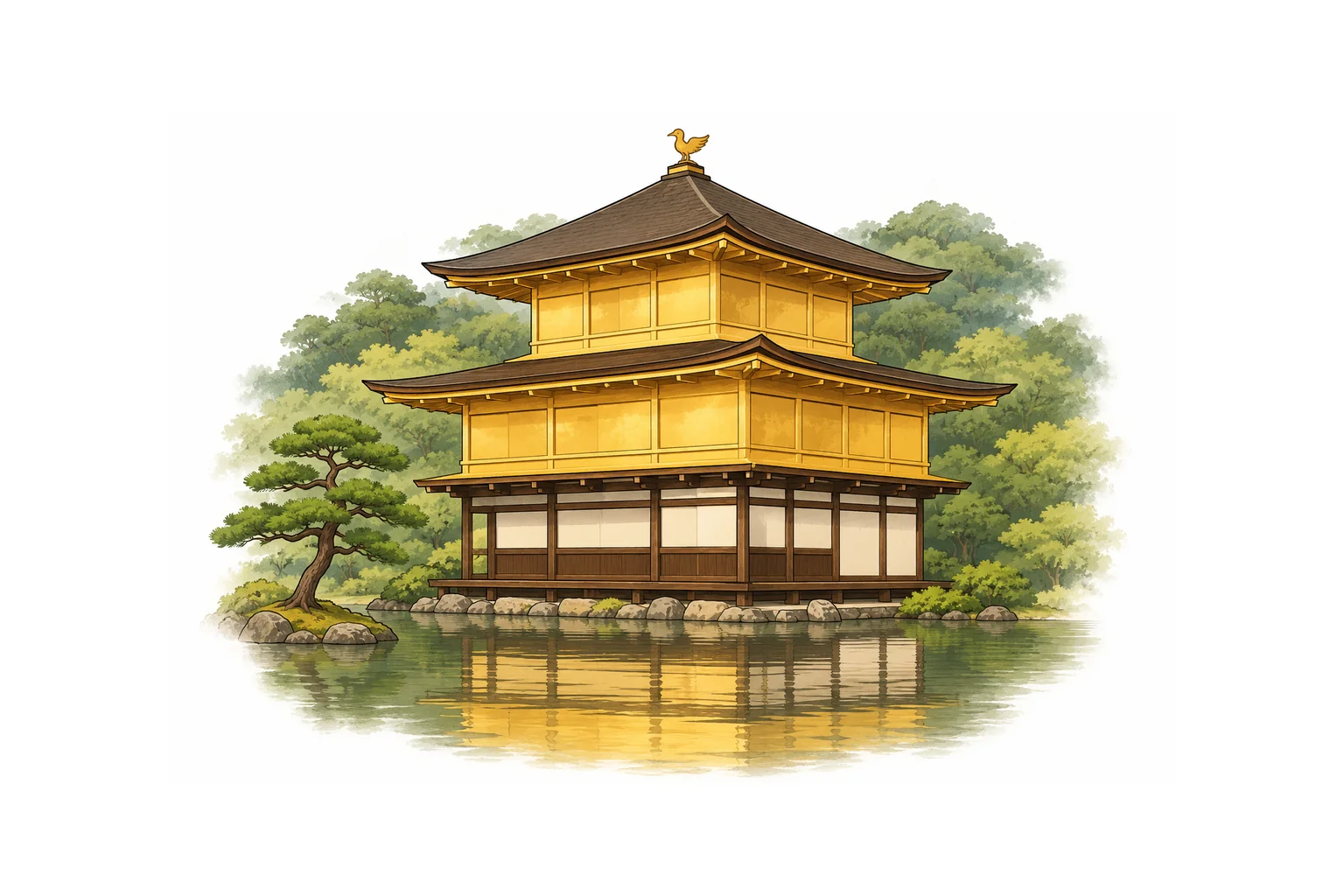
Yoshimitsu also rose within the court itself, reaching the highest office, chancellor of the realm, which no warrior had held since Taira no Kiyomori two centuries earlier. In 1394 he passed the title of shogun to his young son Yoshimochi, and the following year took Buddhist vows, while keeping all real authority. He governed from a new villa in the northern hills of Kyoto, the Kitayama palace, whose gilded three-story relic hall survives in rebuilt form as the Golden Pavilion at Kinkaku-ji. His wife was named honorary mother to the emperor, and his processions followed the protocol for a retired sovereign. An influential theory once held that he planned to put a son on the throne and take the imperial position for his own house. Most historians now doubt this and think he sought something closer to the standing of a retired emperor presiding over both court and warriors.
The government he perfected was a coalition. Beneath the shogun stood a deputy, the kanrei, drawn in rotation from three related houses: Hosokawa, Shiba and Hatakeyama. The board that policed Kyoto was headed by one of four others, among them the Yamana and the Akamatsu. These great governors lived in the capital, sat in council, and left their provinces to deputies. A strong shogun could play them against one another; a weak one became their instrument. The east was handled separately through a branch government in Kamakura under a hereditary line descended from Takauji's son Motouji, assisted by the Uesugi family. This eastern branch repeatedly defied Kyoto.
The shogunate owned relatively little land. Much of its income came from the commercial life of the capital: levies on pawnbroker-moneylenders and sake brewers, tolls at barriers and harbors, and the profits of foreign trade.
5"King of Japan": trade and the sea
The great problem of East Asian waters in the later fourteenth century was piracy. Armed bands known as wakō, based on Tsushima, Iki and the coasts of northern Kyūshū raided the Korean peninsula and the Chinese coast for grain and captives. The Goryeo court in Korea and the Ming dynasty, founded in China in 1368, both sent envoys demanding suppression. The Ming first dealt with Prince Kaneyoshi in Kyūshū and addressed him as king of Japan.
The Ming banned private overseas trade and received only embassies from rulers who acknowledged the emperor, and such embassies could trade. Yoshimitsu wanted that commerce and the recognition that came with it. He sent envoys in 1401, and the reply the next year addressed him as "King of Japan." In 1404 envoys of the Yongle Emperor brought tallies, certificates divided in two so that the halves could be matched on arrival. Only ships carrying them counted as official. This is the tally trade, kangō bōeki.
Ships put in at Ningbo for inspection and the envoys traveled on to the Ming capital, Nanjing at first and Beijing after the court moved there in 1421. Japan sent swords, sulfur, copper, folding fans and lacquerware, and brought back copper coins, raw silk, textiles, books and paintings. The Ming paid the embassy's costs in China and charged no duty, so the returns were very large. The coins mattered most. Japan minted none of its own in this period, and its markets ran on imported Chinese cash.
Accepting investiture from a foreign emperor drew criticism in Japan at the time. Yoshimochi broke off relations in 1411, and the sixth shogun, Yoshinori, restored them in 1432. Over about 140 years fewer than twenty missions sailed. In the later ones the shogunate was only a name on the paperwork. The Hosokawa, backed by merchants of Sakai, and the Ōuchi, backed by those of Hakata, ran the voyages, and in 1523 their rival delegations fought each other in the streets of Ningbo. The trade ended when the Ōuchi fell in the mid-sixteenth century.
Contact with Korea was more frequent. The Joseon dynasty, founded in 1392, granted trading privileges to many Japanese parties and regulated them closely. In 1419 a Joseon fleet attacked Tsushima as a pirate base, an event known in Japan as the Ōei Invasion and in Korea as the Gihae Expedition. Afterward trade settled into an agreed system managed through the Sō family of Tsushima. Cotton cloth, still rare in Japan, was the chief Korean export. To the south, the Ryūkyū islands were unified in 1429 under Shō Hashi and prospered as a relay point between China, Japan and Southeast Asia.
6The shogun chosen by lot
Yoshimitsu died in 1408. His son Yoshimochi ruled cautiously and kept a rough balance with the great governors. When Yoshimochi lay dying in 1428, his only son already dead, he declined to name an heir, saying that a choice the lords did not accept would be worthless. The senior vassals wrote the names of his four brothers, all Buddhist priests, on slips and drew one before the god at Iwashimizu Hachimangū. The lot fell on a former head of the Tendai school. He returned to lay life as Ashikaga Yoshinori.
Yoshinori believed he had been chosen by the gods and set out to restore the authority Yoshimitsu had held. He judged lawsuits in person, reopened the Ming trade, and in 1438–1439 destroyed the defiant eastern branch under Ashikaga Mochiuji in the Eikyō Rebellion. He was also frightening. Dozens of courtiers, priests and warriors were punished for small offenses, and the heads of two governor houses were killed on his orders. An imperial prince wrote in his diary that everyone lived in terror. Zeami, the great master of Noh, was banished to the island of Sado in 1434, in his seventies, for reasons that remain unknown.
In 1441 Akamatsu Mitsusuke, governor of three provinces, heard a rumor that he was next. He invited the shogun to his Kyoto mansion for a performance celebrating a victory in the east, and during the entertainment his men burst in and cut Yoshinori down. The Akamatsu were hunted down within months, but the damage could not be undone. A shogun had been murdered at a banquet by a vassal. His successors were children, and power drifted to the deputies and to palace insiders.
7Villages, markets and leagues
Beneath the politics, the country was becoming more productive. In the advanced central provinces farmers took two crops a year from the same field, rice in summer and wheat or barley in winter. Song Hui-gyeong, a Korean envoy who traveled to Kyoto in 1420, recorded fields near the Inland Sea that yielded three.
The surplus moved through markets. Periodic markets that had met three times a month now commonly met six times. Rents were increasingly paid in coin. Craftsmen and merchants organized in guilds called za, paying a temple, shrine or noble patron for a monopoly in their trade. Packhorse drivers hauled goods overland and warehouse-merchants handled them at the ports. Sakai, Hakata and Hyōgo grew into trading cities where leading merchants shared in running the town.
Villages changed as well. Around the capital, farmers formed self-governing communities called sō. They held assemblies, wrote village codes, managed woodland and irrigation in common, punished thieves themselves, and contracted with the landlord to deliver the whole village's dues in a lump, which kept his agents outside the village.
The word ikki originally meant a league of people sworn to a common purpose, and came to mean the uprisings such leagues carried out. In 1428, with a new shogun, a new emperor, famine and epidemic all in one year, packhorse drivers in Ōmi province rose to demand tokusei, "virtuous government," which by now meant a cancellation of debts. Farmers around Kyoto joined them, broke into pawnshops and breweries, took back their pledges and burned the loan records. A priest in Nara wrote that nothing like it had happened since the country began. After Yoshinori's murder in 1441, tens of thousands surrounded the capital and forced the shogunate to issue its first formal debt cancellation. Such risings then became almost routine.
Two later leagues went further. In 1485 the local warriors and farmers of southern Yamashiro, just outside Kyoto, ordered two feuding armies out of their district and ran it themselves for eight years. In 1488, in Kaga province on the Sea of Japan coast, followers of the Hongan-ji branch of True Pure Land Buddhism overthrew their governor. Their leader Rennyo had built a network of village congregations through plain-language pastoral letters, and those congregations could be mobilized as armies. Kaga was ruled by the sect and its adherents for nearly a century.
8The Ōnin War
The eighth shogun, Yoshimasa, took office in 1449 as a boy. As an adult he tried for a time to rule in earnest, was repeatedly thwarted, and turned to buildings, gardens and art. During a terrible famine around 1460, a monk's diary reports some 80,000 dead in Kyoto in two months and corpses damming the Kamo River. Yoshimasa was then rebuilding his palace, and the emperor sent him a poem of reproach.
Three disputes ran together. Yoshimasa had no son, so in 1464 he brought a brother out of the priesthood as his heir, under the name Yoshimi. The next year his wife, Hino Tomiko, gave birth to a boy, Yoshihisa. Meanwhile two of the three deputy houses, Hatakeyama and Shiba, were each split between rival claimants. And the two most powerful men in the government, Hosokawa Katsumoto and his father-in-law Yamana Sōzen, backed opposite sides. Older accounts blame Tomiko's ambition for her son, an image that owes much to a later war chronicle, the Ōnin-ki. Current opinion sees the Hatakeyama feud as the trigger and treats her role as exaggerated.
Fighting began in the first month of 1467 at a shrine in northern Kyoto. By summer governors from across the country had brought their armies into the city. Hosokawa's camp lay to the east and Yamana's to the west; the weaving district of Nishijin, "western camp," still carries the name. The Ōnin-ki gives the Eastern Army 160,000 men and the Western 110,000, figures that are surely inflated but indicate the scale.
The war lasted eleven years and was fought largely inside Kyoto. Both sides hired ashigaru, lightly armed foot soldiers outside the regular warrior bands, who specialized in arson and plunder. Shōkoku-ji and other great temples burned, along with mansion after mansion. Nobles and priests scattered to the provinces. The fighting settled into stalemate, and partway through the succession camps even swapped: Yoshimi went over to the Western Army while Yoshimasa and his son stayed with the Eastern. Both Sōzen and Katsumoto died of illness in 1473, and Yoshimasa passed the shogunal title to the eight-year-old Yoshihisa. In 1477 the western lords went home. Nobody had won.
The real consequences lay outside the capital. While the governors had been camped in Kyoto, the deputies and local warriors who ran their provinces had taken control. Many governors returned to find their orders ignored, and some were driven out altogether. People at the time called this gekokujō, the low overturning the high. The great lords no longer lived in Kyoto, and the coalition that had been the shogunate ceased to exist.
9What the period made
Muromachi culture is conventionally divided into the Kitayama phase of Yoshimitsu's day, showy and confident, and the Higashiyama phase of Yoshimasa's, quieter and more austere. Running through both are Zen Buddhism and admiration for things Chinese. The shogunate sponsored the Rinzai school of Zen and ranked its leading monasteries in a system called the Five Mountains, modeled on Song China. Their monks read and wrote Chinese, drafted diplomatic letters, composed poetry and painted. Tenryū-ji, founded by Takauji to pray for the spirit of Go-Daigo, was built under the Zen master Musō Soseki with profits from a trading ship sent to China.
Noh grew out of sarugaku, a mixed entertainment performed at temple and shrine festivals. Around 1375 the actor Kan'ami performed at Imakumano in Kyoto with his son, then about eleven. The teenage Yoshimitsu was in the audience and was captivated by the boy, and from then on the troupe had the shogun's patronage. The son, Zeami, turned the form into a restrained drama of chant and dance aiming at yūgen, a quality of subdued, mysterious grace. He wrote dozens of plays and a series of treatises, beginning with the Fūshikaden, on how an actor keeps his "flower," his power to hold an audience, through each stage of life. Between Noh plays came kyōgen, short comedies in everyday speech that mocked lords, priests and foolish masters.
Ink painting arrived with Zen. Its greatest Japanese practitioner, Sesshū, painter of a long landscape scroll of the four seasons, sailed to China on a trade mission in 1467, traveled there for two years, and afterward worked mainly in the far west of Honshū under Ōuchi patronage. In temple gardens, designers used raked gravel and stones to suggest mountains and water without using water at all. The rock garden at Ryōan-ji is the classic example.
After the war Yoshimasa retired to the eastern hills, where from 1482 he built the villa that became Ginkaku-ji, the Silver Pavilion. It was never covered in silver. A small study there, the Dōjinsai, has a floor completely covered in tatami mats, a built-in desk and staggered shelves for displaying objects, and sliding paper screens. This shoin style is the origin of the traditional Japanese room. In such rooms men gathered to drink tea, arrange flowers and appraise imported Chinese objects. Murata Jukō brought a Zen sensibility to tea, favoring small plain rooms and imperfect utensils, the start of what became wabi tea. Ikenobō Senkei, a priest at the Rokkaku-dō in Kyoto, won fame for his flower arrangements, and the Ikenobō school traces its line to him.
Linked verse, renga, composed in turn by a group, was a passion shared by nobles, warriors, monks and townsmen. The poet Sōgi traveled from one provincial lord to another, carrying the tastes of the capital with him. The Zen monk Ikkyū Sōjun, believed on good contemporary evidence to have been an emperor's son, mocked the hypocrisy of the religious establishment in sharp Chinese verse. The tales of Ikkyū as a clever boy acolyte are inventions of later centuries. And in 1500 the townspeople of Kyoto revived the Gion festival, suspended since the war, paying for the floats neighborhood by neighborhood, as they still do.
10A long ending
The shogunate survived the Ōnin War by nearly a century, steadily hollowed out. Yoshihisa tried to reassert himself by leading an army against a disobedient governor in Ōmi in 1487, and died of illness in camp two years later, in his early twenties. Yoshimasa died in 1490. In 1493 the deputy Hosokawa Masamoto waited until the tenth shogun was away on campaign and installed a replacement in Kyoto, an event called the Meiō Coup. From then on shoguns were made and unmade by the Hosokawa and later by the Hosokawa's own vassals, the Miyoshi, and spent long periods as refugees. Many historians date the true start of the Warring States period from 1493 rather than 1467. Around the same year a former shogunal official, Ise Sōzui, remembered as Hōjō Sōun, invaded Izu province and made himself its master, an early example of the self-made warlord.
Over the following decades regional lords wrote their own law codes, surveyed their lands and fought their neighbors. Around 1543 a ship carrying Portuguese traders reached the island of Tanegashima with matchlock guns, and in 1549 the Jesuit Francis Xavier landed at Kagoshima.
In 1565 the thirteenth shogun, Yoshiteru, was attacked and killed in his own palace by Miyoshi forces. His brother Yoshiaki wandered in search of a protector and found one in Oda Nobunaga, a rising lord from Owari, who escorted him into Kyoto in 1568 and had him installed as fifteenth shogun. The two soon fell out, and Yoshiaki began organizing other lords against his patron. In 1573 Nobunaga defeated him and expelled him from the capital. Yoshiaki kept the title for years afterward under the shelter of the Mōri in western Japan, but there was never again an Ashikaga shogun in Kyoto, and the Muromachi shogunate is counted as ending in that year. What followed was unification under Nobunaga and his successor Toyotomi Hideyoshi.