
This period in brief
The Meiji Period
Forty-five years that turned a league of domains into an empire
1A reign that became an era
The Meiji period runs from 1868 to 1912, and it is the first period of Japanese history to be measured by a single emperor's reign. In October 1868 the new government changed the era name to Meiji, "enlightened rule," a phrase taken from the Chinese classic the Book of Changes, and announced that from then on there would be one era name per emperor. Earlier emperors had changed era names after earthquakes, comets, or lucky omens. Now the calendar and the monarch moved together, and the emperor Mutsuhito is known to history by the name of his era.
He was fourteen when he succeeded his father in early 1867, and he did not make the revolution that was carried out in his name. That was the work of a few dozen men, most of them middle- and lower-ranking samurai from two domains in the southwest, Satsuma (modern Kagoshima) and Chōshū (modern Yamaguchi), along with a handful of court nobles such as Iwakura Tomomi. In January 1868 they declared the Tokugawa shogunate abolished and the emperor's direct rule "restored." The civil war that followed, the Boshin War, moved north and east for a year and a half. Edo, the shogun's capital, was handed over by negotiation, without a battle for the city. The domain of Aizu held out under siege in its castle for a month. The last Tokugawa loyalists sailed the shogunate's fleet to Hakodate in the far north and surrendered at the star-shaped fort of Goryōkaku in June 1869.
While the fighting went on, the new leaders had the young emperor swear a five-article oath before the gods, known as the Charter Oath. Its first article promised that "deliberative assemblies shall be widely established and all matters decided by public discussion"; its last, that "knowledge shall be sought throughout the world." The wording was loose enough that parliamentarians and Westernizers alike would later quote it. Edo was renamed Tokyo, "eastern capital," and in 1869 the emperor moved into the former shogun's castle. No edict ever formally transferred the capital from Kyoto.
2Dismantling the old order
The shogunate was gone, but Japan was still divided into more than 260 domains, each with its own lord (daimyo), army, and tax revenue. The new government directly controlled only the lands it had taken from the Tokugawa. Its leading figures, Ōkubo Toshimichi of Satsuma and Kido Takayoshi of Chōshū, understood that unless the domains went, they were running a coalition and not a state.
They moved in two steps. In 1869 the lords of four leading domains "returned" their land registers and population registers to the emperor, and the rest followed; each was reappointed as governor of his old territory. Then, in August 1871, with about ten thousand loyal troops gathered in Tokyo, the government summoned the governors to the palace and read them an edict: the domains were abolished and replaced with prefectures run by officials sent from the center. The former lords were ordered to live in Tokyo. There was no resistance to speak of. Most domains were deep in debt, and the government took over the debts and guaranteed the lords an income and a title.
The people who lost most were the samurai, roughly four hundred thousand households. The old status order of warriors, farmers, artisans, and merchants was abolished. Commoners could take surnames, ride horses, choose their trade, and marry across the old lines. The outcaste categories were ended by law in 1871, though discrimination long outlasted the decree. Samurai stipends, which consumed about a third of government spending, were converted in 1876 into one-time bonds, and in the same year wearing swords in public was banned. Former samurai became officials, policemen, and schoolteachers, or went into business, often disastrously.
Three reforms of 1872 and 1873 reached into every village. The Education System Order called for elementary schools throughout the country, for girls as well as boys. The conscription ordinance made men liable at age twenty for three years of military service, ending the samurai monopoly on arms. And the land-tax reform replaced the old rice levy, which had varied with the harvest, with a cash tax of 3 percent of the assessed value of the land, payable by whoever held the title deed. The state now had a predictable income. Farmers had school fees, a lost pair of hands, and a tax bill that did not shrink in a bad year. The conscription notice used the phrase "blood tax," and rumors spread that the government meant it literally; riots followed, and some new schoolhouses were wrecked. After large tax uprisings in 1876 the rate was cut to 2.5 percent.
3Looking at the West, and living with it
In December 1871, only four months after abolishing the domains, the government sent half of its leadership abroad. The Iwakura Mission, headed by Iwakura Tomomi with Ōkubo, Kido, and the young Itō Hirobumi among its deputies, traveled through the United States and Europe for a year and ten months. Its first purpose, to open talks on revising the unequal treaties signed in the shogunate's last years, went nowhere in Washington. Its second, to see how Western countries actually worked, filled volumes: factories, parliaments, prisons, schools, shipyards. Among the students who sailed with it were five girls, the youngest of them Tsuda Umeko, six years old, who grew up in America and later founded a women's college in Tokyo. In Berlin, Bismarck told the envoys at dinner that international law protected only the strong. They remembered it.
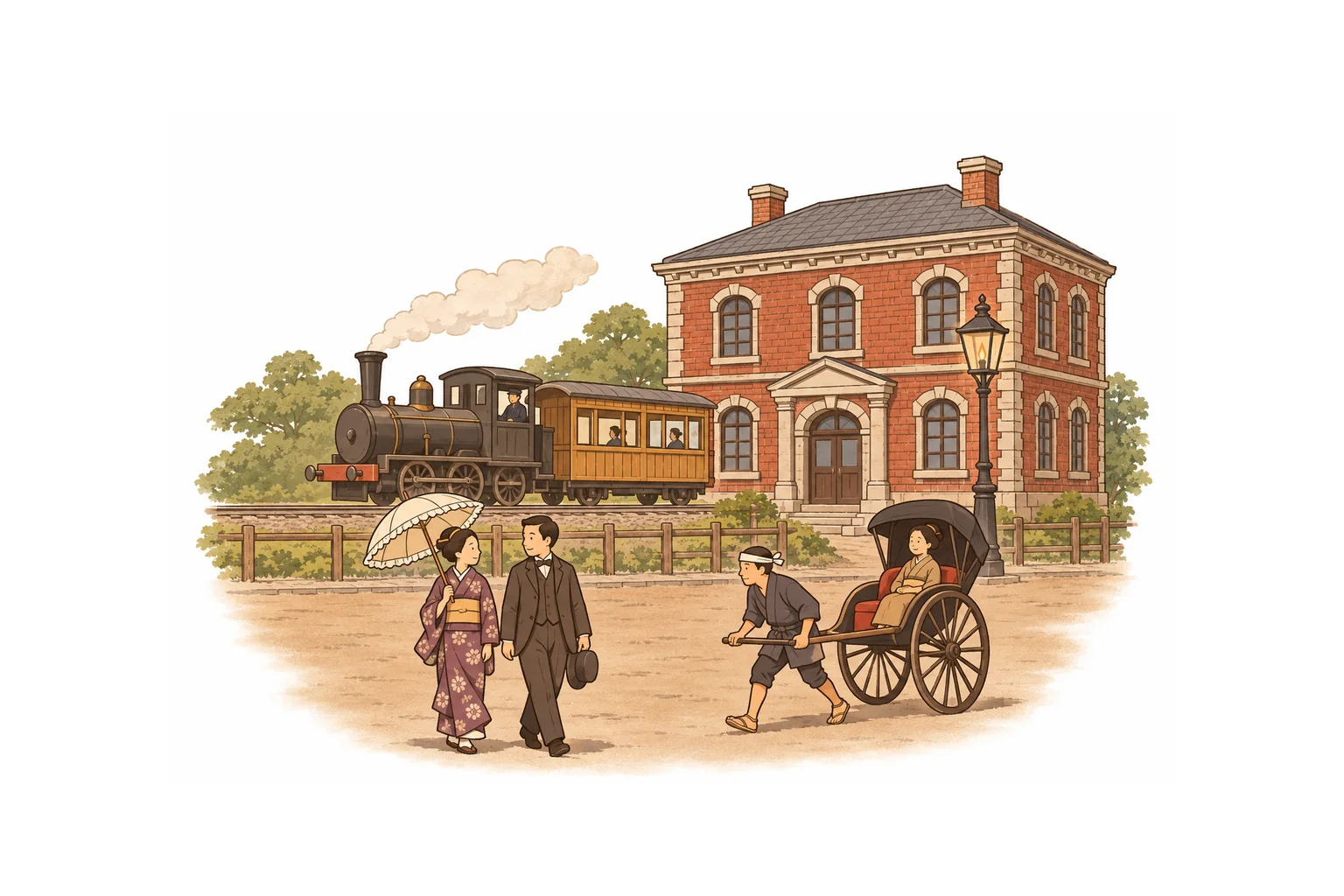
At home the slogan of the 1870s was bunmei kaika, "civilization and enlightenment." A railway opened between Shinbashi in Tokyo and the port of Yokohama in 1872, covering in under an hour what had been a day's walk. The same year a government silk-reeling mill opened at Tomioka with French machinery and instructors, staffed by young women who were expected to carry the techniques back to their home districts. Telegraph lines, a postal service, gas lamps, and a brick-built shopping street in Ginza followed. Men cut off their topknots; beef stew became fashionable; the emperor appeared in Western military uniform. At the end of 1872 the government switched to the solar calendar almost without warning, so that the third day of the twelfth lunar month became January 1, 1873. Rural Japan went on keeping festivals by the old calendar for decades.
The most widely read voice of these years belonged to a man who refused government office. Fukuzawa Yukichi ran a private school, later Keiō University, and from 1872 published Gakumon no susume (An Encouragement of Learning) in installments. Its opening line says that heaven does not create one person above or below another; the differences among people come from learning, and a country is independent only if its people are. The pamphlets are said to have sold more than three million copies in a country of some thirty-five million.
Enlightenment had a harsh side as well. To raise up Shinto as the cult of the imperial state, the government ordered shrines separated from the Buddhist temples with which they had been merged for centuries, and in many places this turned into the destruction of temples, images, and scriptures. The ban on Christianity was quietly dropped in 1873 under foreign pressure.
4The split of 1873 and the last samurai war
When the mission returned in the autumn of 1873 it collided with the colleagues it had left in charge. The issue was Korea, whose court had refused to recognize the new Japanese government's diplomatic letters. Saigō Takamori, the Satsuma general who had commanded the armies of 1868, proposed going to Korea himself as envoy; whether he intended to provoke a war is still debated. Ōkubo and Iwakura argued that Japan could not afford a foreign adventure. The emperor's ruling went their way, and Saigō resigned along with several others, among them Itagaki Taisuke of Tosa.
Those who walked out took two different roads. Itagaki and seven others petitioned in 1874 for an elected national assembly, opening the argument that would dominate the next fifteen years. Others took up arms. A string of samurai revolts broke out in western Japan, and in February 1877 the students of the private academies Saigō had founded in Kagoshima rose and carried him with them. Some thirteen thousand men marched north and besieged Kumamoto Castle; about thirty thousand joined Saigō's side in all. The castle was held by a garrison of conscripts. The peasant soldiers did not break. After seven months of fighting, Saigō, wounded on a hill above Kagoshima, took his own life on September 24, 1877. The Satsuma Rebellion was Japan's last civil war, and it settled the question of whether a conscript army could beat samurai.
Within little more than a year the three leading figures of the Restoration were dead. Kido died of illness during the rebellion. Ōkubo, who had built the powerful Home Ministry and effectively ran the government, was cut down by six disaffected former samurai on his way to work in Tokyo in May 1878. Leadership passed to slightly younger men: Itō Hirobumi, Yamagata Aritomo, who had built the army, and Ōkuma Shigenobu, who managed the finances.
The same years fixed the borders. The northern island of Ezo was renamed Hokkaidō in 1869 and placed under a Development Commission, which laid out the new city of Sapporo, brought in settlers and farmer-soldiers, and opened an agricultural college with American teachers. The Ainu, who had lived there for centuries, lost their hunting and fishing grounds and were pressed to adopt Japanese ways. In 1875 Japan gave up its claims on Sakhalin to Russia in exchange for the eighteen northern Kuril Islands. In the south, the Ryūkyū kingdom, which had long paid tribute to both China and Satsuma, was made a Japanese domain in 1872 and, in 1879, occupied by troops and police and turned into Okinawa Prefecture; China protested, without result. And in 1876, after a clash between a Japanese warship and Korean shore batteries near Ganghwa Island, Japan imposed on Korea a treaty with the same kind of extraterritorial privileges that Japan resented in its own treaties with the West.
5A movement and a constitution
After 1877 opposition moved into lecture halls and newspapers. The Freedom and People's Rights Movement began among former samurai and spread to prosperous farmers, village schoolteachers, and merchants. Local societies debated political theory and wrote their own draft constitutions, and petitions for a national assembly gathered well over two hundred thousand signatures.
Inside the government, Ōkuma proposed an early parliament and British-style party cabinets. In 1881, when newspapers exposed a plan to sell the Hokkaidō Development Commission's assets cheaply to a businessman with Satsuma connections, the resulting uproar gave his rivals their opening. In October the sale was canceled, Ōkuma was dismissed, and an imperial rescript promised a national assembly in 1890. Itagaki organized the Liberal Party; Ōkuma organized a rival party and founded the school that became Waseda University. But the deflation policy of Finance Minister Matsukata Masayoshi, who was withdrawing the paper money printed to pay for the Satsuma war, sent rice and silk prices tumbling. Many small farmers lost their land and became tenants, and a few desperate risings in the mid-1880s, the largest at Chichibu, were put down by troops.
Itō spent more than a year in Europe studying constitutions, mostly with scholars in Berlin and Vienna, and came home convinced that a system with a strong monarch suited Japan. In 1885 he replaced the old Council of State, an institution modeled on eighth-century precedent, with a cabinet, and became the first prime minister. He and a few aides, above all the legal official Inoue Kowashi, then drafted the constitution in private.
The Constitution of the Empire of Japan was promulgated on February 11, 1889, as a gift from the emperor to his subjects. The emperor held sovereignty and supreme command of the army and navy. An Imperial Diet of two houses, an appointed and hereditary House of Peers and an elected House of Representatives, had to approve laws and budgets. Subjects enjoyed freedom of speech, assembly, and religion "within the limits of the law." Ministers answered to the emperor and not to the Diet, and the military chain of command ran outside the cabinet altogether, two features with long consequences. In the first election, in July 1890, the vote was limited to men over twenty-five who paid at least fifteen yen in national taxes, about 450,000 people or roughly 1 percent of the population. The opposition parties won a majority anyway, and the early sessions were consumed by fights over the military budget.
Two imperial pronouncements completed the framework. The Rescript to Soldiers and Sailors of 1882 told servicemen that their loyalty was owed directly to the emperor and that they should stay out of politics. The Rescript on Education of 1890 enjoined filial piety, harmony, and readiness to serve the state in an emergency; it was read aloud at school ceremonies for the next half-century.
6Mills, mines, and the people who worked them
In its first decade the government built and ran model factories, mines, and railways itself. Most lost money, and in the 1880s they were sold off cheaply to private buyers, among them the houses that grew into Mitsui and Mitsubishi. Iwasaki Yatarō built Mitsubishi on shipping, carrying troops and supplies for the government. Shibusawa Eiichi left the Finance Ministry in 1873 to head Japan's first modern bank and went on to help found, by the usual count, around five hundred companies, arguing that business should be run on joint-stock lines and with a sense of ethics.
Industrial growth took hold in the late 1880s, led by textiles. The Ōsaka Spinning Mill ran steam-driven spindles in two shifts around the clock under electric light, and by the late 1890s Japan exported more cotton yarn than it imported. Raw silk, sold mainly to the United States, was the largest export of all and paid for machinery and warships. Both industries depended on teenage girls from farm families, recruited on multi-year contracts, housed in dormitories, and worked twelve hours a day or more; tuberculosis spread through the mills. Heavy industry came later. The state-owned Yawata steelworks in northern Kyūshū, built partly with the indemnity from the war with China, began operating in 1901. A trunk railway linked Tokyo and Kōbe by 1889, and the main lines were nationalized in 1906.
The costs were visible at the Ashio copper mine north of Tokyo, where waste washed into the Watarase River, killed the fish, and poisoned the fields downstream after every flood. The local Diet member, Tanaka Shōzō, raised the matter in parliament for a decade. In 1901 he resigned his seat and tried to hand a petition directly to the emperor's carriage in the street. He was stopped, but the attempt made the pollution a national issue. A Factory Act giving limited protection to women and children was passed only in 1911 and not enforced until 1916.
The population grew from about thirty-five million to about fifty million over the period. Elementary school enrollment passed 90 percent in the first years of the new century, and a reading public came into being. Writers remade the language of literature. Masaoka Shiki used newspaper columns to argue that haiku should sketch from life, and kept writing through years of illness until his death in 1902. Higuchi Ichiyō, who supported her family by her pen, wrote about children growing up on the edge of Tokyo's licensed quarter before dying of tuberculosis at twenty-four. Natsume Sōseki, back from an unhappy stay in London, published I Am a Cat in 1905, a satire of Westernized intellectuals narrated by a nameless house cat. And on the coast of Mie Prefecture, Mikimoto Kōkichi began experimenting with pearl oysters in 1888, raised his first half-round cultured pearls in 1893, and later turned them into an export.
7Treaty revision and the war with China
The treaties of the 1850s exempted foreigners in Japan from Japanese courts and denied Japan control of its own tariffs. Every Meiji government tried to revise them. Foreign Minister Inoue Kaoru hoped to persuade the powers by display: the Rokumeikan, a brick hall opened in Tokyo in 1883, hosted balls where officials and their wives waltzed in Western dress. The press mocked it, and his proposal to seat foreign judges in Japanese courts was shouted down. Ōkuma tried a similar plan in 1889 and lost a leg to a nationalist's bomb. In 1891 a policeman guarding the visiting Russian crown prince at Ōtsu slashed him with a saber. The cabinet, afraid of Russian retaliation, demanded the death penalty, but the chief justice insisted the law allowed only life imprisonment. In July 1894 Foreign Minister Mutsu Munemitsu finally signed a treaty with Britain ending extraterritoriality, effective 1899. Full tariff autonomy came in 1911.
Days after that treaty was signed, Japan was at war with Qing China. The two had been competing for influence in Korea for more than a decade. In 1894 a peasant rebellion inspired by the Donghak religious movement spread across southern Korea; the Korean court asked China for troops, and Japan sent its own. When the rebellion subsided the Japanese did not leave. On July 23 they seized Gyeongbok Palace in Seoul and installed a new government, and two days later the navies exchanged fire. Japanese forces won at Pyongyang and in the Yellow Sea, crossed into Manchuria, and took the naval bases of Port Arthur and Weihaiwei. In the days after the capture of Port Arthur, Japanese troops killed a large number of noncombatants, and Western correspondents reported it at the time. There is no agreed figure for the dead; Chinese accounts, Japanese researchers, and the correspondents of the day give widely different numbers.
In March 1895 the Qing statesman Li Hongzhang came to Shimonoseki to negotiate with Itō and Mutsu. The treaty, signed on April 17, recognized Korea's independence from China, ceded Taiwan, the Pescadores, and the Liaodong Peninsula to Japan, and imposed an indemnity of 200 million taels of silver. Six days later Russia, Germany, and France "advised" Japan to return Liaodong. Japan complied, for an additional payment, and the humiliation fed a decade of rearmament aimed at Russia. In Taiwan, local officials and residents resisted the transfer in arms; it took the Japanese army five months to reach the south of the island, and guerrilla resistance continued for years under what became fifty years of colonial rule.
Victory did not deliver Korea. King Gojong's consort, known posthumously as Empress Myeongseong, and her faction turned to Russia. On October 8, 1895, in a plot organized by the Japanese minister Miura Gorō, Japanese troops, legation staff, and civilian adventurers broke into the palace and killed her. Miura and others were recalled to Japan and, after a preliminary hearing in Hiroshima, released for lack of evidence; the army officers involved were acquitted by a court-martial. Gojong took refuge in the Russian legation for a year, and in 1897 proclaimed the Korean Empire with himself as emperor.
8War with Russia and the annexation of Korea
Russia soon leased Port Arthur for itself, built railways across Manchuria, and after the Boxer uprising of 1900 kept an army there. Japan answered in 1902 with an alliance with Britain, its first with a European power on equal terms. Talks with Russia over Korea and Manchuria failed, and in February 1904 the Japanese navy attacked Russian ships at Port Arthur and Incheon.
This war was far harder than the last. General Nogi Maresuke's army spent nearly five months assaulting the forts of Port Arthur and suffered about sixty thousand casualties; both of his sons were killed in the war. At Mukden in March 1905 more than half a million men fought, and the Japanese won without the strength to pursue. On May 27 and 28, in the Tsushima Strait, Admiral Tōgō Heihachirō's fleet destroyed the Russian Baltic Fleet, which had sailed halfway around the world. By then Japan had mobilized about a million men, lost more than eighty thousand dead, and borrowed heavily in London and New York. Russia faced revolution at home. President Theodore Roosevelt mediated, and the Treaty of Portsmouth, signed September 5, 1905, gave Japan recognition of its paramount interests in Korea, the Russian lease on Port Arthur and Dalian, the railway south of Changchun, and the southern half of Sakhalin, but no indemnity.
The public, fed on victory reports, had expected much more. On the day of the signing a protest rally in Tokyo's Hibiya Park turned into three days of rioting. Crowds burned police boxes and streetcars, martial law was declared, and seventeen people died.
The settlement fell most heavily on Korea. In November 1905, with Japanese troops around the palace, Itō pressed Korean ministers to sign a treaty transferring Korea's foreign relations to Japan, and became the first resident-general in Seoul. Gojong, who had not signed, sent secret envoys to the Hague Peace Conference in 1907; they were refused a hearing. Japan forced him to abdicate, took over internal administration, and disbanded the Korean army, many of whose soldiers joined the "righteous armies" fighting a guerrilla war that Japanese forces suppressed over the following years. On October 26, 1909, a Korean independence activist, An Jung-geun, shot Itō dead on the railway platform at Harbin. He was tried by a Japanese court and executed the following March. He is honored in Korea as a patriot. The Japanese cabinet had already adopted annexation as policy before the shooting. The annexation treaty was signed on August 22, 1910, and announced a week later. Korea was placed under a governor-general, the first of them an army general, who ruled through military police. Koreans have held that this treaty and the one of 1905 were imposed by force and were void from the start; the Japanese government's long-standing position has been that they were validly concluded under the international law of the time. When the two countries normalized relations in 1965 they agreed only that the treaties were "already null and void," and the two views remain unreconciled.
9The end of Meiji
By 1910 Japan had achieved what the men of 1868 set out to do, and more: treaty equality, an army and navy that had beaten two empires, and colonies of its own in Taiwan, Korea, and southern Sakhalin. At home the mood was less settled. Wartime taxes stayed, the countryside was poor, and socialists and labor organizers had appeared in the cities. In 1910 the police uncovered a plan by a few anarchists to assassinate the emperor and used it to arrest hundreds of radicals. After a closed trial, twenty-four were sentenced to death and twelve, including the writer Kōtoku Shūsui, were hanged in January 1911. Most historians think only a handful were involved in any plot. The High Treason Incident silenced the left for years.
In politics the founders had become elder statesmen, the genrō, who chose prime ministers from behind the scenes. Itō had conceded in 1900 that government needed a party and founded one himself; Yamagata built a rival base in the army and the bureaucracy. From 1901 the premiership alternated between Yamagata's protégé, General Katsura Tarō, and Itō's successor as party leader, Saionji Kinmochi.
Emperor Meiji died on July 30, 1912, aged fifty-nine. His son succeeded him, and the era name became Taishō. On the evening of the state funeral, September 13, as the cannon announced the departure of the hearse from the palace, General Nogi and his wife killed themselves at their home in Tokyo, following their lord in death according to a custom most people had thought extinct. Some contemporaries were moved; others were appalled. Two years later Sōseki, in his novel Kokoro, had a character say that the spirit of Meiji had begun and ended with the emperor.
What the Meiji period handed on was double-edged: an elected parliament, parties, newspapers, and a schooled population on one side, and on the other a military outside parliamentary control and an overseas empire. Under Taishō the first of these would produce a movement for party government and universal male suffrage. How the two legacies played out against each other belongs to the years after 1912.