
This period in brief
The Kofun Period
Keyhole Tombs and the Rise of the Yamato Kings
1An age named after its graves
Fly into Kansai on a clear day and you may see, among the houses of Sakai city south of Ōsaka, a wooded island shaped like a keyhole, ringed by three moats. It is 486 meters long. This is the Daisen tomb, officially designated by the Imperial Household Agency as the tomb of Emperor Nintoku, and by ground area it is among the largest burial monuments ever built anywhere.
Japan has roughly 160,000 ancient burial mounds. The Japanese word for them is kofun, "old mound," and the centuries in which they were built take their name from it. The Kofun period begins in the middle of the third century CE, when the first giant keyhole-shaped tomb appeared in the Nara Basin, and ends around the close of the sixth century, when the ruling families stopped building such tombs and began building Buddhist temples instead. By convention the political narrative is handed to the next period, Asuka, in 592.
In those three and a half centuries the scattered chiefdoms of the preceding Yayoi period were drawn into a single political order centered on the region the Japanese call Yamato, today's Nara Prefecture. Its rulers were called ōkimi, "great kings"; the title tennō, emperor, was not yet in use, and the imperial names used below (Yūryaku, Keitai, Kinmei) are posthumous labels applied much later. There are almost no contemporary Japanese written records. What we know comes from the tombs themselves, from a handful of inscribed swords, from Chinese dynastic histories and one Goguryeo stone monument, and from two chronicles compiled in the early eighth century, the Kojiki and the Nihon shoki, which preserve older traditions mixed with legend and later political editing.
2Hashihaka and the keyhole shape
The story starts at the foot of Mount Miwa in the southeastern Nara Basin. Here lies Hashihaka, a mound about 280 meters long, built in the middle or later third century. Next to it is the Makimuku site, a large planned settlement where archaeologists have found pottery carried in from many distant regions of the archipelago, a sign that people from all over were gathering there.
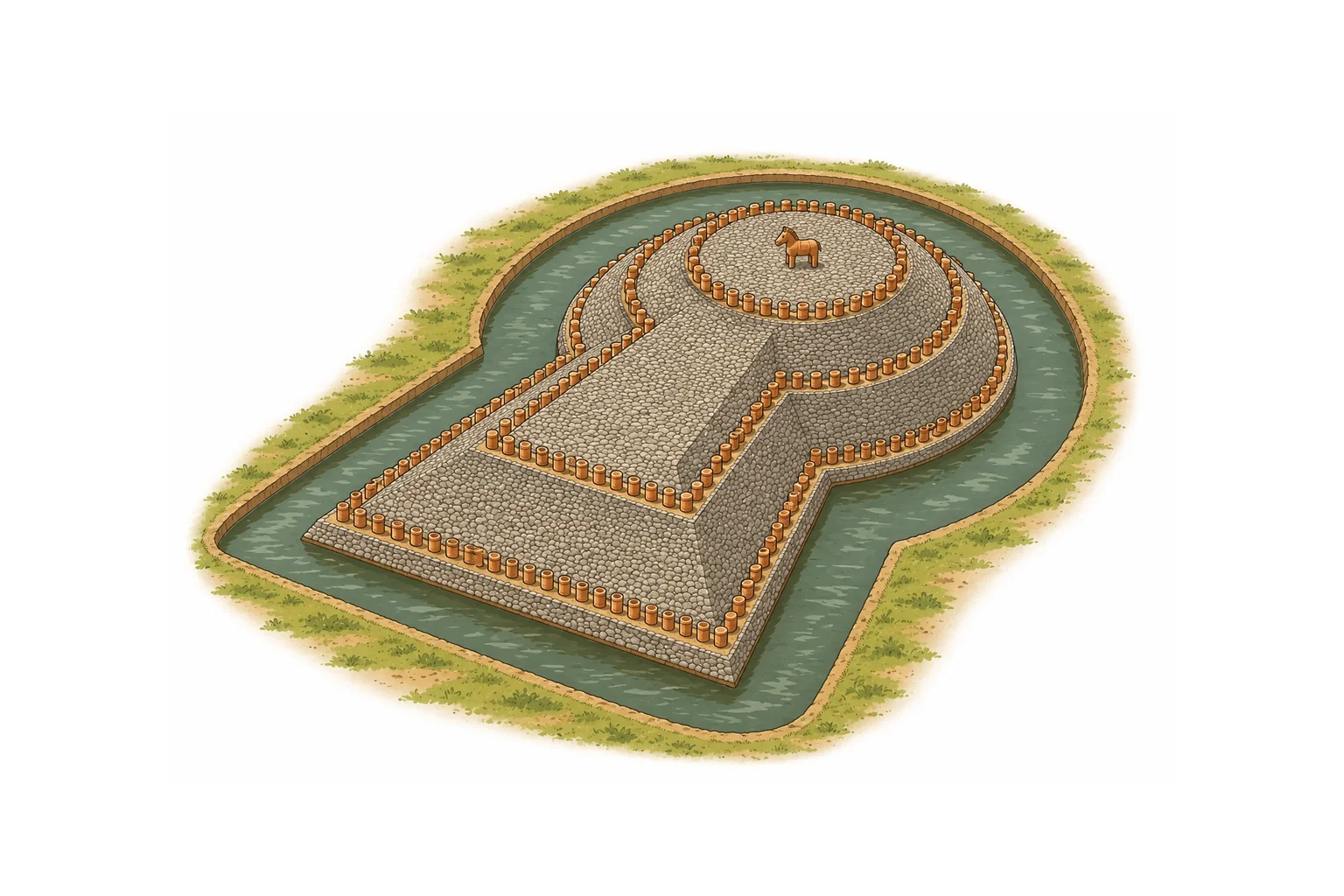
Hashihaka has the form that defines the age: a round mound joined to a projecting trapezoidal platform, so that from above it resembles an old-fashioned keyhole. Japanese archaeologists call this a zenpō-kōen-fun, "square front, round back." The body lay in the round part. The Nihon shoki says Hashihaka is the grave of a princess-shaman (the Imperial Household Agency still designates it as hers), built "by men during the day and by gods at night." Because its date falls close to the death, around 248, of Himiko, the queen of Wa described in the Chinese Records of Wei, some scholars think it is hers. That cannot be proved.
What matters more is what followed. Within a few decades, tombs of the same shape, with the same burial rites, were being built from Kyūshū to the Kantō plain. They came in graded sizes, and the largest were always in the Nara Basin or, later, on the Ōsaka plain. Most scholars read this as the mark of an alliance: regional chiefs acknowledged a leading house in Yamato and expressed their membership, and their rank within it, by the kind of tomb they were permitted to build. Nearly 5,000 keyhole tombs are known, from Iwate in the north to Kagoshima in the south. Lesser figures were buried under round or square mounds.
A new keyhole tomb did not look like the green hill it is today. Its slopes were paved with river stones and its terraces were lined with haniwa, unglazed clay cylinders set in rows. The cylinders descend from ritual pottery stands used in Kibi (modern Okayama) in late Yayoi times. Later craftsmen added clay houses, shields and quivers, roosters and waterfowl, and from the mid-fifth century figures of people, horses, and dogs: armored warriors, shrine maidens, wrestlers, falconers. The Nihon shoki claims haniwa were invented to replace the burial of live attendants. Archaeology does not support this: the plain cylinders came first by two centuries, and there is no evidence of mass human sacrifice at the tombs.
In the early tombs the dead chief lay in a long log coffin in a stone-lined pit at the summit, sealed once and never reopened. Beside him were bronze mirrors, beads, and stone bracelets, along with iron tools and swords. At the Kurozuka tomb in Nara, thirty-three large mirrors of the type called "triangular-rimmed deity-and-beast mirrors" stood in rows outside the coffin. More than 500 such mirrors have been found in Japan. One school holds that they are the "hundred bronze mirrors" the Wei emperor gave Himiko; another points out that no secure example has turned up in China and concludes they were cast in Japan. Either way, the early chiefs went to the grave equipped as ritual specialists as much as rulers.
3The silent fourth century
In 266 a ruler of Wa, the Chinese name for Japan, sent envoys to the Western Jin court. After that the Chinese histories say nothing about the islands for about a century and a half. Japanese historians call this gap "the blank fourth century."
On the Korean Peninsula it was a time of upheaval. Goguryeo in the north destroyed the old Chinese commandery of Lelang around 313. Two kingdoms formed in the south, Baekje in the west and Silla in the east, and between them along the Nakdong River lay a cluster of small polities known collectively as Gaya. Gaya had iron. The Japanese islands could not yet smelt iron in quantity, and the raw metal for tools and weapons arrived as flat ingots from the southern peninsula. Access to that iron, and control over its distribution at home, was one of the foundations of Yamato power.
Two inscribed objects break the silence. The first is the Seven-Branched Sword kept at Isonokami Jingū, a shrine in Nara Prefecture: an iron blade about 75 centimeters long with three prongs branching from each side. Its gold-inlaid inscription carries a damaged date usually read as 369 (other readings would put it in 268 or 468) and says it was made for the king of Wa by the crown prince of Baekje. Whether it was a tribute offering, a gift bestowed from above, or a present between equals is read differently by different scholars, often along national lines. On the usual dating, most take it as evidence of a Baekje–Wa alliance in the later fourth century.
The second is the stele raised in 414 beside the tomb of King Gwanggaeto of Goguryeo, in what is now Ji'an in China's Jilin Province. Among its 1,800 or so characters is a passage stating that Wa crossed the sea in 391 and subjugated Baekje and Silla, followed by accounts of Goguryeo armies driving Wa troops out of Silla in 400 and defeating them again in 404. The 391 sentence is damaged; its grammar and even its subject have been disputed for more than a century by Japanese, Korean, and Chinese scholars, and no reading commands general assent. The stele is also a eulogy, with every reason to magnify the enemy. Still, few doubt its basic implication that Wa forces fought on the peninsula around 400, alongside Baekje and Gaya and against Goguryeo.
They met cavalry there. The Records of Wei had noted that third-century Wa had no horses. In the fifth century, horse trappings, saddles, and armor suited to riding suddenly appear in Japanese tombs. In 1948 the scholar Egami Namio proposed that horse-riding conquerors from the continent had invaded and founded the ruling dynasty. The theory was famous in its day, but tomb styles change gradually across the supposed break, and few specialists accept it now. The usual explanation is that the Wa elite, having seen what cavalry could do, imported horses and the people who knew how to raise them.
4The century of giants
Around 400 the largest tombs moved out of the Nara Basin and down to the Ōsaka plain, to two great cemeteries: Furuichi, inland, and Mozu, overlooking Ōsaka Bay. The Konda Gobyōyama tomb at Furuichi, officially designated as Emperor Ōjin's, is about 425 meters long. Daisen at Mozu is longer still. One modern engineering estimate holds that Daisen would have required up to 2,000 laborers a day for more than fifteen years. The two groups were inscribed as a World Heritage site in 2019.
Because these mounds are designated imperial mausolea, they cannot be excavated, and the traditional attributions are doubtful. Haniwa and pottery collected at Daisen date it to the mid-fifth century, which does not fit the chronicle dates for Nintoku. Archaeologists prefer to call the tombs by their place names.
Why build beside the bay? Ships from Kyūshū and the continent came east through the Inland Sea and landed there. Anyone arriving saw white, stone-faced artificial mountains on the bluff above the shore. Some scholars have argued that the shift marks a new dynasty based in Kawachi, the eastern Ōsaka plain. A larger number think the same royal line simply moved its burial ground, and its harbor, toward the sea as overseas affairs grew in importance.
The kings were not alone in building big. The Tsukuriyama tomb in Okayama, about 350 meters long, is the fourth largest in the country and belonged to a chief of Kibi. Ōta Tenjin'yama in Gunma, about 210 meters, is the largest in eastern Japan. Fifth-century Yamato was still a confederation. The great king presided, but the lords of Kibi, of Kenu in the northern Kantō, of Tsukushi in northern Kyūshū, and of Katsuragi in Nara itself had their own lands and fighting men.
The grave goods of this century tell their own story. Mirrors and beads give way to iron: swords, arrowheads, cuirasses, helmets, and horse gear, sometimes by the hundreds in a single deposit. The chief as priest had become the chief as warlord.
5Five kings and a sword
In the fifth century the Chinese record resumes. The Book of Song reports that between 421 and 478 five successive kings of Wa sent embassies to the Liu Song court at Jiankang, modern Nanjing. It gives them one-character Chinese names: San, Chin, Sei, Kō, and Bu in the Japanese readings.
What they sought was rank. In 438 King Chin asked to be confirmed as "General Who Pacifies the East" and military overseer of Wa, Baekje, Silla, and several other peninsular territories. The Song court granted a lesser generalship and the title King of Wa. Later kings obtained a version of the overseer title covering Silla and the Gaya region, but Baekje was always struck from the list, since Baekje sent its own envoys to Song and held a general's title that ranked above Wa's. These titles record what the Wa kings claimed and what Chinese diplomacy found convenient to grant. They do not show that the southern peninsula was under Wa rule; Silla was no subject of Wa, and some of the names on the list were already obsolete. The kings wanted Chinese recognition as leverage against Goguryeo and as a way to stand above their own nobles, for whom they also requested Chinese titles.
In 478 King Bu sent a memorial in polished literary Chinese. "From of old our forebears clad themselves in armor and helmet and crossed hills and waters, sparing no time for rest," it says near its opening, and goes on to claim the conquest of fifty-five countries of "hairy people" in the east, sixty-six countries in the west, and ninety-five across the sea to the north. The numbers are rhetoric. The memory of a kingdom assembled by generations of campaigning is probably real. The prose itself was almost certainly drafted by a scribe of continental origin.
Bu is generally identified with the ruler the chronicles call Yūryaku, and here archaeology offers confirmation. In 1968 a corroded iron sword was dug from the Inariyama tomb in Saitama Prefecture, north of Tokyo. Ten years later, X-rays taken during conservation revealed 115 characters inlaid in gold on both faces of the blade. A man named Wowake traces his line through eight generations, says his family has served as head of the sword-bearing guards, and declares that when the court of Great King Wakatakeru was at the Shiki palace he "helped rule the realm." The inscription is dated to a year that most scholars equate with 471, though a minority prefer 531. Wakatakeru is the personal name the chronicles give Yūryaku. A sword from the Eta Funayama tomb in Kumamoto, at the other end of the country, bears a silver-inlaid inscription naming the same king.
So by the 470s men in both the Kantō and Kyūshū defined their standing by service to one great king and wrote it down in Chinese characters. The chronicles depict Yūryaku as violent, killing rival princes and breaking the Katsuragi and Kibi houses. The details may be embroidered, but the direction of travel, from first among equals toward a real monarch, seems clear. After 478 the embassies to China stopped. They would not resume for more than a century.
6People from across the sea
Many of the changes in fifth-century life were brought by immigrants from the Korean Peninsula, whom Japanese historians call toraijin, "people who came over." Some were refugees from the peninsula's wars, some were specialists sent by Baekje as part of the alliance, and some were recruited by Wa nobles.
They brought a new kind of pottery. Earlier wares, called hajiki, were soft and reddish, fired in the open. The newcomers dug tunnel kilns into hillsides and fired at over 1,000 degrees Celsius to produce sueki, a hard gray stoneware that holds water. The Suemura kilns in the hills south of Ōsaka, hundreds of them, supplied much of the country. They brought the built-in clay cooking stove with a flue, which replaced the open hearth in the middle of the floor and made steaming rice practical. They brought horse breeding; pastures were laid out on the wet margins of the Ōsaka plain. They brought advanced ironworking, gilding, silk weaving, and the engineering to dig large irrigation ponds and canals.
They also brought writing. The scribes and accountants of the Yamato court were for generations men of immigrant descent. The Kojiki tells of a Baekje scholar named Wani arriving with the Analects and the Thousand Character Classic (the Nihon shoki records his arrival without naming the books); the latter book had not yet been composed at the supposed date, so the story is a family legend, but the route it describes, Chinese learning by way of Baekje, is right. The great immigrant lineages, the Hata and the Yamato no Aya, later claimed descent from Chinese emperors. Their real origins lay on the peninsula.
Traffic went both ways. Over a dozen keyhole-shaped tombs dating from the late fifth and early sixth centuries have been found in the Yeongsan River basin in southwestern Korea. Whether they held Wa settlers, local chiefs with Wa connections, or men of Wa origin in Baekje's service is debated. The coffin of King Muryeong of Baekje, who died in 523, was made of umbrella pine, a tree native to Japan. The Nihon shoki uses the name Mimana (Imna in Korean) broadly for the Gaya region and speaks of a "Japan office" there. The name also appears on the Gwanggaeto stele and in the Book of Song, and is now often thought to have meant originally the Gaya state of Geumgwan; Korean scholars generally call the region Gaya. Older scholarship in Japan took the chronicle as proof of direct Wa rule, a reading Korean scholars never accepted and Japanese scholars have substantially revised since the 1970s. Few on either side now posit a Wa governing organ. Views of the "office" still differ: many Japanese scholars see envoys sent to Gaya or a group of Wa residents in the state of Alla, while some Korean scholars see an agency of Alla itself for dealing with Wa. How much weight Wa carried there is still argued over.
7Villages, lords, and gods
Most people never came near a great tomb except to haul earth for one. They lived in farming hamlets, and thanks to a volcano we can see one. Mount Haruna in Gunma erupted twice in the sixth century. At Kuroimine, two meters of pumice buried a village as it stood: fenced household compounds, each with a sunken-floor dwelling, surface-level buildings, raised storehouses and animal sheds; vegetable plots; trodden paths; and beyond them rice paddies divided into tiny cells of a few square meters each. At nearby Kanai Higashiura, excavators in 2012 found a man in iron lamellar armor who had died face down in a ditch as the pyroclastic flow reached him.
Chiefs lived apart. The Mitsudera site, also in Gunma, was a late fifth-century lord's residence: a square compound about 86 meters on a side, surrounded by a wide stone-faced moat and palisades, with large halls and a channel for water rituals inside.
Religion was a matter of places and offerings. Mount Miwa was itself the deity, worshipped at boulders on its slopes. On Okinoshima, a small island in the strait between Kyūshū and Korea, offerings of mirrors, iron weapons, gold rings, and horse gear were left on and under great rocks from the later fourth century onward to ask for safe crossings. Spring prayers for the crop, autumn offerings of first rice, purification by water, and divination by heating deer bones all go back to this age and fed into what later became Shinto.
8Clans, titles, and service groups
From the later fifth century the court developed a way of organizing its subjects that historians call the uji-kabane system. An uji was a noble lineage group, named either for its home territory, like the Soga and Katsuragi, or for its hereditary function, like the Mononobe (arms and ritual) and the Ōtomo (the royal guard). A kabane was a title conferred by the king that fixed the lineage's rank: omi for the great Yamato houses, muraji for the service nobility, others for provincial chiefs and immigrant specialists. The foremost omi and muraji held the offices of Ō-omi and Ō-muraji, chief ministers who deliberated with the king.
Below them, common people were grouped into be, hereditary occupational or tribute-paying communities, an institution borrowed from Baekje. There were potters' be, weavers' be, grooms' be, and be attached to the upkeep of particular royal households. The court also established miyake, royal estates with granaries run by its own agents. Regional chiefs were recognized as kuni no miyatsuko, provincial governors in name and hereditary local lords in fact, who in exchange sent tribute, labor, and their sons to serve at court. Wowake of the Inariyama sword belongs somewhere in that world of provincial families in royal service.
Everything in this system ran on birth. It was a long way from the law codes and census registers of the eighth century. But through the be and the miyake the king could for the first time reach past the regional lords to land and people of his own.
9A king from the provinces and a war in Kyūshū
After Yūryaku the succession repeatedly broke down. According to the Nihon shoki, the king later called Buretsu died in 506 without an heir, and the chief minister Ōtomo no Kanamura brought in a prince from Echizen on the Japan Sea coast, said to be a fifth-generation descendant of Ōjin. This was Keitai. He took the throne in 507 at a palace on the Yodo River and did not move his court into the Yamato heartland for nearly twenty years. Many historians suspect he was a regional strongman with no real tie to the old line; others accept the genealogy. He married a princess of the earlier house, and their son Kinmei united the two lines. The Imashirozuka tomb in Takatsuki, about 190 meters long, is generally thought to be his actual grave; the mound officially designated as his, Ōta Chausuyama in nearby Ibaraki, dates to the mid-fifth century.
In 527, the chronicle says, the court dispatched an army to the peninsula to recover Gaya lands taken by Silla. Iwai, lord of Tsukushi in northern Kyūshū, blocked the sea lanes and stopped it; the chronicle accuses him of taking Silla's bribes. It also gives him a telling line to the court's commander: once we ate from the same pot as comrades, so by what right do you now give me orders? The war lasted more than a year. In 528 the Ō-muraji Mononobe no Arakabi defeated and killed Iwai, and Iwai's son surrendered an estate to the crown. The Iwatoyama tomb in Yame, Fukuoka, the largest keyhole tomb in northern Kyūshū and once ringed with stone figures of men and horses, is believed to be the tomb Iwai built for himself.
This was the last time a regional lord fought the court on anything like equal terms. Royal estates multiplied across the country in the following decades. Abroad, the picture was the reverse. In 512, the chronicle says, Kanamura agreed to Baekje's takeover of the "four districts of Mimana," a decision that cost him his position in 540. The districts are usually placed in what is now South Jeolla, and whether this was a cession by Wa or after-the-fact acceptance of Baekje's advance is disputed. Silla absorbed the Gaya states one after another, and with the fall of Daegaya in 562, Gaya was gone. Wa had lost its oldest foothold and trading partner on the peninsula and leaned all the more on Baekje.
10The Buddha arrives; the Soga take over
Baekje paid for Wa's military support in learning: scholars of the Confucian classics from 513, later specialists in medicine, calendar-making, and divination. And King Seong of Baekje sent the Yamato court a gilt-bronze image of the Buddha with scriptures and banners. The Nihon shoki dates this to 552. Two other early texts give 538. Both dates are still cited; 538 is the one most historians now prefer, though some doubt both. Immigrant families had likely been practicing Buddhism privately before then.
The chronicle's account is this. King Kinmei, struck by the beauty of the image, asked his ministers whether it should be worshipped. Soga no Iname, the Ō-omi, said that all the lands to the west revered it and Yamato should not be the exception. Mononobe no Okoshi, the Ō-muraji, and the Nakatomi ritualists replied that the king's duty was to the native gods, who would be angered. Iname was allowed to worship the image at home. When an epidemic followed, the Mononobe threw the statue into a canal at Naniwa and burned his chapel.
Behind the argument about religion was a contest between an old military and ritual house and a newer one. The Soga, based in the southern Nara Basin, managed the court's storehouses and finances and worked closely with immigrant scribes and craftsmen. Iname married two daughters to Kinmei; three of the grandchildren would reign.
The next generation settled the matter by force. When King Yōmei died in 587, Iname's son Soga no Umako led a coalition of princes and nobles against Okoshi's son Mononobe no Moriya and killed him at his stronghold in Kawachi. Later tradition places the young Prince Umayado, known to posterity as Shōtoku Taishi, in the Soga ranks. Umako installed his nephew as King Sushun and in 588, with temple builders, tile makers, and painters sent from Baekje, began work on Asuka-dera, the first full-scale Buddhist monastery in Japan. When Sushun grew resentful, Umako had him assassinated in 592. No one at court was in a position to punish him. In the last month of that year by the old calendar (January 593 by the Western one) Umako's niece took the throne as Suiko, and with her accession the Asuka period begins.
11The end of the mounds
The tombs had been changing for a century. A new design from the peninsula, the corridor-style stone chamber, entered from the side of the mound through a passage that could be reopened, turned the tomb into a family vault. The myth in which the god Izanagi visits his dead wife in the underworld, flees at the sight of her decay, and seals the entrance with a boulder is often thought to reflect what people saw in such chambers. In northern Kyūshū the chamber walls were painted with circles, triangles, boats, and horses in red, black, and green. Hillsides filled with clusters of hundreds of small round mounds belonging to prosperous farming families, furnished with a few pots and an iron blade. Once ordinary households could have a mound, a mound said less about a lord.
The elite could still be lavish. The Fujinoki tomb at Ikaruga in Nara, a round mound of the later sixth century, was found unrobbed; when its stone sarcophagus was opened in 1988 it held two bodies with a gilt-bronze crown, gilt-bronze shoes, and swords, and the chamber contained an openwork gilt saddle of extraordinary workmanship. But around 600 the court nobility of the Kinai region stopped building keyhole tombs, and the east followed soon after. Square and round tombs continued for another century on a shrinking scale. The Ishibutai tomb at Asuka, a seventh-century square tomb now stripped of its earth to bare megaliths, is said to be Umako's. The wealth and the craftsmen that had once gone into moving earth now went into tiled roofs, pagodas, and bronze Buddhas, and the keyhole shape that had bound the chiefs of the archipelago together for more than three hundred years was not built again.