
This period in brief
The Kamakura Period
Japan's First Warrior Government, 1185–1333
1Two capitals
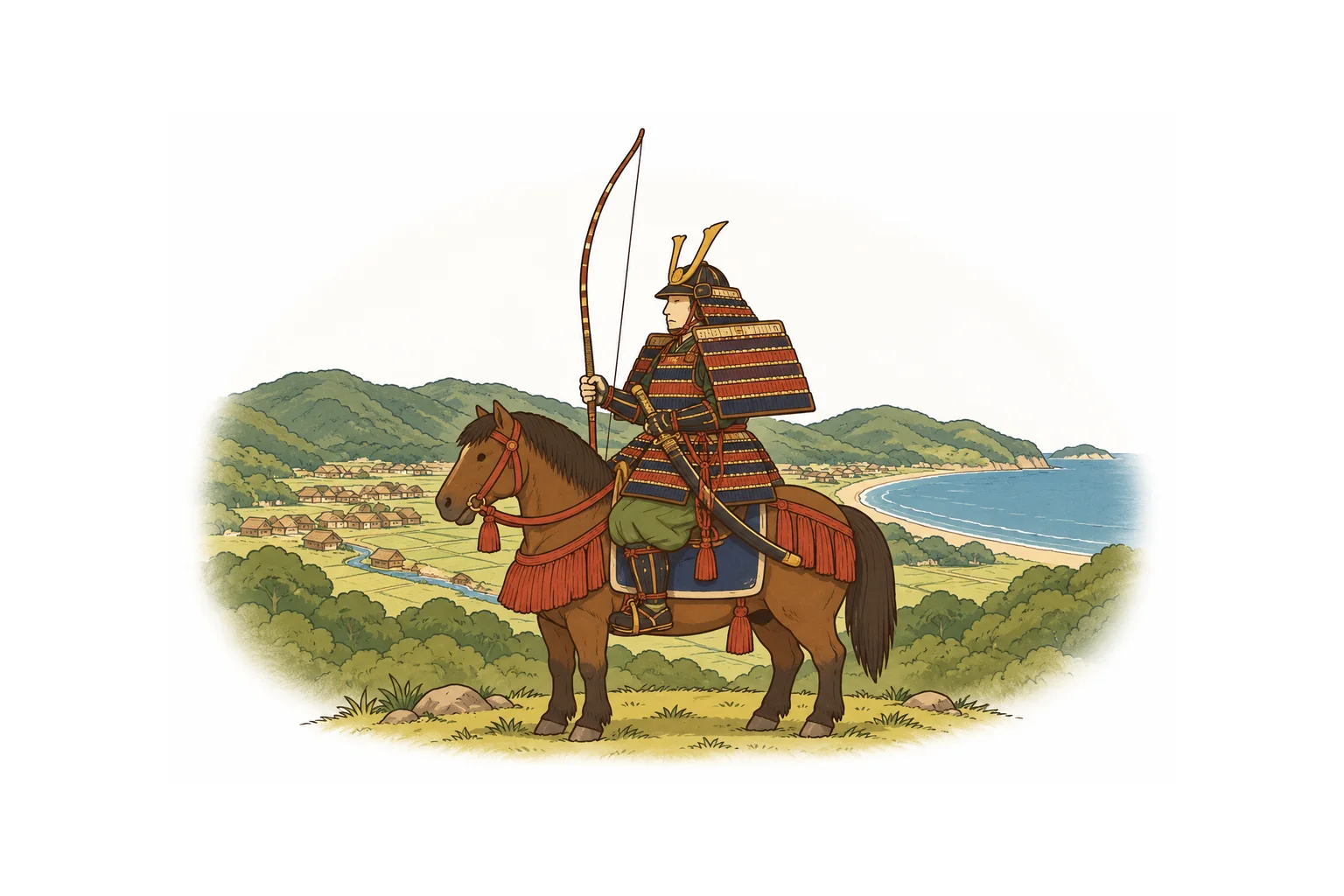
For about a century and a half Japan was run from two towns three hundred miles apart. The emperor, the court nobility and the great temples remained in Kyoto, as they had for four hundred years. But the men who commanded the country's fighting men sat in Kamakura, a small seaside town in eastern Japan, hemmed in by wooded hills on three sides and open to the sea on the fourth. The government they built there is known as the Kamakura shogunate, or in Japanese the bakufu, a word that originally meant a general's field headquarters.
The period takes its name from the town. Its end is easy to date: in the summer of 1333 Kamakura was stormed and the ruling Hōjō family killed themselves. Its beginning is less tidy, because the shogunate was assembled piece by piece. Its founder, Minamoto no Yoritomo, set up his base at Kamakura in 1180; the court recognized his authority over the eastern provinces in 1183; in 1185 his armies destroyed the rival Taira house and he won the right to place his own officers across the country; in 1192 he received the title of shogun. Schoolbooks used to prefer 1192. Most accounts today prefer 1185, when the substance of the regime was in place, and that is the date used here.
What makes these years distinctive is that warriors, who had been the hired muscle of the Kyoto aristocracy, became a governing class with their own institutions, their own law and, increasingly, their own religion and taste. They did not abolish the court. They grew up alongside it and, after one short war, over it.
2Yoritomo builds a government
Yoritomo was born into the main line of the Minamoto, one of the two great warrior clans of the twelfth century. When his father lost a struggle in Kyoto in 1159 to Taira no Kiyomori, the boy was spared and exiled to the Izu peninsula in the east, where he spent twenty years under watch. In 1180 a prince of the court, a son of Retired Emperor Go-Shirakawa, called on the Minamoto to rise against the Taira. Yoritomo answered, was badly beaten in his first fight at Ishibashiyama, escaped by boat across the bay, and within two months had gathered enough eastern warriors to enter Kamakura at the head of an army.
He then did something unusual: he stayed put. While his half-brothers Noriyori and Yoshitsune chased the Taira westward, finishing them in a sea battle at Dan-no-ura in 1185, Yoritomo remained in the east and organized. The eastern warriors who followed him wanted one thing above all, a guarantee of their landholdings, and he offered it. Those who swore loyalty to him became gokenin, "housemen," his direct vassals. He confirmed their inherited lands and rewarded service with new ones. In return they stood guard duty in Kyoto and Kamakura and turned out with their kinsmen in wartime. Three offices handled the business: the Samurai-dokoro, which managed the vassals; the Mandokoro, which handled finance and administration; and the Monchūjo, which heard lawsuits. The last two were staffed by minor Kyoto nobles such as Ōe no Hiromoto, lured east because warriors needed people who could draft documents.
After Dan-no-ura, Yoritomo fell out with Yoshitsune, the war's most celebrated commander. When Go-Shirakawa briefly sided with Yoshitsune, Yoritomo sent troops to Kyoto and extracted a concession known as the Bunji Authorization of late 1185. On the grounds of hunting the fugitive, he was allowed to appoint shugo, military constables, one to a province, and jitō, stewards, on individual estates. The constables mustered vassals for guard duty and pursued rebels and murderers. The stewards managed land, collected rents and kept order, taking a share for themselves. Through these two posts a regime based in the east acquired agents throughout Japan.
Yoshitsune fled north to the Northern Fujiwara, a family that had ruled the far northeast almost independently for a century. Their leader killed him under pressure in 1189; Yoritomo invaded anyway and destroyed them. In 1192, after Go-Shirakawa's death, the court named Yoritomo seii taishōgun, "great general who subdues the barbarians," an old military commission that from now on meant the head of the warrior government. He died early in 1199, by the usual account after a fall from his horse. The shogunate's own chronicle, the Azuma kagami, has a gap at exactly this point.
3The Hōjō take over
The regime had been built on personal loyalty to one man, and his heirs could not command it. Yoritomo's eldest son Yoriie succeeded at sixteen. (Ages here are given in Western reckoning; Japanese sources of the time, which count a person as one at birth and add a year each New Year, give figures a year or two higher.) Within months his power to judge lawsuits was taken away and handed to a council of thirteen senior vassals. Among them were his maternal grandfather Hōjō Tokimasa and his father-in-law Hiki Yoshikazu, and the two families were soon fighting over him.
The Hōjō were a modest family from Izu whose fortune was a marriage: Tokimasa's daughter Masako had married the exile Yoritomo. In 1203, with Yoriie gravely ill, Tokimasa invited Hiki Yoshikazu to his house, had him killed, and wiped out the Hiki. Yoriie was deposed, confined to a temple in Izu and murdered the following year. His eleven-year-old brother Sanetomo became shogun, with Tokimasa directing the government in a post later called shikken, regent. Two years after that, Tokimasa and his second wife, Maki no Kata, were accused of plotting to replace Sanetomo with their son-in-law. Masako and her brother Yoshitoki forced their own father into retirement. In 1213 Yoshitoki provoked the head of the Samurai-dokoro, Wada Yoshimori, into revolt; after two days of street fighting in Kamakura, known as the Wada Battle, the Wada were gone and Yoshitoki held both key offices.
Sanetomo grew up to be a gifted poet who corresponded with the Kyoto master Fujiwara no Teika and collected court titles. In the first month of 1219, on a snowy evening, he was cut down on the stone steps of the Tsurugaoka Hachimangū shrine by his nephew Kugyō, Yoriie's son, who was himself killed within hours. Who, if anyone, stood behind the assassin has been argued over ever since, without resolution. The line of Minamoto shoguns ended with him.
The Hōjō did not have the pedigree to take the title themselves. They sent to Kyoto for an infant of the Fujiwara regent house, Kujō Yoritsune, to be raised as a figurehead. Real authority lay with Yoshitoki and with Masako, who had taken Buddhist vows after her husband's death and was known as the "nun shogun."
4The Jōkyū War
In Kyoto, Retired Emperor Go-Toba watched all this with growing impatience. He was an energetic and many-talented ruler who had sponsored one of the great poetry anthologies, kept warriors of his own, and had hoped to manage Kamakura through the admiring Sanetomo. In the fifth month of 1221, the third year of the Jōkyū era, he declared Hōjō Yoshitoki an outlaw and called on the warriors of Japan to destroy him.
The vassals in Kamakura wavered. No warrior force had ever taken the field against the court. According to the Azuma kagami, Masako summoned them and had a statement read out on her behalf: the late Yoritomo's kindness to them was higher than the mountains and deeper than the sea; let those who would repay it strike down the slanderers at court, and let any who wished to join the retired emperor say so now. The vassals held. On Ōe no Hiromoto's advice the shogunate attacked rather than waiting behind the eastern passes, sending armies under Yoshitoki's son Yasutoki along three roads. Kyoto fell within a month of Go-Toba's proclamation.
The settlement had no precedent. Three retired emperors were sent into exile, Go-Toba to the remote Oki Islands, where he died eighteen years later. The child emperor was removed and a successor chosen by Kamakura. Some three thousand estates belonging to nobles and warriors on the losing side were confiscated and their stewardships given to eastern vassals; since most lay in western Japan, the shogunate's presence became truly national. A permanent headquarters was set up at Rokuhara in Kyoto, staffed by Hōjō kinsmen, to watch the court and govern the western vassals. From then on the imperial succession itself required Kamakura's consent.
5Rule by council and written law
Yoshitoki died in 1224 and Masako the next year. Yasutoki, the new regent, chose to share the burden. He created the post of co-signer for his uncle and a Council of State of eleven senior vassals and officials, and important decisions were taken jointly.
In 1232 he issued the Goseibai Shikimoku, a code of fifty-one articles and the first written law made by warriors for warriors. The court had long had elaborate statutes on the Chinese model, written in formal Chinese that few warriors could read. Yasutoki's code instead set down precedents since Yoritomo's day and what warrior society accepted as dōri, reasonableness. In a letter to his brother he explained that it was meant to let even warriors who could not read Chinese characters know in advance how a case would be judged; it is generally understood to have applied to warrior houses only, leaving court law untouched. Most articles concern land: the limits of a constable's or steward's powers, inheritance, and the rule that twenty years of actual possession settled a title. Daughters could inherit, and a childless widow could adopt an heir to hold her husband's lands. The code was copied and studied for centuries; later warrior governments built on it, and in the Edo period children used it as a writing primer.
Yasutoki's grandson Hōjō Tokiyori, regent from 1246, pushed in two directions at once. He added a panel of judges to speed up land suits. He also crushed the Miura, the last vassal house able to challenge the Hōjō, in the Hōji Battle of 1247. When the Fujiwara shoguns grew up and attracted malcontents, he sent them back to Kyoto and in 1252 installed an imperial prince, Munetaka; shoguns thereafter were princes with no power, returned to the capital when they became inconvenient. Tokiyori went on governing after he had formally retired. Authority was shifting from the office of regent to the head of the main Hōjō line, called the tokusō, and from the council chamber to his private residence. Later tradition, most famously a Noh play, remembered Tokiyori as a ruler who traveled the country disguised as a monk to learn how ordinary vassals lived. The story is legend, but it shows the reputation he left.
6Land, rice and coins
A Kamakura warrior was a country landholder. He lived in a compound ringed by an earthwork and a ditch, with fields worked by his dependents nearby, and he trained above all in mounted archery. The sword as the "soul of the samurai" belongs to a much later age. Families were led by a main heir who answered to the shogunate for military service, but property was divided among the children, and daughters took shares. That worked while there was new land to win. Over several generations it left many houses with holdings too small to live on.
On the estates, stewards and the absentee proprietors in Kyoto and Nara quarreled constantly over rents, and their suits filled the Kamakura courts. Two compromises became common: the steward contracted to deliver a fixed rent and ran the estate as he pleased, or the land was simply split in half. Either way warriors tightened their grip on the countryside.
Farmers in the west and around Kyoto began taking two crops a year, wheat after rice, and made wider use of draft animals and of ash and cut grass as fertilizer. Famine was still never far off. In the great famine of 1230–31 so many starved that the shogunate temporarily tolerated the sale of people into servitude as a way to keep them alive.
With surpluses came markets, held on fixed days at crossroads and temple gates. Japan minted no coins of its own at this time; the money that changed hands was Chinese copper cash imported in bulk from the Song, and rents were increasingly paid in it. Warehousemen appeared in the ports, moneylenders in the towns, and bills of exchange spared travelers from carrying strings of coins. A picture scroll of the life of the wandering monk Ippen shows one such market in Bizen Province, with cloth, rice, fish and pots laid out under thatched stalls.
7Buddhism for everyone
The wars, fires, earthquakes and famines of the late twelfth century convinced many that the world had entered mappō, the degenerate last age of the Buddha's teaching. The established temples on Mount Hiei and in Nara offered learning, ritual and prayers for the state. The teachers who emerged in the Kamakura period, most of them trained on Mount Hiei, each left it with a single practice that anyone could perform.
Hōnen taught from about 1175 that calling on the Buddha Amida with the phrase Namu Amida Butsu, the nenbutsu, was sufficient for rebirth in Amida's Pure Land, whatever one's rank, learning or virtue. He drew followers from court ladies to fishermen, and the older temples had him exiled in 1207. His disciple Shinran, banished to the north, afterward spent two decades among farmers and low-ranking warriors in the east. He married openly, called himself "neither monk nor layman," and held that salvation came from faith in Amida alone. A saying attributed to him runs that if even a good person can be reborn in the Pure Land, how much more so a wicked one, meaning that those who know they cannot save themselves rely on Amida most completely. His following became the True Pure Land school. A generation later Ippen walked the length of the country handing out paper slips inscribed with the nenbutsu and leading crowds in ecstatic dancing.
Zen arrived from China. Eisai returned from his second journey to the Song in 1191 with the Rinzai teaching and with tea seeds, and wrote a treatise recommending tea for health. Rinzai Zen found patrons among the Hōjō, who invited Chinese masters to found Kenchō-ji and Engaku-ji in Kamakura. Dōgen, who came back from China in 1227, taught shikan taza, "just sitting": seated meditation as enlightenment itself. He kept away from the powerful and founded Eihei-ji deep in the mountains of Echizen; his school is Sōtō Zen.
Nichiren, a fisherman's son from the east coast, held that the Lotus Sutra alone was true and taught the chanting of its title, Namu Myōhō Renge Kyō. In 1260 he submitted to Tokiyori a tract, the Risshō ankoku ron, arguing that the country's disasters came from tolerating false teachings, the nenbutsu above all, and predicting rebellion and foreign invasion unless this changed. His attacks on every other school earned him two exiles. His followers relate that when he was arrested in 1271 and taken to the execution ground at Tatsunokuchi, a brilliant object crossed the night sky and the executioners lost their nerve; this is the tradition of his school. When the Mongols did come, his prophecy gained weight among believers.
The older schools responded too. The Nara monk Eison and his disciple Ninshō revived monastic discipline and ran relief works in Kamakura for lepers and the destitute.
8Poems, tales and sculpture
Kyoto's aristocrats had lost power but not their command of letters. In 1205 Fujiwara no Teika and his colleagues completed the Shin kokin wakashū for Go-Toba, an anthology of allusive, finely worked verse. Kamo no Chōmei withdrew to a hut ten feet square outside the capital and in 1212 wrote the Hōjōki, which opens with the image of a river that flows without cease, its water never the same, and goes on to recount the fire, whirlwind, famine and earthquake he had lived through.
Warriors now became the heroes of stories. The Tale of the Heike, on the rise and ruin of the Taira, was chanted to the lute by blind itinerant performers and so reached people who could not read.
The Taira had burned the great Nara temples in 1180. The monk Chōgen raised funds across the country to rebuild Tōdai-ji, with Yoritomo as chief donor, and gave the sculpture to the Nara workshop of Unkei and Kaikei. In 1203 their team carved the two guardian kings of the temple's south gate, each over eight meters tall, in sixty-nine days. Their muscular realism suited warrior patrons, and Unkei worked for eastern lords as well. Kamakura's own Great Buddha, a bronze Amida begun according to the Azuma kagami in 1252, lost its hall long ago and has sat in the open air ever since.
9The Mongol invasions
By the 1260s the Mongol empire reached from Korea to the steppes of eastern Europe. The Korean kingdom of Goryeo had submitted in 1259 after nearly three decades of resistance, and Qubilai Khan, engaged in the conquest of Song China, turned to Japan. In 1268 an envoy from Goryeo delivered his letter to the government office at Dazaifu in Kyūshū. It proposed friendly relations and closed with a hint of force. The court resolved to send no reply, and when envoys came again the following year and the court did draft one, the shogunate blocked it. That same year Hōjō Tokimune, aged sixteen, became regent.
The first attack came in the autumn of 1274. The size of the force is known only from the chronicles: the Korean Goryeosa records 25,000 Mongol and Chinese troops, 8,000 Koreans and 6,700 sailors in some nine hundred ships, while the Chinese Yuanshi speaks of only 15,000 men, and modern accounts usually settle on about thirty thousand. The fleet overran the islands of Tsushima and Iki and landed at Hakata Bay. Japanese warriors were used to riding out singly to seek a worthy opponent. They met infantry maneuvering in formation to drums and gongs, and exploding bombs that panicked their horses. After a day of hard fighting the defenders, among them the local commander Shōni Kagesuke, fell back inland. But the invaders re-embarked that night and withdrew, losing ships to bad weather on the way home. Whether this had been intended as a reconnaissance in force, or whether shortages and losses compelled the retreat, is still debated.
Kamakura assumed they would return. It beheaded Qubilai's next envoys, set the Kyūshū vassals to guarding the coast in rotation, and had them build a stone wall some twenty kilometers long around Hakata Bay. In 1279 the Song fell, placing the ships and manpower of southern China at Qubilai's disposal.
In 1281 two fleets sailed. As the chronicles record it, about forty thousand men came from Korea in nine hundred ships and about a hundred thousand from the Yangzi region, many of them recently surrendered Song soldiers, in thirty-five hundred. The Korean fleet arrived first, found the wall, and was harried in night raids from small boats. The combined force was lying off the island of Takashima when a typhoon struck in mid-August and wrecked most of it; survivors left ashore were hunted down. Shrines and temples promptly claimed that their prayers had raised the storm, and the idea of a "divine wind," kamikaze, protecting a land of the gods took root. Goryeo, which had been required to build ships and supply troops and provisions for both expeditions, bore a very heavy burden.
One participant left his own record. Takezaki Suenaga, a poor vassal from Higo, charged the enemy in 1274 with a handful of followers and was wounded, yet received no reward. By the account in his own scrolls he sold his horses and saddles, traveled to Kamakura, and put his case directly to the official in charge of rewards, Adachi Yasumori, who granted him a stewardship and a horse. Suenaga later commissioned picture scrolls of his exploits, which show the bursting bombs, the wall, and his own interview in Kamakura.
10Debt, discontent and collapse
Few were as fortunate as Suenaga. Earlier wars had paid for themselves with the lands of the defeated. A defensive war yielded nothing to distribute, while vassals had armed and fed themselves and still had to man the coast year after year. Already squeezed by divided inheritance, many pawned or sold their land to moneylenders.
Tokimune died in 1284 at thirty-two, leaving a twelve-year-old heir, Sadatoki. The boy's uncle Adachi Yasumori, who had raised Sadatoki's mother as his adopted daughter and so counted as his grandfather, attempted reforms and collided with Taira no Yoritsuna, chief of the Hōjō family's private retainers. In the eleventh month of 1285 Yoritsuna struck, and the Adachi and many allied vassals were slaughtered in what is called the Shimotsuki Incident. Hōjō household men now dominated the government, and Hōjō kinsmen came to hold, by the usual reckoning, more than half the provincial constableships. The old vassal families had less and less reason to feel the regime was theirs. In that same year Tokimune's widow, the nun Kakusan-ni, herself born an Adachi, founded the convent of Tōkei-ji in Kamakura, known in later centuries as a refuge for women seeking divorce.
In 1297 the shogunate tried a drastic remedy, the Einin Debt Cancellation Edict. Appeals against cases already decided were barred. Vassals were forbidden to sell or pawn their lands. Land already sold was to be returned without payment, except where a fellow vassal had held it for twenty years or had his purchase confirmed by the shogunate; commoners and other non-vassal buyers had no such protection. Suits over loans would not be heard. Debtors recovered their fields and then found that no one would lend to them again, and within a year the bans on sale, on loan suits and on appeals were withdrawn, leaving only the return of land already sold in force. Meanwhile armed bands that the authorities called akutō, "evil bands," defied estate owners and constables alike around the Kyoto region.
The final push came from the court. The imperial family had split into two lines that took the throne alternately under Kamakura's mediation. Emperor Go-Daigo, enthroned in 1318, wanted to rule in person and to keep the succession for his own sons, and both aims required the shogunate's removal. A first plot was discovered in 1324. After a second in 1331 he raised troops, was captured, and was exiled to the Oki Islands, as Go-Toba had been.
This time the war did not end with the emperor's capture. Kusunoki Masashige, a warrior from Kawachi, held a mountain fort against a far larger shogunal army, and Go-Daigo's son Prince Moriyoshi rallied fighters elsewhere. In 1333 Go-Daigo escaped from Oki. Ashikaga Takauji, a commander of distinguished Minamoto descent sent west to crush the rising, changed sides and took Rokuhara. At almost the same moment Nitta Yoshisada rose in the eastern province of Kōzuke and marched on Kamakura, gathering vassals as he went. The war tale Taiheiki has him cast his gilded sword into the sea at Inamuragasaki, whereupon the tide drew back to let his army round the cape; that is literature rather than record. On the twenty-second day of the fifth month, in early July by the Western calendar, Hōjō Takatoki, the last tokusō, and several hundred kinsmen and retainers killed themselves at the family temple, Tōshō-ji.
Go-Daigo returned to Kyoto to govern in his own name. The warriors who had brought down the Hōjō still wanted secure land and fair rewards, and within three years Takauji had broken with him and founded a shogunate of his own, which opens the Muromachi period. He and later warrior rulers took over what Kamakura had devised: vassalage tied to land, constables and stewards, a written warrior code, and judgment by council.