
This period in brief
The Jōmon Period
Ten Thousand Years of Villages Without Farms
1What the name covers
The Jōmon period is the longest stretch of Japan's past that carries a single name. It begins about 16,000 years ago, when people on the islands started making pottery, and it ends around the tenth century BCE, when wet-rice farming took hold in northern Kyūshū. No one in it could write, so there are no kings, no battles with dates, and no individual whose name we know. What survives is what people threw away, built, and buried: pots, shell heaps, house floors, graves, and thousands of small clay figures.
The name means "cord-marked." Many of the period's pots were decorated by rolling a twisted cord across the wet clay before firing, which leaves rows of slanting impressions. The term was coined almost by accident, by an American zoologist looking out of a train window, and that story comes a little later.
Two things make the Jōmon unusual in world prehistory. Its pottery is among the oldest anywhere, and its people lived in permanent villages for thousands of years without depending on agriculture. In most parts of the world, pots and settled life arrived together with farming. On the Japanese islands, hunters, fishers, and gatherers had both.
2Before pottery: the Ice Age islands
People were on the islands long before the first pot. For most of the twentieth century Japanese scholars doubted this. The red volcanic loam that underlies the Kantō plain, the lowland around modern Tokyo, was laid down by Ice Age eruptions, and it was assumed that nobody could have lived under that rain of ash. Excavators stopped digging when they reached it.
The assumption was overturned by an amateur. Aizawa Tadahiro made his living peddling nattō, fermented soybeans, around the villages of Gunma Prefecture, and spent his spare hours looking at road cuts. In 1946, at a place called Iwajuku, he picked flakes of obsidian out of the red loam. In 1949 he found a finished spear point in the same layer and took it to Tokyo. That autumn a team from Meiji University dug at Iwajuku and confirmed stone tools in the loam. Japan had a Paleolithic after all.
More than ten thousand Paleolithic sites have been recorded since. The oldest secure ones date to about 38,000 years ago. (Claims of far older sites collapsed in 2000, when a well-known excavator was caught planting artifacts; the episode made the field cautious about anything earlier.) At that time sea level was far lower than today, more than a hundred meters lower at the coldest point. Hokkaidō was joined to Sakhalin and the Asian mainland. Honshū, Shikoku, and Kyūshū formed one large island. The Tsushima and Tsugaru straits probably never closed completely, so at least some of the first arrivals came by water. Obsidian from Kōzushima, an island well off the Pacific coast, turns up at mainland sites more than 30,000 years old; someone was paddling out to fetch it.
These people hunted large animals such as Naumann's elephant and giant deer, moved camp often, and left stone blades, points, and axes with ground edges that are among the earliest ground stone tools known anywhere.
3The first pots
Around 16,000 years ago, as the Ice Age was winding down, fired clay appears. The oldest pieces found so far in Japan come from the Ōdai Yamamoto site in Aomori, at the northern tip of Honshū: a handful of small, undecorated sherds with charred residue that has been dated to between about 15,000 and 16,500 years ago. Pottery of comparable or greater age is known from southern China and the Russian Far East, and East Asia as a whole is where pottery-making began.
A pot is a way to boil things. Boiling softens tough plants, opens shellfish, renders fat from bones, and removes the bitterness from nuts that are otherwise inedible. For people living off woodland and shore, a cooking pot widened the menu enormously. Most Jōmon vessels throughout the period are deep cooking jars, and many still carry soot on the outside and scorched food on the inside.
When exactly the Jōmon period "starts" depends on what one thinks defines it. The usual answer is the first pottery, about 16,000 years ago. Some archaeologists point out that for the first few thousand years life was still mobile and much like the Paleolithic, and prefer to begin the period around 11,500 years ago, when the climate warmed for good and settled villages spread. The earlier date is the conventional one. Specialists divide the period into six phases named Incipient, Initial, Early, Middle, Late, and Final, defined by changes in pottery style. The first two together last about nine thousand years; the last four are squeezed into the final four thousand or so. The boundary dates differ somewhat from one researcher to the next, and the figures used here are the commonly cited ones.
4Morse and the shell heap
In June 1877 Edward S. Morse, a zoologist from Maine, arrived in Japan to collect brachiopods, small shelled sea animals. Riding the new railway from Yokohama to Tokyo, he noticed a band of white shells exposed in an embankment near the village of Ōmori. Morse had dug shell heaps in New England and knew what he was seeing: an ancient rubbish dump. He was soon hired as a professor at the University of Tokyo, and that autumn he took students out to dig. The Ōmori shell mound was the first scientific excavation in Japan.
In his report Morse described the sherds as "cord marked." Japanese translators tried several renderings before settling on jōmon, and the word passed from the pots to the people and the age. Not all Jōmon pottery has cord marks. Early potters also used fingernails, shell edges, and carved sticks, and some later wares are plain and polished. The name stuck anyway.
5A warmer world: forest, shore, and settling down
The Jōmon way of life was a response to a changed landscape. As temperatures rose, the sea rose with them and the land bridges drowned, leaving the island chain in roughly its present shape. The big Ice Age animals disappeared. Deer and wild boar, quick and medium-sized, took their place, and hunters replaced heavy spears with the bow. Small stone arrowheads become common from the Incipient phase onward. Dogs appear too, and were sometimes buried with evident care.
The forests changed. In eastern and northern Japan, conifer woods gave way to deciduous forest of oak, chestnut, walnut, and horse chestnut. In the west an evergreen broadleaf forest spread. Both produce nuts every autumn, and nuts keep through the winter when stored in pits. The eastern forests were the richer of the two, and eastern rivers had autumn runs of salmon and trout. As a result, the Jōmon population was always concentrated in the east and north, the reverse of later Japanese history.
Sea level peaked between about 7,000 and 6,000 years ago, an estimated two or three meters above today's. Geologists call this the Jōmon transgression. Salt water reached far into what is now the Kantō plain, forming long shallow inlets full of clams, oysters, and fish. People camped and then settled along these shores and tossed their empty shells into heaps beside their villages. More than two thousand shell mounds are known in Japan, thickest around Tokyo Bay. Many now lie tens of kilometers from the coast and mark where the shoreline once ran. They are also the reason so much is known about Jōmon bodies and diets. Japan's volcanic soil is acidic and destroys bone, but the lime in the shells neutralizes it, so shell mounds preserve human skeletons, animal bones, fishhooks, and needles that would have vanished elsewhere.
With dependable food close at hand, moving camp made less sense. Southern Kyūshū warmed first and settled first; at the Uenohara site in Kagoshima, more than fifty house floors survive from a village about 9,500 years old. That southern start was cut short around 7,300 years ago, when the Kikai caldera, a submarine volcano south of Kyūshū, erupted on a scale that spread ash as far as southern Tōhoku in northern Honshū and devastated the communities nearest to it. For the rest of the period the center of gravity lay in the east.
6Making a living
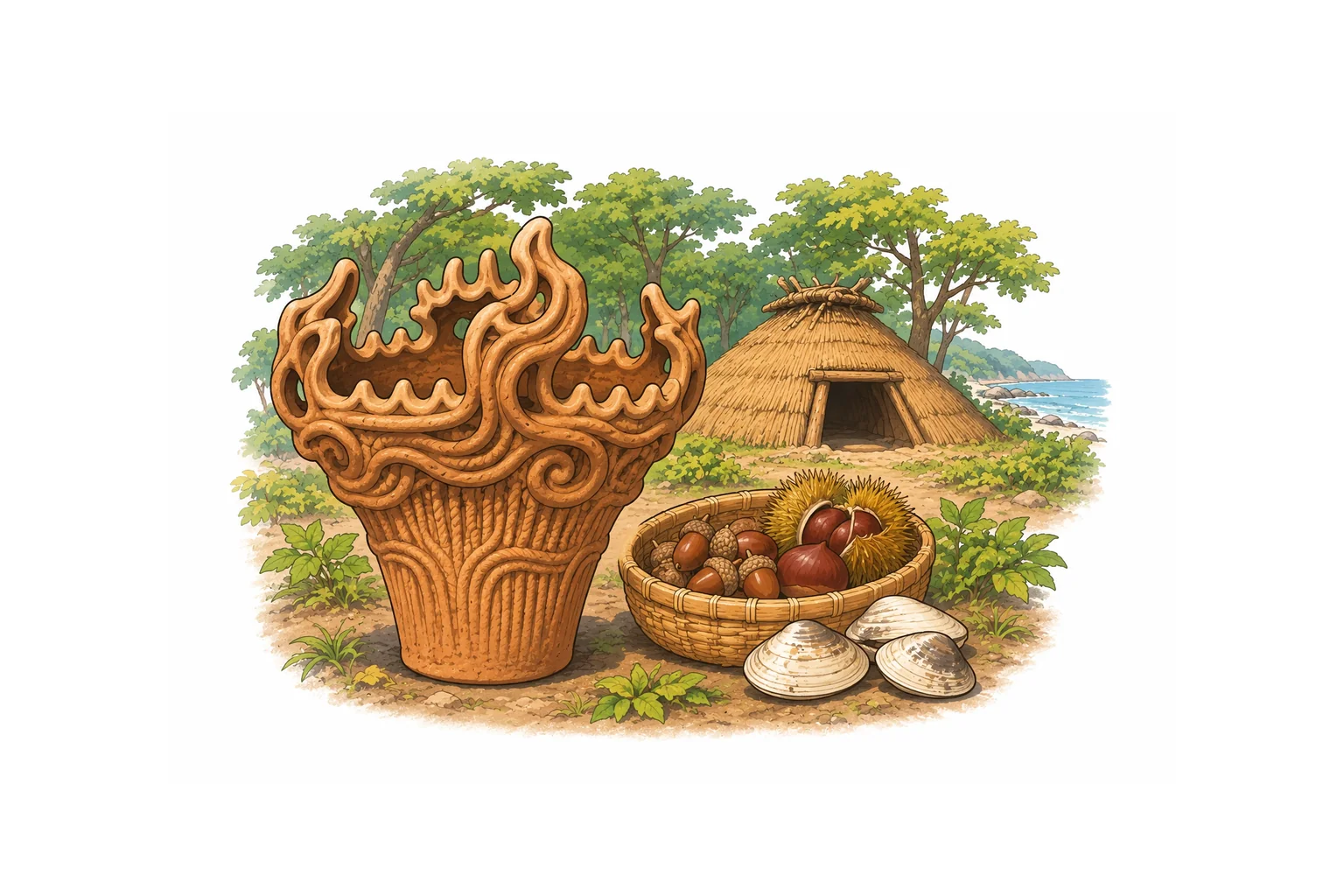
A Jōmon house was a pit dwelling: a round or squarish floor dug perhaps half a meter into the ground, with posts supporting a roof of thatch or earth and a hearth in the middle. A family lived in each. A typical village had a ring of such houses around an open space, and the open space was often the cemetery. The dead stayed in the middle of daily life.
The year followed the seasons. Spring meant wild greens and shellfish, summer meant fishing, and autumn was the rush to bring in acorns, chestnuts, and walnuts and to take salmon where they ran. Winter was for hunting deer and boar. Antler and bone were worked into fishhooks, needles, and harpoons, including, on the northern Pacific coast, toggling heads that detach inside the prey and hold it on a line. Dugout canoes have been recovered from waterlogged sites. At Mawaki on the Japan Sea coast, the bones of hundreds of dolphins show organized drives. In the later phases people on the Pacific coast boiled seawater in rough, thin-walled pots to make salt.
Acorns and horse chestnuts are bitter or mildly toxic until treated. Jōmon people ground them, leached them in running water, sometimes in timber-framed troughs built beside streams, and cooked the starch into cakes. Charred lumps of this food have been found.
They were not farmers, but they were not passive foragers either. At the Torihama shell mound in Fukui, seeds of bottle gourd, perilla, and beans were recovered. Impressions of seeds left in the clay of pots show that soybeans and adzuki beans were being tended in the central highlands by the Middle phase, and that the beans grew larger over time. Chestnut groves near villages appear to have been managed. Lacquer, the sap of the lacquer tree that hardens into a glossy waterproof coating, was in use remarkably early: lacquered grave goods from the Kakinoshima B site in southern Hokkaidō are about 9,000 years old, and Torihama produced a red-lacquered wooden comb about 6,000 years old. Cloth was twined from plant fiber. People wore clay ear ornaments, shell bracelets, and stone beads.
The skeletons add personal detail. Adult men averaged around 158 centimeters in height. Their faces were broad and low with a strong brow and a high nasal bridge. At the Irie shell mound in Hokkaidō, excavators found the skeleton of an adult whose limb bones were extremely thin, apparently someone whose muscles had wasted from disease and who could not walk for ten years or more. That person could not have hunted or gathered and yet lived for years, which means others fed and looked after them.
7Sannai Maruyama
In 1992 Aomori Prefecture began clearing ground for a baseball stadium on the edge of Aomori city. The spot, Sannai Maruyama, had been known to yield old pots since the Edo period, but nobody expected what the rescue excavation uncovered: a settlement that had been lived in from about 5,900 to about 4,200 years ago, some seventeen centuries. There were hundreds of house floors, rows of raised-floor buildings, adult graves lined up along a road, infants buried in jars, and great mounds built up from a thousand years of discarded pottery and soil.
The most famous find came in 1994. Six pits, each about two meters across and two meters deep, stood in two rows of three, spaced exactly 4.2 meters apart. In the bottoms were the stumps of chestnut posts roughly a meter thick. Felling, hauling, and raising timbers of that size with stone axes took many hands and a shared unit of measure. What stood on the posts is unknown. The fifteen-meter tower now reconstructed at the site is one guess; a roofed building or free-standing pillars are others. Nearby was a pit building 32 meters long, big enough for the whole community to gather or work under one roof.
Public interest was so strong that the stadium was canceled and the site preserved. Sannai Maruyama changed the picture of Jōmon society from scattered camps to planned, long-lived communities capable of public works. How many people lived there at one time is disputed, with estimates from one or two hundred up to five hundred, since seventeen centuries of house floors were never all occupied together.
Chestnut pollen rises sharply in the soil during the village's lifetime, and the chestnuts recovered there are genetically more uniform than wild stands. The usual reading is that the residents cultivated chestnut groves, for the nuts and for timber that resists rot.
8Things that traveled
Much of what was found at Sannai Maruyama came from elsewhere. Jade came from the Itoigawa area on the Japan Sea coast, some 500 kilometers away and practically the only jade source in the islands. Obsidian came from Hokkaidō and from the mountains of central Honshū. Amber came from the Pacific coast, and natural asphalt, used as glue to fix arrowheads to shafts, from oil seeps in Akita.
Obsidian is volcanic glass that breaks to a razor edge, the best material available for arrowheads and knives. The main sources, at Wada Pass in Nagano, on Kōzushima, at Shirataki in Hokkaidō, and at Koshidake in Kyūshū, each have a distinct chemical signature, so a tool found hundreds of kilometers away can be traced to its quarry. Itoigawa jade is extremely hard, yet Jōmon craftsmen drilled it with bamboo and sand to make large pendant beads that ended up from Hokkaidō to Kyūshū.
These goods probably moved hand to hand, village to village, as gifts and exchanges, and nothing suggests long-distance traders. Ideas moved the same way, which is why communities far apart made pots in closely related styles. Jōmon sites have no fortifications and no weapons made for use against people, and skeletons with wounds from violence are a small fraction of the total. Most researchers conclude that organized fighting between groups was uncommon.
9Flame pots and clay figures
The Middle phase, roughly 5,500 to 4,500 years ago, was the high point of population. One widely cited estimate puts the islands, not counting Hokkaidō and Okinawa, at around 260,000 people, the great majority in eastern Japan, densest in the Kantō and the central highlands. The most flamboyant pottery belongs to these centuries.
Along the Shinano River in Niigata, potters made what are now called flame pots. Four tall crests rise from the rim like cockscombs, and the body is covered with raised coils that curl into spirals, so the whole vessel looks as if it were burning. The first was found in 1936, and a group from the Sasayama site in Tōkamachi has been designated a National Treasure. They look purely ceremonial, but scorched residue inside shows they were used for cooking, perhaps at feasts. Potters in the neighboring highlands coiled snakes around their rims and modeled human faces on them. The meaning of this imagery is lost.
Then there are the dogū, fired clay figurines. Close to twenty thousand have been found. Most are female, often with full breasts and a swelling belly, and almost all are broken, frequently with a limb missing that cannot be found nearby. One long-standing theory holds that they were broken on purpose, perhaps to carry away an illness or injury in a person's place, perhaps as part of rites for birth and plenty. Others were clearly treasured. A figure from Hachinohe in Aomori, seated with hands clasped as if in prayer, had a broken leg mended in antiquity with asphalt.
Five dogū are National Treasures. The "Jōmon Venus" from Chino in Nagano, 27 centimeters tall with broad hips, was found nearly intact in a small pit in the middle of a village plaza. The "Masked Goddess," also from Chino, has a triangular face that looks like a mask. The "Jōmon Goddess" from Yamagata, 45 centimeters tall, is slender and so pared-down that it is often compared to modern sculpture. The praying figure from Hachinohe is the fourth. The fifth, a hollow figure from Hakodate in Hokkaidō, was struck by a woman's hoe in 1975 while she was digging potatoes. The best-known type of all, with huge slit eyes, comes from Kamegaoka in Aomori and dates to the Final phase. Meiji-era scholars thought the eyes resembled the slitted snow goggles of northern peoples and named the type shakōki-dogū, "goggle figurine."
Other ritual objects include polished stone rods and jars buried at house entrances holding the remains of infants. Adults were usually buried with their limbs flexed. From the Late phase onward, many people had healthy teeth deliberately pulled at set points in life, probably coming of age and marriage.
10A cooler world
A little more than 4,000 years ago the climate cooled. The sea drew back and the rich inlets silted into marsh. In the central highlands and western Kantō, where villages had been thickest, their number fell steeply and large settlements broke up into small ones. The same estimate that gives 260,000 for the Middle phase gives about 160,000 for the Late phase and under 80,000 for the Final. The figures are rough calculations from site counts, but the downward trend in the east is not in doubt.
Smaller, more scattered communities put more work into shared monuments. In northern Honshū and Hokkaidō, people of the Late phase built stone circles. At Ōyu in Akita there are two circles side by side, the larger 52 meters across at its widest, made of thousands of river stones carried from several kilometers away. Graves lie beneath the stones, and the circles were probably a common cemetery and ceremonial ground for a number of hamlets. Each circle contains a setting of stones that looks like a sundial, and a line through the two is often said to point roughly toward sunset at the summer solstice. In Hokkaidō, communities built circular earthen banks around group burials.
In the Final phase, northern Honshū produced the finest craftwork of the entire period, known as the Kamegaoka culture after the site in Aomori. The pottery is thin-walled, burnished, and carved with flowing cloud-like patterns, sometimes coated in red and black lacquer, and it comes in specialized shapes: jars, shallow bowls, spouted vessels, incense-burner forms. Waterlogged deposits at Korekawa in Hachinohe preserved lacquered wooden vessels, bows, and baskets stiffened with lacquer. Kamegaoka-style pots and local copies of them reached as far as the Kinki region around modern Ōsaka and Kyoto, and on into Kyūshū.
11How it ended
Toward the close of the Final phase, something new appeared on the coast of northern Kyūshū facing the Korean Peninsula. At Nabatake in Saga and Itazuke in Fukuoka, excavators found paddy fields with ditches and banks, alongside pottery still in the latest Jōmon style. Wet-rice farming arrived as a complete package of techniques and tools from the southern Korean Peninsula. What it did to society is the story of the following Yayoi period. Its starting date is itself debated. The figure now commonly used is around the tenth century BCE, based on radiocarbon dating published in 2003, while the older view placed it in the fifth or fourth century BCE.
Whichever date is used, the Jōmon did not end in a single year. Rice farming took several centuries to spread east along the Inland Sea to central Honshū and then north. During that time farmers in the west and foragers in the east were contemporaries. Paddy rice did not cross the strait to Hokkaidō, where hunting, fishing, and gathering continued in what archaeologists call the Epi-Jōmon culture. The Okinawan islands also followed their own course, with a fishing and shell-gathering life that went on for many centuries more.
The people did not disappear either. Studies of ancient DNA indicate that newcomers from the continent and the peninsula mixed over a long period with the existing Jōmon population, and that this mixture underlies the later population of the islands. In present-day residents of Honshū and the neighboring islands, most studies put the Jōmon share between about one tenth and one fifth, most often a little over a tenth. It is higher among the Ainu and among Okinawans, for whom some studies give roughly seventy and thirty percent. All of these are estimates worked out from a limited number of ancient skeletons, and the figures vary from study to study.
Lacquerwork, basketry, and the habit of eating wild nuts, greens, and mushrooms from the hills all go back to these millennia. In 2021 seventeen sites in Hokkaidō and northern Honshū, including Sannai Maruyama, Ōyu, and Kamegaoka, were inscribed together on the World Heritage list as evidence of a settled society of hunter-gatherers that lasted more than ten thousand years.