
This period in brief
The Edo Period
Japan under the Tokugawa Shoguns, 1603–1868
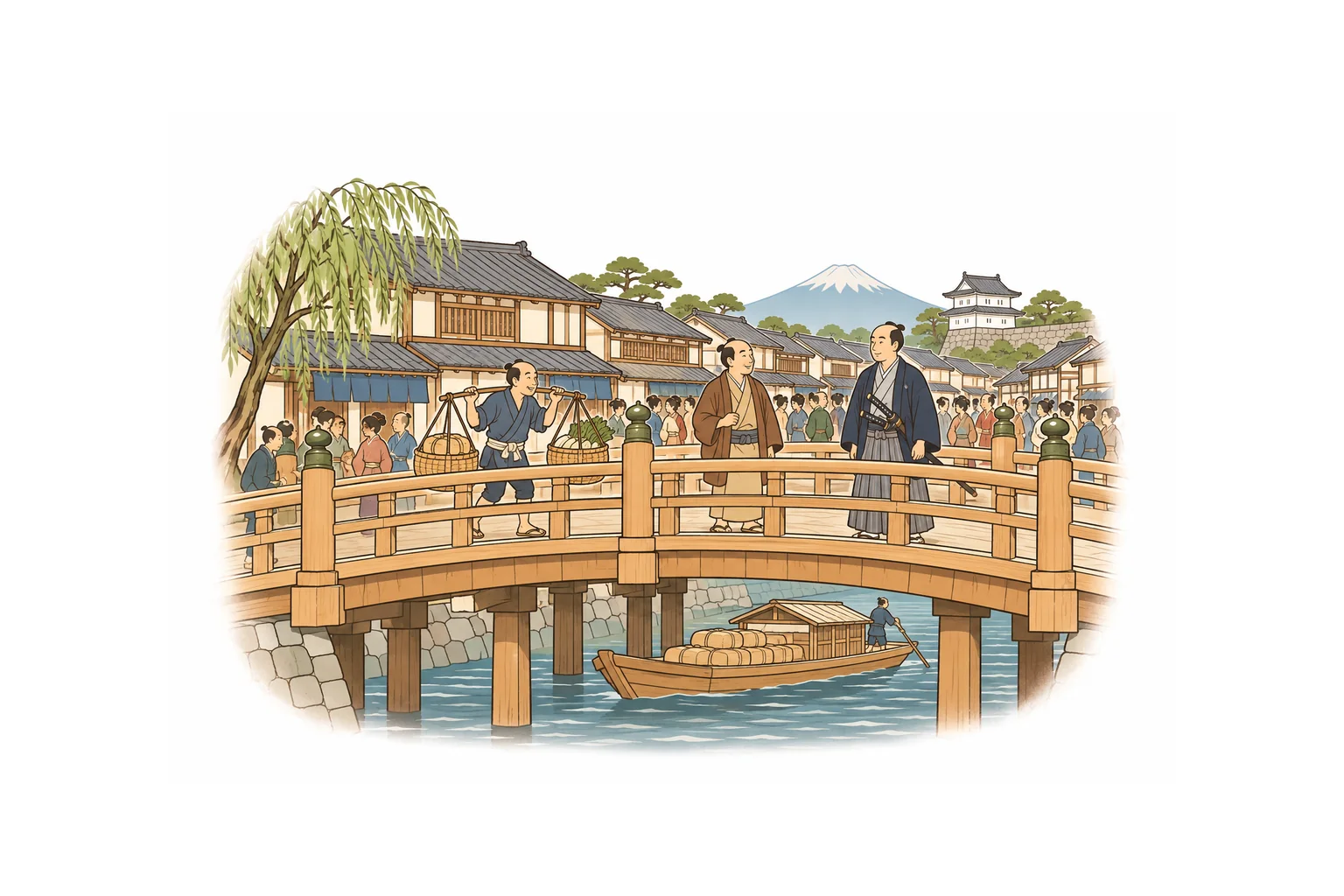
1A peace named after a city
In 1603 the imperial court in Kyoto gave the warlord Tokugawa Ieyasu the title of shogun, the old office of supreme military commander. He set up his government in Edo, a castle town on a marshy bay in eastern Japan that would one day be renamed Tokyo. Fifteen men of his family held the title in turn, and the last of them gave it up in 1867; the new Meiji government took over in 1868. The 265 years in between are called the Edo period after the city, or the Tokugawa period after the family.
What sets these centuries apart is how little fighting there was. The hundred-odd years before 1600 had been a time of constant war between regional lords. After two sieges of Ōsaka in 1614–15 and one large rebellion in 1637–38, Japan saw no major warfare at home or abroad until the 1860s. The samurai, a class defined by arms, spent eight or nine generations as salaried administrators. Meanwhile the population roughly doubled, Edo grew into one of the largest cities on earth, and commoners with money and schooling created kabuki theater, haiku poetry, and the color woodblock print. The same period also saw rigid hereditary status, heavy taxes on villages, the suppression of Christianity, and several terrible famines. All of these belong to the same story.
2How the Tokugawa secured their rule
Ieyasu had won control of the country in 1600 at the battle of Sekigahara, where he defeated a coalition loyal to the heir of the previous ruler, Toyotomi Hideyoshi. That heir, Hideyori, was still a child, living in the great castle at Ōsaka, and many lords still felt they owed his house something. Ieyasu moved carefully. Two years after becoming shogun he handed the title to his son Hidetada, making the point that the office was now hereditary, and went on ruling from retirement at Sunpu (modern Shizuoka). In 1614 he picked a quarrel over the inscription on a temple bell that Hideyori had sponsored, claiming that its wording split the characters of his name and so cursed him. Two campaigns followed, in winter and the next summer. In 1615 Ōsaka Castle burned, Hideyori and his mother killed themselves, and the Toyotomi line ended.
Within months the shogunate issued the rules that framed the rest of the period. Each lord was to keep only one castle in his territory. The Laws for the Military Houses, drafted by the Zen monk Konchiin Sūden, forbade lords to repair fortifications or arrange marriages without permission. A parallel code told the emperor and court nobles to devote themselves to learning and ceremony. When Ieyasu died in 1616 he was deified, on the advice of another monk, Tenkai, as Tōshō Daigongen and enshrined in the mountains at Nikkō. His grandson Iemitsu later rebuilt the shrine there, the Tōshōgū, in the lavish carved and gilded form that survives.
Historians call the resulting order the bakuhan system: the bakufu, or shogunate, on top, and beneath it some 260 to 270 han, the domains of the daimyo. Land was measured not by area but by its assessed rice yield in koku, one koku being roughly what an adult ate in a year. A daimyo was by definition a lord with 10,000 koku or more. In round figures, of about 30 million koku nationwide, the shogun held some 4 million directly and his bannermen another 3 million, along with the main cities, the port of Nagasaki, and the gold and silver mines.
The daimyo came in three kinds. Branches of the Tokugawa family held key provinces and could supply an heir if the main line failed. The fudai, houses that had served Ieyasu before Sekigahara, had modest domains in strategic places and filled every important office. The tozama, "outside" lords who had submitted only around 1600, included the richest houses in the country, such as the Maeda of Kaga, the Shimazu of Satsuma, and the Mōri of Chōshū; they were kept at the edges of the map and out of government. Within his domain a daimyo taxed, judged, and kept his own samurai without interference. But the shogun could move him to another domain or confiscate his lands altogether, and under the first three shoguns more than a hundred houses were dispossessed for offenses or for dying without an approved heir.
The third shogun, Iemitsu, who took office in 1623, was the first born to the position; he had been raised by a formidable wet nurse known as Kasuga no Tsubone, who became a power in the women's quarters of Edo Castle. Under him the administration took its lasting shape, with a council of senior fudai lords called rōjū deciding policy and magistrates beneath them handling finance, temples, and the city of Edo. In 1635 Iemitsu made sankin-kōtai, or alternate attendance, a formal obligation. Every daimyo was to spend alternate years in Edo and in his domain, leaving his wife and heir permanently in the capital. The processions that carried lords back and forth numbered hundreds or thousands of men, and maintaining several mansions in Edo consumed, by common estimates, more than half of all revenue in many domains. The system kept the lords too busy and too poor to plot. It also had effects no one planned: highways and post towns flourished, money flowed from the provinces into Edo, and samurai from every corner of the country spent part of their lives in the same city, absorbing the same fashions and ideas.
The court, too, was tied down. Hidetada married his daughter Masako to Emperor Go-Mizunoo, and when the shogunate overturned honors the emperor had granted to certain monks, he abdicated in protest in 1629 in favor of their young daughter. For the next two centuries emperors lived quietly in Kyoto on a small income supplied by Edo.
3Shut doors and guarded gateways
Ieyasu had welcomed foreign trade. He kept the English pilot William Adams, who had arrived on a Dutch ship in 1600, as an adviser and gave him an estate and the Japanese name Miura Anjin. Licensed Japanese merchant ships sailed to Vietnam, Siam, and the Philippines. In 1613 Date Masamune, lord of Sendai, sent his retainer Hasekura Tsunenaga across the Pacific to Mexico and on to Spain and Rome in search of trade.
Christianity changed the calculation. Missionaries had been at work since 1549, and converts numbered several hundred thousand. The shogunate came to see a faith that placed loyalty to God and a foreign church above loyalty to one's lord as a political danger, and it suspected the Iberian powers of territorial designs. Bans in 1612 and 1614 expelled the missionaries; persecution and forced recantation followed. Hasekura returned in 1620 to a country where his baptism was a crime.
In late 1637 farmers in Shimabara and the Amakusa islands in Kyūshū rose in revolt. Their lords had squeezed them with brutal taxation through years of bad harvests, and the region had a large Christian population. The rebels took a teenage boy, Amakusa Shirō, as their leader and fortified the abandoned castle of Hara. The usual figure for their numbers is about 37,000, though lower estimates exist. A shogunal army of well over 100,000, eventually commanded by the senior councillor Matsudaira Nobutsuna, starved them out, and when the castle fell in the spring of 1638 nearly everyone inside was killed.
The uprising hardened policy. Japanese had already been forbidden in 1635 to travel abroad or to return from overseas. In 1639 Portuguese ships were banned. In 1641 the Dutch, who as Protestant traders showed no interest in conversion, were moved to Dejima, a small artificial island in Nagasaki harbor. At home, every household had to register with a Buddhist temple, which certified that its members were not Christians.
Later generations called this sakoku, the "closed country," but the word was coined only in 1801 by a Nagasaki interpreter translating a European book, and it overstates the case. Contact continued through four gateways. At Nagasaki the shogunate itself supervised trade with Dutch and Chinese merchants, and the Dutch submitted regular reports on world events. The Sō family of Tsushima handled relations with Joseon Korea, which sent twelve embassies to Japan over the period; the Confucian scholar Amenomori Hōshū, who served Tsushima and spoke Korean, argued that dealings between the two countries should rest on mutual good faith. The Shimazu of Satsuma had invaded the Ryūkyū kingdom in 1609 and carried King Shō Nei to Japan; after his return in 1611 the kingdom remained under Satsuma's control while continuing to send tribute missions to China. And in the far north the Matsumae family held a monopoly on trade with the Ainu. Silk, medicines, and books came in; silver and copper went out. What the shogunate controlled was who could deal with the outside world, and it kept that control for two hundred years.
4The villages that paid for it
By most estimates more than four in five Japanese were farmers. Samurai had been gathered into castle towns, so villages largely ran themselves under a headman. Tax was assessed on the village as a whole, typically 40 to 50 percent of the assessed rice yield, and households were grouped in fives and held jointly responsible for payment and good behavior. That rice fed the samurai class, and the authorities tried to keep farmers on the land by forbidding the sale of fields.
Peace brought a century of growth. Lords and villagers dug irrigation channels and reclaimed marsh and floodplain; cultivated land roughly doubled during the 1600s. The population rose from an estimated 12 to 18 million around 1600 to about 30 million by the early 1700s. Farmers bought dried sardines for fertilizer and grew cotton, rapeseed, indigo, and safflower for sale. Then growth stopped. For the last century and a half of the period the population stayed near 30 million, as land ran short and a run of cold summers brought crop failures. Villages grew more unequal, and protest became common: more than three thousand peasant uprisings, large and small, are recorded for the period as a whole.
People often describe Edo society as four ranked classes of samurai, farmers, artisans, and merchants. The real line ran between samurai, an estimated 6 or 7 percent of the population, and everyone else; farmers and townspeople were not ranked against each other in law. Below them all were hereditary outcast groups who were assigned work considered polluting and subjected to discrimination that long outlasted the period.
5Three cities and a money economy
Samurai were paid in rice but lived on cash, so rice had to be sold. Domains shipped their tax rice to Ōsaka, where merchants warehoused it and sold it, and the city became known as "the kitchen of the realm." At its Dōjima exchange merchants traded rice by paper contract for future delivery. Coastal shipping routes laid out in the 1670s ran around Honshū in both directions, and five highways radiated from the Nihonbashi bridge in Edo, lined with post stations and checked by barriers where guards looked especially for guns going into Edo and women leaving it.
Edo itself had an estimated million people by the early eighteenth century. Half were samurai living in spacious compounds; the commoner half was crowded into a small fraction of the city, mostly in rows of one-room tenements. Fires were frequent. The Great Fire of Meireki in 1657 burned for three days, destroyed most of the city and the main keep of Edo Castle, and killed tens of thousands; contemporary figures run from over 30,000 to 100,000. The rebuilt city had wider streets and firebreaks and spread across the Sumida River. The keep was never rebuilt. Kyoto, with an estimated 300,000 to 400,000 people, remained the home of the court and of fine crafts, and Ōsaka was about the same size.
The shogunate minted gold, silver, and copper coins for the whole country, and money changers moved funds between gold-using Edo and silver-using Ōsaka. In 1673 Mitsui Takatoshi opened a drapery called Echigoya in Edo that sold for cash at fixed prices over the counter, instead of on credit at the customer's home. It became one of the great merchant houses. Daimyo, by contrast, slid steadily into debt to men like him.
6The Genroku years
The fifth shogun, Tsunayoshi, ruled from 1680 to 1709, and the era name Genroku, which covers the middle of his reign, became shorthand for prosperity and display. Tsunayoshi was bookish, lectured his own vassals on the Confucian classics, and founded a Confucian shrine and school at Yushima. He is remembered above all for the Laws of Compassion, a long series of edicts beginning in 1685 that forbade abandoning the sick and infants and mistreating animals, dogs in particular. Edo built vast kennels, and people were punished for harming animals; he was nicknamed the "Dog Shogun." The old explanation was that a monk had told the childless shogun, born in the year of the dog, that kindness to dogs would bring an heir. Many historians now read the edicts as an attempt to curb the casual violence left over from the age of war, enforced to excess. To cover rising costs his government debased the gold coinage in 1695, and prices rose.
One event of these years became Japan's best-known revenge story. In 1701 Asano Naganori, lord of Akō, drew his sword on a shogunal master of ceremony, Kira Yoshinaka (also read Yoshihisa), inside Edo Castle, and was ordered to kill himself the same day; his domain was confiscated, and Kira went unpunished. Nearly two years later, on a winter night that falls in January 1703 by the Western calendar, forty-seven of Asano's former retainers led by Ōishi Kuranosuke stormed Kira's mansion, took his head to their lord's grave, and surrendered. Officials and scholars argued over whether this was loyalty or lawless conspiracy. The men were ordered to commit ritual suicide. The puppet and kabuki play Kanadehon Chūshingura (1748) made the story permanent.
Genroku culture was the work of townspeople, especially in Ōsaka and Kyoto. Ihara Saikaku wrote fiction about the pleasure quarters and about how merchants made and lost fortunes. Chikamatsu Monzaemon wrote for the puppet theater; his The Love Suicides at Sonezaki, staged in Ōsaka in 1703, took a real double suicide of a shop clerk and a courtesan a month earlier and treated ordinary people as fit subjects for tragedy. His The Battles of Coxinga (1715) ran for seventeen months. Matsuo Bashō turned the playful linked verse of his day into serious poetry. In 1689 he set out from Edo with his companion Sora on a five-month walk through the north, by way of Nikkō, Matsushima, and Hiraizumi, which became The Narrow Road to the Deep North.
Tsunayoshi's last years were grim. A huge earthquake and tsunami struck the Pacific coast in 1707, and forty-nine days later Mount Fuji erupted, dropping ash on Edo. His successor Ienobu repealed the animal edicts at once and relied on the scholar Arai Hakuseki, who restored the coinage, limited the Nagasaki trade to stop the drain of metal, and in 1711 provoked a dispute with a Korean embassy by changing the shogun's diplomatic title to "King of Japan."
7Three reforms and a merchant-minded minister
In 1716 the main Tokugawa line died out with a child shogun, and Yoshimune, lord of the Kii branch, was brought in as the eighth shogun. He ruled for nearly thirty years, and his program is known as the Kyōhō Reforms. The shogunate was close to insolvent. Yoshimune preached frugality and practiced it. He asked the daimyo for a rice levy and in exchange halved their time in Edo for some years; pushed land reclamation; and fixed tax rates for years at a stretch rather than assessing each harvest, which raised revenue and the burden on farmers alike. He worried so much over rice prices that he was called the "Rice Shogun." His city magistrate Ōoka Tadasuke organized commoner fire brigades from 1718. A locked petition box set out in 1721, to which Yoshimune kept the key, produced a proposal for a charity hospital, which opened at Koishikawa the next year. He had judicial precedents compiled into a code. And in 1720 he relaxed the ban on Western books in Chinese translation, so long as they did not touch on Christianity.
Squeezing farmers had limits. Under the tenth shogun the dominant figure was Tanuma Okitsugu, who rose from page to senior councillor in 1772 and looked to commerce instead. He licensed merchant guilds in return for fees, set up official monopolies, issued silver coins of fixed value, promoted exports of dried seafood to China, and sent surveyors to Ezo, the northern island now called Hokkaidō. Gift-giving for favors flourished, and his name long stood for corruption, though recent assessments are more generous. Nature finished him. Cold summers from 1782 brought the Tenmei Famine, the worst of the period; in 1783 Mount Asama erupted, burying villages and blanketing farmland in ash. Deaths from hunger and disease over these years are estimated in the hundreds of thousands, and some counts run above 900,000, with the northeast suffering most. In 1787 crowds smashed rice dealers' shops in Edo for days, and in Kyoto tens of thousands circled the palace in prayer until Emperor Kōkaku, breaking precedent, had the court ask Edo for relief.
Tanuma had already fallen. Matsudaira Sadanobu, a grandson of Yoshimune who was credited with keeping his own domain free of starvation, took charge in 1787 under the young shogun Ienari. His Kansei Reforms ordered grain stored against famine, created a relief fund from Edo's ward budgets, opened a workhouse for vagrants, canceled samurai debts, restricted the official academy to orthodox Neo-Confucianism, and punished writers and publishers of frivolous books. He also refused Emperor Kōkaku's wish to grant his father the title of retired emperor. Edo tired of his strictness, and he left office in 1793.
Ienari reigned for fifty years, the longest of any shogun, and kept power until his death in 1841. The last reformer, Mizuno Tadakuni, then tried sumptuary bans, the dissolution of the guilds, and an order sending migrants back to their villages. When he proposed in 1843 to take over the lands around Edo and Ōsaka for the shogunate, lords and bannermen alike resisted, and he was dismissed. In the same years domains such as Satsuma and Chōshū were restoring their own finances with some success.
8Scholars, doctors, and a retired merchant with a compass
Peace made samurai into readers. The shogunate's house scholars, beginning with Hayashi Razan, taught the Neo-Confucianism of the Chinese philosopher Zhu Xi, with its stress on hierarchy and duty. Others dissented. Ogyū Sorai argued that the Confucian Way was a set of institutions made by ancient kings and could be recovered only by mastering the ancient language; he also wrote policy advice for Yoshimune. In Mito, Tokugawa Mitsukuni began in 1657 a vast history of Japan centered on the imperial line, a project whose reverence for the throne mattered greatly later on.
Sorai's philological method was turned on Japan's own oldest texts by the school called kokugaku, "national learning." Its leading figure, Motoori Norinaga, a physician in the town of Matsusaka, spent more than thirty years on a commentary on the eighth-century chronicle Kojiki, and argued that an original Japanese sensibility could be found in the language as it was before Buddhism and Confucianism arrived.
Yoshimune's relaxation of the book ban allowed rangaku, "Dutch learning," to grow. In 1771 the physician Sugita Genpaku and several colleagues watched a dissection at the Kozukappara execution ground in Edo, holding a Dutch anatomy book, and found that its plates matched what they saw far better than their Chinese medical texts did. They resolved to translate it. With almost no knowledge of Dutch and no proper dictionary, they worked through it word by word and published the result in 1774 as Kaitai shinsho, "A New Book of Anatomy."
Learning was not confined to samurai. Inō Tadataka, a sake brewer and village headman from Sawara, retired at about fifty, moved to Edo to study astronomy under a man nineteen years his junior, and in 1800 set out, with shogunal permission and largely at his own expense, to survey Ezo. Over the next decade and a half his parties paced and measured the entire coastline. He died in 1818; his colleagues presented the finished map to the shogunate in 1821. His protégé Mamiya Rinzō established in 1808–09 that Sakhalin is an island. Children of merchants and farmers learned reading, writing, and the abacus at small private schools called terakoya, which numbered in the tens of thousands by the end of the period. No reliable literacy figures exist, but the scale of commercial publishing and lending libraries suggests a level high for its time.
9Prints, pilgrims, and hunger
Under Ienari the cultural center shifted to Edo. Full-color woodblock printing appeared in the 1760s, and a print cost about as much as a bowl of noodles. Kitagawa Utamaro drew beautiful women; Tōshūsai Sharaku produced startling actor portraits for about ten months in 1794–95 and vanished. Katsushika Hokusai began issuing his sketchbooks, the Hokusai Manga, in 1814 and his Thirty-six Views of Mount Fuji around 1830, when he was about seventy; he died in 1849. Utagawa Hiroshige followed with The Fifty-three Stations of the Tōkaidō.
Landscape prints sold because ordinary people had begun to travel. Commoners needed a reason to leave home, and pilgrimage was an accepted one. Villages pooled money to send members to the Ise shrines, and in a mass pilgrimage in 1830 four to five million people, by contemporary counts, took to the roads within a few months. Comic novels about bumbling travelers on the Tōkaidō highway were bestsellers.
Then harvests failed again. The Tenpō Famine of the 1830s sent rice prices soaring and set off riots across the country. In Ōsaka in 1837, Ōshio Heihachirō, a scholar and former police official of the city magistrate, sold his library to feed the poor and, when officials went on shipping rice to Edo, led his students and nearby farmers in an armed rising. It was crushed in a day, though the fires burned about a fifth of the city, and Ōshio killed himself after a month in hiding. That a former shogunal officer had rebelled in a city the shogunate ruled directly shocked the country.
10Ships offshore
Foreign pressure was building at the same time. A Russian envoy, Adam Laxman, had landed at Nemuro in Ezo in 1792 asking for trade. More Russian, British, and American ships followed, and in 1825 the shogunate ordered coastal batteries to fire on any that approached. China's defeat by Britain in the Opium War changed minds; in 1842 the order was withdrawn, and that year the scholar Sakuma Shōzan urged his lord to cast Western guns and build warships.
In July 1853 Commodore Matthew Perry of the United States Navy anchored four warships, two of them steamers, off Uraga at the mouth of Edo Bay and delivered a letter demanding that Japan open its ports. The shogunate signed a treaty the following year. The fifteen years after Perry, known as the Bakumatsu, "the end of the shogunate," form a story of their own: treaties, assassinations, the rise of Satsuma and Chōshū, and a brief civil war. In 1867 the last shogun, Tokugawa Yoshinobu, returned his authority to the emperor, and in 1868 Edo became Tokyo.
The new government defined itself against the old regime. Yet it inherited from the Edo period a population of some thirty million used to markets, money, and paperwork, a network of roads and ports, a class of trained administrators, and widespread schooling. Much of what the world now thinks of as traditional Japanese culture took shape in the Edo period.