
01A Canal with a Man’s Name
Stand on Ebisu-bashi, the bridge at the heart of Dōtonbori, and the scene is all noise and light: the Glico running man with his arms raised, the mechanical crab waving its legs over the Kani Dōraku restaurant, crowds holding up phones over the water. It is easy to forget that the water is a canal, dug by hand four centuries ago, and that the strip of buildings along its south bank once held the most famous theater district in western Japan.
The name itself is a clue. Bori (or hori) means a canal or moat, and Dōton is a man’s name. Dōtonbori is "Dōton’s Canal." Its story runs from a merchant’s construction project, through two centuries in which ordinary Ōsaka townspeople packed into theaters to watch kabuki and puppet plays, to the modern entertainment street of cinemas, cafés and food stalls. Through all of it, the people who made Dōtonbori were its audiences.
02Dōton and the Siege of Ōsaka
In the late sixteenth century Toyotomi Hideyoshi made Ōsaka his capital and built a great castle on the Uemachi Plateau. West of the plateau lay low, marshy ground cut by river channels. To turn it into a town, it had to be drained and opened up to boats, and the usual way to do that was to dig canals, which were then lined with warehouses and shops.
Dōtonbori was one of these projects. Work began in 1612 under a man named Dōton, with his cousin Yasui Dōboku and a partner named Hirano Tōji. It was a private venture, paid for out of Dōton’s own funds. Dōton has traditionally been called Yasui Dōton, from Kyūhōji village in Kawachi Province, but many historians now think he belonged to the Nariyasu family of Hirano in Settsu, and "Nariyasu Dōton" is increasingly used.
Before the canal was finished, politics intervened. In 1614 and 1615 Tokugawa Ieyasu besieged Ōsaka Castle to destroy Hideyoshi’s heir, Toyotomi Hideyori. Dōton, who had ties to the Toyotomi, joined the defenders and died in the Summer Campaign of 1615, when the castle fell. Dōboku and the others finished the canal later that year.
The new lord of Ōsaka under the Tokugawa, Matsudaira Tadaakira, is traditionally said to have renamed the canal, until then called the Minami-bori ("South Canal"), after Dōton. It is a striking gesture: the man had died fighting against the shogunate, yet his name was kept on the map by the shogunate’s own man. A memorial stone to Dōton stands at the north end of Nippombashi, at the eastern part of the canal.
03A Licensed Theater Quarter
With the canal finished, the city authorities needed the land along it to fill up. In 1626 playhouses from elsewhere in the city were moved to the south bank of Dōtonbori, and in 1653 the authorities formally recognized a set of theater licenses there. From then on it was the city’s officially recognized theater quarter, the Ōsaka counterpart of Shijō-gawara in Kyoto and the Sakai-chō district in Edo.
In Tokugawa Japan a playhouse needed an official license, and a licensed theater displayed a yagura, a drum tower above its entrance, as the sign of its right to perform. At its height, around 1662, Dōtonbori had more than twenty houses of every kind: kabuki, puppet plays, sung sermon-ballads, mechanical puppets and dance. The Tenpō Reforms of the 1840s cut the number to five, and these became the Dōtonbori Gonoza, the "Five Theaters": the Naniwa-za, Naka-za, Kado-za, Asahi-za and Benten-za, which lasted into the early Shōwa period.
Between and around the theaters stood the shibai-jaya, theater teahouses. For a well-off patron, the teahouse was the way in. It booked seats, supplied food and drink, gave the customer a room to rest and change in between acts, and hosted a party after the show. Poorer spectators bought cheaper places and sat on the floor of the pit. A program lasted from early morning to evening, so people ate at the theater, and the boxed lunches eaten between acts are said to be the origin of the makunouchi bentō, "between-the-curtains lunch." Dōtonbori’s later reputation for eating, summed up in the word kuidaore, "eat until you drop," grew from this: a street where thousands of people spent all day watching plays was bound to become a street of restaurants.
04Takemoto Gidayū and the Puppet Theater
The most important single event in Dōtonbori’s theater history came in 1684, when a chanter named Takemoto Gidayū opened the Takemoto-za on the south bank. Gidayū came from a farming family in Tennōji, just south of the city. He had trained in jōruri, a sung narrative style performed with the three-stringed shamisen, and developed a powerful, flexible way of chanting that became its own school, still called gidayū-bushi.
Ningyō jōruri, the puppet theater now known as bunraku, combines three arts: the chanter, or tayū, who voices every character and narrates; the shamisen player; and the puppeteers. Gidayū’s key move was to recruit a playwright from Kyoto, Chikamatsu Monzaemon. In 1685 the Takemoto-za staged Chikamatsu’s Shusse Kagekiyo (Kagekiyo Victorious), which later scholars came to treat as the start of the "new jōruri."
The breakthrough came in 1703. In the spring of that year a young clerk at a soy-sauce shop, Tokubei, and a courtesan named Ohatsu killed themselves together in the woods of the Tenjin shrine at Sonezaki, in the north of Ōsaka. Within about a month Chikamatsu had turned their story into Sonezaki Shinjū (The Love Suicides at Sonezaki), and the Takemoto-za put it on. It was a sensation, and by tradition its takings cleared the theater’s debts.
What was new was the subject. Earlier puppet plays dealt with warriors, nobles and legend. Sonezaki Shinjū showed the audience people like themselves: a shop clerk, a pleasure-quarter woman, a dispute over borrowed money, the pressure of family and duty. These "contemporary-life plays," sewamono, became a genre. Chikamatsu went on writing for the Takemoto-za for the rest of his career, with works such as Meido no Hikyaku (The Courier for Hell), Shinjū Ten no Amijima (The Love Suicides at Amijima), and the historical spectacle Kokusen’ya Kassen (The Battles of Coxinga), which opened in 1715 and ran for seventeen months.
05East and West: The Age of Takemoto and Toyotake
Success brought a rival. In 1703 Gidayū’s former pupil Toyotake Wakatayū opened the Toyotake-za a little further east along the canal, and after a reorganization a few years later took on the playwright Ki no Kaion as its house writer. The two theaters competed for decades, with distinct chanting styles: the plainer, more realistic "western" style of the Takemoto-za and the brighter, showier "eastern" style of the Toyotake-za.
The first half of the eighteenth century was the high point of the puppet theater, sometimes called the Takemoto–Toyotake era. Puppets grew larger and more expressive, and in the 1730s the three-person method of operating a single puppet appeared, which is still used today. After Chikamatsu’s death in 1724, the Takemoto-za’s plays were written by teams, above all Takeda Izumo, Namiki Senryū and Miyoshi Shōraku. In three successive years they produced the three great classics of the repertoire: Sugawara Denju Tenarai Kagami (1746), Yoshitsune Senbon Zakura (1747) and Kanadehon Chūshingura (1748). The last, a version of the vendetta of the forty-seven ronin of Akō disguised by moving it to the fourteenth century, was quickly taken up by kabuki and became the most frequently performed play in the Japanese theater.
For a time the puppets eclipsed the actors. A saying of the period claimed that with jōruri flourishing, kabuki might as well not exist. But by the later eighteenth century the puppet houses were struggling. The Toyotake-za closed in 1765 and the Takemoto-za around 1767, and kabuki, which had absorbed the puppet repertoire wholesale, took over the Dōtonbori stages.
06Kabuki on the Canal
Kabuki in the Kamigata region, as the Kyoto–Ōsaka area is called, had its own flavor. Where Edo audiences loved aragoto, the bombastic style of superhuman heroes, Kamigata audiences preferred wagoto, a soft, romantic style built around gentle young lovers, first perfected by the Kyoto actor Sakata Tōjūrō. Ōsaka added a strong flavor of merchant life.
Dōtonbori was also a place of stage invention. The playwright Namiki Shōzō, who grew up in a Dōtonbori theater teahouse, is credited with first using a revolving stage, at the Kado no Shibai in 1758, along with other mechanical effects such as trapdoor lifts. Namiki Gohei, who learned from him, wrote in Ōsaka before moving to Edo.
For the audience, the experience was close and loud. The hanamichi, a raised walkway, ran through the seating to the stage, so actors made their entrances among the spectators. Fans shouted the actors’ guild names at climactic moments. Each year the kaomise, the "face-showing" performance that presented a theater’s company for the coming season, filled the canal with banners and crowds.
07The Modern Theater Street
The Meiji period brought fires, rebuilding and new owners, and over the late nineteenth and early twentieth centuries the Kyoto-based company Shōchiku bought up most of the Dōtonbori houses. By the early twentieth century the Naka-za, Kado-za, Naniwa-za and Asahi-za were in its hands.
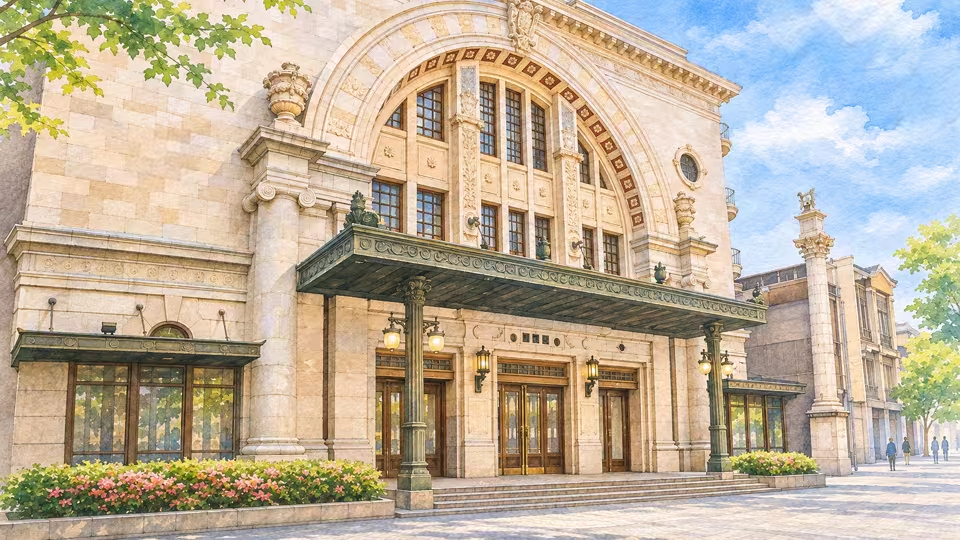
In 1923 Shōchiku opened the Shōchiku-za, the first full-scale Western-style theater in the Kansai region, used at first mainly as a cinema, with a grand arched Neo-Renaissance façade that earned it the nickname "the triumphal arch of Dōtonbori." In the 1920s and 1930s Dōtonbori filled with cafés, dance halls and neon; a popular song, "Dōtonbori Kōshinkyoku" ("Dōtonbori March"), carried its name across the country. The old theater street became a modern pleasure district for office workers, students and visitors.
The American firebombing of Ōsaka in 1945 burned the area to the ground. After the war the theaters were rebuilt, some as cinemas, and some, such as the Kado-za, became centers of manzai, the Ōsaka style of two-person stand-up comedy.
08Bunraku Comes Back, and Leaves Again
The puppet theater survived the eighteenth-century decline in smaller venues. In the 1790s a puppet showman from Awaji Island, Uemura Bunrakuken, opened a theater in Ōsaka; in 1872 his successors moved it to Matsushima and named it the Bunraku-za, and the house became so identified with the art that "bunraku" became its name. For most of the modern period, though, the Bunraku-za stood elsewhere in Ōsaka, in Matsushima, in the grounds of the Goryō Shrine, and from 1930 at Yotsubashi, not in Dōtonbori.
In 1956 Shōchiku opened the Dōtonbori Bunraku-za, a modern theater built specifically for the puppets, bringing them back to the street where Gidayū had started. Shōchiku gave up managing bunraku in 1963, when a foundation backed by the national, prefectural and city governments, the Bunraku Kyōkai, took over, and the theater was renamed the Asahi-za. In 1984 the National Bunraku Theatre opened in Nippombashi, a few minutes’ walk from the eastern end of the canal, and bunraku moved there.
09The Theaters Disappear
In the second half of the twentieth century the Five Theaters vanished one by one. The Benten-za and Naniwa-za closed. The Kado-za was rebuilt and reduced more than once. The Naka-za closed in 1999; in 2002, while gas pipes were being removed during its demolition, a fire broke out that destroyed the theater and damaged nineteen small restaurants and bars in Hōzen-ji Yokochō behind it.
The Shōchiku-za lasted longest. It was rebuilt in 1997 behind its preserved 1923 façade and reopened as the Ōsaka Shōchiku-za, staging kabuki and commercial productions. In 2025 Shōchiku announced that the aging building would close; the last performance was given in May 2026, ending 103 years of performances, and the company has said it plans to demolish the building, though petitions to save it have circulated and the site’s future is unsettled. Either way, Dōtonbori lost its last working large theater.
10Kuidaore, Signs and the Colonel
With the theaters gone, Dōtonbori’s identity shifted wholly to food and spectacle. An old saying contrasts Kyoto, where people ruin themselves on clothes (kidaore), with Ōsaka, where they ruin themselves on food (kuidaore). The Glico running-man sign first went up in 1935 and has been replaced several times; the current version is LED. The Kani Dōraku crab arrived in the 1960s. Kuidaore Tarō, the drum-beating clown doll, stood outside the Kuidaore restaurant from its opening in 1949 until it closed in 2008. In 2009 he moved to the front of the Naka-za Kuidaore Building, which stands on the site of the Naka-za theater.
The canal also has a baseball legend. When the Hanshin Tigers won the Central League pennant in 1985, celebrating fans jumped from Ebisu-bashi into the canal and threw in a statue of Colonel Sanders taken from a nearby KFC, apparently because he resembled a Tigers player, the American slugger Randy Bass. The Tigers’ long drought afterward became "the Curse of the Colonel." Divers found the faded, damaged statue in 2009. Every time the Tigers win a pennant, police line the bridge to stop the jumpers.
11A Walk Along the Water
The canal banks have been rebuilt as a promenade, the Tombori River Walk, which lets you walk at water level beneath the signs.
Start at Ebisu-bashi. Walking east, the building on the south bank with the arched front is the Shōchiku-za, its stage now dark. Further east, past Tazaemon-bashi and Aioi-bashi, is the stretch where the Naka-za, Kado-za, Naniwa-za and Asahi-za stood. Little of them survives, but the Naka-za site is the building where Kuidaore Tarō now stands. Tazaemon-bashi, according to the city of Ōsaka, takes its name from Ōsaka Tazaemon, a showman who came from Kyoto in the mid-seventeenth century to open a kabuki house here.
At the north end of Nippombashi, look for the memorial to Dōton. The National Bunraku Theatre is a short walk south-east. And just south of the canal, in the narrow alley of Hōzen-ji Yokochō, stands the moss-covered statue of Fudō Myōō at Hōzen-ji, splashed with water by worshippers for generations. From there it is a few steps back to the canal, where the crowds under the neon stand on the same ground as the audiences who once queued for Chikamatsu.