
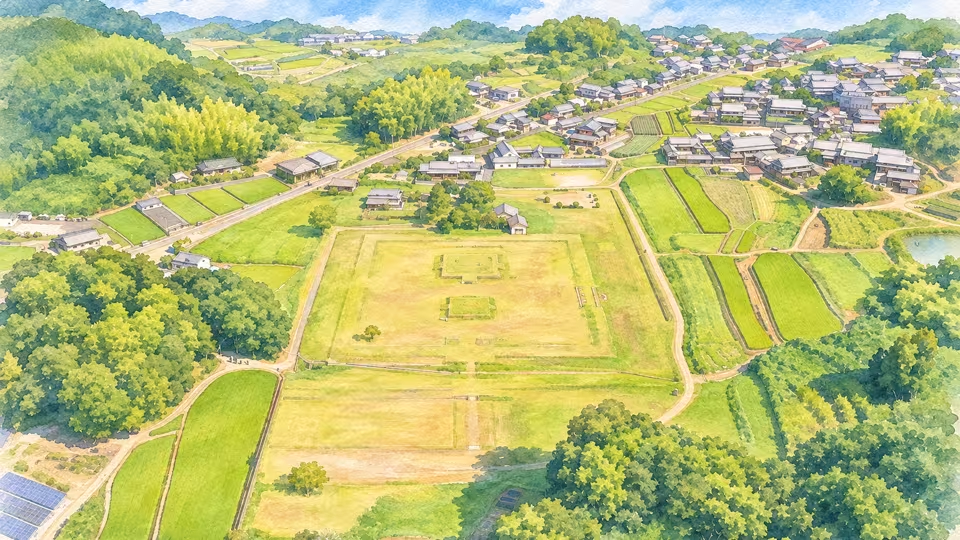
01A Valley of Rice Fields
The Asuka valley, at the southern edge of the Nara Basin, does not look like the cradle of anything. It is a patchwork of rice paddies, persimmon orchards and low wooded hills, cut by the shallow Asuka River. Yet for roughly a century, from the late 500s to the end of the 600s, the rulers of the Yamato kingdom built their palaces here, one after another. Buddhism put down its first institutional roots here. The words Nihon (Japan) and tennō (heavenly sovereign, the title now translated "emperor") came into official use in this valley or within a few kilometers of it. Historians call the whole era the Asuka period.
Just to the northwest, on the flat plain between three small mountains, the court then laid out Fujiwara-kyō, the first Japanese capital built on a Chinese-style grid. The court moved there in 694 and left in 710 for Heijō-kyō, the capital we now call Nara. With that move, Asuka’s time as the political center of Japan ended.
Almost nothing stands above ground. What you see are foundation stones, a reconstructed well, enigmatic carved rocks, stripped tombs and a handful of rebuilt temple halls. What survives in abundance is the landscape itself, protected by law, and the archaeology beneath it. This guide follows the story roughly in order, and ends with a route around the sites.
02The Soga and the First Temple
In the mid-sixth century, Buddhism arrived in Yamato as a diplomatic gift from the Korean kingdom of Paekche. Whether to worship the foreign god divided the court. The Soga clan, an immigrant-connected family that managed the royal treasury and married its daughters into the royal line, championed the new faith. The Mononobe, a hereditary military clan, opposed it. In 587 Soga no Umako, together with a coalition of princes that included the young Prince Umayado, destroyed the Mononobe leader Mononobe no Moriya in battle.
The next year, according to the Nihon Shoki (Chronicles of Japan, compiled 720), Paekche sent monks, temple carpenters, roof-tile makers and painters, and Umako began building Hōkō-ji, better known as Asuka-dera. It was Japan’s first full-scale Buddhist monastery, with a pagoda, worship halls and enclosing corridors. Excavations in the 1950s revealed an unusual plan: a central pagoda flanked on three sides by three golden halls, a layout matched in Koguryŏ, another Korean kingdom. Under the pagoda’s central pillar the builders buried jewels, metal ornaments and horse trappings, objects that look more like the grave goods of a chieftain’s tomb than Buddhist relics. The temple’s roof tiles are the oldest in Japan.
In 606 (or 609; the sources differ), the sculptor Kuratsukuri no Tori, a descendant of Chinese immigrants, completed a large bronze seated Shaka (the historical Buddha) for the central hall. This is the Asuka Daibutsu, the "Great Buddha of Asuka," and it is regarded as the oldest dated Buddhist statue in Japan. Lightning set the temple ablaze in 1196 and the statue was badly damaged; repeated repairs left only parts of the original, generally said to include sections of the face and the right hand. But it still sits where it was installed, on its original stone pedestal, which is the remarkable thing about it. The hall around it is a modest Edo-period rebuilding, and the temple today uses the name Ango-in.
When the capital moved to Nara in 710, Hōkō-ji’s institutional identity moved with it and became Gangō-ji. The Asuka temple lingered on as a much reduced local temple.
In a field just west of the temple stands a small stone stupa that tradition calls the "head mound" of Soga no Iruka, Umako’s grandson. We will come to why.
03Empress Suiko and Prince Shōtoku
In 592 Umako had Emperor Sushun, his nephew, assassinated after relations between them soured. He then placed his niece on the throne as Empress Suiko, the first woman to rule in her own right in recorded Japanese history. Suiko held court at the Toyura Palace and later the Oharida Palace, both in Asuka.
Government under Suiko is usually described as a partnership between the empress, Umako and Prince Umayado, remembered as Shōtoku Taishi. The Nihon Shoki credits this court with the system of twelve cap ranks (603), the Seventeen-Article Constitution (604), and an embassy to Sui China under Ono no Imoko (607), whose letter from "the Son of Heaven where the sun rises" to "the Son of Heaven where the sun sets" famously irritated Emperor Yang. How much of this was Shōtoku’s personal work is debated, and the Constitution’s authorship in particular has been questioned. The overall direction, though, is clear: a court looking to the continent for models of rank, law and religion.
Tachibana-dera, across the river from the main Asuka sites, claims to stand on Shōtoku’s birthplace. Shōtoku himself later based himself at Ikaruga, where Hōryū-ji stands. He died in 622 (621 in the Nihon Shoki); Umako died in 626.
04Ishibutai: The Stone Stage
Southeast of Asuka-dera is the most photographed monument in the valley: Ishibutai Kofun, a megalithic burial chamber standing naked in a grassy field. It was once covered by an earthen mound, which has long since disappeared, leaving about thirty huge granite blocks exposed. The largest roof stone is estimated at more than seventy tonnes. The name means "stone stage"; one folk explanation is that a fox once took the form of a woman and danced on top of it.
The tomb is widely believed to be that of Soga no Umako. The Nihon Shoki says he was buried at Momohara, and the surrounding district of Shimanoshō was the site of his mansion, which had a garden pond with an island in it, earning him the nickname "the Island Minister." Why the mound was removed is unknown. One suggestion is that it was stripped deliberately after the fall of the Soga, but this is speculation.
Archaeologists from Kyoto Imperial University, led by Hamada Kōsaku, excavated the site in 1933 and 1935. It is now a Special Historic Site, and you can walk into the chamber and look up at the underside of that enormous ceiling stone.
05The Isshi Incident of 645
After Umako’s death, his son Soga no Emishi and grandson Soga no Iruka dominated the court. In 643 Iruka sent troops against Ikaruga, and Shōtoku’s son Prince Yamashiro no Ōe and his family took their own lives. The Soga built mansions on Amakashi Hill, overlooking the palace, and according to the Nihon Shoki called their residences "palace gates" and their children "princes."
On the twelfth day of the sixth month of 645 (July 10 in the Julian calendar), a ceremony was held at the Itabuki Palace of Empress Kōgyoku to receive tribute from the three Korean kingdoms. Prince Naka no Ōe, the empress’s son, and Nakatomi no Kamatari had planned an ambush. The Nihon Shoki account is vivid: the hired assassins hesitated, so Naka no Ōe sprang forward and struck Iruka himself. The wounded Iruka crawled toward the throne asking what crime he had committed; the empress withdrew into the inner hall, and Iruka was cut down. His body was left lying in the rain-soaked courtyard, covered with a mat. The next day Emishi set fire to his mansion on Amakashi Hill and died, and the main line of the Soga was finished. Japanese historians call this the Isshi Incident, after the cyclical name of the year.
Kōgyoku abdicated in favor of her brother, Emperor Kōtoku. Naka no Ōe became crown prince, the era name Taika ("Great Change") was proclaimed, and an edict of reform followed in 646. How faithfully the Nihon Shoki preserves the original wording of the Taika Reform Edict is a long-running scholarly argument, but the coup is still treated as the starting point of a sustained effort to bring land and people under central control. Kamatari, rewarded on his deathbed with the surname Fujiwara, founded the family that would dominate the court for centuries.
The head-mound legend at Asuka-dera says that Iruka’s severed head flew from the palace and landed there.
06A Palace Built on Top of Palaces
South of Asuka-dera, on the east bank of the river, is a quiet field with an area of reconstructed stone paving and a square well. For centuries local tradition identified this as the Itabuki Palace, and it is still signposted as the "traditional site of the Asuka Itabuki Palace." Excavation since the 1960s has shown that the ground holds several palaces stacked one above another.
Archaeologists distinguish three main phases. The lowest is identified with Emperor Jomei’s Okamoto Palace, built around 630. The middle phase is Kōgyoku’s Itabuki Palace, where Iruka died. The top phase is Empress Saimei’s Later Okamoto Palace, which was later enlarged as the Kiyomihara Palace of Emperor Tenmu and Empress Jitō. For more than sixty years, in other words, the sovereigns kept rebuilding their palace on the same spot. The paving and well you see belong to the top layer, from the time of Tenmu and Jitō. The National Historic Site was long called the "traditional Itabuki Palace site"; in 2016 it was enlarged and renamed simply the Asuka Palace Site.
Just to the northwest, excavations from 1999 uncovered a large garden with stone-lined ponds, an island and water channels, thought to be the "White Brocade Rear Garden" mentioned in the chronicle.
07Saimei’s Stones and Water
After Kōtoku’s death, Kōgyoku returned to the throne in 655 as Empress Saimei, the first time a sovereign reigned twice. The Nihon Shoki says she loved building projects. She had a long canal dug that critics called "the canal of madness," and stone walls raised on the hills east of the palace.
Many of the strange stone objects scattered around Asuka are linked to her reign. The Sakafuneishi, a large flat rock on a hilltop carved with round basins connected by channels, has puzzled visitors for centuries. In 2000 excavations in the valley below revealed a water installation with a turtle-shaped stone basin, surrounded by stone paving and steps. It is now widely interpreted as a site for water rituals.
At the Mizuochi site northwest of Asuka-dera, archaeologists found the base of a building with an elaborate system of buried pipes. It is identified with the water clock that Naka no Ōe built in 660, which the chronicle says was the first time people were made to know the time. When he later installed a water clock at his new capital at Ōtsu in 671, bells and drums sounded the hours; the date, converted to the modern calendar as June 10, is observed in Japan today as Time Day.
Other stones include the Kameishi, a boulder carved like a crouching turtle; the Saruishi, a group of grotesque figures now lined up at the Kibi-hime tomb; and the Shumisen stone and the paired-figure stone (an elderly man and woman seated on a rock), both dug up in the Meiji era at what is now the Ishigami site and bored with channels so they could serve as fountains. The Ishigami site is thought to have been a place for banquets given to envoys and to people from the frontiers. What most of these stones were for remains a matter of educated guesswork.
08After Hakusukinoe: Tenmu Takes Asuka
In 660 Paekche fell to the combined forces of Tang China and Silla. Saimei resolved to restore it, traveled west with the court, and died at the Asakura Palace in Kyūshū in 661. In 663 the Yamato fleet was destroyed at the mouth of the Paek River, the battle known in Japan as Hakusukinoe. Fearing invasion, Naka no Ōe fortified the western coasts, moved the capital to Ōtsu on Lake Biwa in 667, and was formally enthroned as Emperor Tenji in 668.
Tenji’s death in 671 led to the Jinshin War of 672. His younger brother, Prince Ōama, rose from his retreat at Yoshino, defeated Tenji’s son Prince Ōtomo, and came back to Asuka. In 673 he was enthroned at the Kiyomihara Palace as Emperor Tenmu. Having won the throne by force, Tenmu ruled with unusual authority; poets of the Man’yōshū (the earliest anthology of Japanese poetry) wrote of the sovereign as a god. His court began work on a legal code, ordered the compilation of national histories that would become the Kojiki and the Nihon Shoki, reorganized the aristocracy into eight hereditary titles, and placed the sovereign firmly at the center of the state. The title tennō is generally thought to have come into regular use around this time; a wooden tablet with the characters for tennō was found at the Asuka-ike site.
That site, southeast of Asuka-dera, was a royal workshop producing metalwork, glass and lacquer. In 1998 excavators found large numbers of Fuhonsen coins there, along with casting molds, showing that coins were being minted in Tenmu’s reign, earlier than the Wadō Kaichin of 708 that had long been treated as Japan’s first currency. The Nara Prefecture Complex of Man’yō Culture now stands on the site.
Tenmu also started the project that became Fujiwara-kyō. The Nihon Shoki mentions plans for a "new city" as early as 676; after a pause the work resumed, and in 684 Tenmu toured the capital and fixed the site of the palace. He died in 686 before it could be completed.
09Jitō and the First Grid Capital
Tenmu’s widow, Princess Uno no Sarara, governed after his death. When their son, Crown Prince Kusakabe, died in 689, she took the throne herself in 690 as Empress Jitō. She promulgated the Kiyomihara Code, ordered a national population register, and pressed on with the new capital.
At the end of 694 Jitō moved from the Kiyomihara Palace into the Fujiwara Palace. The chronicle calls the city Aramashi no Miyako, the "newly expanded capital"; the name Fujiwara-kyō is a modern scholarly label. It lay on the plain northwest of Asuka, framed by the three Yamato mountains: Kagu-yama to the east, Unebi-yama to the west, and Miminashi-yama to the north. The palace sat in the middle of the triangle they form.
Fujiwara-kyō was the first Japanese capital laid out on the jōbō system, a grid of streets dividing the city into regular blocks on the Chinese model. For decades the standard reconstruction, by the historian Kishi Toshio, made it a rectangle about 2 km east to west and 3 km north to south. From the 1990s, however, excavations kept finding grid streets beyond those limits, and the leading view now is that the city was a square of ten by ten blocks, about 5.3 km on each side, with the palace at its center. The east-west width is now fairly secure; the north-south extent is still debated. On this reconstruction the city was larger than Heijō-kyō. Placing the palace in the middle, rather than at the northern edge as at Tang Chang’an, has led some scholars to suggest the planners followed the ideal city described in the Chinese classic Rites of Zhou rather than any real Chinese capital.
Inside the palace, the Daigokuden (Great Hall of State) faced south over the halls of state where officials assembled. These were the first Japanese palace buildings with tiled roofs set on stone foundations; earlier palaces in Asuka had posts sunk straight into the ground and roofs of bark or boards.
In 697 Jitō abdicated in favor of her grandson, Emperor Monmu, becoming the first retired sovereign to hold the title daijō tennō. The Taihō Code, Japan’s first complete set of penal and administrative law, was completed in 701. On New Year’s Day of that year Monmu received his court in the Daigokuden, with banners bearing the sun, moon, crow and four directional animals raised before the hall; the Shoku Nihongi remarks that the forms of civilized rule were now complete. Jitō died in the last month of the year corresponding to 702 (January 703 by the Western calendar). She was cremated, the first sovereign to be so, and her ashes were placed in Tenmu’s tomb.
The city lasted only sixteen years. Monmu died in 707, his mother Empress Genmei succeeded him, and in 708 she ordered a new capital to be built. The court moved to Heijō-kyō in 710. One common explanation is that an embassy returning from Tang China in 704 brought firsthand knowledge of Chang’an, which looked quite different from Fujiwara. Fujiwara’s terrain, which sloped down from south to north so that drainage ran toward the palace, may also have been a factor. The Daigokuden and other buildings are generally thought to have been dismantled and their timbers reused at Nara.
10Finding the Palace
Over the centuries the palace’s location was forgotten. The Edo-period scholar Kamo no Mabuchi identified it with a mound in the village of Takadono called Ōmiya-dodan ("great palace mound"); in the early twentieth century the historian Kita Sadakichi argued for a different mound to the west, and the question stayed open. From 1934 to 1943 the Japan Ancient Culture Research Institute, headed by Kuroita Katsumi with the architectural historian Adachi Yasushi leading the digging, excavated around Takadono and confirmed that Ōmiya-dodan was the Daigokuden, with the halls of state to its south. After rescue excavations by Nara Prefecture in the late 1960s, the Nara National Research Institute for Cultural Properties took up the work in 1969 and has carried out well over two hundred excavations since. The palace site was designated a Historic Site in 1946 and a Special Historic Site in 1952.
What you find today is a broad expanse of grass and fields. The Daigokuden platform survives as a low rise, and rows of vermilion posts mark the positions of gates and corridors found by excavation. In spring the surrounding fields are planted with rapeseed flowers and in autumn with cosmos, and the site fills with photographers. From the top of the platform you can see all three Yamato mountains, which is the easiest way to understand why the planners chose this spot. The Nara National Research Institute’s Fujiwara Palace Site Exhibition Room nearby has excavated finds and a model of the city.
11Painted Tombs: Takamatsuzuka and Kitora
South of Asuka, the Hinokuma district remained a burial ground for the royal family and high nobility. The joint tomb of Tenmu and Jitō is here, built in the octagonal shape reserved for sovereigns from the mid-seventh century. A little to the west, the Kengoshizuka tomb, excavated in 2009 and 2010, also proved to be octagonal, with a chamber divided into two burial spaces. Many scholars now think it is the tomb of Empress Saimei and her daughter Princess Hashihito, although the Imperial Household Agency assigns Saimei to a different tomb in neighboring Takatori. Its stone-faced octagonal mound was restored in 2022.
In 1972 archaeologists opened the small Takamatsuzuka tomb and found brightly colored wall paintings: the guardian animals of the four directions, a star chart on the ceiling, and groups of courtiers, including a famous group of women in pleated skirts on the west wall. Nothing like these continental-style paintings had been found in Japan before, and the discovery caused a national sensation. The murals were designated a National Treasure, but mold and deterioration later damaged them badly, and in 2007 the Agency for Cultural Affairs took the stone chamber apart to remove the paintings for conservation.
At the nearby Kitora tomb, a fiber-optic camera revealed a painted black tortoise-and-snake in 1983. Later investigations found the other directional animals, figures of the zodiac animals and a detailed astronomical chart, which is among the oldest surviving star maps in East Asia. Kitora’s murals have also been removed for conservation and are shown periodically at the Shijin no Yakata, a visitor center next to the tomb.
The occupants of both tombs are unknown. Candidates usually proposed are sons of Tenmu or senior officials of the late seventh century.
12Walking (or Cycling) the Valley
Asuka is small and flat enough to see in a day by bicycle, which you can rent near Kintetsu Asuka or Kashiharajingū-mae stations.
Begin at Asuka-dera to see the Great Buddha, then step out to the Iruka head mound and look west at Amakashi Hill. Climb the hill: from the top you can take in the whole valley, Asuka-dera and the three Yamato mountains in the distance, and see why the Soga chose it. Then go to the Mizuochi site for the water clock foundation, south to the Asuka Palace Site for the paving and well, and on to the Sakafuneishi and the turtle-shaped basin. Further south lie Tachibana-dera and the site of Kawara-dera, and to the southeast, Ishibutai. In the southwest are the Kameishi, the tomb of Tenmu and Jitō, the stone chambers known as the Demon’s Chopping Board and the Demon’s Privy, and the Takamatsuzuka and Kitora tombs.
For background, the Asuka Historical Museum of the Nara National Research Institute displays the original paired-figure stone and Shumisen stone along with replicas, and the Man’yō Culture complex covers the workshop finds.
The Fujiwara Palace Site lies north of Asuka and can be reached on foot or by bicycle from Kintetsu Unebi-goryōmae or Yamato-Yagi stations. Try to be on the Daigokuden platform late in the afternoon, when the sun goes down behind Unebi-yama.
The entire village of Asuka is covered by a special law of 1980 protecting its historic landscape, the only municipality in Japan with such protection. That law is why the valley still looks the way it does. On July 26, 2026, nineteen sites in and around Asuka and Fujiwara, among them the two palace sites, Asuka-dera, Ishibutai, Takamatsuzuka and Kitora, were inscribed on the UNESCO World Heritage List as the Ancient Capitals of Asuka and Fujiwara.