
01A Quiet Temple in Western Nara
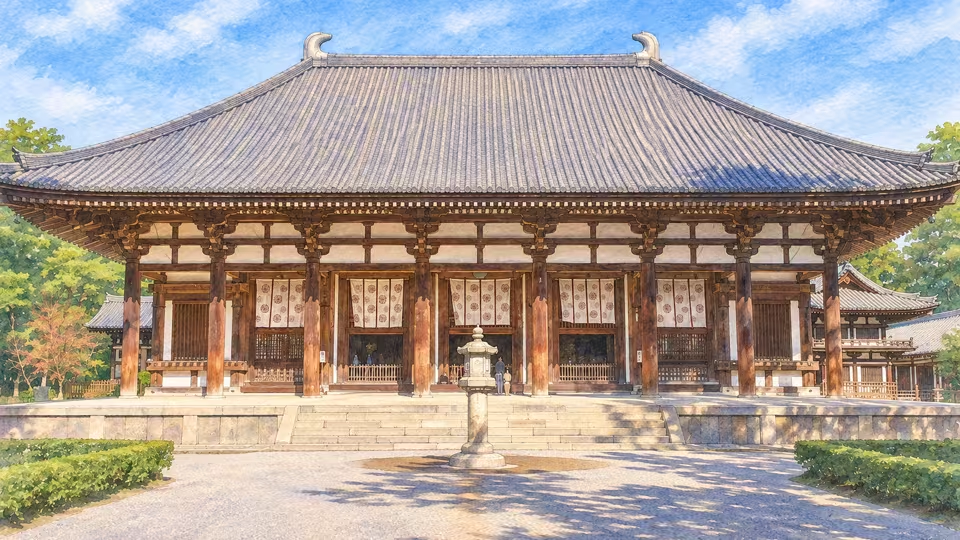
Tōshōdai-ji stands in Nishinokyō, the old "western capital" district of Nara, a short walk north from Nishinokyō Station on the Kintetsu line and a few hundred meters from the great twin-pagoda temple of Yakushi-ji. Compared with Tōdai-ji, the vast state temple of the Great Buddha on the other side of the city, it feels almost rural. A gravel path runs from the South Gate straight to the Golden Hall (Kondō, the main image hall), whose deep porch is lined with eight massive round columns under a sweeping hipped roof.
That hall is the only main hall of a Nara-period (710–794) temple still standing in Japan. But most visitors come for a person rather than a building. Tōshōdai-ji was founded by Ganjin, known in Chinese as Jianzhen, a senior monk from Yangzhou in Tang China who agreed in his fifties to go to Japan, failed five times to get there, lost his sight on the way, and finally landed on the sixth attempt at the end of 753. In Japan he gave the court a proper Buddhist ordination system, and in his last years he built this temple as a place to study and practice the monastic rules.
02Why Japan Needed a Precept Master
By the early eighth century Buddhism had been in Japan for about two hundred years. The court sponsored temples, statues and sutra copying on an enormous scale. What it lacked was a correct way of making monks.
In Buddhist tradition a person becomes a fully ordained monk by taking the complete set of precepts, the monastic rules, in a formal ceremony on an ordination platform. The ceremony requires a quorum of qualified monks: the standard formula is "three masters and seven witnesses." Without enough properly ordained senior monks, a valid ordination cannot happen at all. Japan did not have them.
The practical consequences were serious. Monks were exempt from taxes and labor service, so many people simply shaved their heads and declared themselves clergy. These "self-ordained" monks were beyond the court’s control. A recognized ordination procedure would let the state decide who was and was not a monk, and would also bring Japanese Buddhism in line with the standards of China, which the Nara court took as its model in nearly everything.
In 733 two young Japanese monks, Yōei of Kōfuku-ji and Fushō of Daian-ji, sailed to China with an official embassy. Their assignment was to find a precept master willing to come to Japan.
03The Master of Yangzhou
Ganjin was born in 688 in Yangzhou, a wealthy commercial city near where the Grand Canal meets the Yangtze. He entered the monastic life as a boy, studied in the two Tang capitals, Luoyang and Chang’an, and received full ordination in Chang’an in 708. He specialized in the Vinaya, the body of monastic law, especially the Four-Part Vinaya that governed Chinese monasteries, and he also studied Tiantai Buddhism. Back in Yangzhou, based at Daming Temple, he became the leading precept master of the region. Later tradition credits him with ordaining some forty thousand people.
Yōei and Fushō reached him in 742, after nearly ten years in China. According to the main account of his life, they asked him to recommend one of his disciples for the journey. No one volunteered; one disciple pointed out that the sea crossing was so dangerous that hardly anyone survived it. Ganjin then said that this was for the sake of the Dharma, that life was not worth hoarding, and that if no one else would go, he would go himself. He was fifty-four years old by Western reckoning.
That account is The Eastern Expedition of the Great Tang Master (Tō Daiwajō Tōseiden), written in 779 by the Japanese scholar-official Ōmi no Mifune on the basis of notes by Ganjin’s disciple Situo (Shitaku in Japanese). It is a devotional biography, and its scenes and speeches are shaped accordingly, but its outline of events is generally accepted.
04Five Failures
The first attempt, in 743, collapsed before it left port. A quarrel among the monks led one of Ganjin’s disciples, Ruhai, to tell the authorities that Yōei and his companions were in league with pirates. Officials searched the group, the Japanese monks were detained, and the voyage was abandoned.
A second attempt later the same year ended in shipwreck near the mouth of the Yangtze. The group was taken in by temples near Mingzhou, modern Ningbo. Two further attempts were stopped by local authorities, in one case because Ganjin’s own disciples, alarmed at the danger to their teacher, reported the plan. Ganjin was one of the most respected clerics in the region, and many people simply did not want to lose him.
The fifth attempt, in 748, was the worst. The ship was caught in a storm and drifted for about two weeks before running aground on the southern tip of Hainan Island, near modern Sanya. The party spent about a year on the island and then traveled back north overland through what are now Guangxi and Guangdong. Yōei fell ill and died along the way. Ganjin developed an eye disease, treatment failed, and he went blind. Fushō parted from him for a time, and Ganjin’s loyal disciple Xiangyan, the one who had warned about the sea, died on the road. Ganjin kept lecturing and ordaining as he traveled, and was back in Yangzhou around 750.
05The Sixth Voyage
In 753 a Japanese embassy led by Fujiwara no Kiyokawa was preparing to sail home. The vice-ambassadors Ōtomo no Komaro and Kibi no Makibi called on Ganjin and invited him to come with them. Emperor Xuanzong’s court was unwilling to let him go, so the departure had to be secret. Ganjin slipped out of his temple and boarded Komaro’s ship, the second of four.
Also leaving with the embassy was Abe no Nakamaro, a Japanese scholar who had passed into Tang government service decades earlier and was finally going home. He sailed on the ambassador’s flagship. The fleet was scattered at sea. The flagship was blown south to Annam, in present-day Vietnam; Kiyokawa and Nakamaro made their way back to Chang’an and never saw Japan again.
Ganjin’s ship reached Okinawa, then worked north by way of Yakushima, landing at Akitsumaya-no-ura in Satsuma Province, on the southern tip of Kyūshū, near present-day Bōnotsu in Kagoshima Prefecture, on the twentieth day of the twelfth month of 753 by the Japanese calendar, which fell in January 754 by the Western one. Fushō, aboard Kibi no Makibi’s ship, also arrived safely. On the fourth day of the second month of 754 Ganjin entered the capital, Heijō-kyō. Eleven years had passed since the first attempt.
He brought disciples, among them Situo, Fajin and Rubao (Hōshin and Nyohō in Japanese), along with craftsmen, Buddhist relics, statues, scriptures and commentaries, and calligraphy attributed to Wang Xizhi and his son Wang Xianzhi, the most admired calligraphers in Chinese history.
06The Ordination Platform at Tōdai-ji
The Great Buddha of Tōdai-ji had been dedicated only two years earlier, in 752, and the court was eager to complete its Buddhist establishment. In the fourth month of 754, a temporary ordination platform was set up in front of the Great Buddha Hall. There Ganjin administered the bodhisattva precepts to the retired emperor Shōmu, Empress Dowager Kōmyō and the reigning empress Kōken, and then ordained some four hundred others. A group of Japanese monks who considered their earlier, informal ordinations sufficient objected at first, but after debate they too took the precepts again.
In 755 a permanent Ordination Platform Hall (Kaidan-in) was built at Tōdai-ji. Platforms were later added at Yakushi-ji in Shimotsuke, in present-day Tochigi Prefecture, and at Kanzeon-ji in Tsukushi, near Dazaifu in northern Kyūshū, so that eastern and western Japan each had one. These "three ordination platforms of the realm" gave Japan, for the first time, a state-recognized path to becoming a monk.
In 756 Ganjin was appointed to the Office of Monastic Affairs, the body that supervised the clergy, with the rank of daisōzu, but administration and court politics were a burden for a blind man in his late sixties. In 758 he was relieved of these duties and given the honorific title Daiwajō, "Great Preceptor," so that he could concentrate on teaching.
07A Prince’s Estate Becomes a Temple
The court granted Ganjin the former residence of Prince Niitabe, a son of Emperor Tenmu, in the western part of the capital. In 759 he opened a training center there, at first called Tōritsu Shōdai, roughly "the Tang Vinaya hall for monks of the four directions." The word shōdai comes from a Sanskrit term for the community of monks from everywhere, and came to mean a monastery. The name later settled into Tōshōdai-ji.
Unlike Tōdai-ji or Kōfuku-ji, which were built by the state or by the powerful Fujiwara family, Tōshōdai-ji began as a modest private foundation. Its halls were added gradually, and several of the most important ones were completed only after its founder’s death.
Ganjin died at Tōshōdai-ji on the sixth day of the fifth month of 763, aged seventy-six by the traditional East Asian count. According to the Tōseiden, he died sitting in meditation posture, facing west. Shortly before, his disciple Ninki had dreamed that the ridge beam of the lecture hall had broken, took it as a sign that the master would soon die, and had a portrait statue made. That figure, the seated statue of Ganjin in dry lacquer, is now a National Treasure and is regarded as the oldest portrait sculpture in Japan.
08The Golden Hall
The Golden Hall was built after Ganjin’s death, in the second half of the eighth century; the temple credits its completion to his disciple Rubao, who led the temple for many years and is said to have been of Central Asian descent. No record gives the exact date, and estimates generally place it around the 770s or a little later.
The façade is seven bays wide. The front bay is left open as a porch, so the eight columns stand free in a row; their slight swelling toward the middle is often compared to the entasis of Greek temples. The hall has been heavily repaired several times, in 1270, 1323, 1693–94 and the 1890s, and the hipped roof is generally thought to be steeper and taller now than it was when first built. The two ornamental ridge-end tiles called shibi, shaped like stylized fish tails, were for centuries one from the Nara period and one from the Kamakura period (1185–1333). During the Heisei-era restoration both were taken down for preservation and replaced with replicas; the Nara-period one is now in the temple museum.
Inside, three large statues stand on a single platform: a seated Rushana (Vairocana) Buddha in the center, a standing Yakushi, the healing Buddha, on the east, and a standing Thousand-Armed Kannon on the west. All three are National Treasures. The Rushana, over three meters tall, is hollow dry lacquer and the Kannon, over five meters, is lacquer over a wooden core; both date from the Nara period. The Yakushi was finished a little later, in the early Heian period: coins found in its left palm during a 1972 repair date it to the early ninth century. The Rushana’s halo is said to have carried a thousand small seated Buddhas, of which 862 survive. The Kannon really does have close to a thousand arms: 42 large and 911 small, 953 in all, which is rare among Japanese images of this deity. Standing figures of the gods Bonten and Taishakuten and the Four Heavenly Kings complete the group; they too are National Treasures.
Between 2000 and 2009 the hall was completely dismantled and reassembled in what is called the Great Heisei Restoration. The building you see is the result.
09A Hall from the Imperial Palace
Behind the Golden Hall stands the Lecture Hall (Kōdō). It began life not as a temple building but as the Eastern Assembly Hall of the Heijō Palace, a pavilion where officials gathered before audiences. The court gave it to Ganjin, and it was dismantled and rebuilt here. Every other building of the Nara palace has vanished, so this hall is the only surviving structure from Heijō Palace.
When it was moved, its plain gabled roof was converted to a hip-and-gable roof. Later repairs, especially in the Kamakura period, made the roof steeper and altered the columns, brackets and windows, so the building now looks partly medieval. Inside are a seated Miroku Buddha from the Kamakura period and two Nara-period guardian kings. The Lecture Hall is a National Treasure.
10Decline and Revival
After the Nara period the Vinaya school declined, and Tōshōdai-ji with it. In the thirteenth century a movement to revive monastic discipline arose among the old Nara temples, and the monk Kakujō (1193–1249), who came to Tōshōdai-ji in 1244, restored the practice of the precepts there. He is honored as the restorer of the temple.
Every year on May 19 the temple holds the Uchiwamaki, a ceremony in which heart-shaped paper fans are scattered from the drum tower to the crowd below. It is part of the memorial service on the anniversary of Kakujō’s death. According to legend, he refused to swat the mosquitoes that bit him, and after his death fans were offered in his memory so that insects could be driven off without being killed.
Several buildings date from this period of revival. The Drum Tower (Korō), a two-story pavilion built in 1240, actually houses Buddhist relics associated with Ganjin and is also called the Relic Hall; it is a National Treasure. The long building to its east is divided in two: the southern end is the Raidō, a hall for venerating the relics in the Drum Tower, and the northern end is the East Quarters (Higashimuro), where monks lived. The Raidō took its present form in 1284.
In the Edo period (1603–1868) the temple found patrons around the shogun. In the 1690s the monk Ryūkō, a favorite of the fifth shogun Tokugawa Tsunayoshi, helped organize a nationwide fund-raising campaign, and from 1692 the Golden Hall and other buildings were repaired. Tsunayoshi’s mother Keishōin also gave donations, and the ordination platform was revived in 1698.
11Ganjin in the Modern Imagination
In 1957 the novelist Inoue Yasushi published The Roof Tile of Tempyō (Tenpyō no iraka), which tells the story of Ganjin’s voyage through the eyes of Fushō and other Japanese student monks in China. The title refers to the ridge-end tiles of the Golden Hall. The novel, and a 1980 film based on it, made Ganjin a household name in Japan.
The painter Higashiyama Kaii spent about a decade on a cycle of sliding-door and wall paintings for the Mieidō, the hall that houses Ganjin’s statue. He painted the mountains and sea of Japan, which Ganjin never saw, finished in 1975, and ink landscapes of Yangzhou, Huangshan and Guilin, finished in 1980. The whole project, including the doors of the shrine that holds the statue, ran from 1971 to 1982.
In 1980 the portrait statue of Ganjin traveled to China for the first time and was shown in Yangzhou, a visit described in both countries as a homecoming. Yangzhou later sent qionghua (Chinese snowball viburnum), the flower the city is known for, which now grows beside his tomb. In 1998 Tōshōdai-ji was inscribed on the UNESCO World Heritage List as part of the Historic Monuments of Ancient Nara.
12Walking the Grounds
The South Gate is a 1960 reconstruction in Nara-period style. The plaque reading "Tōshōdai-ji" is traditionally said to be in the hand of Empress Kōken; the one now hanging is a copy, and the Nara-period original is kept in the temple museum.
Walk up the gravel to the Golden Hall. From a distance it is worth taking in the proportions of roof and columns; up close, stand in the porch among the eight columns and look in at the three great statues, which can be viewed from the front.
Behind it is the Lecture Hall, lower and plainer, closer in feeling to palace architecture than to temple architecture. East of the space between the two halls is the Drum Tower, and beyond that the long Raidō and East Quarters. East of them stand two small raised storehouses built of interlocking triangular logs, the larger Treasure House (Hōzō) and the smaller Sutra Storehouse (Kyōzō). Both date from the Nara period and are National Treasures. The Sutra Storehouse is said to have been a rice store on Prince Niitabe’s estate, which would make it older than the temple itself; it is considered the oldest log storehouse of this type in Japan.
Nearby, the Shin-Hōzō museum, built in 1970, displays sculpture from the temple’s collection, including Nara-period wooden figures from the old Lecture Hall, a standing Buddha figure missing its head and hands that is often called the "Tōshōdai-ji torso," and the Nara-period ridge-end tile from the Golden Hall. It opens only in certain seasons.
Further north is the Mieidō, an Edo-period hall from Ichijō-in, the residence of the head of Kōfuku-ji, which later served as the prefectural office and a courthouse before being moved here in 1964 to house Ganjin’s statue. The original statue is shown only three days a year, around the June 6 memorial for Ganjin, together with Higashiyama Kaii’s paintings. A replica made in 2013, the 1,250th anniversary of his death, is on view year-round in the Kaisandō (Founder’s Hall) just southwest of the Mieidō.
Northeast of the Mieidō, along a mossy path through the trees, is Ganjin’s tomb, a simple earthen mound behind a gate, with the qionghua from Yangzhou growing nearby. It is the quietest place in the temple.
On the way back, pass the Ordination Platform on the west side of the grounds. Its hall burned long ago; what remains is a three-tiered stone platform from the Kamakura period, topped since 1978 by a stupa modeled on the ancient one at Sanchi in India. Ganjin crossed the sea so that Japan could have a platform like this one.