
01A Man Runs at the Emperor’s Carriage
On a December day in 1901, the Emperor Meiji was riding back to the palace in Tokyo after opening a session of the Imperial Diet, Japan’s new parliament. As the procession passed through the streets, a sixty-year-old man in a formal coat broke from the crowd and ran toward the imperial carriage, holding a folded petition above his head. He stumbled and was seized by police before he reached it. He had known they would. Presenting a petition directly to the emperor was forbidden, and he had prepared himself to die for it.
The man was Tanaka Shōzō, until that October a member of the House of Representatives for Tochigi Prefecture, north of Tokyo. For ten years he had stood up in the Diet to describe what the Ashio copper mine was doing to the farms along the Watarase River: dead fish, poisoned rice paddies, mulberry trees withered to sticks, tens of thousands of people sinking into poverty. For ten years the government had answered with commissions and promises. The mine kept running. The petition in his hand was his last argument.
The government chose not to make him a martyr. Officials declared him temporarily insane and released him the same evening. But the newspapers carried the story across the country, and the question he had been asking became hard to ignore.
That question is the subject of this essay. The Meiji era, from 1868 to 1912, is usually told as a story of astonishing speed. In little more than forty years a country of feudal domains and samurai became a constitutional state with railways, compulsory schooling, a modern army and navy, and an empire of its own. It defeated China in 1895 and Russia in 1905. No non-Western country had done anything like it.
But transformations of that size are expensive. Someone has to pay for the factories and the warships, someone has to work the machines, and someone has to give up land, health, or life when the state decides the nation needs it. The answer to "who paid?" changes how the whole story reads. Was Meiji modernization a shared national project, or a bill run up by some and settled by others?
02The Land Paid First
The new government that took power in 1868 was nearly broke. The shogunate’s revenues had collapsed with it, the domains kept their own taxes until they were abolished in 1871, and Tokyo had inherited the domains’ debts along with the obligation to keep paying stipends to former lords and samurai. Railways, arsenals, model factories, and a conscript army would all need money, and there was only one large source of wealth in the country: farmland.
In 1873 the government launched the Land Tax Reform. Under the old system, peasants had paid their lords a share of the harvest in rice, at rates that varied by domain and could sometimes be negotiated down in a bad year. The reform surveyed every plot in the country, assigned it a monetary value, issued the owner a certificate of title, and set the tax at three percent of that value, payable in cash, every year, to the central government.
For the state this was a masterstroke. For the first time it had a predictable income it could budget around, unaffected by harvests or rice prices. Through the 1870s the land tax supplied roughly three-quarters or more of all government tax revenue.
For farmers, the arithmetic looked different. Land values had been worked out backward from the revenue the government wanted, so in many districts the burden was no lighter than before. Paying in cash meant that when rice prices fell, a family had to sell more of its crop to raise the same sum, and there was no relief for a poor harvest. Woods and meadows that villages had used in common, but that no individual could prove he owned, were often declared state forest, and villagers lost the firewood, fodder, and fertilizer they had always gathered there.
In 1876 tens of thousands of farmers rose in Mie Prefecture and the surrounding region, burning government offices and the new schools that their taxes paid for. Another uprising broke out in Ibaraki. The government, facing discontented samurai at the same time, cut the rate to 2.5 percent the following year. A popular verse claimed the half-percent reduction had been won with a jab of a bamboo spear.
Then came a second blow. To pay for crushing the Satsuma Rebellion of 1877, the government printed paper money, and inflation followed. Ironically this helped farmers for a few years, since rice sold high while the tax stayed fixed. In 1881 the new finance minister, Matsukata Masayoshi, set out to restore sound money. He cut spending, withdrew paper notes, built up silver reserves, and in 1882 founded the Bank of Japan. By the standards of public finance it was a triumph. The yen stabilized, and the groundwork for industrial investment was laid.
The deflation that made it work fell on the countryside. Prices for rice and silk cocoons dropped by roughly half within a few years, but the land tax did not. Farmers borrowed to pay it, could not repay, and lost their fields to moneylenders and wealthier neighbors. Across the 1880s a large number of smallholders became tenants, handing over about half of each harvest as rent. The landlord-tenant tensions that troubled rural Japan for the next half-century have deep roots in these years.
In 1884, in the silk-raising hills of Chichibu, west of Tokyo, indebted farmers formed what they called the Poor People’s Party. They demanded that debt payments be postponed and local taxes reduced. When nothing happened, several thousand of them took up arms, seized the district office, and held the area for several days before police and troops arrived. Thousands were later punished, and the leaders were executed. Chichibu is sometimes filed under the movement for parliamentary rights, but its cause was plain: cocoons were worth nothing, and the creditors were taking the land.
Japan’s leaders are generally thought to have had a deliberate reason for squeezing their own farmers so hard. They had watched Egypt and the Ottoman Empire borrow heavily from European banks and then lose control of their finances, and they were determined not to repeat the mistake. Without foreign loans, and without colonies to draw on in those early decades, the capital for industrialization had to come from inside the country. In practice that meant from the rice fields.
03The Sons: A "Blood Tax"
The state needed men as well as money. At the end of 1872 the government announced universal conscription, and the law took effect in 1873: men were liable for military service at twenty. The proclamation borrowed a European phrase and called military service a "blood tax," meaning a duty paid with one’s body. In the countryside the words were taken literally, and they mixed with rumors that foreigners drained people’s blood. Riots against conscription broke out in a number of prefectures, and crowds attacked the homes of village officials.
The law as first written was full of exemptions. Heads of households, eldest sons and designated heirs, officials, and certain students were excused, and anyone who could pay 270 yen could buy his way out. That sum was far beyond an ordinary farming family. The men who actually marched off were overwhelmingly the second and third sons of peasants, the ones with no claim to inherit. Families with means found ways around the rules, most commonly by having a son adopted as heir into a household that had none; guidebooks explaining how to dodge the draft circulated openly. Revisions in 1883 and 1889 closed most of the loopholes.
Conscription did break the samurai monopoly on arms, and in 1877 an army of commoners defeated the Satsuma samurai under Saigō Takamori. To many families, though, conscription meant losing a working pair of hands for years, and then, when the wars came, possibly forever. Japan lost about thirteen thousand soldiers against China in 1894 and 1895, counting the fighting that followed on Taiwan, nearly nine in ten of them to disease. Against Russia in 1904 and 1905 estimates of the dead run from over eighty thousand to more than a hundred thousand, and the siege of Port Arthur alone cost nearly sixty thousand killed and wounded, many in frontal assaults.
The war against Russia was financed with heavy borrowing and new taxes that reached into daily life: higher levies on sake, a tobacco monopoly, business taxes. When the peace treaty was announced in September 1905 and it turned out Japan would receive no indemnity, a rally in Tokyo’s Hibiya Park turned into days of rioting, with police stations and police boxes set on fire and a pro-government newspaper besieged. The anger was about diplomacy on the surface. Underneath, people who had paid the taxes and sent the sons felt they had been given nothing in return.
04The Daughters: Silk and Cotton
If the farm sons went to the barracks, the farm daughters went to the mills.
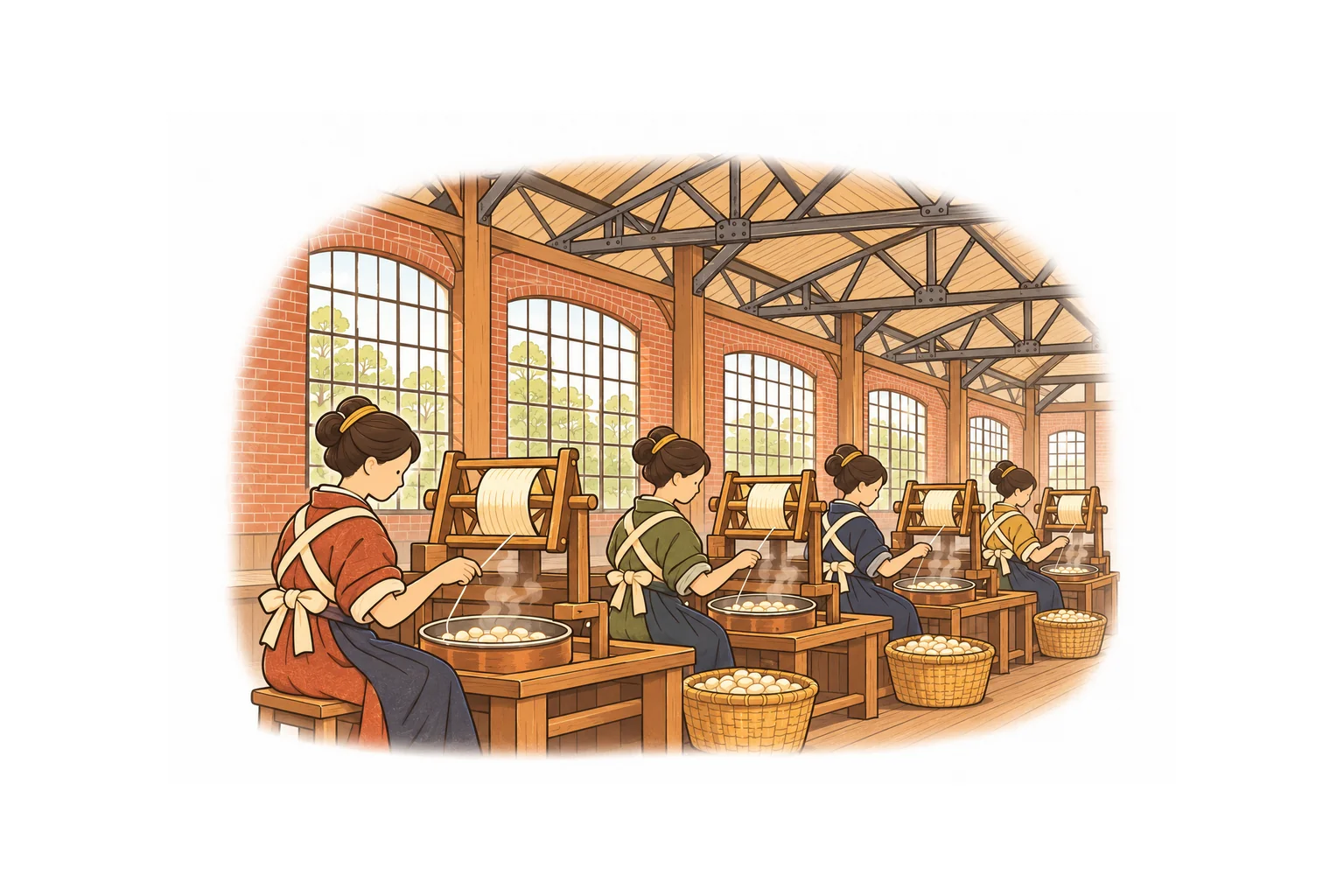
Raw silk was Japan’s leading export for most of the Meiji period, often a third or more of the total. Silk earned the foreign currency that bought locomotives, machine tools, and battleships. The government’s model filature at Tomioka, opened in 1872 with French equipment and a French engineer, was meant to show how it should be done. At first it struggled to recruit, partly because of a rumor that the foreigners drank blood (they were drinking red wine). Officials sent their own daughters to set an example. One of them, Yokota Ei, the daughter of a samurai from Matsushiro in the mountains of Nagano, later wrote a memoir of her time there. She remembered pride above all: she and her companions were learning a new skill to carry home, which she did, becoming an instructor at a mill in her own district.
Tomioka was the showpiece. The industry that actually grew up around it looked different. By the 1880s and 1890s hundreds of private filatures had sprung up, the largest cluster around Lake Suwa in Nagano, and the workers were no longer officials’ daughters but the girls of poor farm families, many in their early teens. Every winter, groups of them walked from the villages of Hida over the snowbound Nomugi Pass to the mills at Okaya, and walked home again at the end of the year to hand their wages to their parents. Their story reached a wide audience only in the late 1960s, when the writer Yamamoto Shigemi published interviews with elderly former mill girls, later made into a film. Some of the women he spoke to remembered companions who slipped from the pass, or who fell sick and were sent home to die on the way.
A working day of thirteen or fourteen hours was ordinary, longer in the busy season. The girls lived in company dormitories with restricted outings. Pay was calculated by output and quality, with fines for broken or uneven thread, so that some girls finished a year owing the company money. Recruiters gave parents an advance against their daughter’s future earnings, which made leaving early almost impossible.
The cotton-spinning mills of Ōsaka and Tokyo were harsher. Imported spinning machinery was costly, so owners ran it around the clock, and women worked night shifts in rooms thick with cotton dust. Tuberculosis spread through the dormitories, and when sick workers were sent home, the disease went with them into the villages. In 1903 the Ministry of Agriculture and Commerce published a survey, Shokkō jijō (Conditions of Factory Workers), documenting long hours, child labor, beatings, and illness in such detail that even officials found it shocking.
Japan’s first Factory Act, limiting the hours of women and children and restricting night work, passed in 1911. Mill owners fought it hard, and it did not take effect until 1916, with exemptions for small workshops and a long grace period before night work by women was banned. In other words, for the entire Meiji era the young women who kept Japan’s largest export industry running had almost no legal protection at all. Japanese silk won market share abroad on price, and much of that price advantage was their labor.
05Ashio: The Poisoned River
The costs of the mills fell on bodies. The costs of the mines fell on land and water too, and Ashio is the case that made this visible.
The Ashio copper mine sits in the mountains of western Tochigi. Worked in the Edo period and then nearly exhausted, it was bought in 1877 by the businessman Furukawa Ichibei, who introduced modern drilling and smelting and struck rich new veins. By 1891 Ashio produced about 40 percent of Japan’s copper. Copper was a valuable export and a military necessity, and Furukawa became one of the great industrialists of the age.
Smelting consumed enormous quantities of timber, and the hills around the mine were cut bare. Sulfur dioxide from the smelters killed what vegetation remained, leaving slopes of naked rock. Rain then washed sediment and copper-laden waste into the Watarase River. Fish died in large numbers through the 1880s. After a great flood in 1890 spread the river’s water across the downstream plain, rice failed and mulberry trees died across parts of four prefectures.
Tanaka Shōzō raised the issue in the Diet for the first time in 1891 and kept raising it. The government ordered settling ponds and filtering equipment and appointed investigative commissions, but would not close the mine. Copper meant foreign exchange, and Furukawa had powerful friends; a son of the cabinet minister Mutsu Munemitsu had been adopted as his heir. Farmers marched toward Tokyo in mass petitions several times. In 1900, at Kawamata on the Tone River, police met one such march and beat the marchers, arresting dozens.
The appeal to the emperor in 1901 made Ashio a national scandal, and students and Christian activists traveled to see the damage. The state’s eventual solution was to protect the wider plain by sacrificing one village. Yanaka, at the confluence of several rivers, was designated as a flood retention basin. It was abolished as a municipality in 1906, and in 1907 the government sent men to demolish the houses of the last sixteen or so families who refused to leave. Tanaka moved to Yanaka to live among the remaining residents in makeshift huts. He collapsed in 1913 while traveling through the river district and died at a supporter’s house. According to a well-known account, his only belongings were a cloth bag holding a few books, some diaries, and some pebbles from the riverbed.
Japanese historians often call Ashio the starting point of the country’s industrial pollution. The pattern it set, in which a region’s land and health were traded for national production and the state sided with the producer, would come back later at Minamata and elsewhere.
06The Ainu and the "Opening" of Hokkaidō
Farmers, mill girls, and the people of the Watarase basin were at least counted as citizens of the nation they were paying for. For others, the land and way of life they had were the very things modernization meant to take.
The northern island now called Hokkaidō was known as Ezo, the homeland of the Ainu, an Indigenous people who lived by fishing, hunting, and gathering, with their own language and religious practices, among them the ceremony in which a bear raised in the village was sent back to the world of the gods. Under the Tokugawa shoguns, the Matsumae domain controlled trade with the Ainu and exploited them harshly, but the interior remained largely theirs.
In 1869 the Meiji government set up a Colonization Office and renamed the island Hokkaidō. It had two aims: to forestall Russian expansion southward, and to develop coal, fisheries, and farmland. The government treated the land as unowned and available for distribution. Settlers from the main islands poured in, and the population climbed from tens of thousands to about a million by around 1900. Farmer-soldiers cleared land and guarded the coasts; Sapporo was laid out on a grid by the colonial official Shima Yoshitake, and American advisers were hired to guide farming and development.
To the settlers, Ainu hunting grounds and fishing rivers looked empty. Officials restricted salmon fishing on the main rivers and banned the poisoned arrows used to hunt deer, cutting at the two foundations of Ainu subsistence. From 1871 women were forbidden to receive the traditional mouth tattoos and men to wear earrings; Japanese-style names were pressed on families, and schools taught in Japanese. From 1878 official documents classified the Ainu as "former natives." Deprived of their livelihoods, many fell into poverty, and disease and alcohol took a heavy toll.
The convicts of the new state helped build the colony too. Prisons were set up in central and eastern Hokkaidō, filled with political prisoners from the civil conflicts of the 1870s and 1880s as well as ordinary felons, and inmates were worked in mines and on roads. The road linking the interior to the Sea of Okhotsk coast was cut largely by chained prisoners, many of whom died and were buried where they fell.
When Japan traded its claim to Sakhalin for the Kuril Islands in an 1875 treaty with Russia, more than eight hundred Sakhalin Ainu were moved to Hokkaidō: first to Sōya in the far north, then inland to Tsuishikari near Sapporo. In the cholera and smallpox epidemics of 1886 and 1887, over three hundred of them are generally reported to have died.
In 1899 the Hokkaidō Former Natives Protection Act offered Ainu households small plots of land if they would farm. It was meant to turn hunters and fishers into farmers, and the plots were often poor land left over after settlers had chosen theirs. The law remained on the books until 1997.
07A Kingdom Becomes a Prefecture
The Ryūkyū Kingdom, in the islands south of Kyūshū, was something else again: a state with its own king, court, and diplomacy, ruling from Shuri Castle on Okinawa. For centuries it had sent tribute to China. Since 1609 it had also been under the control of the Satsuma domain in southern Japan. The kingdom survived by balancing between the two.
A modern state with fixed borders had no room for that ambiguity. In 1872 the Meiji government made King Shō Tai a "domain king," turning the kingdom on paper into a Japanese domain. In 1874 Japan sent an expedition to Taiwan to punish the killing of shipwrecked Ryūkyūans, and the settlement with China was read in Tokyo as an acknowledgment of Japan’s authority over them. The following year Tokyo ordered the Ryūkyūans to stop sending tribute to China. The royal government protested and sent appeals; some officials fled to China to ask for help.
In March 1879 the official Matsuda Michiyuki arrived at Shuri with a force of police and soldiers numbering in the hundreds, and announced that the domain was abolished. Shuri Castle was handed over, Shō Tai was taken to live in Tokyo, and the kingdom became Okinawa Prefecture. Japanese historians call this sequence the Ryūkyū Disposition. China refused to recognize it, and the two governments even discussed dividing the islands, but nothing was settled until Japan’s victory in 1895 ended the argument.
To avoid trouble with the old elite, Tokyo then left Okinawa’s old land, tax, and status systems in place. The policy sounded gentle; in practice it meant that Okinawan farmers kept paying the kingdom’s heavy taxes. On the outer islands of Miyako and Yaeyama a head tax, levied on every adult regardless of means, lasted until 1903, three decades after the land tax reform on the main islands. Governors and senior officials came from elsewhere in Japan. Okinawans first voted in a national election only in 1912, more than twenty years after the first Diet. Jahana Noboru, an Okinawan who had studied agriculture in Tokyo and returned home as an official, broke with the governor over the disposal of common forest lands and led a campaign for Okinawan political rights. It failed, and he died in his forties after a mental breakdown. For Okinawa, absorption brought obligations quickly and rights slowly.
08Korea
From the start, Meiji modernization was bound up with expansion. Many of its leaders believed that Japan could stand as an equal among the Western powers only by acquiring, as those powers had, a sphere of its own. The obvious place was Korea.
In 1875 a Japanese warship provoked a clash near Ganghwa Island, at the mouth of the river leading to Seoul. The next year, under the threat of naval force, Korea signed a treaty opening its ports and granting Japanese residents extraterritorial privileges: the same kind of unequal treaty the United States had imposed on Japan two decades earlier. For the next twenty years Japan and China competed for influence in Seoul. In 1894 a great peasant uprising led by the Tonghak, a religious movement, gave both a pretext to send troops, and the Sino-Japanese War followed. Much of it was fought on Korean soil. When the Tonghak rose again that autumn, Japanese and Korean government troops crushed them, killing tens of thousands.
In October 1895, with Japanese influence in Seoul giving way to Russian, the Japanese minister in Seoul, Miura Gorō, arranged for Japanese soldiers, police, and civilian adventurers to break into the palace and murder Queen Min, who was seen as the center of pro-Russian policy. Her body was burned. The participants were tried in Japan and released for lack of evidence or acquitted.
After defeating Russia, Japan forced Korea to accept a protectorate treaty in 1905, taking control of its foreign affairs, with Itō Hirobumi, the architect of the Meiji Constitution, as the first resident-general. When Emperor Gojong sent envoys to the 1907 peace conference at The Hague to protest, Japan forced him to abdicate and disbanded the Korean army. Former soldiers joined local scholars and peasants in "righteous army" guerrilla resistance; by Japanese count, more than ten thousand of them were killed in the following years. In October 1909 the Korean nationalist An Jung-geun shot Itō dead on the platform at Harbin. In August 1910 Japan annexed Korea outright.
Taiwan, taken from China in 1895, had its own years of armed "pacification" against Chinese settlers and Indigenous peoples. In Korea, a colonial land survey begun in 1910 left many farmers who had not completed the new registration procedures without title, and large tracts passed to the colonial government and Japanese companies. By the end of the Meiji era these costs were only beginning. The longer bill would come over the next thirty-five years.
09Who Paid
So who paid for Japan’s modernization?
The first answer is the countryside. The state’s starting capital came from the land tax. The first industrial workforce came from farm daughters, and the army from farm sons. The losses of the Matsukata deflation were paid by smallholders in the form of their land. Because Meiji Japan avoided foreign debt and did not yet have colonies to exploit, its early accumulation of capital came almost entirely from within, and within Japan the main store of wealth was in the rice paddies.
The second answer is that costs were distributed according to political power: the less voice people had, the more they paid. The old elite did not escape entirely. The samurai lost their hereditary stipends in 1876 in exchange for one-time government bonds, and many lower-ranking families fell into hardship; the Satsuma Rebellion was in part their protest. But former daimyo received peerages and large bond holdings and became a new aristocracy of wealth, while merchant houses close to the government, such as Mitsui, Mitsubishi, and Furukawa, prospered on official contracts and on state enterprises sold off cheaply in the 1880s. Farmers won a single concession when they took up bamboo spears. Mill girls had no vote and almost no public voice. The Watarase farmers had an elected representative fighting for them for a decade, and their village was still flooded.
The third answer is that costs were pushed to the edges of the expanding state. The Ainu lost a whole way of life. Okinawans received Tokyo’s rule long before they received the rights other Japanese were gaining. Koreans and Taiwanese lost their sovereignty and would later supply land, rice, and labor to the empire.
Some historians emphasize the other side of the ledger, with good reason. Literacy, life expectancy, and income per person all rose over the Meiji era. Railways and schools eventually reached the villages. Many mill girls saw factory work as a chance to earn money and see something of the world, and some remembered it with pride. And compared with much of Asia in the same years, the Japanese kept their country out of foreign hands. All of this is true. But national averages describe the country, while the costs landed on particular people. The gains reached the cities, the bureaucracy, and the industrialists first. The costs fell first on the paddies, the mill floors, and the frontiers.
My answer, then, is that Japan’s modernization was paid for chiefly by people with no political say: small farmers and their sons and daughters, the poisoned communities of the mining districts, and the Ainu, Okinawans, and Koreans who were absorbed or conquered. The Meiji achievement was real. It was not a burden the nation shared equally. Tanaka Shōzō’s petition, the one he never managed to deliver, asked whether a rich and strong country had the right to make some of its people bear the price of that strength in silence. The Meiji state’s answer, at Ashio and elsewhere, was yes.