
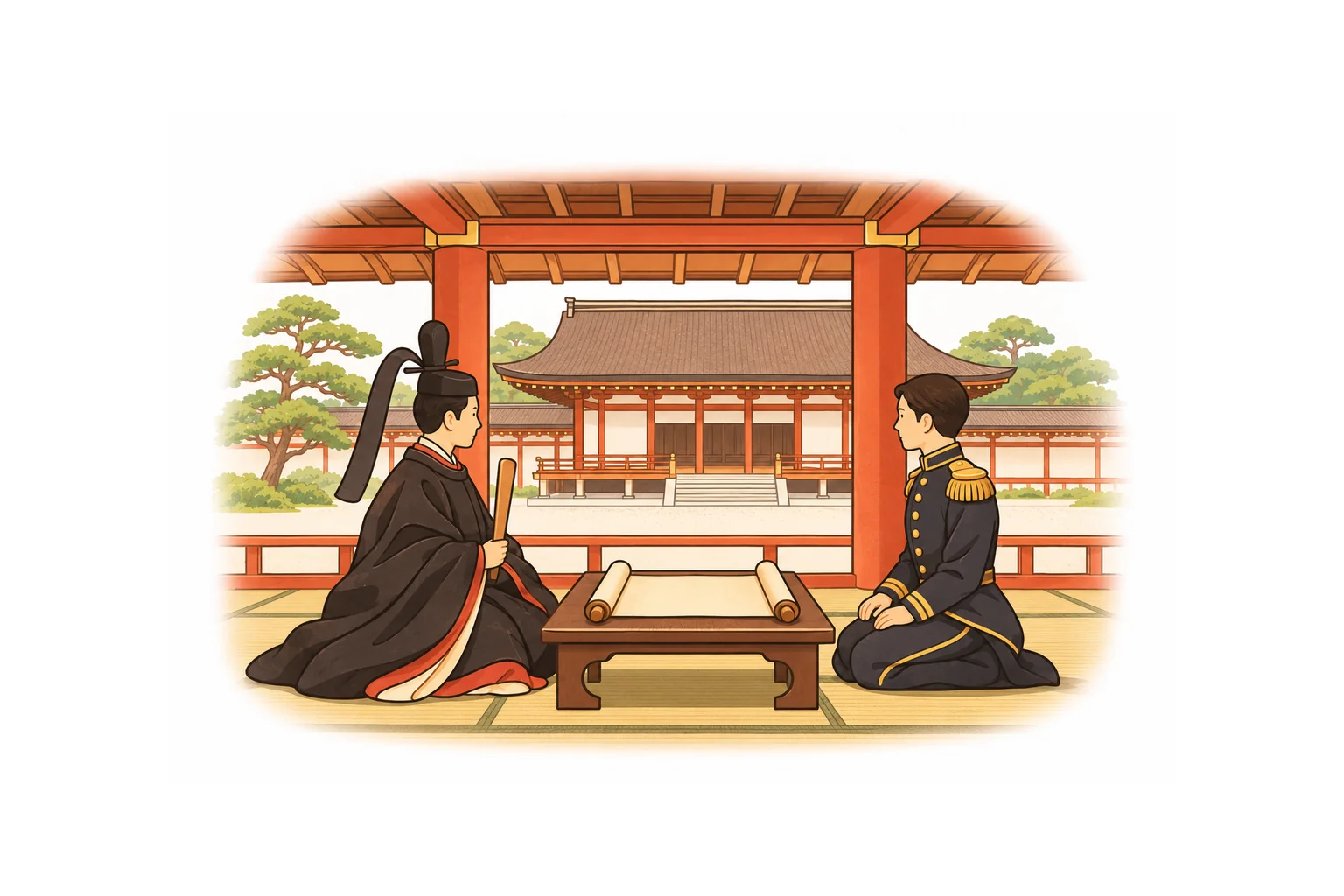
01A Decree About the Distant Past
On January 3, 1868, troops from five domains closed the gates of the imperial palace in Kyoto. Units that had guarded the palace on behalf of the Tokugawa shogunate, the military government that had ruled Japan since 1603, found themselves shut out. Inside, in the name of a fifteen-year-old emperor, a small group of court nobles and samurai issued a short document that historians call the Great Decree of the Restoration of Imperial Rule.
The decree abolished the shogunate. It also abolished the offices of regent and chancellor, through which aristocratic families had managed emperors for nearly a thousand years. In their place it created three new tiers of office, and it announced that all affairs of state would henceforth be conducted "on the basis of the founding of the realm by Emperor Jinmu."
Jinmu is the legendary first emperor of Japan. According to the Nihon shoki, a court chronicle compiled in 720, he ascended the throne in 660 BCE. Nobody can say what his government looked like, because there is no reason to think he existed.
Over the next two decades the men behind that decree dismantled almost everything that defined Japanese society. They abolished the domains and the lords who ruled them. They abolished the samurai as a hereditary class, ended their stipends, and banned them from wearing swords in public. They introduced conscription, compulsory schooling, a national land tax paid in cash, railways, the telegraph, the Western calendar, and finally a written constitution modeled on Prussia’s. The Japanese called all this ishin, "renewal." English speakers called it the Meiji Restoration.
That label should give us pause. By any reasonable standard this was one of the most thorough revolutions of the nineteenth century. Why did its makers insist they were going backward? And did the language of restoration merely decorate the revolution, or did it shape what kind of revolution it became?
02Old Words, New Contents
The names themselves tell part of the story. Ishin comes from a line in the Book of Songs, the ancient Chinese poetry anthology every educated Japanese knew: "Though Zhou is an old state, its mandate is new." The fit was exact. Japan would remain Japan, ruled by the same imperial line it had always claimed, but the way it was governed would be made over.
The era name chosen in 1868, Meiji, means roughly "enlightened rule," and it too came from a Chinese classic. The new government attached a rule to it: from now on, each emperor would have only one era name for his whole reign. Japan had borrowed era names from China in the seventh century, but it had always changed them freely, after earthquakes, epidemics, lucky omens, or astrologically significant years. The one-reign-one-era system had been the practice of Ming and Qing China, never of Japan. It bound the calendar to the person of the emperor so tightly that after his death he became known by his era name, the Meiji Emperor.
So even in its vocabulary, the Restoration did something characteristic. It reached for an ancient form and used it to do something no one in Japan had done before.
03Why Jinmu?
If you are going to restore the past, you have to choose which past. The choice the Restoration leaders made was revealing.
The obvious precedent was the Kenmu Restoration. In 1333 Emperor Go-Daigo overthrew the Kamakura shogunate and tried to govern personally. It was the one time an emperor had actually taken power back from the warriors. But it collapsed within three years, the warlord Ashikaga Takauji set up a new shogunate, and the country split into rival northern and southern courts for more than half a century. That was hardly an encouraging model.
The other candidate was the age of the ritsuryō codes, the Chinese-style legal system of the eighth century, when emperors ruled through a Council of State and a set of ministries. This was the classical golden age of imperial government. But taking it seriously would have meant reviving its hierarchy of court ranks and aristocratic pedigrees, and in such a system the samurai from Satsuma and Chōshū who actually held power in 1868, many of them men of modest rank even within their own domains, would have had no obvious place.
The phrase "the founding by Jinmu" is usually credited to Tamamatsu Misao, a scholar of native learning who advised the court noble Iwakura Tomomi. Its genius was its emptiness. Because nothing concrete was known about Jinmu’s government, appealing to it wiped the slate clean. Regents, retired emperors, shoguns: every institution that had grown up between Jinmu and the present could be dismissed as a later corruption. And since there were no actual precedents to follow, the new rulers were free to invent. The same decree went on to say that decisions would be made through "the fullest public deliberation," without distinction between court nobles and warriors, or between high and low.
Some people in the new government did believe in restoration literally. Followers of the nativist scholar Hirata Atsutane wanted to revive the ancient "unity of ritual and government," with Shinto worship at the heart of the state. In 1869 they had their moment: the government was reorganized into two departments and six ministries, largely under eighth-century titles, and a Department of Divinities was placed formally above the Council of State. Two years later that department was demoted to a ministry, and in 1872 it was abolished altogether. The offices kept their antique names for a while, but the ministries that mattered, for foreign affairs, finance, the army, public works, spent their days on treaties, tariffs, rifles, and railways.
04An Oath to the Gods
On April 6, 1868, the young emperor led his nobles and lords into the Shishinden, the ceremonial hall of the Kyoto palace, and swore an oath before the gods of heaven and earth. It contained five articles. Deliberative assemblies shall be widely established and all matters decided by public discussion. High and low shall unite in carrying out the affairs of state. Officials, warriors, and common people alike shall each be allowed to pursue their aims. Evil customs of the past shall be broken off. Knowledge shall be sought throughout the world to strengthen the foundations of imperial rule.
The Charter Oath, as it is known in English, went through several hands. Yuri Kimimasa of Echizen domain wrote the first draft as a kind of compact among feudal lords; its first article called for an "assembly of lords." Fukuoka Takachika of Tosa revised it. Then Kido Takayoshi of Chōshū made two decisive changes. He replaced "assembly of lords" with simply "deliberative assemblies," and he turned a mutual pledge between ruler and lords into an oath sworn by the emperor alone to the gods. The first change left wide open the question of whose assemblies these would be, and a decade later the movement demanding an elected parliament would quote that article back at the government. The second made the emperor, not the lords, the author of the new order.
On the same day, in Edo, the shogun’s capital, the Satsuma commander Saigō Takamori was negotiating with the shogunate’s Katsu Kaishū over the surrender of the city. The castle was handed over a few weeks later without a battle. While the old regime’s capital changed hands at a negotiating table, the new regime was promising the gods that it would break with the customs of the past.
The form of the oath was archaic; emperors had made solemn reports to the gods since antiquity. The content was startling. Only five years earlier, Kyoto had been the center of a violent movement to "revere the emperor and expel the barbarians." Now the emperor was pledging to seek knowledge from the barbarians’ world. And the very next day the government put up public notice boards across the country that read like a Tokugawa edict: obey the Confucian relationships, do not form factions or abandon your village, and the Christian religion remains strictly forbidden. The ban stayed posted until 1873, when protests from Western governments finally brought it down. Old and new sat side by side in the same week.
05How the Lords Gave Up Their Lands
Overthrowing the shogun did not, by itself, make Japan a centralized state. The country was a patchwork of roughly 270 domains, each with its own lord, retainers, army, tax system, and often its own paper currency. After the civil war of 1868 and 1869, known as the Boshin War, the new government directly controlled only the former Tokugawa lands, perhaps a quarter of the country. Everywhere else, the rice taxes still went to the domains. The government had no army of its own; it had fought the war with Satsuma and Chōshū troops.
The first step came in 1869. The lords of the four leading domains, Satsuma, Chōshū, Tosa, and Hizen, jointly "returned" their lands and people to the emperor, and nearly every other lord followed. In practice little changed. Each lord was reappointed as governor of the domain he had just surrendered, and his retainers remained his retainers. But a principle had been established: the land belonged to the throne.
The real blow fell two years later. In 1871 Ōkubo Toshimichi, Kido Takayoshi, Saigō Takamori, and a few others planned it in secret. First they assembled an Imperial Guard of about ten thousand men drawn from Satsuma, Chōshū, and Tosa. Then, on August 29, 1871, the domain governors present in Tokyo were summoned to the palace and read an imperial edict. The domains were abolished. In their place there would be prefectures, governed by officials sent from the capital. The former lords were to move to Tokyo.
What astonished foreign observers was that nobody fought. A ruling class that had held its lands for centuries lost them in a single morning, and not one domain rose in revolt.
There were several reasons. Many domains were deeply in debt, to Ōsaka merchants above all, after decades of fiscal trouble topped by the expense of rearming in the 1860s and fighting the Boshin War. The central government took those debts over, which for many lords was a relief. The lords themselves were treated generously: they had already been made members of a new peerage in 1869, and they kept a personal income equal to about a tenth of their old domain revenue, money they no longer had to share with hundreds of retainers. The Imperial Guard sat in Tokyo as a reminder of what resistance would cost. And the turmoil of the previous fifteen years had persuaded much of the elite that a Japan divided into hundreds of semi-independent states could not hold its own against the Western powers.
There was resentment. Shimazu Hisamitsu, father of the Satsuma lord and the real power in that domain, had promoted Saigō and Ōkubo early in their careers. Now his own retainers had abolished his domain behind his back. According to a well-known story, he spent the night at his residence in Kagoshima setting off fireworks in a rage. For the rest of his life he wore his hair in the old topknot and kept his distance from the government he had helped create.
But resentment never became rebellion, and the reason lies in the language of restoration. The lords were not surrendering their lands to Satsuma or Chōshū. Had the new government been simply another shogunate, a new warrior house on top, there would have been every reason to resist it. Because it acted in the emperor’s name, giving up one’s domain could be presented, and experienced, as an act of loyalty rather than defeat.
06The Samurai Abolish Themselves
Once the domains were gone, an even harder question remained. What would become of the samurai?
Under the Tokugawa, society was formally divided into warriors, farmers, artisans, and merchants. Samurai and their families made up about six percent of the population. They drew hereditary stipends, wore two swords, dressed and styled their hair in ways reserved for them, and enjoyed legal privileges. Nearly every leader of the Meiji government, Ōkubo, Kido, Saigō, Itō Hirobumi, Yamagata Aritomo, was born a samurai, most of them in the lower ranks. These were the men who took their own class apart.
They did it step by step. In 1869 former nobles and lords were grouped together as a peerage, samurai were renamed "gentry," and everyone else became "commoners." In 1870 commoners were permitted to take surnames. In 1871 samurai were allowed to cut off their topknots and stop wearing swords, marriage across the old status lines was permitted, and an edict abolished the legal categories of eta and hinin, the outcaste groups at the bottom of Tokugawa society, declaring them commoners. Discrimination against them in daily life continued for generations, but the legal walls came down. In 1873 a conscription law made every man of twenty liable for military service; fighting was no longer a hereditary privilege. In 1876 samurai were forbidden to wear swords in public, and in the same year their stipends were converted, once and for all, into government bonds. The hereditary income that had defined the class for two and a half centuries simply ended.
Why would samurai do this to samurai? The plainest reason was money. When the government abolished the domains, it inherited their obligation to pay the retainers, and for several years stipends consumed a third or more of government spending. A state trying to build railways, schools, and a navy could not carry a hereditary class that produced nothing. There was a strategic argument too. Yamagata Aritomo, the architect of the conscript army, was convinced that farmers’ sons, properly trained, would make better soldiers than samurai whose first loyalty was to their old domains. He had seen it in Chōshū in the 1860s, where mixed units of commoners and samurai had beaten the shogun’s forces.
Not every samurai accepted his fate. In 1874 Etō Shinpei, a former government councillor, led an uprising in Saga. In 1876 a group in Kumamoto called the League of the Divine Wind attacked the local garrison with swords and spears, refusing on principle to use firearms; smaller revolts followed in Akizuki and Hagi. The largest came in 1877. Disaffected samurai in Kagoshima rallied around Saigō Takamori, who had left the government in 1873, and marched north to besiege Kumamoto Castle. The government met them with an army of conscripted commoners armed with modern rifles. After more than half a year of hard fighting, the rebels were destroyed, and Saigō died on the hill of Shiroyama above Kagoshima.
Saigō embodied every contradiction of the Restoration. He was the man waiting outside the palace on the night of the coup. He brought the troops to Tokyo that made the abolition of the domains possible. And he died leading the last stand of the class he had helped abolish. Within a few years he had become a popular hero; in 1889 the government formally pardoned him, and the bronze statue of him in a cotton kimono, walking his dog, still stands in Ueno Park in Tokyo.
After 1877 no one challenged the Meiji state with arms again. Its opponents turned instead to newspapers, speeches, and the demand for a parliament.
07Making an Emperor Visible
Restoration put the emperor at the center of the state. But the emperor it put there was nothing like his predecessors.
Tokugawa emperors almost never left the palace in Kyoto. Their days were organized by court nobles and ladies-in-waiting; they wore white face powder and blackened teeth, and most of their subjects had no idea what they looked like. The Meiji leaders set out to turn this secluded priest-king into a monarch people could see.
In late 1868 the emperor traveled to Edo, now renamed Tokyo, "the eastern capital." In 1869 he went again and simply stayed; the shogun’s castle became the imperial palace. No decree ever formally moved the capital, a silence that Kyoto residents did not appreciate. Then came the visible changes. The emperor learned to ride, reviewed troops, received foreign diplomats, put on a Western military uniform, and grew a beard. Beginning in 1872 he made a series of long tours through the provinces, from Kyūshū to the northeast and Hokkaidō, and villagers who had never imagined seeing an emperor watched his procession go by. In 1873 the photographer Uchida Kuichi made a formal portrait of him in Western dress; copies were later sent out to the prefectures.
Inside the palace there was resistance. The older court ladies were reportedly horrified by the haircuts, the beef, and the frock coats. But the reformers had an unanswerable reply: this was the emperor’s wish. Here again, the language of restoration did its work. Any change carried out in the emperor’s name was very hard to denounce as betrayal of tradition.
What, then, had been restored? Not personal rule. The Meiji Emperor seldom made political decisions himself; policy was set by Ōkubo, Itō, and their colleagues. What the Restoration actually created was the emperor as the symbol of national unity and the source of all legitimacy, a banner under which everything else could be done.
08Writing "Unbroken for Ages Eternal" into a Constitution
The first article of the Charter Oath had promised deliberative assemblies, but for years nothing came of it. Power rested with a handful of men from Satsuma and Chōshū, whom critics called the "domain clique."
In 1873 the government split over whether to send an expedition to Korea, and Saigō, Itagaki Taisuke, Etō Shinpei, and others resigned. The next year Itagaki and his allies submitted a petition calling for an elected assembly, and the Freedom and People’s Rights Movement was born. By the late 1870s it had spread across the country: local political societies, private draft constitutions written by village notables, packed lecture halls. When Itagaki was stabbed by an assailant in Gifu in 1882, he supposedly cried out, "Itagaki may die, but liberty will not." Whether he actually said it was disputed even at the time, but the line became famous.
The government’s answer was to seize the initiative. In 1881 it announced that a national assembly would open in 1890. In 1882 Itō Hirobumi went to Europe to study constitutions, attending lectures by Rudolf von Gneist in Berlin and consulting Lorenz von Stein in Vienna. He came home convinced that the Prussian model suited Japan: a monarch with strong reserved powers, cabinet ministers responsible to the throne rather than to parliament, and an elected lower house with real but limited authority over legislation and the budget.
The Constitution of the Empire of Japan was promulgated on February 11, 1889. The date was chosen with care. It was National Foundation Day, the anniversary, by a nineteenth-century calculation, of Jinmu’s accession. Article 1 declared that the Empire of Japan "shall be reigned over and governed by a line of Emperors unbroken for ages eternal." Article 3 declared the emperor "sacred and inviolable." The same document guaranteed subjects freedom of speech, assembly, association, and religion within the limits of law, and established an elected House of Representatives.
That morning, as he left his official residence for the ceremony, the education minister Mori Arinori was stabbed by a young nationalist who believed, on the strength of an unproven rumor, that Mori had shown disrespect at the Ise Shrine, the most sacred site of Shinto. He died the next day. A modern constitution proclaimed on the anniversary of a mythical founding, an assassination in the name of a shrine: the two faces of the Restoration appeared on the same day.
The constitution was presented as a gift from the emperor to his subjects, not something the people had won. The first Imperial Diet met in 1890, and the same year the government issued the Imperial Rescript on Education, read aloud in every school, which enjoined subjects to "offer yourselves courageously to the State" in an emergency and so guard the prosperity of the imperial throne. Twenty-two years after the decree that invoked Jinmu, the promise had taken its finished shape: a centralized state with a constitution, a parliament, a conscript army, and universal schooling, whose legitimacy was said to reach back two and a half millennia.
09Restoration or Revolution?
Japanese scholars argued about the nature of the Restoration for most of the twentieth century. In the 1930s Japanese Marxists split into two camps. One, the Lectures faction, held that the Restoration created an absolutist emperor-centered state that preserved landlordism and much of the feudal order; the bourgeois revolution, in their view, had not happened yet. The other, the Worker-Farmer faction, held that the Restoration was essentially a bourgeois revolution, imperfect but real. The argument was about the past only on the surface; underneath, it was about what kind of revolution Japan needed next.
After the war, Western historians offered other labels. Some called it a "revolution from above," since it was driven not by peasant uprisings or urban crowds but by a section of the ruling class. The American historian Thomas C. Smith called it an "aristocratic revolution": a privileged class abolishing its own privileges. That is rare in world history. In France the nobility’s privileges were taken from it by the Third Estate. In Japan the lower samurai dismantled the samurai themselves.
My own answer is this: the Meiji Restoration was a genuine revolution, and "restoration" was its method, not its content.
It was a revolution because within about two decades it changed nearly every basic structure of the Japanese state: who ruled, who owned the land, how taxes were collected, who fought, whether people were born into fixed status, where children went to school, even how days were counted. On the government’s order, the third day of the twelfth month of the fifth year of Meiji became January 1, 1873. A palace coup that merely replaced one ruling house with another does none of these things.
Restoration was the method because the emperor’s name allowed this revolution to be carried out at a comparatively modest cost in blood. The Boshin War and the Satsuma Rebellion were brutal, but measured against the revolutions and civil wars of the same century elsewhere, they were limited. Lords could "return" their lands to the throne far more easily than they could hand them to a rival domain. Samurai laid down their swords in obedience to an imperial edict, not in surrender to an enemy. And an appeal to a past as remote and blank as Jinmu’s allowed the reformers to claim loyalty to tradition while overturning every concrete tradition they found in their way.
The method had a price. The emperor, placed at the center of everything, became an authority no one could openly question. The constitution made him supreme commander of the army and navy, and the armed forces answered to him rather than to the cabinet. While the founding generation lived, they held that arrangement in balance. In the 1930s, officers used it to escape civilian control. The leaders of 1868 used the emperor’s name to make a revolution, and the banner they left behind was later carried by others toward very different ends.
The men gathered in the Kyoto palace in January 1868 announced a return to the age of Jinmu. What they actually wanted from that age was not its institutions, of which there were none to recover, but its blankness: a starting point from which everything could be built again.