
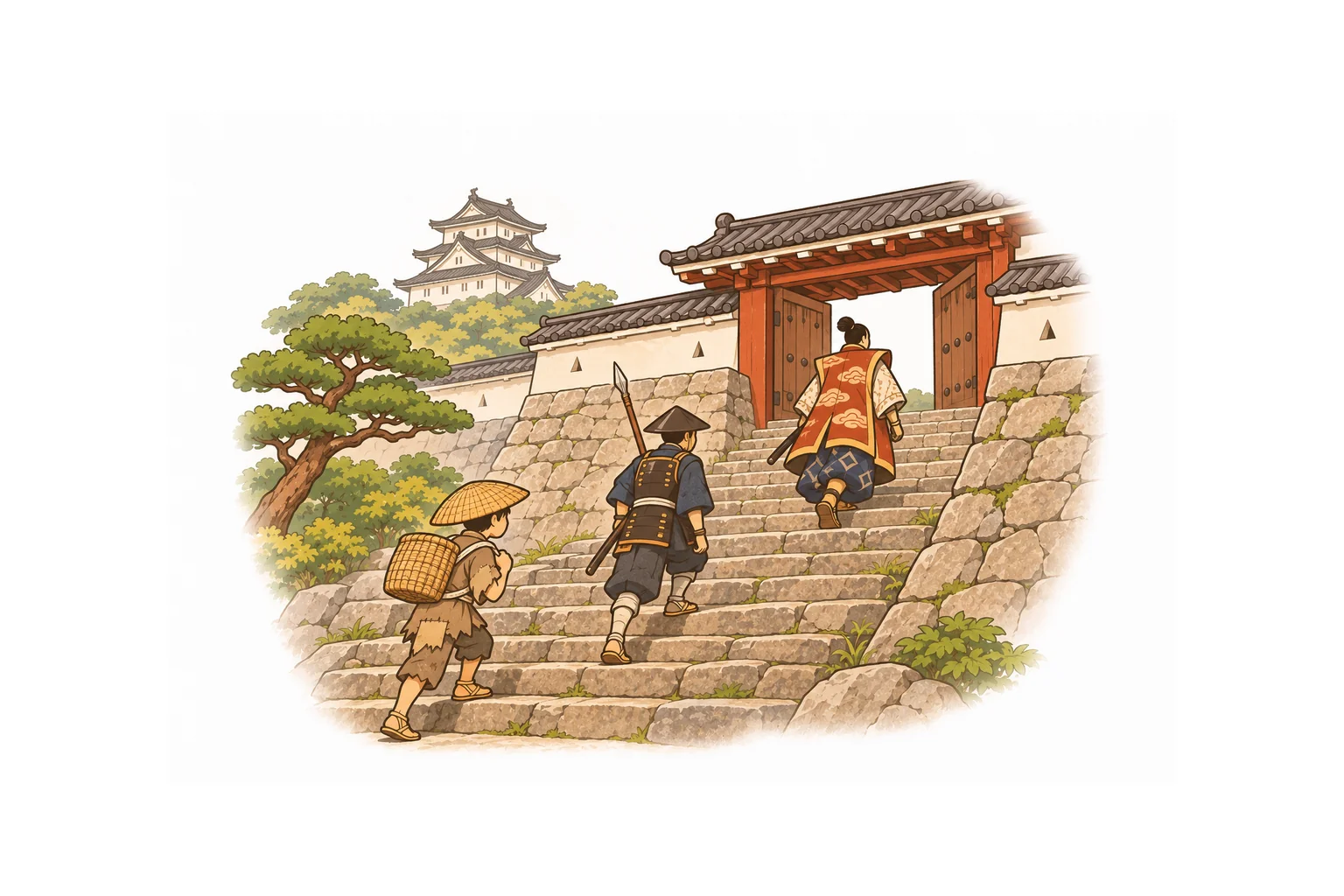
01A Retired Brewer Goes Back to School
In 1795 a prosperous man of about fifty arrived in Edo, the shogun’s capital, and asked to become the student of an astronomer nineteen years his junior. The newcomer was Inō Tadataka. He had spent three decades running a sake-brewing and rice-trading house in Sawara, a river town east of Edo, and had just handed the business to his eldest son. His new teacher, Takahashi Yoshitoki, was an official astronomer to the Tokugawa shogunate, charged with reforming the calendar. Tadataka set up an observatory in his new house and began, at an age when most men of his time were thinking about death, to learn mathematics and the measurement of the heavens from scratch.
Five years later, at fifty-five, he set out on foot to survey the southern coast of Ezo, the northern island now called Hokkaidō. Over the next sixteen years he made ten journeys, pacing and measuring the coastline of the entire Japanese archipelago. By the end the shogunate had taken over his project, paid for it, and granted him the status of a retainer with the right to wear two swords. He died in 1818; his students finished the great map in 1821. It was remarkably accurate, and it remained the basis of Japanese maps well into the Meiji era.
Tadataka’s story is usually told as an inspiring tale about late starts. But look at how it began. He was not born an Inō. He was born in 1745 in a fishing village on the Kujūkuri coast, the youngest son of a village headman’s household, with no inheritance of his own, and at seventeen he was taken into the Inō house as a mukoyōshi, an adopted son-in-law who married the daughter, took the family name, and became its heir. Everything that followed, the fortune, the leisure, the standing to approach a shogunal astronomer, rested on that adoption.
That is the question this essay asks. Japan before 1868 was, by any measure, a society organized by birth. Warriors, farmers, artisans and merchants were fixed in their stations; within the warrior class, rank was inherited down to the precise size of a family’s rice stipend. There was no examination system of the Chinese kind, no road by which a clever village boy could test his way into high office. And yet Japanese history is full of men who rose astonishingly far: a peasant’s son who became the most powerful man in the land, a provincial scholar who became a minister of state, an impoverished minor vassal who negotiated the surrender of the shogun’s capital. How did they do it? And how high, really, could talent take you?
02Copying China, Minus the Exam
When the Japanese court rebuilt its government on the Chinese model in the late seventh and eighth centuries, it imported the whole apparatus of a bureaucratic state: a law code, ministries, provincial governors, and a ladder of about thirty court ranks running from Senior First Rank at the top down to the lowest grades of clerks. It even founded a state academy, the Daigakuryō, where students read the Confucian classics, law and mathematics and sat examinations for office.
On paper, this was a ladder anyone with learning might climb. In practice the Japanese version came with a crucial modification. Under the so-called on’i system, the sons of nobles of the Fifth Rank and above, and the grandsons of those of the Third Rank and above, received court rank automatically when they came of age. The heir of a First Rank minister began his career at Junior Fifth Rank, Lower Grade, which was the threshold of the aristocracy itself, a level many ordinary officials never reached in a lifetime. A graduate of the academy, by contrast, started down around the Eighth Rank. The aristocratic young men had no reason to compete in examinations at all, and mostly did not. The academy became a place for the sons of lesser officials and provincial families.
Kibi no Makibi was one of those sons. Born in the 690s in Bitchū province, in what is now western Okayama, into a minor local clan whose head served as a low-ranking guard officer, he was chosen in 717 as a student to accompany an embassy to Tang China. On the same voyage went Abe no Nakamaro, who would stay in China for the rest of his life and serve the Tang emperor. Makibi stayed in Chang’an for about seventeen years, studying the classics, history, astronomy, calendrical science, military texts and music. When he came home in 735 he brought with him ritual codes, a new calendar, astronomical instruments, musical instruments, bows and arrows. In a country that had sent only a handful of people to the source of all this learning, he was suddenly one of the most valuable men alive.
The court made him deputy head of the academy and then tutor to the crown princess, a woman who would later reign twice, first as Empress Kōken and later as Empress Shōtoku. His rise was resented almost immediately. In 740 a Fujiwara nobleman named Hirotsugu raised a rebellion in Kyūshū, and one of his demands was the dismissal of Makibi and the monk Genbō, upstarts who in his view had the emperor’s ear. The rebellion was crushed, but Makibi was later sidelined to a provincial post in Kyūshū, and in 752 he crossed to China a second time as vice-ambassador. On the way home his fleet carried the blind Chinese monk Jianzhen, known in Japan as Ganjin, who founded Tōshōdai-ji in Nara.
What finally made Makibi’s career was a crisis. In 764 the most powerful man at court, Fujiwara no Nakamaro, rose in revolt. Makibi, then around seventy, planned the government’s military response, cutting off the rebels’ escape, and the revolt collapsed within days. He was promoted to Minister of the Right, one of the three highest offices of state, and eventually Senior Second Rank. A scholar from a provincial family had climbed nearly to the top of the ladder.
Later centuries turned him into a legend. A twelfth-century picture scroll shows him held captive in China while the Chinese test him with obscure literary texts and a game of go, and the ghost of Abe no Nakamaro slips in at night to help him pass every trial. It is a fantasy, but it captures what Makibi meant to people: the man who beat the great empire at its own game by sheer learning.
His career also shows how narrow the road was. He needed rare knowledge that almost no one else in Japan possessed, the personal favor of a monarch, and a civil war among the Fujiwara to clear the way. A century and a half later Sugawara no Michizane, from a family of hereditary scholars, also rose by learning to Minister of the Right, and within two years was exiled to Kyūshū by his Fujiwara rival. He died there in 903. When disasters struck the capital afterward, the court concluded that his angry spirit was responsible and began worshipping him as a god. He is still revered today as the patron deity of scholarship. A society that deified its most brilliant scholar in order to pacify him was not one in which learning offered an easy route to power.
03The Monk Who Came Too Close
There was another ladder in early Japan, and it ran through the Buddhist clergy. A monk left his family behind when he took the tonsure, and in principle he left his family’s rank behind too. The eighth-century monk Gyōki, from an obscure family descended from continental immigrants, began as a popular preacher building bridges and irrigation ponds with crowds of lay followers, a movement the government at first tried to suppress. He ended as the first Daisōjō, the highest rank in the clergy, recruited to raise support for the Great Buddha at Tōdai-ji.
The man who took this ladder furthest was Dōkyō, and what happened to him shaped Japanese politics for a thousand years.
Dōkyō came from the Yuge clan of Kawachi province, near modern Ōsaka, a family of no great consequence. He trained as an ascetic in the mountains, learned some Sanskrit, and acquired a reputation for healing through esoteric ritual. In 761 the retired Empress Kōken, the same woman Makibi had tutored, fell ill, and Dōkyō nursed her back to health. From then on she trusted him above everyone. Her attachment to him drove a wedge between her and the reigning emperor and his patron Fujiwara no Nakamaro, and helped provoke the revolt of 764 that Makibi suppressed. Afterward she deposed the emperor and took the throne again as Empress Shōtoku. Dōkyō was named Grand Minister and Meditation Master, and the following year was given the title Hōō, "Dharma King," with honors equal to the sovereign’s.
In 769 an oracle arrived from the Usa Hachiman shrine in Kyūshū, declaring that the realm would know peace if Dōkyō were made emperor. The empress sent a courtier, Wake no Kiyomaro, to Usa to confirm the message. He came back with the opposite: since the founding of the country the line between sovereign and subject had been fixed, a subject could never become ruler, and the unworthy man should be swept away. The furious empress renamed him with a name meaning roughly "filthy" and banished him to the far south. But Dōkyō never took the throne. When the empress died the next year, he lost his protector and was exiled to a provincial temple in Shimotsuke, where he died in 772.
Historians still argue over whether Dōkyō himself plotted for the throne or whether others used the oracle to test the waters. The consequences are less debatable. No woman reigned again in her own right for more than eight centuries. Kiyomaro became a model of loyalty. And the principle he carried back from Usa hardened into something close to an unwritten constitution: whatever a subject achieved, the throne itself was out of reach. Later regents, retired emperors and shoguns would wield far more real power than Dōkyō ever did, but none of them tried to sit in that seat.
The Buddhist ladder itself narrowed over time. From the tenth century onward the top positions in the great monasteries went increasingly to princes and the sons of high nobles, and certain temples came to be headed, generation after generation, by men of imperial or regental blood. The clergy remained a place where a commoner’s son could make a respectable life, and sometimes a distinguished one, but its summit had acquired a pedigree requirement of its own.
04When Offices Became Inheritance
By the eleventh century the court bureaucracy that Makibi had climbed had turned into something quite different. Offices had become family property. The northern branch of the Fujiwara monopolized the posts of regent; eventually only five houses, the gosekke, were eligible to provide them. Below them, other houses could rise as far as Grand Minister, others only as far as Major Counselor. Specialist posts became hereditary too: astronomy and divination belonged to the Kamo and Abe families, mathematics to the Otsuki, medicine to the Tanba and the Wake, literary scholarship to the Sugawara and the Ōe.
There was a practical logic to this. In a world without universities or examinations, specialized knowledge was best passed down within a family from father to son. The descendants of the famous diviner Abe no Seimei were still serving the court in that capacity in the nineteenth century. But the effect was that a person’s ceiling was set at birth. The Japanese later called this ranking of houses kakaku, "house standing," and it is the thread that runs from the Heian court through to the samurai bureaucracies of the Tokugawa age.
05The Peasant Who Became Regent
If there is one name every Japanese person would offer as proof that a commoner could rise to the very top, it is Toyotomi Hideyoshi.
He was born around 1537 in Nakamura, a village in Owari province near modern Nagoya. His father was a peasant who may have served as an ashigaru, a common foot soldier, and died when Hideyoshi was a child. Almost everything about his early life comes from later stories, and even his childhood name is uncertain. What is clear is that he left home young and eventually entered the service of the warlord Oda Nobunaga in a menial capacity. A famous story has him warming his master’s sandals inside his shirt on a winter morning; it is a later invention, but Nobunaga really did promote this man without any family background, step by step, to independent command of whole armies.
Hideyoshi could rise because he lived in an age that valued competence over lineage. After the Ōnin War of the 1460s and 1470s shattered the authority of the Ashikaga shoguns, the old provincial lords were overthrown one by one by their own retainers and by local strongmen, a phenomenon the Japanese called gekokujō, "the low overturning the high." Saitō Dōsan, who seized Mino province, was said in later accounts to have started life as an oil peddler, though historians now think the oil-selling belongs to his father and that the seizure of Mino took two generations. Nobunaga himself came from a cadet branch of a deputy governor’s family, hardly grand. In that world, a man who could fight, negotiate, and keep an army fed was worth more than a man with an impressive genealogy.
After Nobunaga was killed at Honnō-ji in 1582, Hideyoshi destroyed the assassin, Akechi Mitsuhide, outmaneuvered Nobunaga’s other generals, and within a few years was master of most of Japan. And at that point he ran into a problem talent could not solve. Power needed a title, and titles needed a pedigree.
The highest warrior title, seii taishōgun, was by tradition reserved for descendants of the Minamoto clan. Hideyoshi had no claim to that. A story circulated later that he asked the exiled last Ashikaga shogun, Yoshiaki, to adopt him and was refused; it comes from late sources and may not be true. What he actually did was cleverer. In 1585, when two court nobles were deadlocked over who should become kanpaku, the imperial regent, Hideyoshi had himself adopted, as a nominal son (yūshi), by Konoe Sakihisa, head of one of the five regental houses, and took the post himself as a member of the Fujiwara. The next year the court created an entirely new clan name for him, Toyotomi, and made him Grand Minister.
A peasant’s son had become the first subject of the realm. But notice the method. He did not abolish the system of house standing; he entered it at the highest point by borrowing a family. He claimed in letters to foreign rulers that his mother had dreamed of the sun entering her womb, and his court biographer hinted that he was secretly of imperial blood. The most successful self-made man in Japanese history spent part of his time at the top manufacturing a lineage.
Then he pulled up the ladder. In 1588 he ordered the Sword Hunt, confiscating weapons from the peasantry. In 1591 he issued an edict forbidding warrior servants from becoming townsmen or farmers and forbidding farmers from abandoning their fields for trade or wage labor. The message was plain: everyone was to stay where they were. The man who had gone from village to battlefield to palace made sure no one else could follow the same path. It is less of a contradiction than it looks. A ruler who had climbed out of chaos understood better than anyone how dangerous social movement was to order.
06Families That Could Be Joined
The Tokugawa shoguns who came after Hideyoshi built on his edicts and made the status order the backbone of their state for two and a half centuries. Warriors were ranked in fine gradations, from great lords down to the lowest foot soldiers; stipends and offices were attached to houses; commoners were registered by village and ward. On the surface it was one of the most rigid social orders in the premodern world.
Underneath, it had a remarkable flexibility, and the key was the Japanese idea of the ie, the house. In China, family succession was a matter of blood, and adoption was normally restricted to boys of the same patrilineal clan. The Japanese ie was something closer to a going concern: a name, a stipend or business, an ancestral altar, a reputation, all of which had to be carried forward. Blood was preferred, but it was negotiable. A house without a son adopted one. A house whose son was incompetent might adopt one anyway. The adoptee could be a relative or a complete stranger, and very often he was a son-in-law, like Inō Tadataka. In many samurai domains a quarter or more of all successions seem to have passed through adoption. Among the great merchant houses of Ōsaka, the preference for capable adopted sons-in-law over natural sons was widely remarked upon.
This was the side door through which talent entered. A gifted young man from a poor family who caught the eye of a house without an heir could acquire, overnight, that house’s name, rank and income.
There was a cruder door too: money. By the eighteenth century many gokenin, the lowest grade of the shogun’s direct vassals, were too poor to keep up appearances, and an informal market grew up in which a wealthy commoner could buy a vassal’s house. The buyer’s son was formally adopted as heir, and a merchant family became a samurai one. The history of Katsu Kaishū, of whom more below, begins with exactly such a purchase.
The shogunate itself found ways to bend the rules for ability. In 1723 the eighth shogun, Tokugawa Yoshimune, introduced the tashidaka system: a man of low hereditary stipend appointed to a high office would receive a supplement to bring his income up to the level the post required, for as long as he held it. Officials could now be chosen for merit without permanently enlarging anyone’s hereditary stipend. Ōoka Tadasuke, the Edo magistrate later celebrated in countless courtroom stories, was among the men Yoshimune promoted in this spirit.
Yoshimune’s own retinue produced the most dramatic Tokugawa-era rise. Among the attendants who came with him from his home domain of Kii was a foot soldier named Tanuma Okiyuki. His son, Tanuma Okitsugu, won the trust of the ninth and tenth shoguns and rose from a minor bannerman to a daimyo of 57,000 koku and a senior councillor, or rōjū, a post normally reserved for long-established hereditary lords. He encouraged commerce, licensed merchant guilds, and planned the development of Ezo. When he fell in 1786 he was denounced as the most corrupt man of the age. How much of that hatred was about his policies and how much about an upstart sitting where he did not belong is hard to separate.
For women, the routes upward were narrower still and ran almost entirely through marriage and service in the inner quarters of great households. Keishōin, mother of the fifth shogun Tsunayoshi, was, according to popular tradition, the daughter of a Kyoto greengrocer (other stories differ, and her real origins are uncertain) who entered the shogun’s women’s quarters, bore a future shogun, and in old age received Junior First Rank from the court. A popular etymology connects her childhood name, Tama, to the phrase tama no koshi, "riding the jeweled palanquin," meaning to marry far above one’s station. The etymology is a popular legend, but it shows what upward mobility for a woman looked like in the Edo imagination.
Skill offered narrower but real openings. Medicine, scholarship, mathematics and astronomy were professions in which commoners could make names and be recruited into a lord’s service. Motoori Norinaga, the greatest scholar of Japan’s native classics, was the son of a cotton merchant in Matsusaka who failed at trade, trained as a doctor, and spent his evenings on the ancient chronicle Kojiki. Inō Tadataka’s late career belongs here too: a retired merchant could devote himself to astronomy and be rewarded with warrior status for the results.
07Crisis Opens the Gate
Katsu Kaishū’s great-grandfather was a blind man from a poor family in Echigo, on the Sea of Japan coast. He came to Edo and joined the guild of the blind, which the shogunate permitted to lend money. He grew rich as a moneylender, rose to the guild’s highest rank, and bought a gokenin house for one of his sons. A generation later, a younger son of that house, Kokichi, married into another minor shogunal retainer family, the Katsu, as an adopted heir, with a stipend of forty-one koku, a pittance.
Kokichi was a brawler and a wastrel who never held an office. In old age he wrote Musui dokugen, a rollicking memoir of his own misbehavior intended as a warning to his descendants. His son, born in 1823, grew up so poor that in some years the family could not afford New Year’s rice cakes. The boy trained in swordsmanship and then turned to Dutch studies, the only window onto Western knowledge. He borrowed the fifty-eight-volume Dutch–Japanese dictionary known as the Doeff Halma and copied it out twice by hand in a single year; by the usual account he kept one copy and sold the other to pay for the loan.
In ordinary times, such a man had nowhere to go. Then in 1853 Commodore Perry’s warships anchored off Uraga, and the senior councillor Abe Masahiro did something unprecedented: he invited opinions on the crisis from lords, bannermen and even minor vassals. Katsu submitted a memorandum on coastal defense and the training of talent. An official named Ōkubo Tadahiro noticed it. Two years later Katsu was sent to the new naval training school in Nagasaki to learn seamanship from Dutch instructors. In 1860 he sailed the Kanrin Maru across the Pacific to San Francisco as head of its naval instructors, the role later remembered as captain. Aboard, as attendant to the expedition’s admiral, was a young man from the Nakatsu domain named Fukuzawa Yukichi.
Katsu became commissioner of warships, founded a naval school at Kōbe, and took as his disciple a runaway samurai from Tosa named Sakamoto Ryōma. In 1868, as the armies of the new imperial government closed in on Edo, he met their commander Saigō Takamori and arranged for the city to be surrendered without a fight, sparing a million people a siege. The great-grandson of a blind moneylender, the son of a disreputable vassal, ended up deciding the fate of the shogun’s capital.
He was not alone. The men who toppled the shogunate were mostly from the lower ranks of the warrior class. Saigō and Ōkubo Toshimichi grew up in the same modest neighborhood of Kagoshima. Sakamoto Ryōma was a gōshi, a rural samurai, looked down on by the castle-town upper samurai of Tosa. Itō Hirobumi was born the son of a farmer in Chōshū; his father was adopted by a chūgen, a low domain attendant, who was in turn adopted into a foot soldier’s family named Itō, which put the son on the bottom rung of warrior society. When the old order failed, what the domains and the shogunate needed was men who understood Western ships and guns, who could negotiate with foreigners and fight a modern war. Birth had little to do with that.
08"Hereditary Rank Is My Father’s Enemy"
Fukuzawa Yukichi, the young attendant on the Kanrin Maru, became the great public intellectual of Meiji Japan, and he never forgot where he came from. His father, Fukuzawa Hyakusuke, was a low-ranking samurai of the Nakatsu domain in northern Kyūshū and a fine Confucian scholar, posted to Ōsaka to keep the domain’s accounts with rice brokers and moneylenders, work he despised. He died in 1836 when Yukichi was a toddler. In his autobiography, Fukuzawa recorded that, as his mother told him, his father used to say he would make the boy a Buddhist monk. Fukuzawa later reasoned out why: in Nakatsu a foot soldier’s son would always be a foot soldier, but in a temple, even the son of a mere fishmonger might rise to the highest clerical rank. "For my part," Fukuzawa wrote, "the system of hereditary rank is my father’s enemy."
He described a childhood in which lower-samurai children had to use honorific speech to upper-samurai children even at play, and in which he could outdo his social superiors in the classroom and still have to bow to them in the street. He left for Nagasaki in 1854 and then Ōsaka to study Dutch, taught himself English in Edo, and traveled to America and Europe with shogunate missions.
When the Meiji government abolished the domains in 1871, declared the four classes equal, opened professions and marriage across class lines, and ended samurai stipends in 1876, Fukuzawa was its most eloquent advocate. His Encouragement of Learning, which began appearing in 1872, opens with the line that heaven creates no man above another and no man below another, and goes on to say that the differences among people come from learning or the lack of it. Read beside his father’s wish to send him to a monastery, the sentence takes on its full weight. The father could only look for a gap outside the system. The son could argue that the system itself should distribute position according to learning.
The new state did build something like that ladder: primary schools, middle schools, higher schools, imperial universities, and from the late 1880s a civil service increasingly recruited by examination. For the first time in Japanese history a farmer’s son could rise by test scores into the elite bureaucracy. It had taken until the end of the nineteenth century.
Yet new pedigrees grew almost at once. In 1884 the government created a peerage, enrolling former court nobles, former daimyo, and the leaders of the Restoration as princes, marquises, counts, viscounts and barons. Itō Hirobumi, the farmer’s son, became a prince. Katsu Kaishū became a count. Fukuzawa refused all office and all titles and lived out his life as a private educator and newspaper publisher, a sharp critic of the habit of revering officials and despising ordinary citizens. And the outcaste communities formally emancipated in 1871 went on facing discrimination long after the law said they were equal.
09The Answer
So how high could a person of humble birth rise in premodern Japan?
Very high: to Minister of the Right, to imperial regent, to senior councillor of the shogunate, to the man who decided whether Edo would burn. There was one position no one could reach, the throne itself, and the line around it was drawn in 769 and never crossed. But nearly everyone who climbed did so not through open competition but by entering someone else’s house.
This is the deepest difference from China. Japan borrowed the Chinese bureaucratic state but not its examination culture; the aristocracy’s automatic ranks made the exam irrelevant from the start, and by the Heian period offices had become family property. From then on, the basic unit to which Japanese society assigned position was the house, not the individual. And precisely because the house was a unit to be carried forward rather than a bloodline to be preserved, Japanese families were remarkably willing to let outsiders in. Hideyoshi became a Konoe to become regent. Inō Tadataka became an Inō. Katsu’s great-grandfather bought his son a vassal’s name. Itō’s father entered a foot soldier’s family through two adoptions. Across nearly three centuries, the method was the same. Japanese status rules were stricter than China’s, but the walls of the Japanese family were far more porous. Talent rarely broke through status directly. It borrowed a status and rode it upward.
The other great surges of mobility came when the order was shaking. Makibi’s promotion followed a civil war; Dōkyō’s rise came out of the same court struggle; Hideyoshi was born into the age of the low overturning the high; Katsu, Saigō and Itō were made by the black ships and the collapse of the shogunate. In quiet times, even with Yoshimune’s stipend supplements, a rise like Tanuma’s provoked a furious backlash. Societies set birth aside only when they need talent badly enough to be frightened.
And almost every time someone reached the top, a door closed behind him. Dōkyō came near the throne, and the line between sovereign and subject became untouchable. Hideyoshi rose from the village and then nailed the villagers to their fields. The lower samurai of the Restoration abolished hereditary privilege and then made themselves princes and counts. The people who climbed the ladder understood better than anyone what a ladder could do.
Fukuzawa Hyakusuke, adding up rice accounts in an Ōsaka warehouse in the 1830s, could see only one narrow gap, the monastery. Forty years later his son was telling the whole country that people are born equal and that learning should decide where they stand. What lay between those two moments was not a change of heart but the overturning of an entire political order. That has been the pattern throughout Japanese history: in quiet times the door to talent stands open a crack, and it swings fully open only when the whole house is shaken.