
Sakai lies on the eastern shore of Ōsaka Bay in Ōsaka Prefecture. In the Sengoku period it was one of the wealthiest trading ports in Japan, and it was the hometown of the tea master Sen no Rikyū. Places connected with tea, such as the site of Rikyū’s residence and the temple Nanshū-ji, are scattered across central Sakai today, while the remains of the medieval merchant city lie beneath its streets.
01A self-governing port and the rise of tea
From the late 15th century Sakai prospered through the official trade missions to Ming China and other overseas commerce, and later through trade with the Portuguese. A moat surrounded the town on three sides, and a council of wealthy merchants known as the egōshū managed its affairs. Jesuit missionaries compared Sakai in their letters to Venice. Its merchants collected Chinese and Korean wares and used tea gatherings to build connections, and tea men such as Takeno Jōō, Imai Sōkyū and Tsuda Sōgyū came from the town. After Oda Nobunaga entered Kyoto in 1568 he demanded war funds from Sakai, which eventually submitted, and its self-government gradually came to an end. Before the Summer Siege of Ōsaka in 1615, Toyotomi forces burned the town, and most of today’s street plan dates from the rebuilding that followed.
02Sen no Rikyū
Rikyū was born in Sakai in 1522 into a family of fish wholesalers; his original name was Tanaka Yoshirō. He studied tea under Kitamuki Dōchin and Takeno Jōō. He served Oda Nobunaga and later became tea master to Toyotomi Hideyoshi. When Hideyoshi held a tea gathering at the imperial palace in 1585, Rikyū received the Buddhist name "Rikyū," and in 1587 he helped run the Great Kitano Tea Gathering. He developed wabi-cha, a style of tea built around small thatched rooms and plain utensils. In 1591 he took his own life on Hideyoshi’s order, at the age of 69 (70 by traditional count). The reasons are still debated.
03What can be seen today
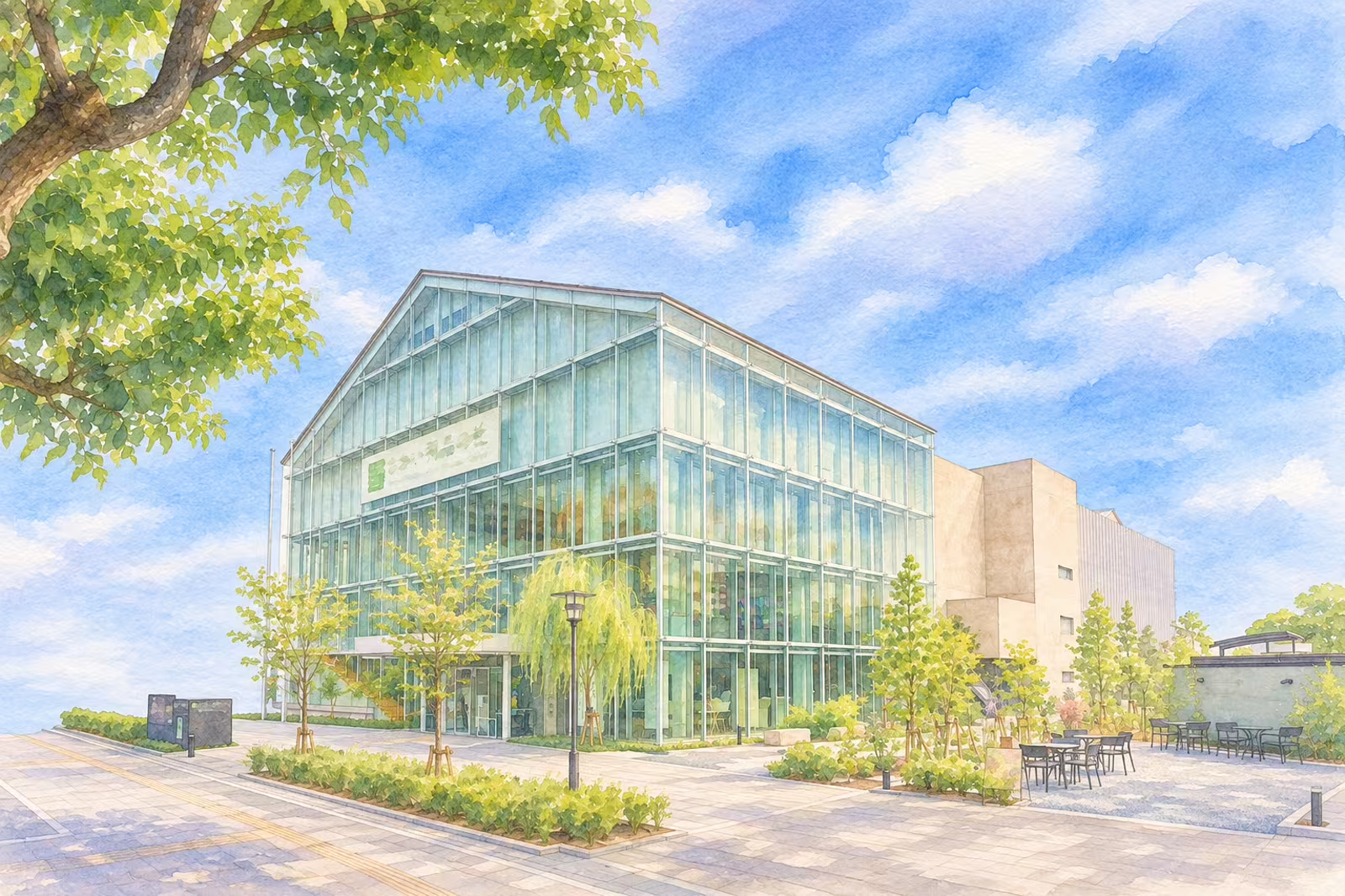
The site of Sen no Rikyū’s residence in the Shukuin area is thought to mark where his house stood. The house is gone, but a well called the Tsubaki-i remains; its wellhouse is said to reuse old timber from the main gate of Daitoku-ji. Across the street, Sakai Rishō no Mori opened in 2015. It introduces Rikyū and the poet Yosano Akiko and includes reconstructed tea rooms.
Nanshū-ji is a Zen temple founded by Miyoshi Nagayoshi in memory of his father, and Rikyū practiced Zen there. It was rebuilt after burning in 1615; its Buddha hall, main gate and Chinese-style gate, all early Edo-period buildings, are Important Cultural Properties, and the abbot’s garden is a national Place of Scenic Beauty. The temple has memorial towers for Rikyū’s lineage and the Jissō-an tea house, moved there from elsewhere in the Meiji period.
Excavations of the Sakai moated-city site have uncovered large quantities of ceramics and building remains, showing what the town Rikyū grew up in looked like.
Sakai and Sen no Rikyū
01A Town on the Border
The character for Sakai means "boundary." The town grew up where three ancient provinces met: Settsu to the north, Kawachi to the east, and Izumi to the south. In medieval documents the settlement appears as two estates, Sakai-kita-no-shō in Settsu and Sakai-minami-no-shō in Izumi, divided roughly along the east–west street still called Ōshōji, "the street of the big and small roads."
If you stand in central Sakai today, among apartment blocks and the clatter of the Hankai tram, it takes some imagination to see what this place was in the sixteenth century: the richest, most independent commercial city in Japan, a town of warehouses and ships whose merchants bankrolled warlords, sold them guns, and served them tea. One of those merchants was a fishmonger’s son named Yoshirō, who became Sen no Rikyū, the man most responsible for the shape of the Japanese tea ceremony as it is practiced today.
The great keyhole-shaped tombs on Sakai’s eastern side, including the mound attributed to Emperor Nintoku, belong to a much earlier world of the fifth century. The Sakai of this story is a medieval harbor facing Ōsaka Bay, linked northward to the Yodo River and Kyoto and southward to the sea lanes around Shikoku toward Kyūshū. It was also closely tied to Sumiyoshi Taisha, the great shrine of sea gods just to the north; the shrine’s festival procession still travels to Sakai’s Shukuin district each summer.
In 1399 the powerful western warlord Ōuchi Yoshihiro made Sakai his base when he rose against the shogun Ashikaga Yoshimitsu. In this Ōei Rebellion the town was fortified, besieged and burned, and Yoshihiro was killed. Already at the end of the fourteenth century, then, Sakai was a port worth fighting over.
02The China Ships Come to Sakai
Sakai’s fortune was made by foreign trade. The Ashikaga shoguns ran an official trade with Ming China under a system of tallies, kangō, which certified each Japanese ship as a legitimate tribute mission rather than a pirate. The main Japanese port for these ships had been Hyōgo, in today’s Kōbe. When the Ōnin War (1467–1477) tore apart the Kyoto region, a China ship returning in 1469 avoided the Inland Sea, which was controlled by hostile forces, and sailed instead around the Pacific coast of Shikoku straight into Sakai.
From then on, Sakai’s merchants worked with the Hosokawa family, who dominated the shogunate, to finance and manage China voyages. Their rivals were the Ōuchi, backed by the merchants of Hakata in Kyūshū. The rivalry came to blows in 1523, when Hosokawa and Ōuchi delegations fought each other in the Chinese port of Ningbo, after which the Ōuchi largely monopolized the official trade. Sakai hardly suffered. Its merchants had already built networks reaching to the Ryūkyū kingdom, Kyūshū and beyond, and Chinese silk, medicines, paintings and ceramics flowed through their warehouses to buyers in Kyoto and the provinces.
For a few years Sakai was even a seat of government. From 1527 the warlords Hosokawa Harumoto and Miyoshi Motonaga installed Ashikaga Yoshitsuna, a rival claimant to the shogunate, in Sakai, and contemporaries spoke of a "Sakai shogun." The arrangement lasted about five years. The Miyoshi family, who went on to dominate the capital region in the mid-sixteenth century, treated Sakai as their financial rear base.
03The Egōshū and the Moat: "Like Venice"
What made Sakai famous was its self-government. Town affairs were handled by a council of leading merchants, known in documents as the egōshū (sometimes read kaigōshū), literally "the assembled ones." Sources give their number variously as ten or thirty-six. Most were nayashū, owners of warehouses who dealt in wholesale trade and shipping. They settled disputes, kept order, and negotiated with the warlords who surrounded the town.
Sakai was protected by moats on three sides, with the sea on the fourth. Within the moat, rival samurai who met in the streets were expected to keep the peace.
The most famous description comes from the Jesuit missionaries. Around 1561 Gaspar Vilela, who lived in Sakai, wrote to Europe that the town was very rich and was governed by consuls in the manner of Venice. He described the sea on the west and deep moats on the other sides, and reported that there was no safer place in all Japan: while war raged elsewhere, Sakai remained at peace. Luís Fróis wrote in similar terms. These letters, copied and printed in Europe, made Sakai the "Venice of the East."
The picture is somewhat flattering. The merchants’ autonomy depended on paying off the powers around them, the Miyoshi and others, and Sakai was never a sovereign republic. But a town run by merchants that could stay neutral between warring armies was a remarkable thing in sixteenth-century Japan.
04Xavier’s Visit and the Southern Barbarians
At the end of 1550, the Jesuit Francis Xavier passed through Sakai on his way to Kyoto, where he hoped to meet the emperor. He was received by a merchant named Hibiya Ryōkei, who later became a Christian; the Hibiya house became an important base for missionaries in the capital region. Xavier Park in central Sakai is said to stand near the site of the Hibiya residence.
Portuguese ships, which the Japanese called Nanban, "southern barbarian," vessels, docked at Kyūshū ports such as Hirado and later Nagasaki rather than at Sakai itself. But their goods reached Sakai through Kyūshū trading networks: raw silk, textiles, glass, leather, and above all saltpeter and lead. Neither was readily available in Japan, and both were essential to the new weapon that was changing warfare.
05The Gun Town
In 1543, a ship carrying Portuguese travelers came ashore on Tanegashima, an island south of Kyūshū. The island’s lord, Tanegashima Tokitaka, bought their matchlock guns and had his smiths copy them. Some scholars place the event a year earlier.
According to Teppōki, an account written decades later, a Sakai merchant named Tachibanaya Matasaburō stayed on Tanegashima, learned the craft, and brought it back to Sakai, earning the nickname "Gun Mata." The details are hard to confirm, but within a few decades Sakai, along with Kunitomo in Ōmi Province and Negoro in Kii, had become one of Japan’s main centers of gun production. Sakai already had skilled metalworkers who could divide the work of making barrels and locks. More importantly, it controlled the import of gunpowder ingredients. A Sakai merchant could sell a warlord the gun, the saltpeter, and the lead for the bullets.
As battles came to depend on firearms, no ambitious warlord could afford to ignore Sakai. That was also why its independence could not last.
06Nobunaga’s War Levy
In 1568 Oda Nobunaga marched into Kyoto with Ashikaga Yoshiaki, whom he installed as shogun. He then demanded war funds from the temples and towns of the region, including a levy of 20,000 kan of cash from Sakai. Sakai’s leaders were allied with Nobunaga’s enemies, the Miyoshi, and at first they refused, reportedly deepening the moats and hiring masterless samurai. The nearby town of Amagasaki is said to have refused as well, and to have been burned.
The following year, after the Miyoshi failed in an attack on the shogun at the Honkoku-ji temple in Kyoto, Sakai gave in and paid. The go-between was Imai Sōkyū, a Sakai merchant who had cultivated Nobunaga early. Sōkyū was made a deputy administrator near Sakai and prospered in the trade of guns and gunpowder. From then on Sakai was governed through Nobunaga’s appointed officials, and the merchants’ self-rule was over in all but name.
Nobunaga also made political use of Sakai’s other specialty: tea. He bought up and requisitioned famous tea utensils, a campaign remembered as meibutsu-gari, "hunting for famous objects," and granted his vassals permission to hold tea gatherings as a reward, turning tea into a mark of rank. His tea masters were three Sakai merchants: Imai Sōkyū, Tsuda Sōgyū, and Sen Sōeki, the future Rikyū.
07The Fishmonger’s Son
Rikyū was born in Sakai in 1522 into a merchant family that dealt in fish wholesale and warehousing under the shop name Totoya. His father was Tanaka Yohyōe; his childhood name was Yoshirō. The family name Sen is traditionally said to come from his grandfather Sen’ami, supposedly an attendant to the Ashikaga shoguns, though there is little contemporary evidence for this.
For the sons of Sakai’s rich merchants, tea was a necessary accomplishment. Tea gatherings were where merchants met samurai and monks, and fine tea utensils were valuable assets in their own right. At seventeen Yoshirō studied tea with Kitamuki Dōchin and then with Takeno Jōō, a Sakai leather merchant who had taken the austere wabi tea of Murata Jukō further toward simplicity. Yoshirō also practiced Zen at Daitoku-ji in Kyoto, where the abbot Dairin Sōtō gave him the Buddhist name Sōeki. Daitoku-ji had close ties to Sakai’s merchants; Sakai’s Nanshū-ji temple, founded by the warlord Miyoshi Nagayoshi in memory of his father Motonaga, belonged to the Daitoku-ji line, and Dairin Sōtō was its founding abbot.
Until he was nearly fifty, Sōeki was known mostly within the tea circles of Sakai and Kyoto: a successful merchant with a reputation for an unusual eye.
08Tea Master to the Rulers of Japan
Sōeki entered Nobunaga’s service in the early 1570s, alongside Imai Sōkyū and Tsuda Sōgyū. After Nobunaga died in the Honnō-ji Incident of 1582, Sōeki served Toyotomi Hideyoshi, and soon outranked the other two.
The decade under Hideyoshi was the high point of his life. In 1585, after Hideyoshi became imperial regent, he served tea to Emperor Ōgimachi inside the palace, with Sōeki assisting. Because a commoner without court rank could not enter the palace, Sōeki was given the Buddhist lay title Rikyū Koji. From then on he was Sen no Rikyū.
Rikyū’s tea is associated with the tiny rustic tearoom. The Taian, a tearoom at the Myōki-an temple in Ōyamazaki south of Kyoto, measures just two tatami mats. Guests crawl in through a low entrance called the nijiriguchi; the walls are bare earthen plaster. It is regarded as the only surviving tearoom that can reasonably be attributed to Rikyū and is a National Treasure. Rikyū also had the potter Chōjirō make hand-shaped black and red tea bowls without a wheel, the origin of Raku ware.
Yet Rikyū was no hermit. He was involved with Hideyoshi’s famous Golden Tea Room, a portable room with gold leaf covering walls, ceiling and utensils, which was carried into the imperial palace for the emperor to see and, after Rikyū’s death, taken to Hideyoshi’s Nagoya Castle in Kyūshū. On the first day of the tenth month of 1587, Hideyoshi held the Grand Kitano Tea Gathering at the Kitano Tenmangū shrine in Kyoto, inviting everyone regardless of rank; Rikyū, Imai Sōkyū and Tsuda Sōgyū served as hosts. Planned for ten days, it lasted one.
His influence went beyond the tearoom. In 1586 the Kyūshū warlord Ōtomo Sōrin came to Ōsaka to ask Hideyoshi for help, and afterward wrote down what Hideyoshi’s brother Toyotomi Hidenaga told him: in private matters, go through Sōeki; in public matters, go through me. The remark is often quoted to show how close Rikyū stood to power.
09The Death of Rikyū
In the first month of 1591, Hidenaga died. He had been a moderating presence between Rikyū and Hideyoshi. Soon after, Hideyoshi ordered Rikyū to leave Kyoto and confine himself in Sakai. On the thirteenth day of the second month Rikyū left by boat down the Yodo River; tradition says the only disciples who came to see him off were Hosokawa Tadaoki and Furuta Oribe. He was then summoned back to Kyoto and, on the twenty-eighth day of the second month (April 21, 1591), ordered to commit ritual suicide at his residence near Hideyoshi’s Jurakutei palace. He was seventy by the traditional Japanese count.
Why Hideyoshi ordered his death has never been settled. Two charges circulated at the time. The first concerned Daitoku-ji. In 1589, for the fiftieth memorial of his late father, Rikyū had paid for the upper story of the temple’s main gate, called Kinmōkaku, and the grateful monks placed a wooden statue of him, wearing sandals, inside it. Critics said that Rikyū had made the regent and imperial envoys walk beneath his feet. The second charge was that Rikyū had profited by buying tea utensils cheap and selling them dear, behaving like a corrupt monk. Later writers added other theories: aesthetic disagreement with Hideyoshi, entanglement in factional struggles within the Toyotomi government, or Hideyoshi’s desire to take Rikyū’s daughter as a concubine. The last is a later legend.
According to contemporary records, after his death Rikyū’s head was displayed at the Ichijō Modoribashi bridge in Kyoto, with the wooden statue from the Daitoku-ji gate set above it, as if trampling it. His farewell verses survive.
The Sen household was disbanded for a time and later restored under his adopted son Shōan. Shōan’s son Sōtan had three sons who founded the three Sen schools still active today, Omotesenke, Urasenke and Mushanokōjisenke, all of which honor Rikyū as their founder.
10Burned and Rebuilt
By the time Rikyū died, Sakai’s great age was over. When Hideyoshi built Ōsaka Castle, he moved some of Sakai’s merchants to his new castle town, and around 1586 Sakai’s moat was filled in on his orders.
In 1615, on the eve of the Summer Campaign of Ōsaka, Toyotomi forces set fire to Sakai to deny it to the Tokugawa. The medieval town burned almost entirely. Excavations in central Sakai routinely find a thick layer of burned soil, which archaeologists use as the dividing line between medieval and early modern remains.
The Tokugawa shogunate rebuilt Sakai on a grid plan and dug a new moat around it, the ancestor of today’s Doi River. Under the Sakai magistrate, the town remained an important manufacturing center through the Edo period. Gunsmiths continued to work, and Sakai blades, especially kitchen knives and tobacco-cutting knives, became famous across the country; Sakai knives are still renowned today.
In 1704 the Yamato River was diverted to flow directly into Ōsaka Bay just north of Sakai. The silt it carried gradually choked the harbor, and Sakai’s role as a port declined sharply.
11Walking the Old Town
The old town is long and narrow, running north to south. The Hankai tram line runs down its spine along Daidō-suji, the old road to Kii Province; Shukuin station is roughly at the center.
A short walk west of Shukuin is the Sen no Rikyū Residence Site, a small open plot with a well called the Tsubaki-no-i, traditionally said to have belonged to Rikyū’s house. The roofed frame over the well is said to have been built from old timber taken from the Daitoku-ji gate during repairs. Right beside it is Sakai Rishō no Mori, a museum opened in 2015 with exhibitions on Rikyū and on the poet Yosano Akiko, who was also born in Sakai. It includes a reconstruction of the Taian tearoom as it was first built, and a space where visitors can be served tea.
The name Shukuin comes from the Shukuin Tongū, the resting place of Sumiyoshi Taisha’s deity during its festival. A little east is Aguchi Shrine, known locally as Ōtera, one of the religious centers of medieval Sakai.
At the southern end of the old town, Nanshū-ji is the best place to feel the link between Sakai and tea. The temple has memorials associated with Takeno Jōō and Rikyū, a memorial tower for the Sen family erected by the three Sen schools, and Jissō-an, a tearoom in Rikyū’s style rebuilt in 1960. The original temple burned in 1615 and was rebuilt on its present site in 1617 by the Zen monk Takuan; its Buddha hall and gates are Important Cultural Properties and its garden is a national Place of Scenic Beauty. The temple also has a stone monument said to be the grave of Tokugawa Ieyasu, based on a local legend that Ieyasu was wounded in the Ōsaka campaign and died in Sakai. It is a legend and nothing more.
In the northern part of the old town stands the Edo-period house of the Inoue family of gunsmiths, the only surviving Edo-period gunsmith’s house and workshop in Japan, restored and opened to the public in recent years. Near the waterfront on the west side is the Old Sakai Lighthouse, a wooden Western-style lighthouse completed in 1877 and among the oldest of its kind in Japan, a reminder that this was once a harbor town.
East of the old town, in Daisen Park, the Sakai City Museum displays guns, tea utensils and other material on Sakai’s history, next to the wooded mound of the Nintoku tomb. Walk along the Doi River and you can trace the boundary of the rebuilt Edo-period town. The merchants’ moat was filled in under Hideyoshi; the channel you see is its successor.