
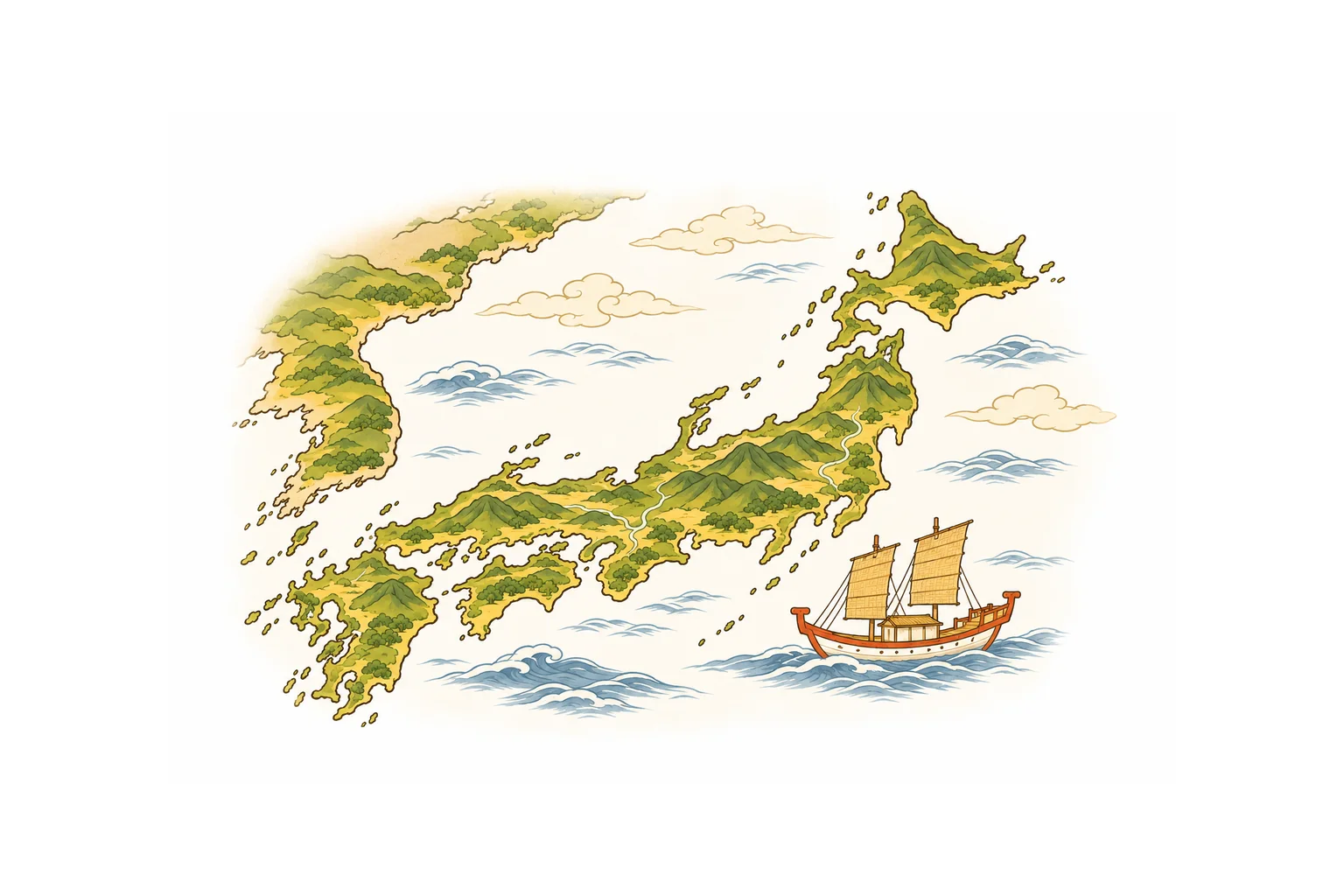
01A Bow of Mountains in the Sea
Japan is an archipelago shaped like a drawn bow, curving from northeast to southwest for about 3,000 kilometers. Four large islands make up most of it: Hokkaidō in the north, Honshū in the middle, and Shikoku and Kyūshū in the southwest. Thousands of smaller islands trail off at either end, from the Kuril chain toward Kamchatka down to Okinawa, which lies closer to Taiwan than to Tokyo.
Most of this land stands on end. Roughly three-quarters of Japan is mountainous, much of it volcanic, and earthquakes are a fact of ordinary life. Rivers run short and fast from the mountains to the sea, too steep for the kind of long inland navigation that carried goods up and down China’s great rivers. Flat land suitable for rice comes in separate pockets: the Kantō Plain around modern Tokyo, the largest; the Nōbi Plain around Nagoya; the lowlands around Ōsaka Bay; and a scatter of smaller basins and coastal strips.
That pattern explains a good deal of Japanese history. Each plain could feed a local power, and mountains made those powers hard to conquer from outside, so periods of fragmentation came easily. Rice land was scarce and fiercely contested. And because hauling heavy loads over mountain passes was slow and costly, water was the real highway. Coastal shipping moved rice, timber, salt and fish long before Japan had anything like a road network.
The most important stretch of water was the Inland Sea, the sheltered, island-studded channel between Honshū, Shikoku and Kyūshū. It runs from the Straits of Shimonoseki at Kyūshū’s northern tip to Ōsaka Bay. For more than a thousand years, people, goods and ideas arriving from the Asian mainland landed in northern Kyūshū and then sailed east along it. At its far end lay the Kinai, the region around Nara, Kyoto and Ōsaka, where Japan’s early rulers made their home. The capital sat at the end of the main sea lane, which was no coincidence.
02Two Centers, East and West
A second pattern runs through the whole story: Japan has tended to have two centers of gravity, one in the west and one in the east.
The western center was the Kinai. It was fertile, crowded and close to the continent, and from roughly the third century onward it was home to the royal court. Nara (capital from 710) and Kyoto (from 794) both lie there.
The eastern center was the Kantō Plain. To the early court it was a frontier, thinly settled and far away, but it was broad, good for raising horses, and full of men who knew how to fight on horseback. The name itself shows the court’s point of view. In the eighth century the government kept three guarded barriers on the roads east of the capital; Kantō simply means "east of the barriers," the distant lands beyond.
Power swung between the two for a thousand years. In the 1180s the warrior leader Minamoto no Yoritomo set up his headquarters at Kamakura, in the Kantō, while the emperor stayed in Kyoto. The Ashikaga shoguns of the fourteenth century moved the warrior government back to Kyoto. In 1603 Tokugawa Ieyasu founded his shogunate at Edo, a castle town on the Kantō Plain, while Kyoto kept the emperor and Ōsaka grew into the nation’s commercial hub. Finally, in 1868–69, the young Emperor Meiji himself moved east, and Edo, renamed Tokyo ("eastern capital"), became the single capital.
Two great roads tied east and west together. The Tōkaidō ran along the Pacific coast; the Nakasendō threaded through the mountains of central Honshū. Under the Tokugawa both were official highways lined with post towns where travelers changed horses and spent the night. The two met at Kusatsu in Ōmi Province for the last stretch into Kyoto. On the way, the Nakasendō squeezed through a narrow gap between mountain ranges at the western edge of Mino Province, near today’s border of Gifu and Shiga prefectures. One of the ancient barriers stood in that gap. So did the village of Sekigahara, where in 1600 Tokugawa Ieyasu won the battle that decided who would rule Japan. Armies moving between east and west had little choice but to meet there.
The east-west divide still shows up in odd places. Eastern Japan’s electricity runs at 50 hertz and western Japan’s at 60, because in the 1890s Tokyo bought generators from Germany and Ōsaka bought them from the United States. People in Tokyo and Ōsaka still enjoy teasing each other about accents and the right way to season noodle broth.
03Across the Strait: Rice, Writing and the Buddha
The nearest point of the continent is the Korean Peninsula, across a strait from northern Kyūshū. The islands of Iki and Tsushima sit in between like stepping stones, and on a clear day the Korean coast is visible from Tsushima. Almost everything that transformed early Japan came this way.
Some time in the first millennium BCE (the starting date is still argued over), wet-rice farming and metal tools crossed from the peninsula into northern Kyūshū. With them came migrants, and the long Jōmon period of hunting, fishing and gathering gave way to the rice-growing Yayoi period. Rice, and the settled villages, granaries and wars over land that came with it, spread steadily east.
Japan first appears in writing in Chinese records. A Chinese dynastic history says that in 57 CE a ruler of "Na in the land of Wa" sent an envoy to the Han court and received a seal. In 1784 a farmer on Shikanoshima, an island in Hakata Bay, turned up a small solid-gold seal inscribed with the name of the Han dynasty and the kingdom of Na; most historians accept it as that very seal. In the third century, Chinese records describe a queen called Himiko, who ruled a land called Yamatai and sent envoys to the Chinese kingdom of Wei.
Between the fourth and seventh centuries the Korean Peninsula was divided among three rival kingdoms, Goguryeo, Baekje and Silla, and the Japanese court was closely allied with Baekje. Waves of migrants from Korea and China settled in Japan. Later generations called them toraijin, "people who crossed over." They brought Chinese writing, Confucian texts, silk weaving, new pottery techniques, ironworking and engineering. Some migrant families, such as the Hata of the Kyoto area, became powerful clans who ran the court’s records, finances and workshops for generations.
Buddhism arrived the same way. According to Japan’s official chronicle, the Nihon shoki, the king of Baekje sent a gilt-bronze Buddha and sutras to the Japanese court in 552; other sources give 538, the date most modern textbooks prefer. The question of whether to worship this foreign god split the court. The Soga clan championed it, the Mononobe opposed it, and after decades of rivalry the Soga won by force. The first great temples of the Asuka period, many built and furnished by migrant craftsmen, followed.
The Korean alliance ended badly. In 660 Tang China and Silla destroyed Baekje. Japan sent a large expedition to restore it, and in 663 the Tang navy crushed the Japanese fleet at the mouth of the Geum River, a battle known in Japan as Hakusukinoe. Fearing invasion, the court built mountain forts across western Japan and a long earthen rampart, the Mizuki or "water fortress," to guard its outpost at Dazaifu in Kyūshū. It also set about remaking itself on the Chinese model, as fast as it could.
04Envoys to Tang China
From 630 the court appointed some twenty official embassies to Tang China, fifteen or sixteen of which actually sailed over the next two and a half centuries. From the eighth century a typical mission had around five hundred people in four ships: ambassadors, scholars, student monks, doctors, musicians, artisans and sailors.
The voyages were dangerous. Early missions hugged the Korean coast, but after relations with Silla soured, the ships struck straight across the East China Sea toward the mouth of the Yangzi. They were not built for open-ocean storms, and missions often lost one or more ships.
What came back shaped Nara and early Heian Japan: law codes, the grid-plan capital modeled on the Tang capital Chang’an, Buddhist scriptures and images, calligraphy, music, court dress and the calendar. The Shōsōin, the storehouse of Tōdai-ji in Nara, still holds objects from this world, including glass and textiles that traveled the Silk Road to Chang’an before being carried to Japan.
Some travelers never returned. Abe no Nakamaro went to China as a teenager in 717, is said to have passed the Chinese civil examinations, and rose to high office; he was a friend of the poets Li Bai and Wang Wei. In 753 he was finally allowed to sail home, but his ship was blown south to what is now Vietnam, and he ended his days in Chang’an. A famous poem attributed to him, written by tradition on the eve of his departure, recalls the moon rising over Mount Mikasa in Nara.
Others came the other way. Jianzhen (Ganjin in Japanese), a senior monk from Yangzhou, agreed to go to Japan to establish proper Buddhist ordination. His first five attempts failed because of storms, official obstruction and a disciple who reported the plan to the authorities; by tradition he lost his sight along the way. On his sixth attempt he reached Kyūshū at the end of 753 and entered Nara the next year. In 754 he set up an ordination platform in front of the Great Buddha Hall at Tōdai-ji, gave the bodhisattva precepts to the retired emperor Shōmu and others, and properly ordained monks; he later founded the temple of Tōshōdai-ji.
The embassy of 804 carried two monks who would change Japanese religion: Saichō and Kūkai. They sailed on different ships and came home to found, respectively, the Tendai and Shingon schools of Buddhism.
In 894 the scholar Sugawara no Michizane, newly named ambassador, advised that the mission be called off, pointing to disorder in China and the perils of the sea. No embassy ever sailed again. Trade did not stop, however. Chinese merchants kept calling at Hakata in Kyūshū, and in the twelfth century the warrior-statesman Taira no Kiyomori improved a harbor near modern Kōbe to trade with Song China. So many Song copper coins flowed in that they became Japan’s everyday money for centuries.
05The Mongol Invasions
In the thirteenth century the Mongols built the largest land empire the world had seen. Khubilai Khan, having forced Korea into submission, sent letters to Japan demanding that it open relations, in terms that amounted to a call for surrender. The warrior government at Kamakura, led by the regent Hōjō Tokimune, refused to answer and later executed Mongol envoys.
In 1274 a Mongol and Korean fleet sailed for Japan. It overran Tsushima and Iki, killing many islanders, and landed at Hakata Bay. Japanese warriors, used to fighting as individuals in search of personal glory, struggled against massed Mongol tactics, poisoned arrows and exploding bombs. After a day of hard fighting the invaders returned to their ships and soon withdrew; tradition says a storm struck the fleet.
Expecting them back, Kamakura ordered the warriors of Kyūshū to build a stone wall along Hakata Bay, about 20 kilometers long. Stretches survive in the city of Fukuoka today. The Mongols returned in 1281 with a much larger force sailing in two fleets, one from Korea and one from southern China. The wall kept them from establishing a beachhead, and Japanese warriors raided the anchored ships at night in small boats. In August, nearly two months after the first fleet reached Hakata Bay, a typhoon wrecked much of the invasion fleet, by then gathered off Takashima in Hizen. Those left ashore were killed or captured.
The two storms fixed in memory the idea of the kamikaze, the "divine wind" sent by the gods to protect Japan. A Kyūshū warrior named Takezaki Suenaga, determined to have his deeds rewarded, commissioned a pair of illustrated scrolls showing his part in both campaigns. The Mongol Invasion Scrolls remain the most vivid picture of the fighting, down to the armor of Mongol soldiers and the design of their ships.
Victory brought its own problems. A defensive war won no land, so the government had little to give warriors who had spent their fortunes fighting, and the coast had to be guarded for years against a third invasion. Resentment spread. The Kamakura shogunate fell in 1333, and the strain of the invasions is usually counted among the reasons.
06Pirates, Tallies and the Kingdom of Ryūkyū
In the fourteenth century, while Japan was split by civil war between rival imperial courts, armed bands from Kyūshū and the Inland Sea raided the coasts of Korea and China. They were called wakō, "Japanese pirates." By the sixteenth century most so-called wakō were in fact Chinese smugglers, with Japanese a minority among them.
Ming China allowed foreign trade only in the form of tribute missions. To get access to its riches, the third Ashikaga shogun, Ashikaga Yoshimitsu, accepted the title "King of Japan" from the Ming emperor in the early 1400s. From 1404 Japanese ships carried official tallies, or kangō, which the Chinese matched against counterfoils to tell legitimate traders from pirates. Swords, copper, sulfur and folding fans went to China; copper coins, raw silk, porcelain and books came back. Yoshimitsu’s willingness to style himself a vassal of China drew criticism in his own time and long afterward.
To the south, a kingdom built on the sea was taking shape. The main island of Okinawa had been divided among three rival lords until 1429, when Shō Hashi of the central realm united them as the Kingdom of Ryūkyū, with its capital at Shuri. Ryūkyū sent tribute to China and traded with Japan, Korea and Southeast Asia, carrying Chinese porcelain, Southeast Asian spices and dyewood, and Japanese swords from port to port. A bronze bell cast for Shuri Castle in 1458 proudly describes the kingdom as a bridge between all nations.
In 1609 the Shimazu lords of Satsuma, in southern Kyūshū, invaded Ryūkyū and carried off its king. For the next two and a half centuries Ryūkyū lived a double life: officially an independent kingdom sending tribute to China, in practice controlled by Satsuma, which quietly profited from the China trade.
07The "Southern Barbarians"
In 1543 a Chinese junk was driven ashore on Tanegashima, a small island south of Kyūshū. Aboard were a few Portuguese, the first Europeans to reach Japan. The island’s lord bought their matchlock guns and had his smiths copy them. Within a few decades gunsmiths at Sakai and elsewhere were turning out firearms in large numbers, just as Japan’s warlords were fighting for control of the country. Oda Nobunaga’s massed musketeers at the Battle of Nagashino in 1575 are the classic example of what they could do.
Because the Portuguese arrived from the south, the Japanese called them nanban, "southern barbarians." Operating from Macao, Portuguese merchants carried Chinese silk to Japan and took away silver. Japan was then one of the world’s great silver producers, much of it from the Iwami mine in western Honshū, and its silver helped tie East Asia into a global economy.
Missionaries followed the merchants. The Jesuit Francis Xavier landed at Kagoshima in 1549. Several Kyūshū lords accepted baptism, attracted by the faith, by trade, or by the gunpowder the Portuguese ships carried. One of them, Ōmura Sumitada, opened Nagasaki as a port and later handed it over to the Jesuits. In 1582 four young Japanese Christians set out for Europe, met the pope in Rome, and returned home eight years later. At its height, Japan’s Christian community probably numbered in the hundreds of thousands.
Toyotomi Hideyoshi, who completed the unification of Japan, at first tolerated the missionaries. In 1587 he abruptly ordered them expelled, and in 1597 he had twenty-six Christians crucified in Nagasaki. He feared a religion that commanded loyalty beyond his own and that seemed linked to European empires.
Hideyoshi also looked across the strait. In 1592 and again in 1597 he sent huge armies into Korea, announcing that he would go on to conquer Ming China. The Japanese took Seoul within weeks, but the Korean admiral Yi Sun-sin cut their sea lanes, Ming armies came to Korea’s aid, and the war bogged down. When Hideyoshi died in 1598, his generals withdrew. The invasions devastated Korea. Tens of thousands of Koreans were carried off to Japan, among them potters whose skills founded famous kilns such as those at Arita in Kyūshū.
08Four Windows on the World
Tokugawa Ieyasu, Hideyoshi’s successor, at first encouraged foreign trade. He licensed merchants with red-sealed permits, and Japanese ships sailed to Vietnam, Siam and the Philippines, where Japanese settlements grew up in several ports. Through the lords of Tsushima, he also restored relations with Korea.
Under his grandson, the third shogun Tokugawa Iemitsu, policy turned sharply. Fearing Christianity and wanting foreign trade under its own control, the shogunate issued a series of edicts in the 1630s forbidding Japanese to go abroad or to return from overseas. In 1637–38 a rebellion of peasants and masterless samurai on the Shimabara Peninsula and the Amakusa islands near Nagasaki, many of them Christians and led by a teenager known as Amakusa Shirō, took more than 100,000 troops to crush. In 1639 Portuguese ships were banned altogether. In 1641 the Dutch, who had shown no interest in missionary work, were moved to Dejima, a small fan-shaped artificial island in Nagasaki harbor.
This system later came to be called sakoku, the "closed country." The word itself was coined only in 1801, by a Nagasaki interpreter translating a chapter of a German doctor’s book about Japan. Historians today stress that Japan was not sealed off. Rather, contact with the outside world was channeled through four gateways, each under the shogunate’s watch.
Nagasaki was the first. Dutch and Chinese merchants traded there, the Dutch confined to Dejima and the Chinese, from the late seventeenth century, to a walled quarter of their own. The head of the Dutch trading post traveled regularly to Edo to pay his respects to the shogun (every year at first, every four years after 1790), and each year’s Dutch ship brought reports of world news, submitted through the Nagasaki magistrate, which the shogunate read closely. Tsushima was the second: its lords handled diplomacy and trade with Korea, and Korean embassies visited Japan twelve times during the Edo period, received with great ceremony along the road to Edo. Satsuma, the third, managed Ryūkyū. The fourth was the Matsumae domain at the southern tip of Hokkaidō, which held a monopoly on trade with the Ainu.
Knowledge seeped in through these openings. In the eighteenth century Japanese doctors and scholars began learning Western medicine, astronomy and geography from Dutch books, a field called rangaku, "Dutch learning." In 1771 the physician Sugita Genpaku and his colleagues watched the dissection of an executed criminal’s body in Edo and were astonished at how accurately a Dutch anatomy text matched what they saw. Their translation, published in 1774 as Kaitai shinsho (New Book of Anatomy), is usually counted as the start of serious Western learning in Japan.
09The North: Ezo and the Ainu
What is now Hokkaidō was known in the Edo period as Ezo. Its native people, the Ainu, lived by hunting, fishing and gathering, with their own language and religion. For centuries they traded with Honshū, Sakhalin and the Amur region, exchanging salmon, kelp, furs and hawk feathers for rice, iron tools, lacquerware and sake.
The shogunate gave the Matsumae domain exclusive rights to that trade, and over time Japanese merchants took over fishing grounds across Ezo, pressing ever harder terms on the Ainu. In 1669 an Ainu chief named Shakushain led a widespread uprising. He was killed at a peace banquet arranged by Matsumae, and afterward Japanese control tightened. Many Ainu ended up working in merchant-run fisheries under harsh conditions.
Ezo’s products traveled south along the Japan Sea coast. From the eighteenth century, merchant ships known as kitamaebune sailed between Ōsaka and Ezo by way of the Shimonoseki Straits, buying and selling at every port. Hokkaidō kelp became a staple of Ōsaka cooking, and some was even shipped on through Satsuma and Ryūkyū to China.
By the late eighteenth century a new neighbor had appeared in the north. Russia had expanded across Siberia to the Pacific, and in 1792 the Russian envoy Adam Laxman arrived at Nemuro in eastern Ezo, returning shipwrecked Japanese sailors and asking for trade. Alarmed, the shogunate sent surveyors to map Ezo, the Kurils and Sakhalin. One of them, Mamiya Rinzō, confirmed around 1809 that Sakhalin was an island, separated from the mainland by a narrow strait.
In 1869 the new Meiji government renamed Ezo as Hokkaidō and created a colonization office to settle it. Farmers and soldier-settlers poured in. Ainu lands were taken over by the state, salmon fishing and deer hunting were restricted, and the Ainu were pressed to give up their language and customs. Japan formally recognized the Ainu as an Indigenous people only in 2019.
10After the Black Ships
In the early nineteenth century Western ships appeared off Japan with growing frequency. In 1808 a British warship forced its way into Nagasaki harbor; in 1825 the shogunate ordered that foreign ships be driven off by gunfire. Then, in 1842, came news that Britain had defeated Qing China in the Opium War. Shaken, the shogunate softened its order and allowed foreign ships to take on fuel and water.
In July 1853 Commodore Matthew Perry of the United States Navy brought four warships into the mouth of Edo Bay at Uraga. Their dark hulls and the smoke pouring from the steamers earned them the name "black ships." Perry delivered a letter from the president and promised to return for an answer. When he did, in 1854, the shogunate signed a treaty opening the ports of Shimoda and Hakodate. A commercial treaty followed in 1858, opening Yokohama, Nagasaki, Hakodate, Niigata and Kōbe, giving foreigners the right to be tried by their own consuls, and denying Japan control over its own tariffs. Britain, France, Russia and the Netherlands quickly signed similar treaties.
The upheaval that followed brought down the shogunate, which is a story of its own. On the map, the new government moved quickly to fix Japan’s borders. In 1875 it gave up its claims to Sakhalin in return for the whole Kuril chain. In 1879 it abolished the Kingdom of Ryūkyū, made it Okinawa Prefecture, and moved its last king to Tokyo. Victory over China brought Taiwan in 1895, and in 1910 Japan annexed Korea.
For most of two thousand years Japan had learned from its neighbors across the water: rice, writing and Buddhism from Korea, a model of the state from Tang China, a first look at Western science through Dutch books. By the end of the Meiji era in 1912 the direction had reversed, and Korea, the peninsula from which so much had once come, was a Japanese colony.