
01The Throne Nobody Took
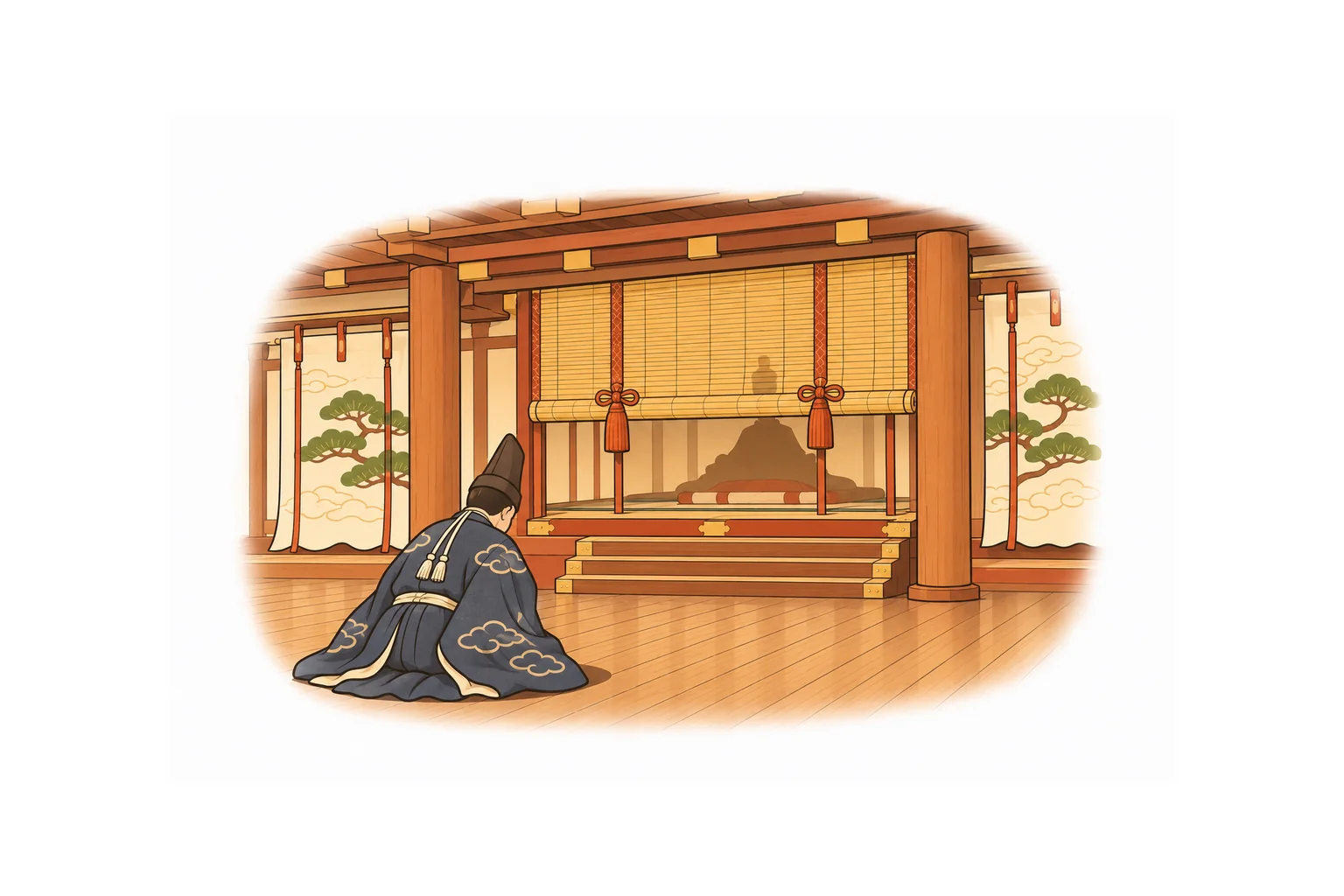
In most monarchies, the way to take power is to take the throne. English history is full of usurpers, Chinese history of founders who rose from nothing and swept an old dynasty away. Japan is the odd one out. From the time written records become reliable, the same family has occupied the top position, and no rival has ever replaced it. Shoguns came and went, warlords rose and fell, but the imperial line carried on.
This was not because the emperors were always in charge. For most of the last thousand years they were not. The usual arrangement was that the emperor reigned while someone else ruled, and often that someone else was himself being steered by a third party. Once you see this pattern of a figurehead at the top and a working power behind him, a great deal of Japanese history falls into place.
The imperial family’s own account of its origins, set down in two 8th-century chronicles, the Kojiki and the Nihon Shoki, traces the line back to the sun goddess Amaterasu and dates the first emperor, Jinmu, to 660 BCE. Historians treat this as myth. What can be said with more confidence is that between roughly the 3rd and 6th centuries, the rulers of the Yamato region around the Nara basin built up a coalition of powerful clans, and by the late 7th century these rulers had adopted the title tennō, the word still used for "emperor" today.
The 7th and 8th centuries were the high point of Japan’s borrowing from Tang-dynasty China. A set of reforms beginning in 645 and a law code issued in 701 created, on paper, a centralized state modeled on China’s: all land belonged to the throne, farmers received allotments recorded in household registers, and a salaried bureaucracy collected taxes in rice, cloth and labor. On paper, the emperor was an absolute monarch.
There was one deep difference from China. Chinese political theory held that heaven granted a mandate to rule, and a dynasty that governed badly could lose it, which justified rebellion. The Japanese emperor’s claim rested on descent from the gods, not on good behavior. There was no mandate to lose. In 769 a Buddhist monk named Dōkyō, a favorite of the reigning empress, came close to being named heir on the strength of an oracle. A courtier, Wake no Kiyomaro, was sent to the Usa Hachiman shrine to confirm it and came back with the opposite message: only someone of imperial blood could take the throne. Dōkyō fell from grace, and the episode became the standard example of a subject who reached too far.
If the throne could not be seized, ambitious people had to find another route to power. The route they found was to stand beside the emperor and speak for him.
02The Fujiwara: Grandfathers to the Throne
The first family to master this was the Fujiwara. Their founder, Nakatomi no Kamatari, had helped launch the 645 reforms and received the Fujiwara surname on his deathbed. Over the following centuries his descendants spread through the court until they dominated it.
Their method was marriage. A Fujiwara daughter would become an imperial consort; her son would become emperor; and her father, the boy’s grandfather, would guide the young ruler. Aristocratic children in this period were usually raised in their mother’s household, and imperial princes were no exception. A boy emperor who grew up under his grandfather’s roof was naturally inclined to listen to him.
In 858 a nine-year-old emperor came to the throne, and his maternal grandfather, Fujiwara no Yoshifusa, took charge of the government, later receiving the formal title of sesshō, or regent. He was the first person outside the imperial family to hold it. His adopted heir, Mototsune, went a step further. From 884, serving an adult emperor, Mototsune acted as kanpaku, a title formally granted in 887: a chief adviser through whom all business passed before it reached the throne. Regent for a child, chief adviser for an adult: between them the two offices let the Fujiwara govern no matter how old the emperor was. Historians call this the age of regency government.
Its peak came under Fujiwara no Michinaga in the early 11th century. Michinaga placed four daughters at court, three of whom became empresses, and he was grandfather to three emperors: Go-Ichijō, Go-Suzaku and Go-Reizei. In 1018, at a banquet on the day his daughter Ishi became Go-Ichijō’s empress, he composed a short poem comparing himself to the full moon, which lacks nothing. We know about it because a fellow noble, Fujiwara no Sanesuke, wrote it down in his diary, not entirely approvingly.
Michinaga never tried to become emperor himself. His position as grandfather was worth something only because there was an emperor to be grandfather to. The Fujiwara and the throne needed each other: the emperor gave the Fujiwara legitimacy, the Fujiwara ran the government in his name. That bargain would be struck again and again by others.
The court of this era is the world of The Tale of Genji, written by Murasaki Shikibu, a lady-in-waiting to Michinaga’s daughter. It was a world of poetry contests, layered silk robes and incense-blending competitions. Outside the capital, however, the tax system was coming apart. Local landholders were commending their fields to great nobles and temples in Kyoto, nominally handing them over in return for tax exemption and protection. These private estates, called shōen, funded the court’s elegance while steadily draining the state of revenue and control.
03The Retired Emperors
The Fujiwara system had a weakness. It depended on luck: a Fujiwara daughter had to marry the right prince and bear a son.
In 1068 the luck ran out. Go-Sanjō became emperor without a Fujiwara mother, the first in over a century, and he began curbing the regents and auditing the estates. His son Shirakawa found an even better trick. In 1086 he abdicated in favor of his young son and moved into his own palace as a retired emperor, keeping hold of the real decisions. A retired emperor’s residence was called an in, so this style of government is known as insei, "rule from the retired emperor’s palace," usually translated as cloistered rule, because most retired emperors also took Buddhist vows.
Cloistered rule beat the Fujiwara at their own game. The Fujiwara governed as grandfathers on the mother’s side; the retired emperor governed as father or grandfather on the father’s side, and in a society that ranked fathers above in-laws, that was the stronger claim. Free of the endless rituals that tied down a reigning emperor, a retired one could run his own office, issue his own orders, promote men of middling rank who owed everything to him, and hire warriors as guards.
Shirakawa dominated the court for more than forty years. A famous line attributed to him in the war epic The Tale of the Heike lists the only three things he could not control: the waters of the Kamo River, which flooded Kyoto, the fall of the dice, and the armed monks of Mount Hiei, who would march down from their monastery carrying sacred palanquins to press their demands. Whether he really said it is uncertain, but the list tells you what was worrying the most powerful man in Japan. The third item was about force.
By now the structure had several layers. There was a reigning emperor, a retired emperor who actually ruled, and Fujiwara regents who kept their grand titles. No one had been abolished. Each layer simply gained or lost weight. This habit, of leaving old institutions standing and building new power beside or above them, is one of the most consistent features of Japanese politics.
04The Warriors Arrive
The word samurai comes from a verb meaning "to serve," and the first warriors were exactly that: armed men who served someone. In the provinces, families with land raised fighting men to protect it. In Kyoto, nobles and retired emperors hired them to guard their palaces and put down revolts. Two warrior lineages became especially prominent, the Minamoto (also called Genji) and the Taira (Heike). Both descended from emperors. The imperial family produced more sons than it could support, so surplus princes were given surnames, removed from the royal line and left to make their own way, and some of their descendants became provincial warrior chiefs.
In the 1150s, quarrels at court were settled by warriors for the first time. In the Hōgen Disturbance of 1156, a reigning emperor and his retired elder brother fought over the succession, the Fujiwara split down the middle, and each side called in Minamoto and Taira fighters. Three years later, in the Heiji Disturbance, the warriors fought among themselves. Taira no Kiyomori won. The Minamoto leader was killed, and his thirteen-year-old son, Minamoto no Yoritomo, was exiled to the Izu peninsula.
Kiyomori became the first warrior to reach the top of the court. In 1167 he was named Chancellor of the Realm, the highest office in the old law codes. To secure his position, he did exactly what the Fujiwara had done. He married his daughter to the emperor, and in 1180 he placed their infant son on the throne as Emperor Antoku. The warriors had arrived, but they were still playing by court rules.
Taira arrogance made enemies everywhere. In 1180 Yoritomo raised an army in exile, and five years of fighting, the Genpei War, followed. It ended in 1185 at the sea battle of Dan-no-ura, where the defeated Taira drowned themselves rather than surrender. The six-year-old Antoku went into the water in his grandmother’s arms. Even then nobody suggested doing without an emperor. Kyoto had already enthroned another one.
05The Shogun
Yoritomo did something Kiyomori had not. He stayed away from the capital. Instead of chasing court offices in Kyoto, he built his own headquarters at Kamakura, in the eastern Kantō plain where his supporters lived.
He understood that what his eastern warriors wanted was secure title to their land. He bound them to him as vassals, known as gokenin, or "honorable housemen": he confirmed and rewarded their holdings, and they fought and served for him in return. In 1185, using the hunt for his rebellious brother Yoshitsune as a pretext, he won the court’s permission to appoint his own men as provincial constables (shugo) and as estate stewards (jitō) across the country. The constables handled military and police matters; the stewards collected dues and managed the land. With that, the warrior government reached into the administration of land everywhere, with the court’s formal blessing.
In 1192 Yoritomo received the title sei-i taishōgun, "great general who subdues the barbarians." It was an old title, originally given to commanders sent against the Emishi peoples of the northeast around 800 and handed back once the campaign was over. After Yoritomo it became the permanent title of the head of the warrior class, shortened to shōgun. His government came to be called the bakufu, literally "tent government," after the curtained enclosure where a general directed a battle.
Why would a man with an army need an emperor’s appointment at all? Because swords could win land but not lasting loyalty. A title granted by the throne placed the shogun inside an order that everyone accepted. The shogun’s authority came from the emperor, and the emperor in turn relied on the shogun to keep the peace and keep the estate revenues flowing to Kyoto. It was the Fujiwara bargain in armor.
From then on Japan had two centers: Kyoto, home of the emperor and court, with their ceremonies, ranks and a share of the land; and Kamakura, home of the shogun and the warriors. The two were not equal, but neither swallowed the other.
06Puppets Behind Puppets
Within a generation, the warrior government went the way of the court.
Yoritomo died in 1199. Both his sons became shogun and both were murdered; by 1219 his direct line was extinct. The real power in Kamakura had already passed to his widow, Hōjō Masako, and her family. Her father and then her brother held the post of shikken, or regent to the shogun, and turned it into the true seat of authority.
The Hōjō never took the title of shogun themselves. They brought in a small boy from the Fujiwara regents’ house in Kyoto, and later imperial princes, to fill it. So now the shogun was an ornament from the capital and the Hōjō regent ran the government. In time even the regency became a formality, and power concentrated in the head of the main Hōjō line, known as the tokusō. Under the last of them, Hōjō Takatoki, day-to-day business was handled by the chief of his household staff.
Lay it out from top to bottom and the chain in the late 13th century looks something like this: an emperor in Kyoto, a retired emperor above him, a shogun in Kamakura, a regent controlling the shogun, the head of the Hōjō family controlling the regent, and a household steward running affairs for the head of the family. Each layer kept its title and its dignity. None was the final word. Readers new to this period often find it baffling, and they are in good company.
The court did try to fight back. In 1221 the retired emperor Go-Toba declared the Hōjō regent an outlaw, expecting warriors across the country to rally to the throne. According to the Kamakura chronicle Azuma Kagami, Masako gathered the housemen and reminded them of everything Yoritomo had done for them. Kamakura’s armies took Kyoto within a month. Three retired emperors were sent into exile on remote islands, the shogunate posted officials in Kyoto to watch the court, and lands belonging to Go-Toba’s supporters were confiscated and handed to loyal warriors. And then Kamakura installed a new emperor. The throne could be defeated, but it was never abolished.
Kamakura fell in 1333, and Emperor Go-Daigo tried to bring back direct imperial rule. His restoration lasted less than three years. He could not satisfy the warriors’ hunger for land and rewards, and one of the generals who had helped him, Ashikaga Takauji, turned on him. Takauji set up a rival emperor in Kyoto, while Go-Daigo fled south to the mountains of Yoshino. For nearly sixty years Japan had two imperial courts, northern and southern, until they were reunited in 1392. The Ashikaga shogunate, based in the Muromachi district of Kyoto, settled back into the familiar shape: emperor above, shogun in charge.
07Lords of the Provinces
The Ashikaga shoguns never had the grip that the Hōjō had once enjoyed. The provincial constables grew steadily stronger, turning local warriors into their own retainers and their provinces into their own domains. These regional lords came to be called daimyō, literally "great names," after the large named landholdings they controlled.
In 1467 succession disputes in the shogun’s family and in several great lord houses exploded into the Ōnin War. Armies poured into Kyoto and fought for eleven years, leaving much of the city in ashes and the shogun’s authority in ruins. For the next century Japan was a patchwork of warring domains. Retainers overthrew their lords, local strongmen displaced constables, and people had a phrase for it: gekokujō, "the low overthrowing the high."
The imperial court was never poorer than in these years. Emperor Go-Kashiwabara came to the throne in 1500 but could not afford his enthronement ceremony until 1521. His successor is said to have sold samples of his calligraphy to make ends meet, and his own ceremony went ahead only after several lords chipped in. Yet no warlord, however ruthless, tried to get rid of the emperor. They competed instead to send gifts to the court, because a court title still set a man above his rivals.
The three unifiers who ended the wars, Oda Nobunaga, Toyotomi Hideyoshi and Tokugawa Ieyasu, each handled the throne differently, and none crossed that line. Hideyoshi, born a commoner, had a particular problem. The usual explanation is that by custom the shogun had to be of Minamoto descent, and no genealogist could stretch that far. So in 1585 he had himself adopted into the Konoe family, a branch of the Fujiwara regents’ house, and took the title of kanpaku, chief adviser to the emperor. A farmer’s son became the most powerful man in Japan by borrowing a title the Fujiwara had invented seven hundred years earlier.
Ieyasu was appointed shogun in 1603 and founded the Tokugawa shogunate, governing from Edo, the city that is now Tokyo. The Tokugawa managed the throne more tightly than anyone before them. A code issued in 1615 opened by declaring that the emperor’s foremost concern should be learning, which was a polite way of saying that politics was not his business. A Tokugawa official in Kyoto watched the court, and the emperor rarely left his palace grounds. When Emperor Go-Mizunoo granted honorific purple robes to senior monks without asking permission, the shogunate canceled the grants. Go-Mizunoo abdicated in protest in 1629 and handed the throne to his young daughter, who became the first reigning empress in more than eight centuries.
Yet the Tokugawa needed the throne as much as anyone. Each new shogun received his appointment from the emperor, and after the third shogun, Iemitsu, imperial envoys traveled to Edo to deliver it. Below the shogun, some 260 daimyo ruled their own domains, each with its own castle town, samurai and tax system, while spending alternate years in Edo and leaving their families there as permanent hostages. Inside each domain, the lord was often a figurehead too, with senior retainers making the decisions. The layering went all the way down.
08Everyone Else
All of this describes the top of the pyramid. Most of the pyramid was made up of people who grew rice.
Under the 8th-century codes, farmers worked state allotments and owed heavy taxes and labor; many simply ran away. As private estates spread, a single field might carry several layers of claims: a noble or temple in Kyoto as nominal owner, a local estate manager, and after 1185 a steward appointed by Kamakura, each taking a share of the harvest. A petition written in 1275 by villagers on an estate called Ategawa survives and makes the pressure vivid: they complained that the steward kept them from delivering timber owed to their proprietor by forcing them into his own service, and threatened to cut off the ears and noses of their wives and children if they did not comply.
During the century of war, the line between farmer and fighter blurred. Many villagers worked their fields in peacetime and followed a lord to battle when summoned. Villages also learned to govern themselves, setting their own rules, managing irrigation and, when pushed too far, banding together in leagues called ikki to resist lords and tax collectors.
Hideyoshi put an end to that. He ordered a nationwide land survey that recorded the yield and cultivator of every field, and in 1588 he decreed a "sword hunt" that disarmed the countryside. From then on, those who fought and those who farmed were separate groups. Samurai moved off the land into castle towns and lived on stipends paid in rice; farmers stayed in the villages and paid the land tax. Under the Tokugawa that tax often took 40 to 50 percent of the harvest. It was assessed on the village as a whole, and the village headman divided the burden. Lords dealt with villages rather than individual farmers, which left villages with a good deal of control over their own affairs.
Japanese textbooks long described Edo society as four ranked classes: samurai, farmers, artisans and merchants. The scheme came from Chinese Confucian writing, and most historians now see it as an ideal rather than a description. The real dividing line ran between samurai and everyone else. Samurai wore two swords, used surnames and enjoyed legal privileges. Below them, the meaningful distinction was between villagers and townspeople, called chōnin, not among farmers, artisans and merchants. Beneath all of these were outcast groups who did work considered polluting, such as butchering, leatherwork and executions, and who faced discrimination that outlasted the Edo period by a long way.
Townspeople sat low in theory but did well in practice. Ōsaka became the nation’s kitchen, where domains shipped their tax rice to be sold for cash, and rice brokers and money changers grew rich. Many daimyo fell deep into debt to merchant houses, while samurai on fixed rice stipends found their incomes squeezed by rising prices. Kabuki theater, puppet drama and woodblock prints, the arts most people now associate with old Japan, were largely the entertainments of townspeople.
The clergy occupied a place of their own. From the Heian period on, great temples were great landlords with estates and armed monks; Enryaku-ji on Mount Hiei and Kōfuku-ji in Nara regularly defied the court. In the warring-states era, followers of the True Pure Land sect formed leagues that overthrew the constable of Kaga province and ran it themselves for nearly a century, and their fortress-temple at Ishiyama in Ōsaka held out against Oda Nobunaga for ten years. Nobunaga’s burning of the Mount Hiei monasteries in 1571 was the hardest blow any warlord dealt to armed Buddhism.
The Tokugawa found a different use for temples. To root out Christianity, which they had banned, they required every household to register with a Buddhist temple, which certified that its members were not Christian. Births, marriages, moves and deaths all passed through the temple’s books. Temples stopped being rivals to secular power and became, in effect, the local registry office. The link many Japanese families still have with a particular temple for funerals goes back to this system.
09Two Masters Become One
When Commodore Matthew Perry’s American warships arrived in 1853, the shogunate’s authority began to crack, and its opponents rallied around the institution it had kept on the shelf for centuries. Their slogan, "revere the emperor, expel the barbarians," carried a pointed message: the emperor was the true sovereign, and the shogun only a steward who had failed in his duty.
In late 1867 the fifteenth Tokugawa shogun, Yoshinobu, handed governing authority back to the court. About two months later his opponents declared a restoration of imperial rule and abolished the offices of shogun, regent and chief adviser in one stroke. Nearly seven centuries of warrior government and a thousand years of Fujiwara-style regency ended together.
The teenage Meiji emperor moved from Kyoto to Edo, which was renamed Tokyo, "eastern capital." In 1869 the daimyo returned their domains to the throne, and in 1871 the domains were abolished and replaced by prefectures. The old status order was redrawn: court nobles and former daimyo became a new peerage, samurai became "former samurai," a title with no privileges attached, and everyone else became commoners, free to choose their work and marry whom they liked. Outcast status was legally abolished in 1871, though the prejudice did not disappear with it. In 1876 former samurai lost the right to wear swords in public.
The constitution of 1889 declared the emperor sacred and inviolable and vested sovereignty in him. For the first time, the nominal ruler and the real one were supposed to be the same person. In practice the Meiji emperor rarely decided anything himself. Policy was set by a small circle of senior statesmen, men such as Itō Hirobumi and Yamagata Aritomo who had come up through the anti-shogunate domains of Satsuma and Chōshū, along with the cabinet, and then issued in the emperor’s name. The old habit had put on Western clothes. In the 20th century, a system in which everything was done in the emperor’s name and no one held final responsibility would carry Japan into disaster.
After defeat in 1945, a new constitution made the emperor "the symbol of the State and of the unity of the people," with no political powers at all. The family that no one ever replaced is still there, reigning now in the most literal sense, and ruling not at all.