
01A Map of the Names
Anyone who opens a book on Japanese history meets a wall of era names almost at once: Jōmon, Yayoi, Kofun, Asuka, Nara, Heian, Kamakura, Muromachi, Sengoku, Azuchi-Momoyama, Edo, Meiji. They look like a list to memorize, but each name has a reason behind it, and the reasons make them easier to hold.
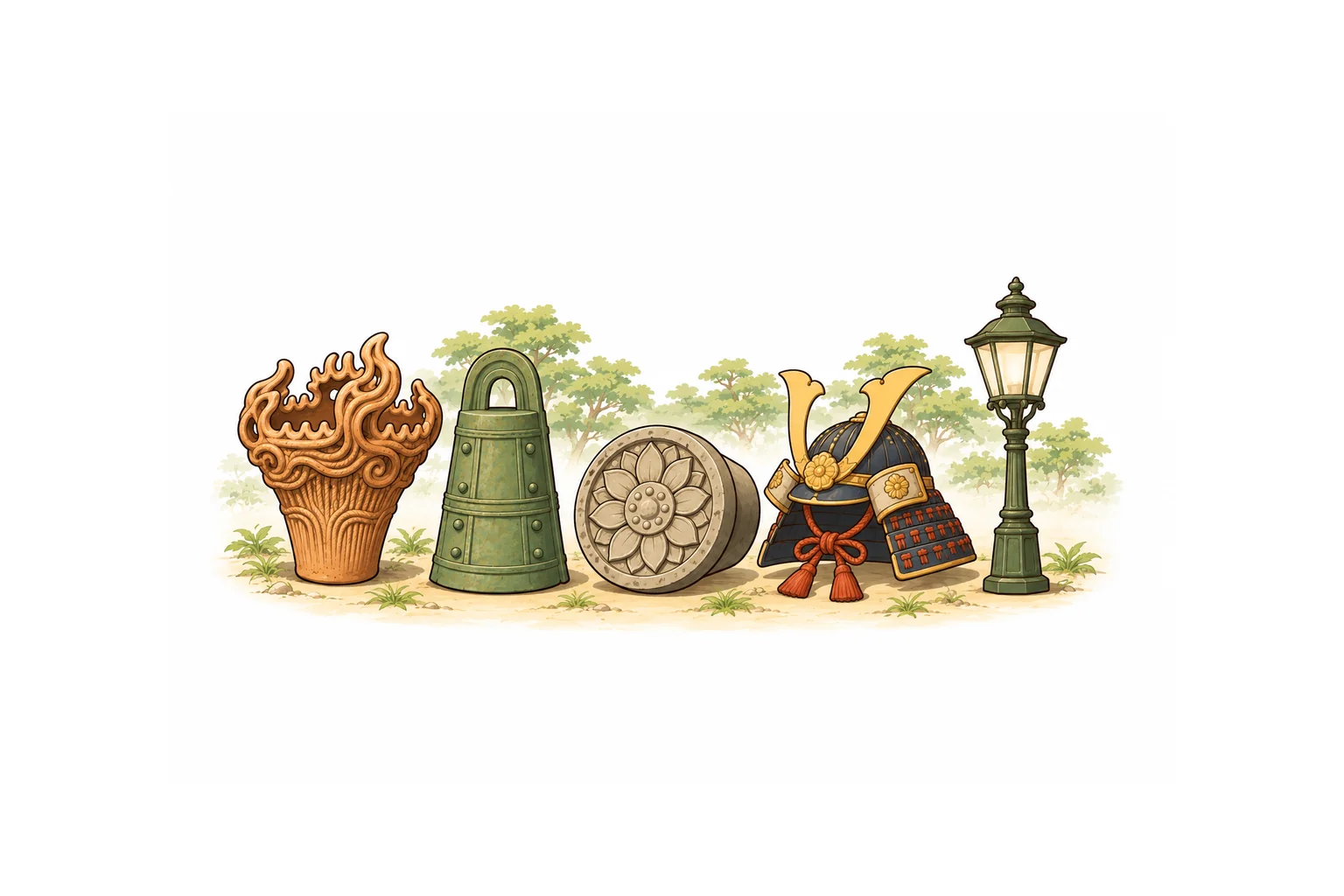
The first three come from archaeology, because the people who lived then left no writing of their own. Jōmon means "cord-marked," after the patterns pressed into ancient pottery. Yayoi is a neighborhood in Tokyo where pots of a later style were first dug up. Kofun simply means "old mound," after the giant earthen tombs of the next age. From Asuka onward, the eras are named for wherever power sat. Asuka is a cluster of villages at the southern end of the Nara basin; Nara and Heian (today’s Kyoto) were capital cities; Kamakura was the seaside base of the first warrior government; Muromachi is the Kyoto street where the later shoguns kept their palace; Azuchi and Momoyama are the sites of castles built by the two warlords who reunited the country; Edo is the old name of Tokyo. Sengoku, "warring states," is borrowed from a chaotic period of ancient Chinese history. Meiji is the reign name of an emperor, and from 1868 onward each emperor kept a single reign name, so the eras follow the throne.
Behind the names lie three great turns. Around three thousand years ago, rice farming arrived and turned a land of hunters and gatherers into a land of villages, chiefs, and eventually a state. In the late twelfth century, mounted warriors set up a government of their own beside the emperor’s court, and for nearly seven hundred years after that, the people who actually ran Japan were usually samurai. In the 1850s, Western warships forced the country open, and within fifteen years the samurai government had fallen and a new one, ruling in the emperor’s name, set out to remake Japan as a modern nation.
02Hunters and Rice Farmers: Jōmon and Yayoi
People on the Japanese islands were making pottery around sixteen thousand years ago, among the earliest anywhere in the world. Much of it was decorated by rolling twisted cord across the wet clay, and an American zoologist, Edward Morse, who dug an ancient shell heap near Tokyo in 1877, described it in his report as "cord-marked." The Jōmon period took its name from his phrase, translated into Japanese. Jōmon people hunted deer and boar, fished, and gathered acorns, chestnuts, and shellfish. They were not always on the move: at Sannai-Maruyama in far northern Honshū, archaeologists found the post holes of large timber structures and a village occupied for well over a thousand years. Jōmon potters made vessels crowned with flame-like rims, and small clay figures called dogū, some with huge goggle-shaped eyes. The Jōmon period lasted more than ten thousand years, by far the longest stretch of Japan’s human story.
Somewhere in the first millennium BCE, wet-rice farming crossed from the Korean peninsula to northern Kyūshū and spread east. Exactly when the Yayoi period began is argued over; older books say around 300 BCE, while newer radiocarbon dates push it several centuries earlier. Rice changed everything. Paddies needed irrigation and organized labor, and stored grain was worth stealing. Yayoi villages dug defensive ditches and raised watchtowers; the reconstructed site of Yoshinogari in Saga prefecture shows both. Bronze swords, bronze bells, and iron tools appeared.
This is also when Japan first shows up in writing, though not its own. Chinese chronicles describe a land called Wa, divided into many small countries. One of them sent an envoy to the Han court in 57 CE and received a gold seal; in 1784 a farmer on Shikanoshima island near Fukuoka turned up a small gold seal inscribed with the words "King of Na of Wa of Han." A Chinese history of the third century describes a queen named Himiko who ruled a country called Yamatai, was said to practice sorcery, rarely let herself be seen, and sent envoys to the Chinese kingdom of Wei in 239. Whether Yamatai lay in Kyūshū or in the Nara basin has been debated for centuries and is still unsettled.
03Tombs, Buddhism, and the First State: Kofun and Asuka
From the later third century, enormous keyhole-shaped tombs began to rise in the Nara basin and then across much of the country. The largest, the Daisen tomb in Sakai near Ōsaka, traditionally attributed to an emperor called Nintoku, has a mound about 486 meters long. Rows of clay figures called haniwa, in the shape of warriors, horses, houses, and shields, were set up on the slopes. The fact that the same tomb design appears from Kyūshū to the Kantō plain tells archaeologists that a confederation centered on the Nara area, known as the Yamato kingship, had drawn regional chiefs into a shared order. Its leader was called the "great king." Many immigrants from the Korean peninsula arrived in these centuries, bringing writing in Chinese characters, iron-working, new pottery techniques, and silk.
In the sixth century, Buddhism came from the Korean kingdom of Paekche. Whether to accept a foreign religion became a fierce court quarrel, and the pro-Buddhist Soga clan defeated its rivals. For the next century the court sat mostly at Asuka. The best-known figure of the age is Prince Shōtoku, who served as regent for his aunt, Empress Suiko. Tradition credits him with a system of court ranks, a "Seventeen-Article Constitution" of moral maxims for officials, and a mission to Sui China in 607 that carried a letter from "the Son of Heaven where the sun rises" to "the Son of Heaven where the sun sets," which the Chinese emperor found insolent. Later generations turned Shōtoku into something close to a saint, and historians disagree over how much of this he personally did. Hōryū-ji, a temple near Nara linked to him, preserves some of the oldest surviving wooden buildings in the world.
In 645 Prince Naka no Ōe and his ally Nakatomi no Kamatari assassinated the most powerful Soga leader in the middle of a court ceremony. A program of reforms followed, aiming to bring land and people directly under the throne on the Chinese model. In 663 a Japanese army sent to help Paekche was crushed at the Battle of Hakusukinoe by the combined forces of Tang China and the Korean kingdom of Silla, and the shaken court hurried to build forts and strengthen its institutions. After a succession war in 672, Emperor Tenmu greatly strengthened the monarchy, and around this time the title tennō, "heavenly sovereign" or emperor, and the country name Nihon, "origin of the sun," came into use. The Taihō Code of 701 set out a full system of law and administration modeled on Tang China.
04Capitals and Courtiers: Nara and Heian
In 710 the court moved to a new capital, Heijō-kyō, at present-day Nara. Laid out on a grid in imitation of the Tang capital at Chang’an, it was the first capital meant to last; earlier rulers had often moved their palace with each new reign. Embassies sailed to China to bring back books, law, and art. Emperor Shōmu, reigning through epidemics and rebellion, ordered a Buddhist temple built in every province and a colossal bronze Buddha cast for the temple of Tōdai-ji in the capital. The statue’s eyes were ceremonially painted in 752, with monks from as far away as India in attendance. The Chinese monk Ganjin (Jianzhen in Chinese), who failed five times to cross the sea and lost his sight along the way, finally arrived on his sixth attempt, late in 753, and later founded the temple of Tōshōdai-ji. Japan’s first histories, the Kojiki and the Nihon shoki, and its first great poetry anthology, the Man’yōshū, were compiled in the Nara period.
The great temples grew so powerful that a monk named Dōkyō came close to the throne itself. Emperor Kanmu left Nara behind, and in 794 founded Heian-kyō, the "capital of peace and tranquility," which became Kyoto. Emperors lived there until 1869. Over the next centuries, the Chinese-style system loosened. Official embassies to China stopped after 894. More and more land slipped into private estates held by noble families and temples, and tax revenue drained away from the state.
Real power at court passed to the Fujiwara family, who married their daughters to emperors and then governed as regents for their own grandsons. The greatest of them, Fujiwara no Michinaga, saw three daughters become empresses and, at a banquet in 1018, recited a poem comparing his world to a full moon with nothing missing. This same court produced one of the world’s first great novels. Writing in kana, a phonetic script developed from simplified Chinese characters and used especially by women, the lady-in-waiting Murasaki Shikibu wrote The Tale of Genji around the year 1000, while Sei Shōnagon, who served a rival empress, filled The Pillow Book with sharp lists and observations. Much of what is now thought of as Japanese taste, a sensitivity to the seasons, to understatement, and to things that pass, took shape in the Heian court.
From 1086, retired emperors began ruling from behind the throne, a system called insei, or "cloister government." Emperors, retired emperors, and Fujiwara regents competed with one another, and all of them leaned on warriors from the provinces. In 1156 and again in 1159, disputes within the capital were settled by armed fighting, and the winner, Taira no Kiyomori, rose to become chancellor and grandfather of an emperor. For the first time, a warrior stood at the top of the court.
05The Warriors Take Over: Kamakura and Muromachi
The Taira grip provoked revolt. In 1180 Minamoto no Yoritomo, an exile in the eastern provinces, raised an army. Five years of war ended at the sea battle of Dan-no-ura in 1185, where the Taira were destroyed and the child emperor Antoku drowned. Yoritomo did not move to Kyoto. He stayed at Kamakura, on the coast south of present-day Tokyo, and appointed his own men as military governors and estate stewards across the country. In 1192 the court named him shōgun, a title meaning roughly "generalissimo." His government became known as the bakufu, literally "tent government," after a general’s field headquarters. Japan now had two centers: the emperor’s court in Kyoto and the shogun’s government in Kamakura.
After Yoritomo’s death, power slipped to his widow Hōjō Masako and her family, who ruled as regents for a line of figurehead shoguns. In 1221 the retired emperor Go-Toba tried to destroy the Kamakura government and was beaten in about a month; he and two other retired emperors were exiled. In 1274 and again in 1281, the Mongol rulers of China sent invasion fleets against Kyūshū. Samurai fought hard on the beaches, and storms wrecked the invaders’ ships, especially the second time. The storms were later remembered as kamikaze, "divine winds." Defensive war won no land to hand out as rewards, though, and unpaid warriors grew bitter.
In 1333 Emperor Go-Daigo, backed by discontented warriors, overthrew the Kamakura regime and tried to rule directly. His restoration lasted barely three years. One of his own generals, Ashikaga Takauji, turned on him, set up a rival emperor in Kyoto, and in 1338 became shogun. Go-Daigo fled to the mountains of Yoshino, and for nearly sixty years Japan had two competing imperial courts, the Northern and Southern Courts, until the third Ashikaga shogun, Yoshimitsu, reunited them in 1392. Because the Ashikaga shoguns lived on Muromachi street in Kyoto, their age is called the Muromachi period. Yoshimitsu built the Golden Pavilion, accepted the title "King of Japan" from the Ming emperor of China, and profited from official trade with China. Zen Buddhism, ink painting, Noh theater, the tea ceremony, and dry rock gardens all flourished under the Ashikaga; the Silver Pavilion, built later by the shogun Yoshimasa, captures the restrained taste of the age.
06A Century of War and Three Unifiers: Sengoku and Azuchi-Momoyama
The Ashikaga never controlled the provinces firmly. In 1467 a succession dispute in the shogun’s house and among his chief vassals pulled two great coalitions into battle inside Kyoto itself. The Ōnin War dragged on for eleven years and left much of the city in ashes. After it, the shogun still existed but was obeyed by almost no one. Regional lords, called daimyō, fought one another, and vassals overthrew their masters so often that people had a phrase for it, gekokujō, "the low overturning the high." This Sengoku or Warring States period overlaps the late Muromachi period; it is the name for its turmoil rather than a separate government.
Europeans arrived in the middle of it. In 1543 a ship carrying Portuguese traders landed on the island of Tanegashima south of Kyūshū, and Japanese smiths were soon copying their matchlock guns by the thousands. In 1549 the Jesuit missionary Francis Xavier landed at Kagoshima, and Catholicism spread through western Japan, with some daimyo baptized. The Japanese called the newcomers nanban, "southern barbarians," because they came from the south by sea.
Three men ended the wars. Oda Nobunaga, a lord from the province of Owari near present-day Nagoya, defeated a far larger army at Okehazama in 1560, marched into Kyoto in 1568 with an Ashikaga claimant in tow, and drove the last Ashikaga shogun out in 1573. He used massed musketeers, burned the warrior-monk stronghold on Mount Hiei, and built a towering castle at Azuchi on Lake Biwa. In 1582 one of his generals, Akechi Mitsuhide, attacked him at the Honnō-ji temple in Kyoto, and Nobunaga died there. Another general, Toyotomi Hideyoshi, a man of humble birth (legend has him starting out as Nobunaga’s sandal-bearer), destroyed Mitsuhide within days and by 1590 had brought every region under his authority. Hideyoshi surveyed the land of the whole country and recorded it by its rice yield, and he ordered farmers to surrender their swords, drawing a hard line between samurai and peasants. He then invaded Korea in 1592 and 1597, wars that devastated the peninsula and gained Japan nothing; when he died in 1598 the armies came home. The years from Nobunaga’s march on Kyoto in 1568 to the founding of the Tokugawa shogunate in 1603 are named Azuchi-Momoyama after their castles, and the period’s look is one of gold-leaf screens and soaring keeps.
Hideyoshi left a small son, and the strongest lord in the land, Tokugawa Ieyasu, moved to take his place. In 1600, at Sekigahara in central Japan, Ieyasu’s army defeated a coalition of lords loyal to the Toyotomi cause. That one day decided who would rule Japan for the next two and a half centuries.
07The Long Peace: Edo
In 1603 Ieyasu became shogun and based his government at Edo, a castle town on the Kantō plain. In 1614 and 1615 he besieged Ōsaka Castle and wiped out the Toyotomi family. After that, Japan saw almost no war for over two hundred years. The Tokugawa shoguns held about a quarter of the country’s land directly, along with the major cities and mines, and divided the rest among roughly two hundred and fifty to three hundred daimyo, whose domains were called han. Each daimyo governed and taxed his own domain but obeyed the shogun’s laws. Under the system of "alternate attendance," formalized in 1635, lords spent every other year in Edo, while their wives and heirs lived there permanently. Daimyo processions of hundreds or thousands of retainers tramped the highways, enriching inns, roads, and the merchants of Edo, and draining the lords’ treasuries.
The shogunate also tightly controlled contact with the outside world. In 1637 a rebellion at Shimabara in Kyūshū, with many Christians among the rebels, convinced the government to stamp out Christianity completely. The Portuguese were expelled in 1639, and from 1641 the Dutch were confined to Dejima, a small artificial island in Nagasaki harbor. Later writers called this sakoku, the "closed country," but Japan was never sealed: Chinese merchants traded at Nagasaki, the domain of Tsushima dealt with Korea, Satsuma controlled the Ryūkyū kingdom to the south, and the Matsumae domain traded with the Ainu people in the north. What ended was free contact; ordinary Japanese could not leave, and foreign trade ran through channels the shogunate chose.
Peace brought growth. By the eighteenth century Edo held about a million people, among the largest cities on earth. Ōsaka was the commercial hub, nicknamed "the nation’s kitchen," and Kyoto remained a center of crafts and learning. Society was divided by birth into samurai, farmers, artisans, and merchants. Samurai no longer fought; they became salaried administrators who studied Confucian texts and wrote reports, and many sank into debt to merchants who, in theory, ranked beneath them. Townspeople with money created a lively urban culture: kabuki theater, puppet plays by Chikamatsu Monzaemon, the comic novels of Ihara Saikaku, woodblock prints of actors and courtesans, and the haiku of Matsuo Bashō. Temple schools taught children to read and count, and by the nineteenth century literacy in Japan was high by the standards of the time. Through Dejima, Dutch books trickled in, and a small community of scholars studied Western anatomy, astronomy, and gunnery under the name rangaku, "Dutch learning."
By the early 1800s the system was under strain. Famines, peasant uprisings, poor samurai, and an empty treasury defeated repeated attempts at reform, and foreign ships appeared off the coasts with growing frequency.
08Black Ships and a New Japan: Meiji
In July 1853 Commodore Matthew Perry of the United States Navy steamed into the mouth of Edo Bay with four warships, two of them belching coal smoke, and demanded that Japan open its ports. The Japanese called them the "black ships." When Perry returned the next year, the shogunate signed a treaty of friendship, and in 1858 it signed a commercial treaty that gave foreigners the right to be tried by their own consuls and fixed Japan’s import tariffs. These "unequal treaties" were signed without the emperor’s approval, and outrage gathered under the slogan "Revere the emperor, expel the barbarians." In 1860 the official who had pushed the treaty through, Ii Naosuke, was cut down by assassins outside a gate of Edo Castle. Over the following years the powerful southwestern domains of Satsuma and Chōshū, having each traded fire with Western warships and found themselves outgunned, abandoned the idea of expelling foreigners, bought Western rifles, and turned against the shogunate itself.
In late 1867 the last shogun, Tokugawa Yoshinobu, handed his authority back to the emperor. Early in 1868 his opponents seized the palace in Kyoto and proclaimed the restoration of imperial rule. In the Boshin War of 1868 and 1869, the new government’s armies defeated the shogun’s supporters. Edo itself was surrendered without a battle after talks between Saigō Takamori of Satsuma and the shogunate’s Katsu Kaishū. It was renamed Tokyo, "eastern capital," and the teenage Emperor Meiji moved there from Kyoto.
The men who ran the new government were mostly lower-ranking samurai from Satsuma and Chōshū, many in their thirties. They dismantled the old order with astonishing speed. In 1871 the domains were abolished and replaced by prefectures governed from Tokyo. The class system was scrapped, and samurai lost their stipends and their right to wear swords. In 1873 came universal male conscription and a new land tax payable in cash. A delegation led by Iwakura Tomomi spent almost two years touring the United States and Europe, and came home determined to build factories, railways, and schools. The first railway, between Tokyo and Yokohama, opened in 1872.
The cost fell on many shoulders. Former samurai rose in revolt, most seriously in 1877, when Saigō Takamori himself led the Satsuma Rebellion and was defeated by a conscript army of peasants. Farmers carried the weight of the land tax. The Ainu of Hokkaidō and the people of Ryūkyū, annexed as Okinawa prefecture in 1879, were absorbed into the new state and pressed to give up their languages and ways of life.
In 1889 the emperor granted a constitution, and the first elected parliament met in 1890, the first in East Asia. Sovereignty rested with the emperor, and the army and navy answered to him directly. Abroad, Japan began to build an empire. It defeated Qing China in 1894 and 1895 and took Taiwan; it defeated Russia in 1904 and 1905, the first victory of an Asian power over a European one in modern war; and in 1910 it annexed Korea. By 1911 the last of the unequal treaties had been revised. When Emperor Meiji died in 1912, less than sixty years after Perry’s ships appeared, Japan had gone from a closed realm of samurai and daimyo to an industrializing empire with colonies of its own.
09After Meiji
Eras are still named for reigns: Taishō, Shōwa, Heisei, and since 2019, Reiwa. The Taishō years saw party politics and a boisterous mass culture in the cities, and the Great Kantō Earthquake of 1923, which destroyed much of Tokyo and Yokohama. In the early Shōwa years the military gained the upper hand, Japan invaded China, and in 1941 it went to war with the United States and Britain. It surrendered in 1945 after the atomic bombings of Hiroshima and Nagasaki and the Soviet declaration of war. Under American occupation, a new constitution made the emperor a symbol of the nation, and the decades that followed brought rapid economic growth.
The rest of this series takes the outline above and fills it in: the geography of the islands and their dealings with the wider world, the long partnership between emperors and those who ruled in their name, the three shogunates, the wars of unification, and Japan’s leap into the modern age.