
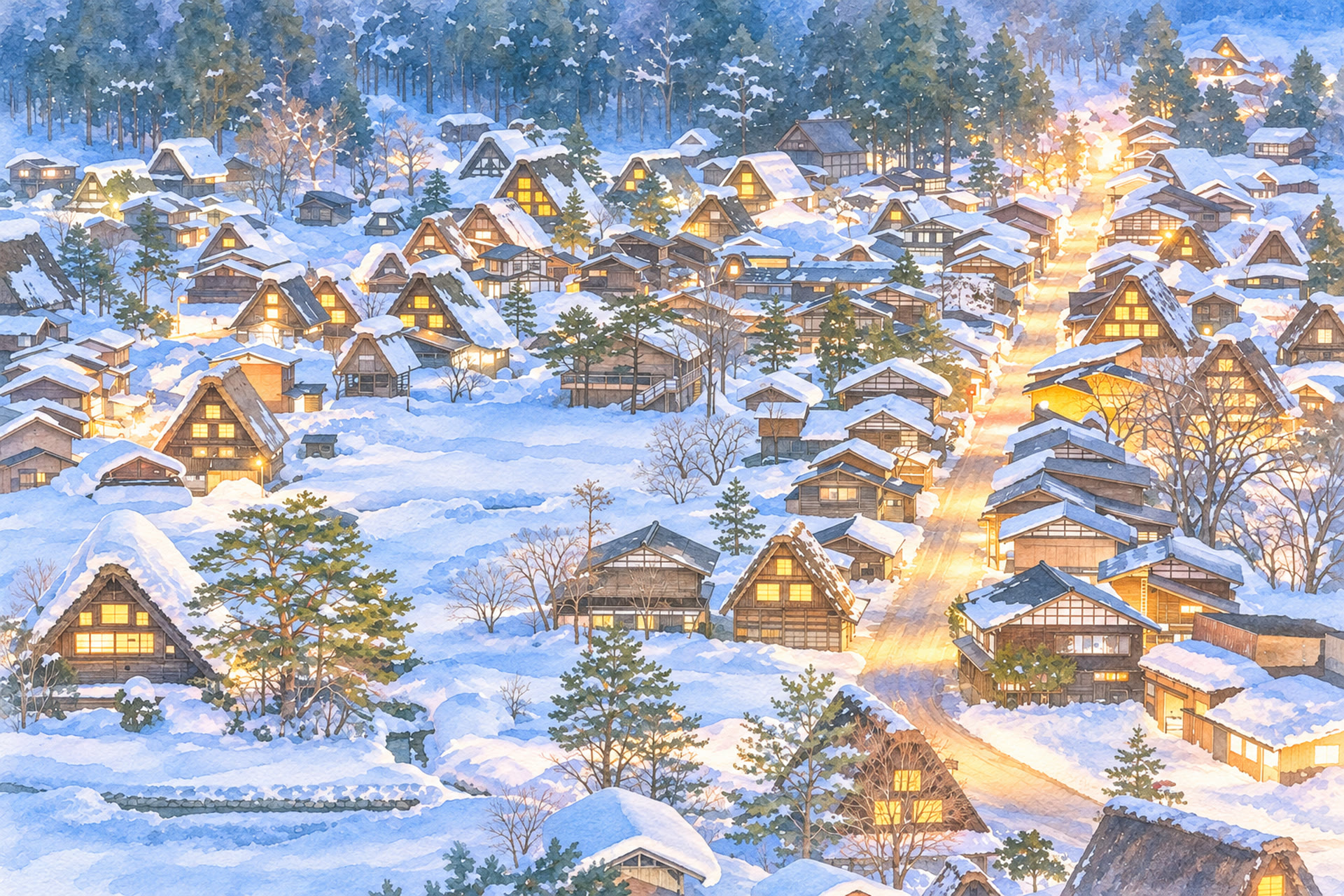
Shirakawa-gō is in the village of Shirakawa in northwestern Gifu Prefecture, in the valley of the upper Shō River. It adjoins Gokayama in Toyama Prefecture to the north and lies in one of Japan’s heaviest snow belts. Steep mountains left little flat land, and the valley was long hard to reach, so a distinctive way of life developed here: in some households, extended families of 20 or 30 people under one roof, silkworms raised in the attic, and saltpeter for gunpowder produced beneath the floor and sold for cash. Jōdo Shinshū Buddhism took deep root, and temples and meeting halls were the center of village life. In the Edo period the area belonged to Hida Province, which came under direct shogunate rule in 1692.
The site covered here is Shirakawa-gō, chiefly the gasshō-zukuri village of Ogimachi. Gasshō-zukuri houses are large farmhouses with steep thatched roofs, said to resemble hands joined in prayer; the slope sheds snow, and the roomy attics served for silkworm rearing. In 1995 the gasshō-zukuri villages of Shirakawa-gō and Gokayama were inscribed together as a World Heritage Site.
1Shirakawa-gōA snowy mountain village of steep-thatched gasshō farmhouses in the Shō River valley, inscribed as World Heritage in 1995.