
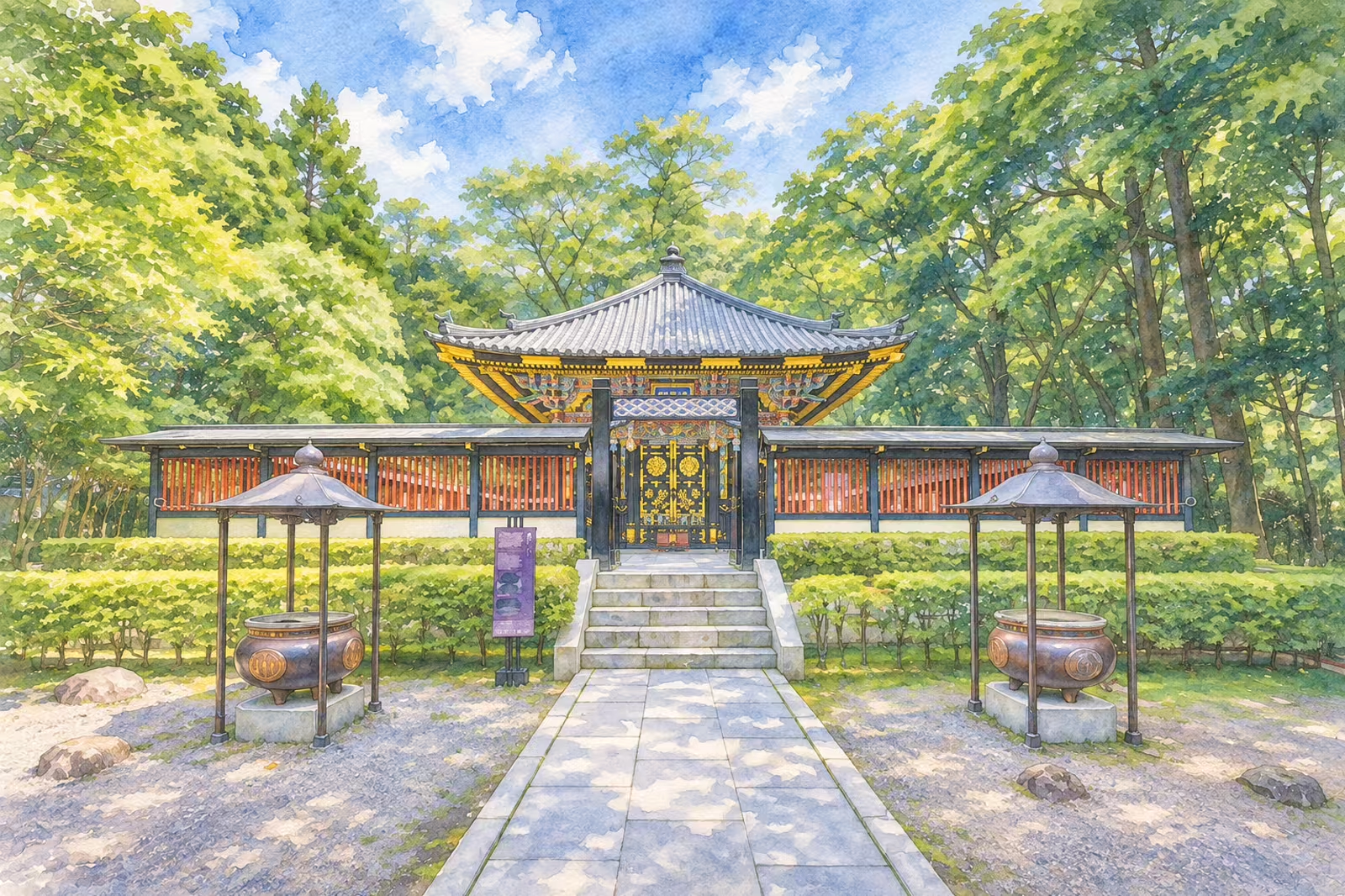
Zuihōden is the mausoleum of Date Masamune, founder of the Sendai domain. It stands on Kyōgamine, a small wooded hill above the Hirose River in Aoba Ward, Sendai, Miyagi Prefecture. Its black lacquer, gold leaf and brightly painted carvings follow the Momoyama style of early Edo mausoleum architecture. The building itself is a postwar reconstruction, but the grave has stayed in the same place since the 17th century, and the hill also holds the mausoleums of the second and third Date lords.
01Masamune’s death and the first mausoleum
Masamune died in Edo in 1636, aged 68 (70 by traditional count). According to the records, he had chosen Kyōgamine as his burial place. His son and successor, Date Tadamune, completed Zuihōden there the following year, in 1637. Tadamune’s own mausoleum, Kansenden, and that of the third lord, Tsunamune, called Zennōden, were later built on the same hill, and other members of the ruling family were buried nearby.
Throughout the Edo period this was a private ritual site of the lord’s house. In 1931 Zuihōden was designated a National Treasure, and the two neighboring mausoleums were protected with it.
02Destruction and reconstruction
All three mausoleums burned in the air raid on Sendai in July 1945. Before rebuilding began, the grave chamber was excavated in 1974. The excavation recovered Masamune’s remains and grave goods, including swords, writing implements and smoking utensils, and researchers used the skeleton to estimate his height and appearance.
Zuihōden was rebuilt in 1979 with a fire-resistant reinforced concrete structure, its exterior based on prewar photographs and records. Kansenden and Zennōden followed around 1985. A major renovation in 2001 added carvings and decoration that had been left out in 1979, bringing the exterior closer to its 1637 appearance.
03What can be seen today
A cedar-lined approach and stone steps lead up through the Nehan Gate to the mausoleum forecourt. The present building is not 17th-century fabric; it is a carefully researched reconstruction on the original grave site, and its National Treasure status ended with the fire. A small museum in the precinct displays the excavated grave goods and a reconstruction of Masamune’s face based on his skull. Kansenden, Zennōden and the graves of later lords lie on the same hill.
Zuihōden
01A Hill Across the River
Sendai’s Hirose River makes a wide loop as it passes the west side of the city. On the inside of one bend rises a small wooded hill called Kyōgamine. A long flight of uneven stone steps, shaded by tall Japanese cedars, climbs from the road to the top. At the end of the climb stands a compact building in black lacquer, crowded with carved and painted animals, flowers and gold leaf. This is Zuihōden, the mausoleum of Date Masamune, the warlord who founded Sendai and the domain that ruled it for more than two and a half centuries.
The hill faces Aobayama, the site of Sendai Castle, across the river. Masamune chose this spot for his own burial, and his son built the mausoleum the year after his death. The building you see today, however, is not the one his son built. The original, once a National Treasure, burned in an American air raid in 1945. The present Zuihōden is a reconstruction completed in 1979, and before it was built, archaeologists opened Masamune’s tomb and examined his remains. The hill therefore holds three layers of history: the life and death of Masamune, the early Edo-period mausoleum, and the destruction and rebuilding of the twentieth century.
02The One-Eyed Dragon
Date Masamune was born in 1567, the eldest son of Date Terumune, lord of Yonezawa in Dewa province. The Date were an old warrior house that had held land in southern Tōhoku (the northeastern region of Honshū) since the Kamakura period. As a child Masamune lost the sight of his right eye to smallpox, and later generations called him Dokuganryū, the "one-eyed dragon."
He became head of the family in 1584, at the age of seventeen by Western reckoning. The next year his father was seized by a rival lord, Hatakeyama Yoshitsugu, and both Terumune and Yoshitsugu died in the confrontation that followed as Masamune’s men pursued them. Over the next several years Masamune fought almost constantly against his neighbors. In 1589 he crushed the Ashina family at the Battle of Suriagehara and took Aizu, bringing the Date domain to its greatest extent.
By then Toyotomi Hideyoshi had unified most of Japan. When Hideyoshi besieged Odawara in 1590, Masamune arrived late. According to a well-known story, he presented himself dressed in white, the clothing of a man prepared for death. Hideyoshi spared him but confiscated Aizu. Suspected soon afterward of stirring up a peasant and retainer uprising in the former Kasai and Ōsaki lands, Masamune was moved to Iwadeyama.
At the Battle of Sekigahara in 1600 he sided with Tokugawa Ieyasu and fought the Uesugi in the north. Afterward he began building a new castle on Aobayama and laying out a castle town below it, the origin of modern Sendai. The domain was assessed at 620,000 koku (a measure of rice yield), one of the largest in the country. In 1613 Masamune sent his retainer Hasekura Tsunenaga, accompanied by the Franciscan friar Luis Sotelo, on an embassy to Spain and Rome.
In his later years Masamune was treated with marked respect by the second and third Tokugawa shoguns, Hidetada and Iemitsu. He died at his residence in Edo in 1636, aged sixty-eight by Western count.
03Choosing Kyōgamine
A story often told in Sendai says that Masamune, while out hunting near Kyōgamine, stopped, planted his staff in the ground and declared that he wished to be buried there. The anecdote comes from later accounts, but the choice itself is clear: Masamune asked to be buried on this hill, directly across the river from his castle.
His body was carried by palanquin from Edo to Sendai and buried on Kyōgamine. A legend attached to the burial says that the diggers found an old stone chamber holding a monk’s staff and rosary, which local elders identified as the grave of a holy man named Mankai Shōnin; from this grew the story that Masamune was the monk reborn. Several of his retainers chose to follow him in death by ritual suicide, a practice known as junshi. Fifteen of his own retainers did so, and five of their retainers followed them, for twenty in all. In the early Edo period junshi was still regarded by many samurai as the ultimate expression of loyalty; the shogunate formally prohibited it only in 1663. Memorial stone pagodas for the twenty men still stand beside the mausoleum.
Masamune’s successor, Date Tadamune, the second lord of Sendai, ordered the construction of a mausoleum over the grave. It was completed in 1637, facing west toward the main enclosure of Sendai Castle. In the same year a family temple, Zuihō-ji, was founded beside it to perform rites and guard the site.
04A Mausoleum in the Momoyama Manner
Zuihōden was built in the ornate style associated with the Momoyama period, the late sixteenth-century age of Oda Nobunaga and Hideyoshi, when lords displayed their power through bold color and gold. The main hall is small. Its walls and pillars are lacquered black, its central doors are gilded and bear the Date family’s sparrows-and-bamboo crest, and the brackets, beams and transoms are covered with carved and painted peonies, lions, dragons, kirin (a mythical beast) and other motifs, picked out in red, green and gold. Inside is a wooden statue of Masamune, shown to the public only on special days such as the anniversary of his death.
The style is closely related to that of Nikkō Tōshōgū, the shrine to Tokugawa Ieyasu that his grandson Iemitsu rebuilt on a lavish scale and completed in 1636, the year Masamune died. In the early Edo period, mausoleums of great men were meant to dazzle. Zuihōden is far smaller than Tōshōgū, but it concentrates the same density of decoration on a single small hall.
The complex consists of the main hall, a worship hall, an offering hall, a Chinese-style gate and an outer gate, arranged as a sequence. Visitors pass through the Nehanmon (Nirvana Gate), approach the Haiden (worship hall), where rites were performed, and look through the Karamon, a gate with curved Chinese-style gables, to the main hall itself. Masamune’s burial chamber lies beneath the main hall.
05A Cemetery for the Date Lords
After Masamune, Kyōgamine became the burial ground of the Date lords. Tadamune died in 1658, and in 1664 the fourth lord, Date Tsunamura, completed his mausoleum, Kansenden, beside Zuihōden. It was nearly as lavish, and it too was flanked by memorial pagodas for retainers who followed their lord in death. The third lord, Date Tsunamune, was ordered by the shogunate to retire in 1660 for dissolute behavior, an event that set off the long factional struggle known as the Date Disturbance. Tsunamune lived on until 1711 and was buried on the hill. His mausoleum, Zennōden, was completed in 1716 under the fifth lord, Yoshimura, with simpler decoration of phoenixes and peonies. By then junshi was banned, and instead of dying with him one retainer became a monk to mourn him; the retainer’s grave stands in front of Zennōden.
Most later lords were buried at Dainen-ji on another hill in Sendai, and no further mausoleums of this kind were built. Kyōgamine does hold two other burial areas: Myōunkaibyō, with the graves of the ninth lord, Chikamune, and the eleventh lord, Narayoshi, and his wife; and a cemetery for the children of the lords from Yoshimura onward.
Throughout the Edo period the hill was ground reserved for the Date family. Monks of Zuihō-ji tended the mausoleums, and ordinary townspeople could not enter. Because it was closed for so long, its woodland survived largely intact.
06National Treasure
After the Meiji Restoration abolished the domains, the Date family became members of the new peerage. In the early Meiji years, after the Boshin War of 1868–69, the subsidiary buildings of Kansenden and Zennōden were removed, leaving only their main halls. In 1877 the Date family and former retainers raised a cast-iron memorial on the hill to about 1,260 people of the domain who died in the Boshin War and the fighting at Hakodate. In 1931 Zuihōden and Kansenden were designated National Treasures under the law then in force, recognized as outstanding examples of early Edo mausoleum architecture in the Momoyama manner.
07Fire from the Sky
In the early hours of July 10, 1945, American B-29 bombers struck Sendai with incendiary bombs, burning out most of the city center. Kyōgamine was hit as well. Zuihōden, Kansenden and Zennōden, together with their gates and worship halls, burned to the ground. Three centuries of carved and painted wood were gone in a single night.
What survived, as is generally understood, were mostly things made of stone, such as the steps, retaining walls and the lanterns donated by senior retainers, along with some of the old cedars along the approach. The memorial pagodas at Kansenden were lost and were set up again during reconstruction. For decades after the war, while Sendai rebuilt itself, the mausoleum site lay in ruins.
08Opening the Tomb
Plans to rebuild Zuihōden took shape in the 1970s. In 1974, as construction began, a team of researchers excavated the burial chamber beneath the site of the main hall. It was the first time Masamune’s grave had been opened.
The stone-lined chamber held his bones, packed in lime and well preserved. From the length of his thighbone researchers estimated his height at about 159.4 centimeters, and they identified his blood type as B. The skull was intact enough that a likeness of his face was reconstructed from it beginning in 1975. About thirty grave goods were recovered, among them a document box, a tobacco pipe, writing things including a brush case, an inkstone and a pencil (the oldest pencil found in any excavation in Japan), and a small gold ornament thought to be a European-style brooch in the form of a rosary cross, an object often linked with Masamune’s interest in foreign things and his embassy to Europe. In 2019 researchers at the National Museum of Nature and Science re-examined the skull and found a difference of about 2.5 millimeters in the height of the eye sockets, taken as a trace of his blind eye.
The graves of Tadamune and Tsunamune were investigated between 1981 and 1983, and their remains and grave goods were recovered. Tsunamune lay in an urn coffin, with spectacles, a pipe and a sword beside it and ten gold Hōei-era coins inside. Some of Masamune’s grave goods are held by the Sendai City Museum; the small museum beside Zuihōden, built on the site of the old offering hall, shows finds from the lords’ graves together with reconstructed likenesses of all three.
09Rebuilding
The main hall, worship hall, Nehanmon and offering hall of the new Zuihōden were completed in 1979 in the prewar style, and the offering hall opened as a museum the following year. Kansenden and Zennōden followed in 1985. In 2001, for the 400th anniversary of Sendai’s founding, Zuihōden underwent a major renovation that restored details left out of the first reconstruction, including lion-head carvings on the pillar tops and dragon-head roof tiles.
The present Zuihōden is a reconstruction rather than the original, and it no longer carries National Treasure status. What links it directly to the seventeenth century lies underfoot and around it: the burial chamber, the stone steps and the old trees.
10Walking the Hill
The approach from the road climbs through the cedars on uneven stone steps. Local tradition says there are sixty-two of them, one for each 10,000 koku of the domain’s 620,000. Partway up, the path divides. One branch leads to Zuihōden, the other to Kansenden and Zennōden.
At Zuihōden, look first at the Nehanmon: black doors with gilded Date crests, a kirin carved above the doorway, peonies and lions on the side panels. Its name refers to nirvana, the Buddhist release from desire, and by extension to death. Pass through the Haiden and look through the Karamon to the main hall. Take time with the carving on the front and sides and the tiers of brackets under the eaves painted red, green and gold; the lion heads on the pillar tops and the dragon-head roof tiles are the 2001 restorations. Beside the hall stand the stone pagodas for the twenty men who followed Masamune in death. Nearby is a memorial to Mankai Shōnin; the original stone was lost in 1945 and the present one dates from 1989.
The museum beside the mausoleum explains the excavations and displays finds from the graves and the reconstructed faces of the three lords. Seeing the measurements of Masamune’s skeleton and the small objects he was buried with gives the gilded hall above a human scale.
Kansenden and Zennōden stand side by side, the first nearly as ornate as Zuihōden, the second plainer. Nearby are Myōunkaibyō and the children’s graves, and on the hill stands the Meiji-era memorial to the Boshin War dead.
On the way down, look across the river toward Aobayama. Masamune chose to lie facing the castle he built, and from Kyōgamine the two sites are still in plain view of each other.