
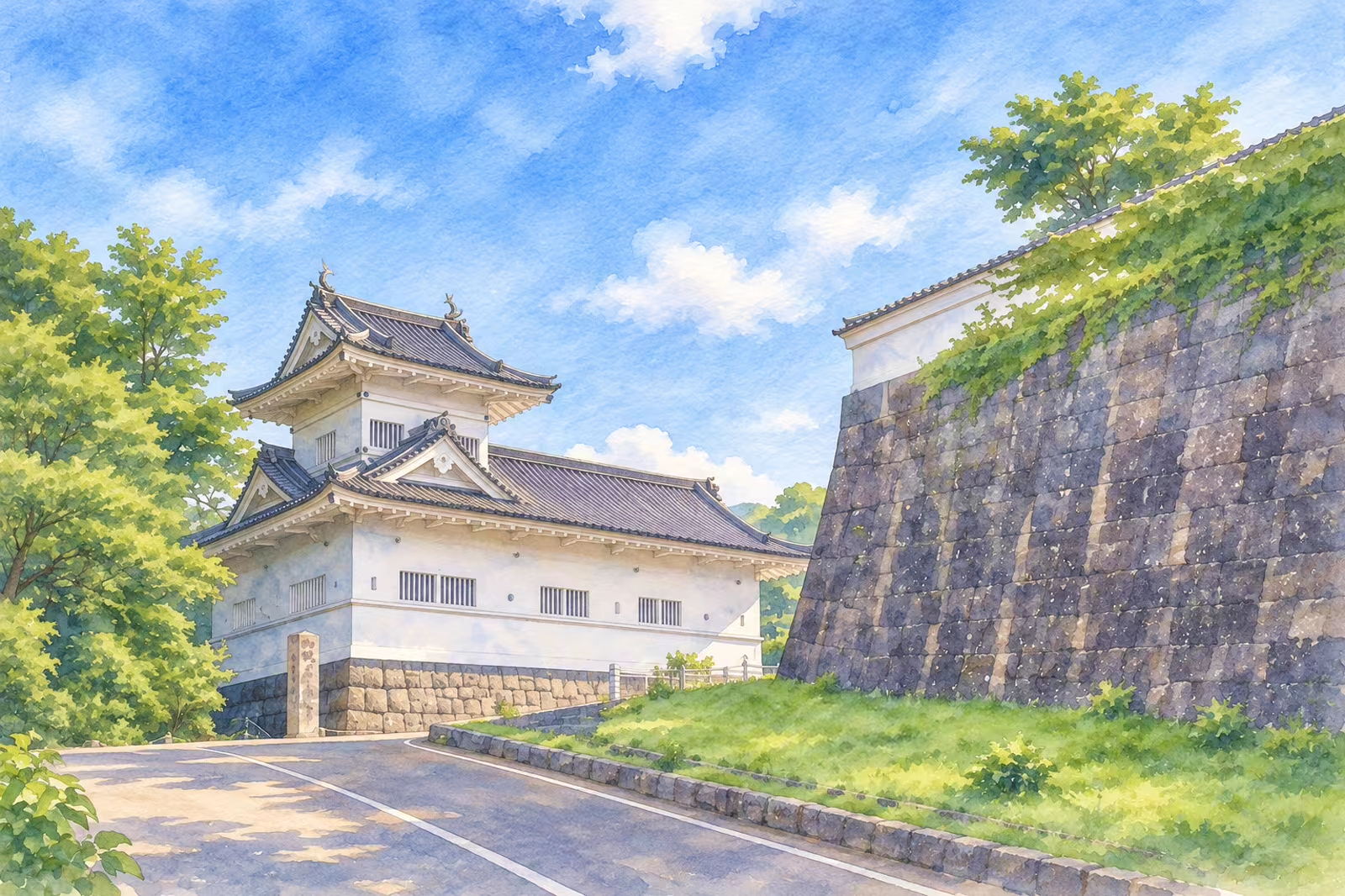
The Sendai Castle ruins stand on Aobayama in Aoba Ward, Sendai, Miyagi Prefecture, which is why the castle is also called Aoba Castle. It was founded by Date Masamune and for about 270 years served as the seat of the Date family’s Sendai domain, assessed at 620,000 koku. The castle town below grew into Sendai, today the largest city in the Tōhoku region. Almost none of the castle buildings survive. What remains are high stone walls, a reconstructed corner turret, and a sweeping view over the city.
01Masamune’s Hilltop Castle
After the Battle of Sekigahara, Masamune began laying out a new castle at the end of 1600, started construction in 1601, and built a castle town at the same time, moving his base here from Iwadeyama. Aobayama is protected by cliffs dropping to the Hirose River on the east, a deep ravine on the south, and rough hills to the west. No main keep was ever built. The center of the main enclosure, the Honmaru, was the Great Hall (Ōhiroma), finished in 1610, a large and lavishly decorated building for audiences and ceremonies. Around 1638 the second lord, Date Tadamune, built the Ninomaru at the foot of the hill. Daily government then moved there, and the hilltop Honmaru was used mainly for ceremony.
02Loss and Reconstruction
After the Meiji Restoration the army took over the grounds, housing the Tōhoku garrison and later the 2nd Division, and the palace buildings were removed or burned. The surviving Ōtemon gate and its corner turret were designated National Treasures but burned in the Sendai air raid of July 1945. The turret was rebuilt in 1967. Repairs to the Honmaru’s northern stone wall from the late 1990s to the early 2000s revealed older walls inside the present one, showing that the ramparts were rebuilt several times. The site was designated a National Historic Site in 2003. Earthquakes, including that of 2011, damaged sections of the walls, which have since been repaired in stages.
03What You Can See Today
On the Honmaru are markers outlining the Great Hall, stone walls about 17 meters high, an equestrian statue of Date Masamune, and the Miyagi Gokoku Shrine. The statue is a modern work: the first bronze was taken for metal during the war, and the present one was recast afterward. Below the hill, most of the former Ninomaru is now Tōhoku University’s Kawauchi campus, and the Sendai City Museum, which holds Date family treasures, stands in the former Sannomaru.
Sendai Castle Ruins (Aoba Castle)
01A Castle Without a Keep
Visitors who climb to the top of Aobayama, the wooded hill on the west side of Sendai, often arrive expecting a white tower. There is none, and there never was. Sendai Castle, also called Aoba Castle (Aoba-jō, "Green Leaf Castle," after the hill), was built without a tenshu, the multi-story keep that most people picture when they think of a Japanese castle.
What you find instead is a broad, level summit ringed by towering stone walls, a bronze statue of a mounted warrior in a crescent-crested helmet, a shrine, and one of the best views in northern Japan. To the east, the Hirose River runs below a sheer cliff, and beyond it the city of Sendai stretches toward the Pacific. Nearly everything in that view, from the grid of the city center to the name "Sendai" itself, goes back to one man: Date Masamune, the first lord of the Sendai domain.
02The One-Eyed Dragon
Date Masamune was born in 1567, the eldest son of Date Terumune, a warlord based at Yonezawa in what is now Yamagata Prefecture. Smallpox cost him the sight of his right eye in childhood, and later generations called him Dokuganryū, the "One-Eyed Dragon."
He became head of the Date family in 1584, still in his teens, and spent the next several years fighting his neighbors in southern Tōhoku, the northeastern region of Honshū. In 1589 he crushed the Ashina clan at the Battle of Suriagehara and took Aizu, making himself master of a large part of the region.
His timing was poor. Toyotomi Hideyoshi, who was completing the unification of Japan, had forbidden private wars between lords, and in 1590 he summoned the eastern daimyo to join his siege of the Hōjō at Odawara. Masamune came late. According to a famous story, he appeared before Hideyoshi dressed in white burial clothes, as if ready to die. Hideyoshi spared him but took Aizu away. A year later, suspected of stirring up a peasant uprising in the Kasai and Ōsaki lands, Masamune was moved again, to Iwadeyama in the north of present-day Miyagi Prefecture.
When Hideyoshi died in 1598, Masamune aligned himself with Tokugawa Ieyasu. During the Sekigahara campaign of 1600 he fought the Uesugi on Ieyasu’s northern flank. Ieyasu had promised him extensive additional lands, a pledge remembered as the "million-koku promise" (a koku was a measure of rice used to rate the size of a domain). It was never fully honored, partly because Masamune was found to have secretly backed an uprising in the neighboring Nanbu domain. Even so, the Date ended up with a domain assessed at about 620,000 koku, one of the largest in the country.
03Choosing Aobayama
Masamune needed a new seat worthy of that domain, and he chose a hill called Aobayama above a place known as Chiyo. A local warrior family, the Kokubun, had held a fortress there in the Warring States period.
The site was strong. The Hirose River and a steep cliff guarded the east side. To the south lay the Tatsunokuchi gorge, a deep ravine cut into the volcanic rock. To the west, the hills rose into dense forest. Only the approach from the city side needed heavy fortification.
Masamune began laying out the castle at the end of 1600, and construction began in earnest in 1601. The castle was substantially complete in 1602, and he moved in from Iwadeyama in 1603. It is generally said that when he founded the castle he changed the place name from Chiyo ("a thousand generations") to Sendai, borrowing the characters from a line by the Tang dynasty poet Han Hong that mentions a "terrace of immortals." The story is widely repeated, though no record from the time explains exactly how the change was made.
The Spanish envoy Sebastián Vizcaíno, who visited Sendai in 1611, described the castle as one of the strongest and best in Japan. The summit enclosure alone measured roughly 245 by 267 meters, among the largest of any daimyo castle.
At the same time, Masamune laid out a castle town on the flat land across the river. A main street ran east from the castle’s main gate, and the town was divided into districts for samurai, merchants and craftsmen, and temples. Much of modern central Sendai still follows that plan.
04Why No Keep?
Why would a lord of Masamune’s ambition build a castle without its most visible symbol? No document records his reasons, and several explanations circulate.
The most common is political caution. Masamune began the castle just after Sekigahara, when the new Tokugawa regime was watching powerful outside lords closely. A great keep might have looked like a challenge. Another view holds that the hilltop itself made a keep unnecessary: the summit already gave an unobstructed view over the plain and dominated the town below. Either way, the absence was a choice, not a matter of money.
In place of a keep, the heart of the main enclosure (the honmaru) was a vast reception hall called the Ōhiroma, completed in 1610. Here the lord received his retainers and held ceremonies. Records say it had 260 tatami mats of matted floor, or about 430 counting its wooden verandas, and its rooms were decorated with painted wall panels and gilt metal fittings. North of the raised seat used by the Date lords was a still higher dais reserved for an emperor or shogun, should one ever visit. Along the northern part of the eastern cliff stood kakezukuri buildings, built out over the drop on wooden supports, in the same manner as the famous stage at Kiyomizu-dera in Kyoto. From there the lord could look down on the river and his city.
05Moving Down the Hill
A hilltop castle is easy to defend and hard to live in. Once the wars of the early seventeenth century ended, the daily business of governing a large domain mattered more than defense, and the climb up Aobayama became a burden.
In 1638 the second lord, Date Tadamune, obtained the shogunate’s permission and began building a new enclosure, the ninomaru (second bailey), on lower ground at the foot of the hill, north of the summit. When it was finished the following year, the domain’s administrative offices and the lord’s residence moved there. The summit honmaru was kept for ceremonies and as a symbol of the house. The ninomaru site is now the Kawauchi campus of Tohoku University.
East of the summit, close to the river, lay the sannomaru (third bailey), also called the Higashimaru; its exact date of construction is unknown. Its site is now occupied by the Sendai City Museum.
06The Lord and His Afterlife
Masamune died in Edo in 1636, at the age of 70 by the traditional Japanese count. His body was carried back to Sendai and buried on Kyōgamine, a hill across the Hirose River to the south of the castle. His mausoleum, the Zuihōden, was a richly colored and gilded building in the Momoyama manner. It burned in the air raids of 1945 and was rebuilt in 1979.
The Date family ruled from Sendai until the end of the Edo period. The domain’s most notorious crisis was the Date Disturbance (Date Sōdō) of the 1660s and 1670s, a power struggle among senior retainers during the minority of the fourth lord, Date Tsunamura. It ended in 1671 with a violent scene in Edo, at the residence of the senior shogunal official Sakai Tadakiyo, where the retainer Harada Kai cut down his rival Date Aki during a hearing and was himself killed. The affair inspired the kabuki play Meiboku Sendai Hagi, in which Harada Kai is the arch-villain.
In the Boshin War of 1868, Sendai led the Northern Alliance (Ōuetsu Reppan Dōmei) of northeastern domains against the new imperial government. The alliance collapsed and Sendai surrendered, and the Date lands were sharply reduced.
07Earthquakes and Walls
The stone walls are the most important original feature at the site today, and their story is bound up with earthquakes.
Northeastern Japan is one of the most seismically active regions in the country. In 1611 the Keichō Sanriku earthquake sent a great tsunami onto the Date coastline. In 1616 an earthquake damaged the castle’s walls and turrets. The quake of 1646 was worse: three turrets collapsed, and the three-story Tatsumi turret at the southeast corner of the summit was apparently never rebuilt. Further quakes, including a damaging one in 1668, struck throughout the Edo period, and each time the domain had to report the damage to the shogunate and seek permission for repairs.
Between 1997 and 2004 the city of Sendai dismantled and rebuilt the high northern wall of the honmaru, which had begun to bulge. The work allowed archaeologists to look inside, and they found two earlier walls buried behind the visible one, as well as traces of the older Chiyo fortress. The oldest wall, from Masamune’s time, was built of rough, unworked stones. The second was a rebuilding that is thought to have been damaged in the earthquake of 1668. The third, the wall you see now, was rebuilt after that quake from carefully cut blocks laid in level courses, and rises about 17 meters at its highest. It is the tallest stretch of wall at the castle.
In modern times the 1978 Miyagi-oki earthquake brought down sections of wall, and the Great East Japan Earthquake of March 11, 2011 collapsed walls in three places; those repairs were completed in 2015. An offshore earthquake in March 2022 damaged the walls again and cracked the Masamune statue.
08Barracks, Fire and Bombs
After the Meiji Restoration of 1868, Sendai Castle passed to the Ministry of War. In 1871 the Tōhoku garrison (later the Sendai garrison) was established in the ninomaru, and in 1888 it became the headquarters of the Imperial Army’s 2nd Division. The palace on the summit, including the Ōhiroma, was dismantled in the early Meiji years, and a fire in 1882 destroyed most of the ninomaru buildings.
By the twentieth century only a few structures survived, chief among them the Ōtemon, the great main gate, with its flanking turret (the wakiyagura). The Ōtemon was a massive two-story timber gate with a hipped-and-gabled tiled roof, nearly 20 meters wide, and in 1931 the gate and its turret were designated National Treasures. Scholars differ on whether it dated from Masamune’s first building campaign or from the ninomaru works of the 1630s. A tradition held that it had been brought from Nagoya Castle in Hizen, the base Hideyoshi built for his invasions of Korea, though this is not supported by firm evidence.
On the night of 9 to July 10, 1945, American bombers attacked Sendai. The Ōtemon, its turret and the Tatsumi gate burned, and with them went the last major Edo-period buildings of the castle. After the war the US Army occupied the ninomaru as Camp Sendai. The land was returned in 1957 and became part of Tohoku University, while the summit became Aobayama Park.
09The Statue
The image of Sendai Castle for most Japanese visitors is the equestrian statue of Masamune on the summit. The first statue, by the Miyagi-born sculptor Komuro Tōru, was unveiled in 1935 to mark the three hundredth anniversary of Masamune’s death. In 1944 it was removed for the wartime metal drive. In 1964 a second casting, made from the surviving original model, was installed on the honmaru; this is the statue you see today. Part of the original is said to have been found after the war, and a bust of Masamune now stands in the gardens near the Sendai City Museum.
Masamune wears his signature helmet with a long, thin crescent moon on the front. It is one of the most recognizable pieces of armor in Japanese history and has become a symbol of Sendai.
10What Is Original, What Is Not
It helps to know what you are looking at. The stone walls and the shape of the land are original, though the high north wall was dismantled and rebuilt stone by stone between 1997 and 2004. No Edo-period building stands on the site.
The turret beside the site of the Ōtemon was rebuilt in 1967 with money raised by citizens. It is a timber-and-mortar structure, and its design differs in places from the original. It is the one castle building most visitors see, and it marks the old main approach. The gate itself has not yet been rebuilt, and a road passes through its site; the city is pursuing a plan to reconstruct it and has begun excavations.
On the honmaru stands the Miyagi Prefecture Gokoku Shrine, founded in 1904 as a shōkonsha (a shrine for the war dead) and given its present name in 1939. Its buildings burned in 1945 and were rebuilt after the war. West of the statue, the foundation stones of the Ōhiroma have been laid out according to the excavation results, so you can trace the rooms of the vanished hall. The Sendai Castle Kenbunkan, a small exhibition hall beside it, explains the castle and the wall excavations.
Sendai Castle Ruins was designated a National Historic Site in 2003, and in 2006 it was named one of Japan’s 100 Fine Castles.
11A Walk Around the Castle
A good route starts at the Sendai City Museum on the site of the sannomaru, where the Date family collections are displayed; look for the bust of Masamune in the gardens outside. Remains of the sannomaru moat lie nearby.
From there, walk uphill past the site of the Ōtemon and the reconstructed turret, and follow the road that climbs toward the summit. This is roughly the route retainers took to reach the honmaru, and by the time you reach the top you will understand why the domain moved its offices downhill.
On the summit, go first to the north side and look up at the great wall from below; its height is best felt from the foot. Then walk to the eastern edge, near where the cliffside pavilion once stood, for the view across the Hirose River to the city that Masamune laid out. The statue stands here, facing the town. Finally, stop at the foundation stones of the Ōhiroma and picture the hall that stood in place of a keep. On the north side, two foundation stones survive from the Tsumemon, the summit’s main gate.
The forests to the west and south of the summit are now largely a Tohoku University botanical garden, preserving the old woods of Aobayama. South of the honmaru, the Tatsunokuchi gorge drops away beneath a bridge, the natural moat that made this hill worth choosing.