
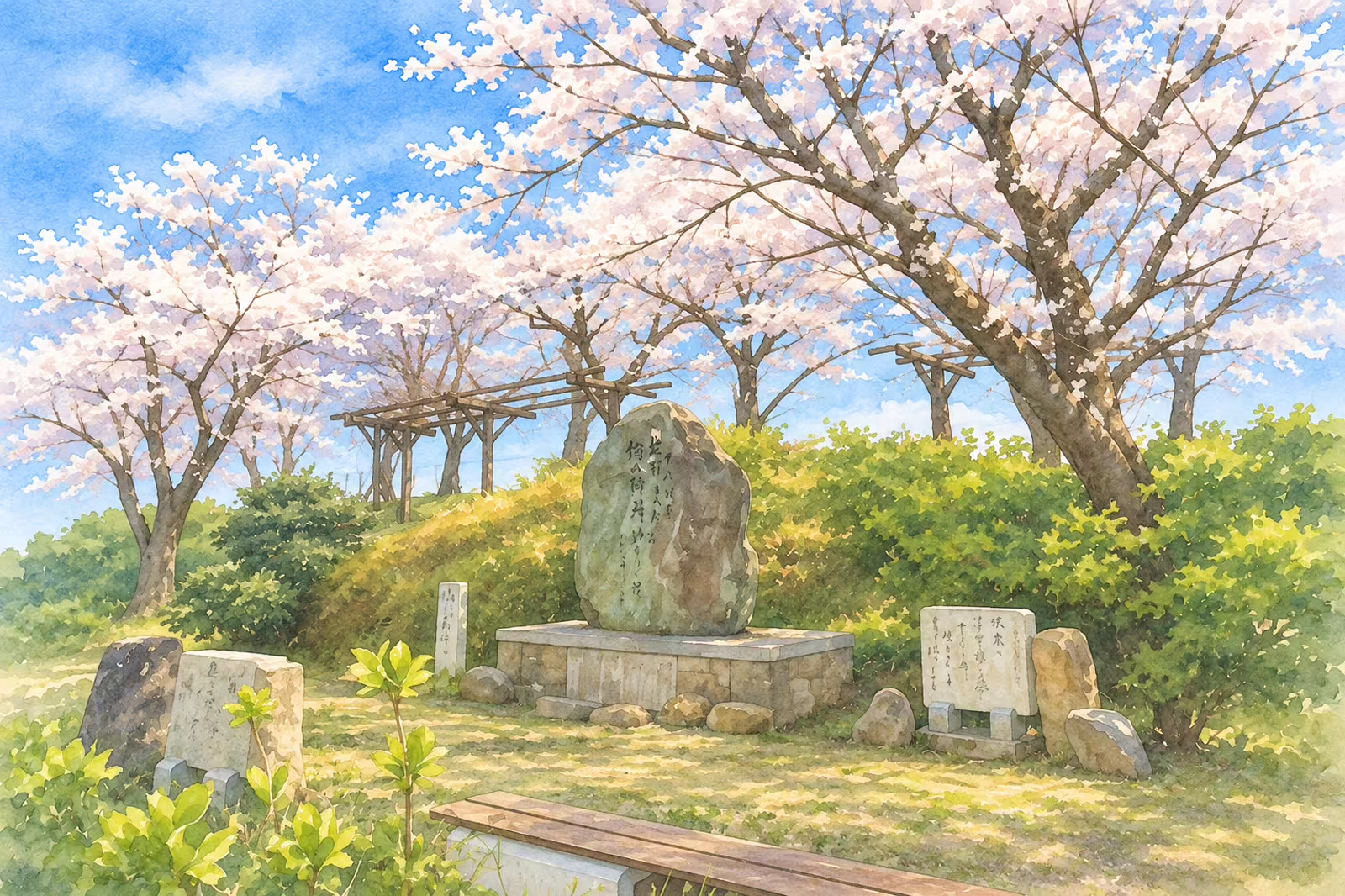
The Magari no Jin site, in the Kamimagari area of Rittō in Shiga Prefecture, marks the field headquarters of Ashikaga Yoshihisa, the ninth shogun of the Muromachi shogunate, during his campaign in Ōmi Province. From 1487 to 1489 Yoshihisa stayed here for well over a year, and the shogunate’s administration, lawsuits and audiences followed him into camp, briefly making Magari a working seat of government. Yoshihisa died in the camp. Today the site consists of a temple, markers and some earthworks, and the exact location of the headquarters has not been confirmed.
01The shogun’s campaign
After the Ōnin War (1467–1477), shogunal authority was badly weakened, and provincial military governors (shugo) seized estates belonging to temples, shrines, court nobles and the shogun’s own retainers. Rokkaku Takayori, the military governor of Ōmi, was one of them. In the ninth month of 1487 the young Yoshihisa led an army of daimyo into Ōmi in person to punish the Rokkaku and restore the shogun’s prestige. Takayori avoided a decisive battle and withdrew into the hills of Kōka, where local warriors kept up resistance. Later accounts tell of Kōka warriors raiding the camp at night and link this to the legend of the Kōka ninja, but these stories come mostly from much later sources.
02A year and a half in camp
Yoshihisa first lodged at a temple in Magari and later built a residence known as the Shinpōkan. Magistrates, close retainers and petitioners gathered in the camp, documents continued to be issued, and martial displays such as inuoumono (dog-chasing archery) as well as linked verse and waka gatherings were held there. Yoshihisa was a keen scholar and poet and exchanged waka with his father, Ashikaga Yoshimasa. The campaign dragged on, and in the third month of 1489 Yoshihisa died in the camp at the age of 23 (25 by traditional count). Illness is generally given as the cause, though some accounts blame heavy drinking. The campaign failed, and two years later his successor, Ashikaga Yoshiki, marched against the Rokkaku again.
03The site today
The center of the camp is generally placed around present-day Eishō-ji, whose mountain name is "Magari Jinzan" (Magari Camp Mountain). The temple grounds have been designated a historic site by local authorities and carry markers. Earthen ramparts survive beside the temple, and some have read nearby waterways as remains of moats; a camp plan drawn in the Edo period has also shaped later reconstructions. There is still no firm proof, however, that the surviving earthworks date from Yoshihisa’s time, and some of their shape may come from the later temple and village. A modern poetry monument stands by the nearby Kamimagari Pond.