
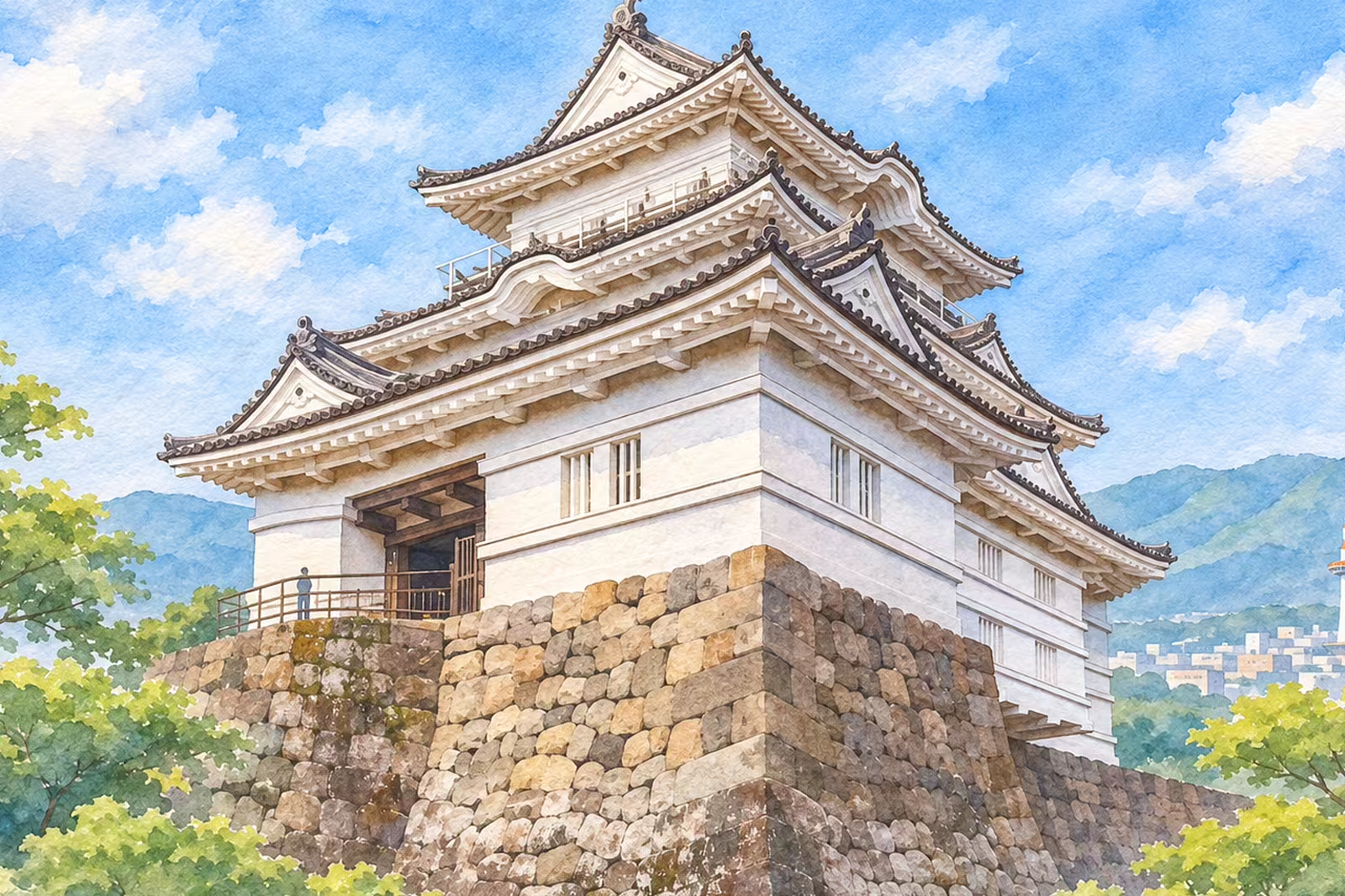
Odawara Castle stands in the city of Odawara in Kanagawa Prefecture, at the eastern foot of the Hakone hills beside Sagami Bay, where the Tōkaidō road enters the Kantō plain. In the Sengoku period it was the seat of the Later Hōjō, who ruled much of the Kantō for five generations and close to a century. Toyotomi Hideyoshi’s siege of Odawara in 1590 ended Hōjō rule and completed his unification of the country. The park today is laid out on the Edo-period castle, and its keep is a 1960 reconstruction.
01Seat of the Later Hōjō
A castle was first built here in the mid-15th century by the Ōmori, a local warrior family. Late in that century Ise Sōzui, better known as Hōjō Sōun, seized Odawara, traditionally around 1495, though some historians argue for a later date. His successors Ujitsuna, Ujiyasu, Ujimasa and Ujinao made it their main castle as their power spread across the Kantō. Uesugi Kenshin in 1561 and Takeda Shingen in 1569 both brought armies to its walls and both failed to take it.
In the late 1580s, preparing for war with Hideyoshi, the Hōjō built the sōgamae, a ring of ditches and earthen ramparts about 9 kilometers around that enclosed the whole castle town. In 1590 Hideyoshi surrounded Odawara with a vast army, built a castle of his own on nearby Ishigakiyama, and took the Hōjō branch castles across the region one by one. In the seventh month the Hōjō surrendered. Ujimasa and his brother Ujiteru were ordered to take their own lives, and Ujinao was exiled to Mount Kōya.
02After the Hōjō
Tokugawa Ieyasu was moved to the Kantō and made Edo his base, and Odawara went to his trusted vassals the Ōkubo, followed later by the Inaba and then the Ōkubo again. In the 17th century the castle was rebuilt with stone walls and tiled buildings, burying much of the Hōjō layout. The Genroku earthquake of 1703 destroyed the keep, which was rebuilt around 1706. The castle was abandoned in the early Meiji years and most buildings were pulled down, and the Great Kantō Earthquake of 1923 brought down much of the remaining stonework.
03What survives
The castle site is a designated National Historic Site. The present keep, built of reinforced concrete in 1960, follows plans and a model associated with the 18th-century rebuilding; it houses a museum and was seismically renovated in the 2010s. The Tokiwagi Gate, the Akagane (copper) Gate and the Umadashi Gate were reconstructed between the 1970s and 2009, and a corner turret of the second bailey was rebuilt in the 1930s. Outside the park, places such as the great dry moats at Komine Okanedai preserve sections of the Hōjō earthworks, and excavation continues in areas such as the Goyōmai enclosure north of the main bailey.
Odawara Castle
01The Tower in Front of You
The white keep that rises above the pines of Odawara Castle Park looks like something from the Edo period, and in outline it is. Three tiers of tiled roofs step up over plastered walls, with a smaller attached turret on one side. But the building itself dates from 1960. It is a reinforced-concrete reconstruction, modeled on drawings and a wooden scale model of the keep that stood here in the eighteenth century.
That is the first thing to understand about Odawara: the castle you walk through today is largely the castle of the Edo period, rebuilt in parts during the last sixty-odd years. The castle that made Odawara famous was something larger and older. From the end of the fifteenth century until 1590, this was the headquarters of the Later Hōjō, a family of warlords who over five generations made themselves masters of the Kantō, the great eastern plain where Tokyo now sprawls. Two of the most celebrated generals of the age, Uesugi Kenshin and Takeda Shingen, marched their armies to its walls and went home without taking it. It fell only when Toyotomi Hideyoshi, the man who reunified Japan, brought the whole country’s armies against it.
So when you stand here, you are standing on two castles at once. One is a vast earthwork fortress of the Warring States period (the Sengoku era, roughly 1467 to 1590), whose outer ramparts ran for about nine kilometers around the entire town. The other is a compact stone-walled castle of the Tokugawa peace, guarding the Tōkaidō highway where it climbs into the Hakone mountains.
02A Gateway to the East
Look west from the keep and you see the reason the castle is here. The Hakone range rises steeply behind the town, and the Tōkaidō, the main road between Kyoto and the east, crossed those mountains on its way into the Kantō. Odawara sits at the foot of the pass, on the coast of Sagami Bay, in what was then Sagami Province. Anyone coming east from Suruga or Izu had to come through here.
In the early fifteenth century the area was held by the Ōmori, a warrior family originally from Suruga, who took over lands in western Sagami from a family on the losing side of the Uesugi Zenshū rebellion of 1416–17. The Ōmori are generally credited with building the first fortification at Odawara, though very little is known of what it looked like. They were allies of the Ōgigayatsu branch of the Uesugi, one of the great houses contending for power in the region.
03Ise Sōzui Takes Odawara
The man who ended Ōmori rule is known to most Japanese as Hōjō Sōun. He never used that name. In his lifetime he was Ise Shinkurō Moritoki, later taking the Buddhist name Sōzui, and he came from a branch of the Ise family that served as administrators to the Ashikaga shoguns in Kyoto. For a long time he was pictured as a masterless adventurer who rose from nothing, the archetype of the Sengoku upstart. Historians now see him as a well-connected official who went east because his sister had married into the Imagawa, the governors of Suruga.
In Suruga he helped secure the succession of his nephew, Imagawa Ujichika, and was rewarded with a castle. Around 1493 he invaded neighboring Izu and overthrew the local Ashikaga lord, making Nirayama his base. Then he turned to Sagami.
The traditional date for his capture of Odawara is 1495. The traditional story, found in later war chronicles, is a good one. Sōzui asked the Ōmori lord, Ōmori Fujiyori, for permission to send hunters into the Hakone hills to drive deer. The beaters were soldiers in disguise. At night they tied torches to the horns of a thousand oxen and drove them toward the castle, and the defenders, seeing the hillsides alight, believed a huge army was upon them and fled. The tale closely echoes a famous ruse from ancient China, which is one reason historians treat it as embroidery. Some scholars, working from surviving documents, also argue that the takeover came later, perhaps around 1500.
Whatever the details, Sōzui never moved to Odawara himself. He died at Nirayama in 1519. It was his son, who took charge of the family around 1518, who made Odawara the family seat.
04Becoming the Hōjō
Ise Ujitsuna took over from his father and pushed north and east into Musashi Province. Around 1523 he changed the family surname from Ise to Hōjō. The original Hōjō had been regents of the Kamakura shogunate, effectively rulers of eastern Japan in the thirteenth and early fourteenth centuries. The new name was a claim to legitimacy in a region that might otherwise see the family as interlopers from the west. Historians call them the Later Hōjō, or the Odawara Hōjō, to tell them apart from their Kamakura namesakes.
Ujitsuna took Edo Castle in 1524 and Kawagoe in 1537, and defeated a rival branch of the Ashikaga at the first battle of Kōnodai in 1538. He also sponsored the rebuilding of the Tsurugaoka Hachimangū shrine in Kamakura, a gesture that tied the family to the old symbolic center of eastern warrior rule.
His son Hōjō Ujiyasu, the third lord, is usually regarded as the greatest of the line. In 1546 he relieved the besieged castle of Kawagoe with a night attack on a much larger allied army of the two Uesugi branches and the Koga kubō, the Ashikaga governor-general of the Kantō. The Ōgigayatsu Uesugi were destroyed, and the head of the Yamanouchi Uesugi was eventually driven to seek refuge with the Nagao family of Echigo, far to the north. That decision would bring trouble to Odawara.
Ujiyasu was also an administrator. The Hōjō carried out land surveys, standardized taxes, and kept registers of their retainers’ obligations. Their official documents carried a seal with a tiger on it. Among the Sengoku warlords they stand out for how systematically they governed, and their towns and villages were, by the standards of the time, well ordered.
In the 1550s the Hōjō allied with the Takeda of Kai and the Imagawa of Suruga, sealing the pact with marriages among the three houses.
05Kenshin and Shingen at the Gates
The Uesugi refugee found his champion in Nagao Kagetora, the young lord of Echigo. In 1560 Kagetora crossed the mountains into the Kantō, and many local lords who resented Hōjō expansion joined him. In the spring of 1561 he led an army, said to number around 100,000, south to Odawara.
Ujiyasu refused to come out and fight. The besiegers burned the town and tested the defenses for about a month without breaking in. Kagetora’s coalition was loose, his supply lines were long, and Takeda forces were threatening his rear. He withdrew. On the way home he stopped at Tsurugaoka Hachimangū in Kamakura, where he was formally adopted into the Uesugi and took the title of Kantō kanrei, or deputy shogun for the east. He is remembered as Uesugi Kenshin.
The alliance with the Takeda fell apart in 1568, when Takeda Shingen invaded Suruga. In 1569 Shingen marched through Musashi and appeared before Odawara. His siege lasted only a few days. He too burned the town and turned back. The Hōjō pursued him and fought his army at Mimase Pass in northern Sagami, but the Takeda forced their way through and returned home.
Two famous generals had come and gone. Odawara acquired a reputation as a castle that could not be taken, and the Hōjō drew a lesson from it: hold fast, and the attacker will run out of food before you do.
06A Castle of Earth
The Hōjō castle did not look like the one you see now. It had few or no stone walls. Hōjō engineering was a matter of earth: steep ramparts, deep dry moats, and moats whose floors were divided by low earthen ridges into a waffle-like grid, so that attackers who climbed down into them were trapped in compartments under fire from above. These "lattice moats" have been found in excavations at Odawara and at other Hōjō sites.
The heart of the Sengoku castle seems to have lain on the Hachimanyama hill to the west of today’s park, where traces of enclosures and cuttings remain. From there the fortress stepped down toward the plain.
In the 1580s, as Toyotomi Hideyoshi completed his conquest of western Japan, the fourth and fifth lords, Hōjō Ujimasa and his son Ujinao, enlarged the castle on an extraordinary scale. They built the sōgamae, an outer perimeter of earthen ramparts and ditches roughly nine kilometers around. It enclosed not just the castle but the whole town, its temples, fields and the hills behind. Inside it, a population could be fed and sheltered through a long siege. Stretches of these earthworks still survive in the hills north and west of the town, and some of the ditches remain startlingly deep.
07The Siege of 1590
By 1587 Hideyoshi had subdued Kyūshū, and only the Kantō and the far north stood outside his order. He demanded that the Hōjō come to Kyoto and submit. The Hōjō temporised. In late 1589 a Hōjō retainer seized Nagurumi Castle in Kōzuke, which Hideyoshi had awarded to the Sanada family, and Hideyoshi declared war.
In the spring of 1590 he mobilized an army usually estimated at more than 200,000 men. One force came along the Tōkaidō, another down from the north. Yamanaka Castle, the key Hōjō fortress on the Hakone road, fell in a single day. Hōjō outposts across Izu, Sagami, Musashi and Kōzuke were taken one by one. By early summer Odawara was surrounded by land, and fleets blockaded it from the sea.
Hideyoshi settled in for a long siege, and made a show of it. On Kasagake-yama, a hill about three kilometers southwest of the castle, he built a castle of his own with proper stone walls, the first of its kind in eastern Japan. The popular story says he screened the work behind trees and then had them felled all at once, so that the defenders woke to find a castle on the hill as if it had appeared overnight. In fact it took around eighty days to build. It is still known as Ishigakiyama Ichiya-jō, the "One-Night Castle" on Stone-Wall Hill. Hideyoshi summoned his tea master Sen no Rikyū to the camp and let the lords bring their wives and entertainers. The message was that he could wait as long as it took.
Inside the castle, the Hōjō leadership debated whether to fight or negotiate and could not decide. The phrase Odawara hyōjō, "an Odawara council", passed into Japanese as a byword for a meeting that talks endlessly and settles nothing. How the councils actually went is not recorded in any reliable source.
Meanwhile the lords of the north came to make their peace with Hideyoshi. The most famous was Date Masamune, who arrived late and, according to a well-known story, appeared before Hideyoshi dressed in the white robes of a man prepared to die. Of the Hōjō’s satellite castles, only a few held out; Oshi Castle in Musashi survived an attempt by Ishida Mitsunari to flood it.
In the seventh month of 1590, Ujinao came out of the castle and surrendered, offering his own life in exchange for those of the garrison. Hideyoshi instead held Ujinao’s father Ujimasa and uncle Ujiteru responsible for the war and ordered them to commit suicide. Ujinao was spared, partly because he was married to a daughter of Tokugawa Ieyasu, and was exiled to Mount Kōya. He died the following year. The Later Hōjō, after five generations and about a century, were finished.
Hideyoshi gave the Hōjō lands to Ieyasu, who chose to make his headquarters not at Odawara but at the small castle of Edo. The fall of Odawara is, in that sense, where the story of Tokyo begins.
08The Edo-Period Castle
Ieyasu gave Odawara to one of his senior retainers, Ōkubo Tadayo. His son Ōkubo Tadachika became a powerful figure in the early shogunate but was abruptly stripped of his domain in 1614, apparently a casualty of factional struggles within the shogunate. Parts of the castle were pulled down.
The castle’s present form owes most to Inaba Masakatsu, who received Odawara in 1632. Masakatsu was the son of Kasuga no Tsubone, wet nurse to the third shogun, Tokugawa Iemitsu, and so had grown up as the shogun’s foster brother. Under the Inaba the castle was rebuilt as a stone-walled fortress in the contemporary style, with the inner enclosure (honmaru) and second enclosure (ninomaru) laid out much as you see them. An earthquake in 1633 caused heavy damage, but the work was carried through, and Iemitsu stayed at the castle on his journey to Kyoto in 1634.
In 1686 the Ōkubo family returned, in the person of Ōkubo Tadatomo, and they held the Odawara domain until the end of the shogunate. Odawara was a trusted post. Its lords guarded the first major checkpoint on the road into the shogun’s capital region and were responsible for staffing the barrier at Hakone, where travelers’ papers were examined.
The great Genroku earthquake of 1703 brought down the keep and most of the castle buildings, and fire swept the town. The keep was rebuilt and completed in 1706. This is the Hōei-era keep, named after the era in which it was finished, and it is the one the modern reconstruction copies. Its top floor housed an image of Marishiten, a Buddhist deity favored by warriors as a protector; the statue is said to have been installed by Ōkubo Tadatomo in 1686 and to have survived the 1703 fire.
During the Boshin War of 1868, Odawara wavered, first siding with the new imperial government, then briefly cooperating with a band of pro-shogunate fighters, and then hurriedly returning to the imperial side. There was fighting near Hakone.
09Demolition, an Imperial Villa, and an Earthquake
After the Meiji Restoration the castle was decommissioned in 1870, and by 1872 the keep and nearly all the other buildings had been dismantled or sold. In 1901 an imperial villa was built in the ninomaru area as a winter retreat for the imperial family.
The Great Kantō Earthquake of 1923 hit Odawara hard. Almost all of the castle’s stone walls collapsed, and the villa was badly damaged and later closed. Some of the toppled stonework was left where it fell and can still be seen. The walls were repaired in the 1930s, and a corner turret in the ninomaru was rebuilt at reduced size.
Part of the castle site was designated a national Historic Site in 1938, and most of the rest of the honmaru and ninomaru was added in 1959. The designation has since been extended several times, taking in sections of the outer sōgamae earthworks.
10Rebuilding
The keep was reconstructed in 1960 to mark a municipal anniversary. Its exterior follows Edo-period plans and the scale models of the Hōei keep preserved at the University of Tokyo and at Ōkubo Shrine, though at the city’s request a railed viewing balcony was added around the top floor, which the original did not have. Inside it has always been a museum. A major seismic retrofit and renovation in 2015–16 refreshed the displays and recreated the Marishiten shrine space on the top floor.
The city then began rebuilding the gates. Tokiwagi-mon, the main gate to the honmaru, was rebuilt in concrete in 1971. Akagane-mon, the main gate to the ninomaru, was reconstructed in 1997 using traditional timber construction, based on old photographs and excavated foundation stones; it takes its name, "copper gate", from the copper fittings on its doors. In 2009 the Umadashi-mon was also rebuilt in timber. With the walled space in front of it and the gate behind, it forms a masugata, a square killing ground in which attackers who broke through the first gate would be trapped before the second.
11A Walk Through the Castle
Approach from the south, across the moat by the Manabi Bridge, and the first thing you meet is the Umadashi-mon. Pass through it and the inner gate behind, and you are in the ninomaru. Across the Sumiyoshi Bridge stands Akagane-mon, forming a second masugata. Look closely at the heavy doors and their copper fittings.
In the ninomaru you will find small museums, including one devoted to the ninja of the Fūma band, who according to later tradition served the Hōjō. Treat the ninja stories as folklore; the Fūma appear in Edo-period writings, and almost nothing about them can be confirmed.
Climb the stone steps toward Tokiwagi-mon. The gate’s name refers to evergreen trees, a wish for the castle’s permanence, and a venerable pine stands near the steps. Through it is the honmaru and, at its center, the keep.
From the top floor, the view explains the castle’s history better than any display. West are the Hakone mountains and the road the Hōjō guarded. South is Sagami Bay, where Hideyoshi’s ships once rode at anchor. On a clear day you can see the Izu Peninsula and the island of Ōshima. And to the southwest, on the wooded summit of Kasagake-yama, is the site of the One-Night Castle. In the summer of 1590 the Hōjō could look up at it every morning.
If you have more time, walk northwest out of the park to the Hachimanyama area, where the ground still preserves the shape of the Hōjō earthwork castle, and follow the line of the sōgamae into the hills to see the great ditch at Komine. Near the east exit of Odawara Station, among ordinary houses, is a small graveyard said to mark the place where Ujimasa and Ujiteru took their own lives. It is a quiet spot, and an apt one to end on.