
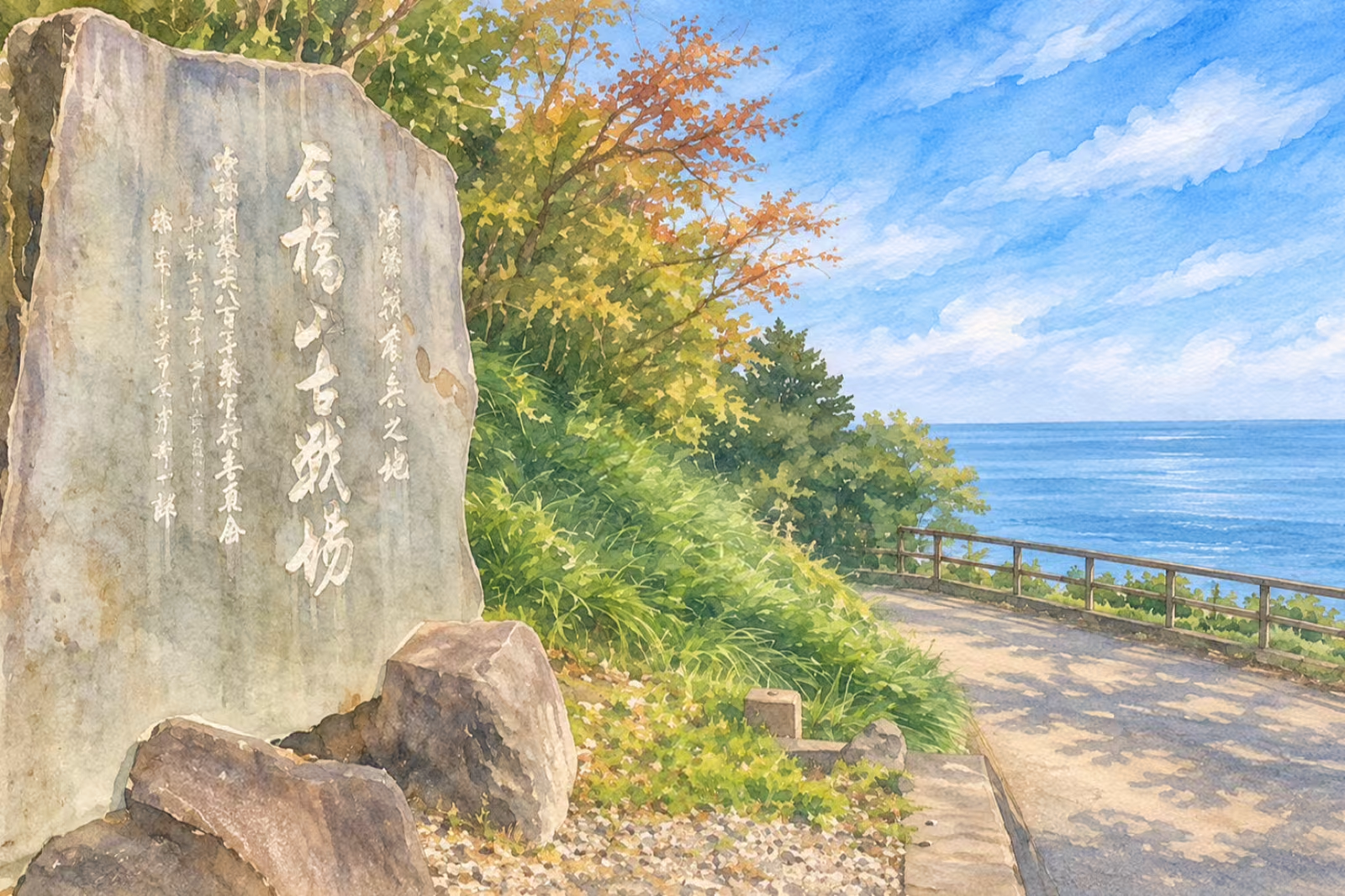
The Ishibashiyama battlefield lies in the southern part of Odawara in Kanagawa Prefecture, on the steep slopes where the eastern flank of the Hakone hills drops to Sagami Bay. In the eighth month of 1180, Minamoto no Yoritomo suffered a crushing defeat here only days after raising his rebellion, and barely escaped with his life. He then crossed the sea to Awa, rebuilt his forces, and entered Kamakura two months later, which is why Ishibashiyama is often told as the opening scene of the Kamakura shogunate.
01The rising and the defeat
In 1180 Prince Mochihito called on the Minamoto across the country to rise against the Taira. Yoritomo, then living in exile in Izu, rose with the backing of his father-in-law Hōjō Tokimasa and others. In the eighth month he attacked and killed Yamaki Kanetaka, the Taira deputy governor of Izu, and then marched east with about 300 men, hoping to join the Miura clan. According to the Azuma Kagami, while he was encamped at Ishibashiyama, the Taira partisan Ōba Kagechika attacked from the front with about 3,000 men, and Itō Sukechika closed in from the hills behind. The Miura force was held up by a flooded river. The fighting took place at night in a storm, and Yoritomo’s army broke.
During the battle Sanada Yoichi Yoshitada, son of Okazaki Yoshizane, grappled with the enemy warrior Matano Kagehisa and was killed by soldiers who came to Kagehisa’s aid. He is recorded as having been 25 by traditional count. His retainer Bunzō Ieyasu also died. Retold and embellished in war tales such as the Genpei jōsuiki, their story became well known locally.
02Escape and recovery
Yoritomo fled with a handful of followers into the mountains around Doi. A famous story holds that he hid in a cave and that Kajiwara Kagetoki, searching the hills for the Taira side, found him and chose to let him go; this comes from later accounts and is usually treated as legend. At the end of the eighth month Yoritomo sailed from the Manazuru area to Awa on the Bōsō Peninsula. There he won over warriors of Kazusa, Shimōsa and neighboring provinces, and in the tenth month he entered Kamakura at the head of a much larger army.
03The site today
Roads, a railway line and mandarin orchards now cut across the battlefield, but the way the slope falls straight to the shore is still easy to read. The site has a battlefield monument, the Yoichi-zuka marking where Yoshitada is said to have fallen, and the Bunzō-dō commemorating his retainer. The nearby Sanada Reisha shrine is dedicated to Yoshitada and remains a place of local worship. The battlefield is designated a historic site by Kanagawa Prefecture.