
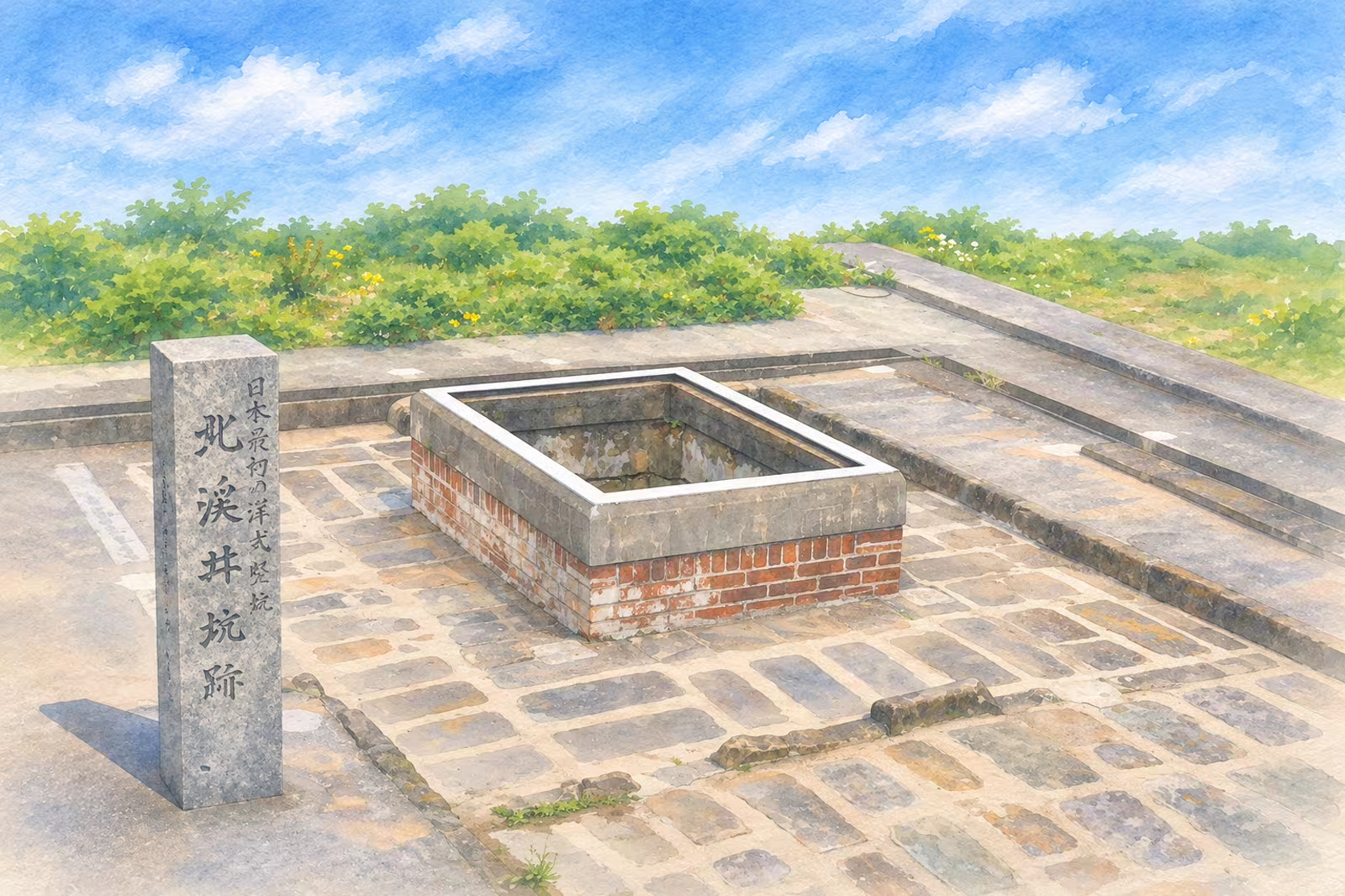
The Hokkei Shaft site lies on Takashima, an island about 15 kilometers southwest of Nagasaki Harbor that is now part of Nagasaki City. It preserves the remains of a steam-powered vertical shaft that began producing coal in 1869, generally regarded as the first mine shaft in Japan sunk with Western techniques and worked by steam engines. Only traces around the shaft mouth survive, but the site marks the start of mechanized coal mining in Japan, and in 2015 it was inscribed as a component of the World Heritage property Sites of Japan’s Meiji Industrial Revolution.
01Saga and Glover
Coal had long been dug on Takashima; according to tradition the seams were found in the late 17th century. Under the Saga domain during the Edo period, miners worked shallow deposits by hand. After Nagasaki opened to foreign trade, the steamships calling at the port created a steady demand for coal, and Takashima lay conveniently close. In 1868 the Saga domain and Glover & Co. formed a joint venture, brought in a British engineer named Morris, and introduced steam machinery to sink a vertical shaft. Coal came up in 1869 from a depth of about 43 meters. Steam engines hoisted coal and pumped out water, and output is recorded at around 300 tons a day, far beyond what older methods achieved.
02A short life and the later mine
The Hokkei Shaft operated for only a few years. After Glover & Co. went bankrupt in 1870 the mine changed hands several times: it came under government management in 1874, was sold the same year to Gotō Shōjirō, and was bought in 1881 by Iwasaki Yatarō of Mitsubishi. The Hokkei Shaft itself went out of use around 1876, by one account because of seawater flooding. Other shafts on the island kept working, and under Mitsubishi the Takashima mine and nearby Hashima, known as Gunkanjima, became the most important undersea coal mines around Nagasaki. Harsh treatment of Takashima miners was exposed in the press during the Meiji period and became a public issue, and wartime labor by workers from the Korean Peninsula and China in the area was among the points disputed between Japan and South Korea when the World Heritage listing was made. The Takashima mine closed in 1986.
03What can be seen today
The site has been excavated and laid out for display. Visitors can see the location of the shaft mouth and traces of the buried machinery foundations around it, but the headframe, engine house and other surface buildings have not survived, and the shaft cannot be entered. On-site panels and digital reconstructions explain how the facilities were arranged. Elsewhere on the island, the Takashima Coal Museum displays materials on the history of the mine.