
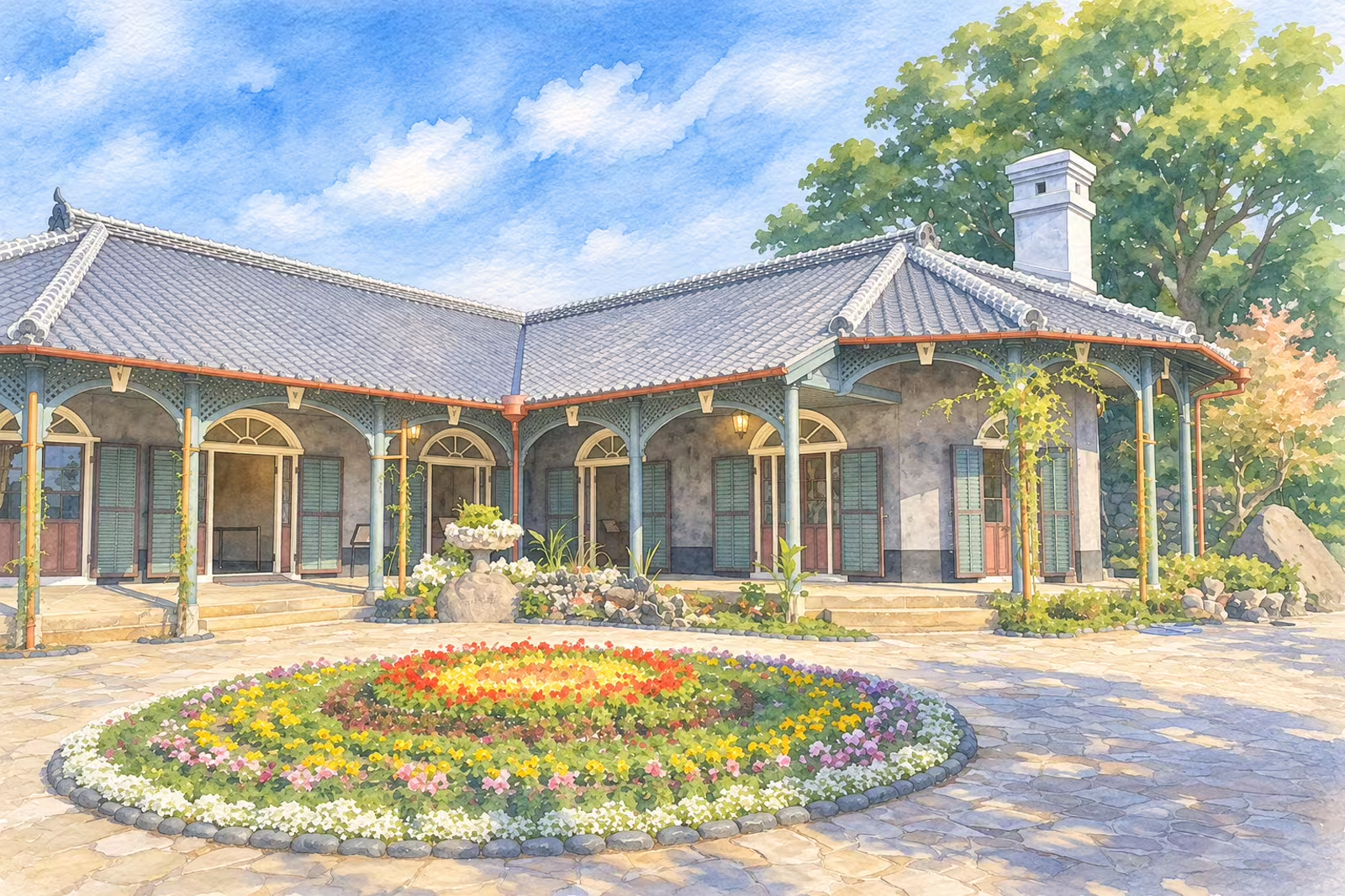
Glover Garden is an open-air site on the Minamiyamate hillside in Nagasaki, opened by the city in 1974 to preserve Western-style houses from the era of the foreign settlement. Its centerpiece, the Former Glover House of 1863, is generally regarded as the oldest surviving Western-style wooden building in Japan and is a component of the World Heritage property Sites of Japan’s Meiji Industrial Revolution. From the slope the garden looks straight down on Nagasaki Harbor, the port on which the merchants who lived here built their businesses.
01Glover and Minamiyamate
Nagasaki opened to foreign trade in 1859, and the Scottish merchant Thomas Glover arrived the same year. His firm, Glover & Co., dealt in tea, ships and weapons. In the 1860s he worked closely with domains such as Satsuma and Chōshū, helped Itō Hirobumi and four other young men from Chōshū, as well as a group of Satsuma students, leave Japan secretly to study in Britain, and took part in developing the Kosuge slip dock and the Takashima coal mine. After his firm went bankrupt in 1870 he stayed in Japan and served for many years as an adviser to Mitsubishi, receiving a Japanese decoration in 1908. He died in Tokyo in 1911 and was buried in Nagasaki. The house passed to his son, Kuraba Tomisaburō, was sold to Mitsubishi around 1939, and was later donated by Mitsubishi to the city.
02The buildings
The historic buildings fall into two groups. The Former Glover, Ringer and Alt houses stand where they were built during the settlement period, and all three are Important Cultural Properties. The Glover House is a single-story timber building with broad verandas and a tiled roof; it is generally attributed to the Japanese carpenter Koyama Hidenoshin, and combines a Western plan with Japanese building methods. The Alt House dates from around 1865 and the Ringer House from about 1868, homes of the British merchants William Alt and Frederick Ringer.
The other Western-style buildings were moved here from elsewhere in Nagasaki. They include a dormitory from the Mitsubishi shipyard’s No. 2 Dock, Jiyūtei, one of Japan’s earliest Western restaurants, and the Former Walker House. Each once belonged to a different part of the city, and their grouping here is a later preservation arrangement, not part of the Glover household’s world.
03The garden today
The Former Glover House was designated an Important Cultural Property in 1961 and inscribed as part of the World Heritage property in 2015, after which it underwent several years of conservation work. The garden also has statues of Giacomo Puccini and the soprano Miura Tamaki, recalling the opera Madama Butterfly. The opera is set in Nagasaki, but the idea that the Glover House was the heroine’s home is a later popular association rather than established fact.
Glover Garden (Nagasaki)
01A Hillside Above the Harbor
Glover Garden sits on Minami-Yamate, the "south bluff" above the Ōura waterfront in Nagasaki. From its terraces you look straight down the long, narrow harbor. On the far shore are the cranes and dry docks of the Mitsubishi Heavy Industries Nagasaki Shipyard. That view is the key to the whole place: the merchants who built houses here in the 1860s wanted to watch the ships come in, and the man whose name the garden carries spent much of his life helping to build the industry you can see across the water.
When Japan’s Tokugawa shogunate signed commercial treaties with the United States, the Netherlands, Russia, Britain and France in 1858, Nagasaki was one of the ports opened to foreign trade the following year. The city already had a long history with outsiders. Through two centuries of restricted foreign relations, Dutch traders had been confined to the artificial island of Dejima and Chinese merchants to a walled compound. Now the shogunate reclaimed land along the Ōura shore for warehouses and offices and set aside the hills behind for foreign residences. Minami-Yamate became one of the most desirable parts of this foreign settlement.
The garden you walk through today was created by the city of Nagasaki and opened in September 1974. Its core is three houses that still stand where they were built in the 1860s: the former residences of Thomas Glover, Frederick Ringer and William Alt. All three are designated Important Cultural Properties, Japan’s main national category of protected buildings. To these the city added several Meiji-period (1868–1912) Western-style buildings moved here from elsewhere in Nagasaki. In 2015 the Glover House became one of the components of the UNESCO World Heritage Site "Sites of Japan’s Meiji Industrial Revolution."
02Thomas Blake Glover
Thomas Blake Glover was born in 1838 in Fraserburgh, a fishing port in Aberdeenshire in the northeast of Scotland. His father was an officer in the coastguard. After schooling in Aberdeen he joined a trading firm with business in the Far East.
He arrived in Nagasaki in 1859, the year the port opened, at the age of twenty-one. At first he worked under Kenneth Mackenzie, the local agent of Jardine Matheson, the great British trading house of the China coast, buying tea and silk. In 1861 he set up on his own as Glover and Company, while also acting as Jardine Matheson’s agent in Nagasaki. Tea remained part of his business, but the political crisis of the 1860s soon offered something far more profitable.
03Guns, Ships and the Southwestern Domains
In the 1860s Japan was sliding toward civil conflict. The shogunate’s authority was weakening, and the large domains of the southwest, ruled by daimyo (feudal lords) with their own armies, were arming themselves. Satsuma in southern Kyūshū, Chōshū at the western tip of Honshū, Tosa on Shikoku, Hizen (Saga) and Higo (Kumamoto) all sent agents to Nagasaki to buy rifles, cannon and steamships. Backed by Jardine Matheson’s capital and shipping, Glover and Company became one of the biggest suppliers in the port. It sold to the shogunate as well as to the domains.
Glover’s closest partner was Satsuma. In 1863 a British squadron had bombarded Kagoshima after Satsuma men killed an English merchant, Charles Richardson, on the road near Yokohama. Rather than nurse a grudge, Satsuma turned toward Britain. Glover bought ships for the domain and became friendly with Satsuma samurai such as Godai Tomoatsu. In 1865 Satsuma secretly sent nineteen young men, students and envoys, to Britain, in defiance of the shogunate’s ban on travel abroad. Glover helped arrange the voyage, which left from Hashima on the coast of Satsuma. Among the group were Mori Arinori, later Japan’s first Minister of Education, and Godai himself, who would become a leading figure in Ōsaka business.
Chōshū had already done something similar. In 1863 five young Chōshū samurai, Itō Hirobumi, Inoue Kaoru, Inoue Masaru, Endō Kinsuke and Yamao Yōzō, were smuggled to Britain to study, with Jardine Matheson’s help. They are remembered as the Chōshū Five. Itō became Japan’s first prime minister, and Inoue Masaru the father of its railways. Glover was involved in the arrangements and stayed close to Itō and Inoue for the rest of his life.
The best-known episode came in 1865. After Chōshū’s clash with Western warships at Shimonoseki in 1864, the shogunate declared Chōshū an enemy and forbade foreigners to sell it weapons. Sakamoto Ryōma, a masterless samurai from Tosa, and his trading group in Nagasaki, the Kameyama Shachū, found a way around the ban. Using Satsuma’s name as cover, they bought several thousand Minié rifles and a steamship, the Union, from Glover and passed them on to Chōshū. The ship was called the Sakurajima Maru by Satsuma and the Itchū Maru by Chōshū. The deal helped build trust between two domains that had been bitter rivals, and in early 1866 Satsuma and Chōshū concluded the alliance that would bring down the shogunate two years later.
Glover is said to have remarked late in life that, among all the rebels against the Tokugawa government, he had been the greatest. The remark is often quoted, though it comes from later recollection, when he had every reason to stress his part in the new Japan.
04A Slip Dock, a Coal Mine and Bankruptcy
Glover wanted to do more than trade. With Satsuma he built a patent slip at Kosuge, on the harbor south of the city, completed early in 1869 and soon sold to the new Meiji government. A steam engine hauled ships up an inclined cradle out of the water for repair. Locals called it the "soroban dock" because the cradle looked like an abacus. It was Japan’s first modern ship-repair facility, and its remains are also part of the World Heritage listing.
With the Saga domain he developed the Takashima coal mine on an island outside the harbor, bringing British engineers and steam-powered machinery to sink the Hokkei shaft in 1869. Takashima became Japan’s first modern, Western-style coal mine.
These ventures needed large amounts of capital. After the Meiji Restoration of 1868 the domains stopped buying arms, and many could not pay what they owed. In 1870 Glover and Company went bankrupt. Glover stayed in Japan and continued to work at Takashima.
05Glover and Mitsubishi
The Takashima mine passed into government hands, then to Gotō Shōjirō of Tosa, and in 1881 to Iwasaki Yatarō’s Mitsubishi. Glover stayed on at the mine under Mitsubishi, and from around 1885 he served the company as an adviser. In 1884 Mitsubishi leased the government’s Nagasaki shipyard and in 1887 bought it outright, with Glover’s help; this is the shipyard visible from the Glover House veranda.
Glover later moved to Tokyo, where he remained an adviser to Mitsubishi and a lifelong friend of Iwasaki Yanosuke, Yatarō’s younger brother and successor as head of the company. He also helped found the Japan Brewery Company in Yokohama in 1885, which began selling Kirin beer in 1888, and he encouraged the Iwasaki family to take part; in 1907 its business passed to the new Kirin Brewery Company, set up with Mitsubishi backing. A popular story says that the whiskers of the mythical kirin on the beer label were modeled on Glover’s moustache; there is no firm evidence for this.
In 1908 the Meiji government awarded Glover the Order of the Rising Sun, Second Class, a rare honor for a foreign merchant. He died in Tokyo on December 16, 1911, aged seventy-three, and was buried in Nagasaki’s Sakamoto International Cemetery beside his wife.
06The Glover Family and Madame Butterfly
Glover’s wife was Awajiya Tsuru, whom he is said to have met in Ōsaka, reportedly through Godai Tomoatsu. She bore him a daughter, Hana, in 1876 and died in 1899. He also had a son, Tomisaburō, born around 1870 to a Nagasaki woman, Kaga Maki. Maki raised the boy until he was about six, when Glover took him into his household. He took the surname Kuraba, a Japanese rendering of "Glover."
Kuraba Tomisaburō studied at Ohio Wesleyan University and the University of Pennsylvania, returned to Nagasaki, and became a prominent figure in the city’s international community. He also commissioned more than eight hundred watercolor illustrations of the fish of the seas around Nagasaki, now known as the Glover Atlas. He lived in the family house after his father’s death. In 1939, as Japan’s war in China deepened and suspicion of anyone with Western connections grew, he sold the house to Mitsubishi. The battleship Musashi was then being built in secret at the Nagasaki shipyard, and the house overlooked the slipway, which is often given as one reason the company wanted it. Kept under surveillance by the military police during the war, Tomisaburō took his own life on August 26, 1945, just over two weeks after the atomic bombing of Nagasaki.
The Glover House is often called the "Madame Butterfly House." Giacomo Puccini’s opera Madama Butterfly, first performed in 1904, is set in Nagasaki and tells of a Japanese woman abandoned by an American naval officer. It was based on a story by the American writer John Luther Long, who is said to have drawn on what his sister, the wife of a missionary in Nagasaki, told him. Glover’s own marriage has no direct connection to the opera; the label is a later tourist association. In the garden stand statues of Puccini and of Miura Tamaki, the Japanese soprano who became famous worldwide in the role of Butterfly.
07The Glover House
The Glover House was built in 1863 and is the oldest surviving Western-style wooden building in Japan. Its builder was Koyama Hidenoshin, a carpenter from the Amakusa islands. It is a single-story bungalow with a broad veranda, a stone-paved floor along the front and a plan that curves outward in a shape often compared to a clover leaf. This "veranda colonial" type was common in British Asia; here Japanese carpenters built it with Japanese materials and methods, so the roof is covered in Japanese tiles and much of the joinery is local work.
The house was extended several times, with a kitchen wing and other rooms at the back and a later conservatory. Glover called it Ipponmatsu, "Lone Pine," after a large pine beside it that died and was cut down in 1905. Guides often point to a hidden space above the ceiling where anti-shogunate activists are said to have hidden; this is a story without reliable documentation.
In 1957 Mitsubishi Shipbuilding donated the house to the city of Nagasaki to mark the centenary of the shipyard’s founding, and it opened to the public the following year. It was designated an Important Cultural Property in 1961. In recent years the house has undergone a major conservation project and has reopened.
08The Ringer and Alt Houses
Two other houses in the garden still stand on their original sites.
The Alt House was begun in 1865 for William John Alt, a British tea merchant. One of the largest houses in the settlement, it has outer walls and Tuscan veranda columns of Amakusa sandstone under a Japanese tile roof. Koyama Hidenoshin was again the builder. Alt moved his family to Ōsaka in 1868. The house later served as a Methodist girls’ school and as the American consulate, and from 1903 it belonged to the Ringer family, who lived there until Japan entered the Pacific War in December 1941.
The Ringer House was built in 1868 and acquired six years later by Frederick Ringer, an Englishman from Norwich. Ringer had been a tea inspector in China when Glover invited him to Nagasaki in 1865 to run Glover and Company’s tea business. Three years later he and Edward Holme founded Holme, Ringer and Company, which took over Glover’s tea exports and grew into banking, insurance, shipping, coal, flour milling and whaling, becoming one of the most powerful houses in the settlement. The house is a single-story bungalow with a wooden frame, sandstone walls and a granite-paved veranda. Ringer lived here from 1883 until his death in England in 1907; his second son Sydney and his family lived here, apart from the years around the Second World War, until he sold it to the city in 1965.
Together the three houses preserve the arrangement of a merchant’s residence in the foreign settlement: facing the harbor, backed by the hill, with a garden in front.
09Buildings Brought From Elsewhere
When the city created the garden in the 1970s, it moved in several Meiji buildings that were threatened elsewhere in Nagasaki.
The Mitsubishi No. 2 Dock House, built in 1896, stood beside the shipyard’s second dry dock at Akunoura across the harbor and housed crews while their ships were under repair. Mitsubishi donated it to the city in 1972 and it was moved to the top of the garden, where its upper veranda gives the widest view of the harbor.
The Jiyūtei was a Western-style restaurant run by Kusano Jōkichi, a Nagasaki man who learned European cooking while working for the Dutch on Dejima and opened a restaurant in his own home in 1863, making him one of the first Japanese to run a Western restaurant. After some years running restaurants in Ōsaka and Kyoto, he returned and opened this two-story building in the Umamachi district below Suwa Shrine around 1878. The restaurant closed after his death in 1886, and the building later served as the official residence of the chief public prosecutor. It was moved to the garden in 1974, and its upper floor is now a café.
The Walker House, a mid-Meiji wooden house, originally stood at No. 28 Minami-Yamate and was moved into the garden in 1974. It was bought in 1915 by Robert Walker Jr. His father, Robert Neill Walker, was an English sea captain who came to Japan in 1874 and later founded the Banzai aerated-water works, one of Japan’s first soft-drink makers; his mother was Japanese. Walker Jr. became a Japanese citizen in 1928 and lived here until his death in 1958.
Other relocated buildings include the official residence of the chief judge of the Nagasaki District Court, built in 1883 near today’s city hall and moved here in 1979; the Steele Memorial Academy, a boys’ school built in 1887 at Higashi-Yamate by missionaries of the Reformed Church in America and named for William H. Steele, who funded it in memory of his son; and the 1905 gatekeeper’s lodge of the Nagasaki Higher Commercial School, a predecessor of Nagasaki University’s economics faculty, moved here in 1977. The signs at each building give their original locations, and it is worth keeping in mind which buildings belong here and which were brought in.
10A Walk Through the Garden
The garden climbs a steep hill. There is an entrance at the bottom near Ōura Church and another higher up, linked by an inclined elevator and moving walkways, and most visitors go to the top first and work their way down.
Start at the Mitsubishi No. 2 Dock House. From its veranda you can see the shipyard across the water; the sites of Glover’s slip dock and the route out to Takashima lie within the same bay. Walk down past the judge’s residence and the Walker House to the Ringer and Alt houses. At the Alt House look at the stone columns on the front; at the Ringer House, at the heavy stone walls and veranda.
The Glover House sits in the middle of the garden. Its lawn faces the harbor, and from the veranda it is easy to imagine a merchant watching for ships. Inside are family photographs and household objects, along with displays on Kuraba Tomisaburō.
In the garden near the house are the statues of Miura Tamaki and Puccini. Among the paving stones are heart-shaped ones that visitors like to look for; they are a modern tourist attraction rather than a historical feature.
Near the exit are the Jiyūtei and the Steele Memorial Academy building, and the Nagasaki Traditional Performing Arts Museum, which displays floats and dragon dance props from the city’s autumn Kunchi festival. Below the garden stands Ōura Church, completed in 1864, the oldest surviving church in Japan and a National Treasure. Together with the Higashi-Yamate district and the Dutch Slope farther east, it forms what remains of Nagasaki’s treaty-port foreign settlement.