
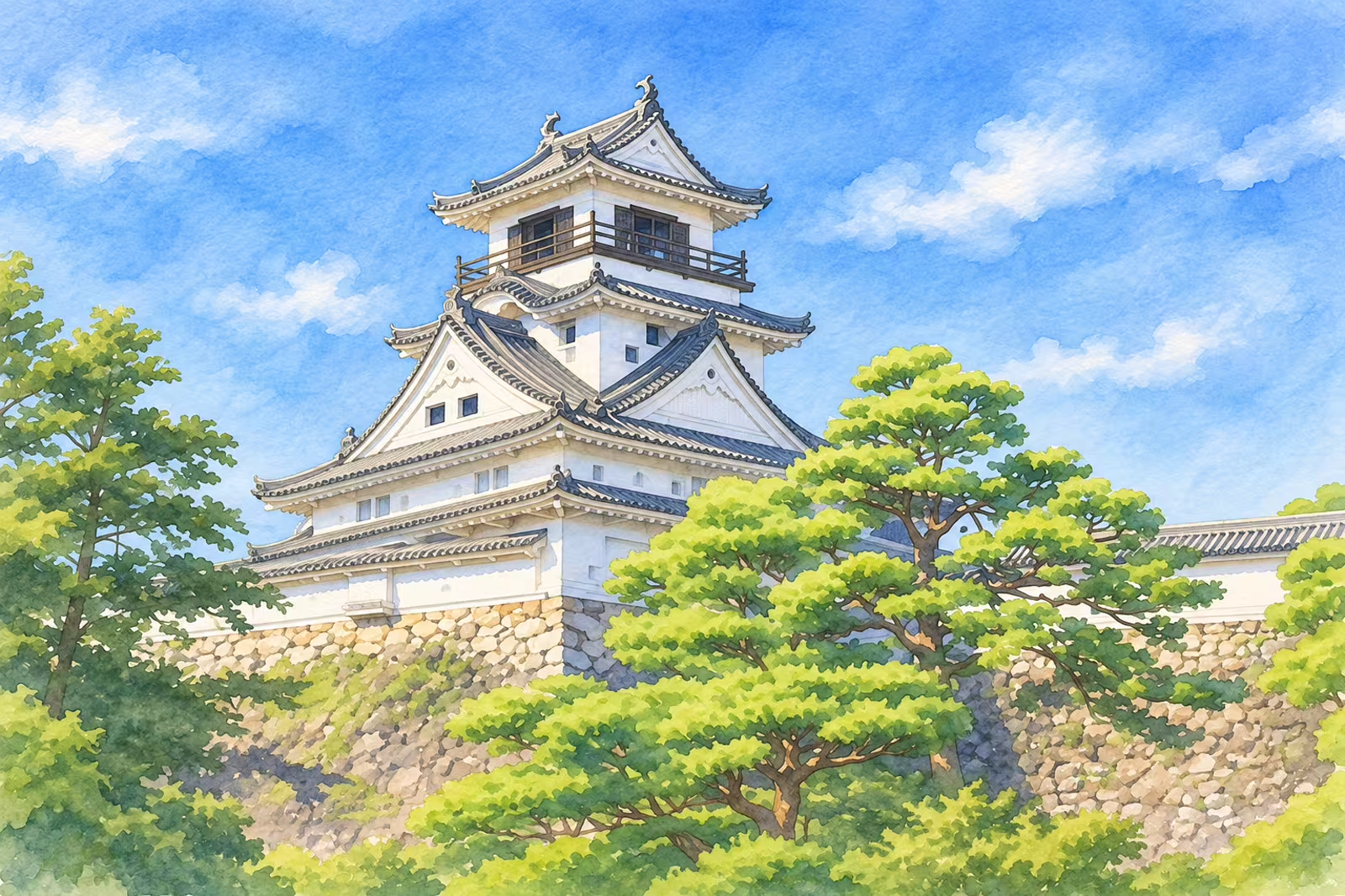
Kōchi Castle sits on Ōtakasa Hill in the center of Kōchi City, Kōchi Prefecture, and was the seat of the Yamauchi lords of Tosa domain through the Edo period. It is one of the 12 castles in Japan whose Edo-period keep survives, and the only one where every building in the inner citadel (honmaru) still stands, so the keep and the lord’s palace can be seen side by side.
01Founding and the Yamauchi
Fortifications stood on Ōtakasa Hill in the Warring States period, and Chōsokabe Motochika is said to have tried to build a castle here before moving his seat to Urado. After the Battle of Sekigahara in 1600 the Chōsokabe lost their lands, and Yamauchi Kazutoyo was given Tosa. He began building on the hill in 1601, moved into the honmaru in 1603, and the work was largely complete by around 1611. The names of the castle and its town went through several written forms before settling on "Kōchi." The Yamauchi ruled Tosa from here for some 270 years. The domain kept a sharp divide between upper and lower samurai, a split that shaped late-Edo movements such as the Tosa Loyalist Party.
02The fire of 1727 and rebuilding
In 1727 a fire spread from the town into the castle and destroyed the keep and most other buildings; the Ōtemon gate and a few others survived. The domain rebuilt, completing the keep around 1749 and restoring the remaining structures through the 1750s. The new keep is said to have followed the original design, which in turn is generally thought to have echoed Kazutoyo’s earlier castle at Kakegawa.
03What can be seen today
Fifteen buildings, including the keep, the honmaru palace (Kaitokukan), the Ōtemon, the Kurogane-mon gate and the Rōka-mon gate, are designated Important Cultural Properties, and the castle grounds are a National Historic Site. All are original Edo-period structures, most dating from the rebuilding after 1727. Many other buildings were demolished in the early Meiji years, when the grounds became a park. A bronze statue of Itagaki Taisuke stands inside the Ōtemon, and extensive stone walls survive around the third bailey.
Kōchi Castle
01A Castle That Kept Its Core
Kōchi Castle stands on a low hill in the middle of Kōchi City, the capital of the old province of Tosa on the Pacific side of Shikoku. From the street you see the main gate, the Ōtemon, and above its roof, framed almost perfectly, the white keep. Few Japanese castles allow that view, and it has become the city’s signature image.
What makes Kōchi unusual among Japan’s twelve castles with an original keep is not the keep alone. Here the whole cluster of buildings in the honmaru, the innermost enclosure, survives from the Edo period (1603–1868): the keep, the lord’s reception palace, the gates, and the long storehouse-turrets called tamon. Kōchi is the only castle in Japan where that complete set remains. Fifteen of its structures are designated Important Cultural Properties.
The castle belonged to the Yamauchi family, who ruled Tosa from 1601 until the Meiji Restoration. But the story of Kōchi Castle is also the story of the people the Yamauchi displaced. Tosa had been the home of the Chōsokabe clan, and the tension between the incoming Yamauchi retainers and the descendants of the Chōsokabe warriors produced one of the harshest class divides in Tokugawa Japan. Two and a half centuries later, men from the lower side of that divide, among them Sakamoto Ryōma, would help bring down the shogunate.
02The Hill Before the Castle
The hill is called Ōtakasaka-yama. It rises about 44 meters between two rivers, the Kagami and the Enokuchi, on a plain that was once marshy and prone to flooding. In the fourteenth century, during the conflict between the Northern and Southern Courts, a local warrior named Ōtakasaka Matsuōmaru is said to have held a fortress here for the Southern Court. It fell, and the hill was largely forgotten for two centuries.
In the late sixteenth century, Tosa was united by Chōsokabe Motochika, a warlord whose family had started from Okō Castle in the hills east of the plain. Motochika went on to push into the other three provinces of Shikoku and by 1585 controlled most of the island. That year Toyotomi Hideyoshi, now master of central Japan, sent a large invasion force. Motochika surrendered and was allowed to keep Tosa alone.
Around 1588 Motochika moved his headquarters down from the hills to Ōtakasaka, intending to build a castle town on the plain. Flooding defeated him. Within a few years he moved again, to Urado Castle on the coast at the mouth of Urado Bay, which suited a lord who now had to supply ships and men for Hideyoshi’s invasions of Korea. Ōtakasaka was abandoned once more.
03The Ichiryō Gusoku and the Urado Uprising
Chōsokabe power rested on a distinctive kind of soldier, the ichiryō gusoku, literally "one set of armor." These were farmer-warriors who worked their fields in peacetime and turned out at a moment’s notice when called. Tradition says they kept their armor and spear at the edge of the paddy while they worked. They were numerous, rooted in the villages, and fiercely loyal to the Chōsokabe house.
Motochika died in 1599 at Fushimi. His heir, his fourth son Chōsokabe Morichika, joined the Western army in the Sekigahara campaign of 1600. At the battle itself his troops barely fought, but the side he had chosen lost, and Tokugawa Ieyasu confiscated the Chōsokabe domain. Tosa went to Yamauchi Kazutoyo, lord of Kakegawa in Tōtōmi Province, who had backed Ieyasu.
When Ieyasu’s officers arrived to take over Urado Castle late in 1600, the ichiryō gusoku refused to surrender it, demanding that at least part of Tosa be left to Morichika. The rising, known as the Urado Ikki, was put down, reportedly with the help of senior Chōsokabe retainers who turned against the rebels from inside. According to later chronicles such as the Tosa Monogatari, some 273 participants were killed. The episode left the newcomers deeply suspicious of the Tosa warrior class, and that suspicion shaped everything the Yamauchi built.
04Kazutoyo and Chiyo
Yamauchi Kazutoyo came from Owari Province and began his career as a minor retainer of Oda Nobunaga before following Hideyoshi. He was not a celebrated general. He rose steadily, a careful middle-ranking lord, and by 1600 held Kakegawa with about 50,000 koku (a koku being the rice measure used to rate domains).
His wife Chiyo is as famous as he is. In a well-known story, recorded long after the fact, Chiyo used ten gold ryō from her dowry to buy her husband a magnificent horse that no one else could afford, and the horse caught Nobunaga’s eye at a cavalry review, advancing Kazutoyo’s career. Whether the episode happened as told cannot be confirmed, but it made Chiyo a model of the wise wife in Japanese popular memory.
The events of 1600 are better documented. As Ieyasu marched against Uesugi Kagekatsu, Kazutoyo was with him. Chiyo, in Ōsaka, sent her husband a letter along with a sealed message from the Western side, telling him to pass the sealed message to Ieyasu unopened as proof of his loyalty. At the war council at Oyama, Kazutoyo offered to hand over his own castle at Kakegawa to Ieyasu’s forces, and other lords along the Tōkaidō highway followed his lead. Ieyasu remembered. After Sekigahara, Kazutoyo received all of Tosa, rated at 202,600 koku, roughly four times what he had held before.
05Building on the River Hill
Kazutoyo arrived in Tosa in the first month of 1601 and lodged first at Urado. He quickly chose to build his new seat on Ōtakasaka, the site Motochika had given up. Construction was placed under a general commissioner known as Dodo Echizen.
Ground was broken in the ninth month of 1601. By 1603 the stone walls of the inner enclosures and the first honmaru buildings were finished, and Kazutoyo moved in that August. He named the hill Kōchiyama, written with characters meaning "mountain within the rivers." Floods continued, and the character for "river" came to seem unlucky. In 1610, under the second lord, Yamauchi Tadayoshi, the name was rewritten with characters meaning "high wisdom," and in time it settled into the form Kōchi, which now names both the castle and the prefecture. With the third enclosure completed around 1611, the castle took its full shape.
Kazutoyo did not live to see it. He died in 1605. Having no son of his own, he was succeeded by his nephew Tadayoshi, who completed the castle and laid down the institutions of the domain.
06Upper Samurai and Lower Samurai
The Yamauchi brought retainers from Kakegawa, but far fewer than the warriors already living in Tosa. They kept their own men in the castle town and in the senior posts. Over time these became the jōshi, or upper samurai: house elders, mounted guards, pages, and similar ranks.
Below them were the kashi, the lower samurai: foot soldiers, low-ranking attendants, and above all the gōshi, or rural samurai. The gōshi were Tosa’s peculiar institution. Having crushed open resistance, the Yamauchi drew some former Chōsokabe men into service as gōshi, giving them samurai status and the right to bear swords in return for clearing and farming new land in the countryside. Under Tadayoshi, the domain official Nonaka Kenzan pushed large land-reclamation and irrigation projects and used gōshi status as a reward for those who opened new fields. Later still, gōshi status could be bought, and wealthy merchant and farming families purchased their way in.
The line between upper and lower was enforced with unusual rigor. Customs recorded for Tosa include lower samurai having to step aside and bow to upper samurai on the road, restrictions on clothing materials, and the near-absence of intermarriage. Tradition holds that gōshi were not allowed to carry umbrellas or wear wooden clogs in the presence of upper samurai. Violence broke out more than once. In 1861, in what is remembered as the Iguchi Village Incident, an upper samurai cut down a gōshi after a quarrel in the street; the dead man’s elder brother killed two upper samurai and then took his own life, and both sides gathered their men in what nearly became civil strife.
By the nineteenth century the divide was no longer a simple matter of Yamauchi men against Chōsokabe men. Many gōshi families had bought their rank. But the sense of being held down, and the memory of where the upper samurai had come from, gave the lower ranks a shared grievance.
07Fire and Rebuilding
In 1727 a fire spread from the castle town into the castle and destroyed the keep and most of the honmaru. The Ōtemon survived. The domain’s finances were strained, and the rebuilding took decades. Planning began in 1729, work on the honmaru started in 1746, the present keep was finished in 1749, and the last of the other buildings by 1753.
The rebuilt keep followed the old design. It has four roofs outside and six floors inside, in the older bōrō style, where a lookout tower sits on top of a broad lower building with a large hip-and-gable roof. That gives Kōchi an early-seventeenth-century silhouette even though the present structure is from the mid-eighteenth. A local tradition says Kazutoyo modeled the original keep on his former one at Kakegawa. When Kakegawa’s keep was reconstructed in wood in the 1990s, the builders consulted Kōchi’s.
The Ōtemon dates from 1664, when it was rebuilt, and is among the oldest buildings on the site. It is a turret gate set within a masugata, a square enclosure that forces attackers to turn a corner under fire from above.
08Yōdō and the Loyalist Party
In 1848 Yamauchi Toyoshige became the fifteenth lord of Tosa. He is better known by his retirement name, Yōdō. Intelligent, hard-drinking and proud, he promoted the reformer Yoshida Tōyō and came to be counted among the "four wise lords" of the late Edo period, with Matsudaira Shungaku of Echizen, Shimazu Nariakira of Satsuma and Date Munenari of Uwajima. In the succession dispute of 1858 he backed Hitotsubashi Yoshinobu, and in the Ansei Purge that followed, the regent Ii Naosuke forced him to retire and placed him under house confinement. Formal lordship passed to Yamauchi Toyonori, but Yōdō remained the real power in Tosa.
Meanwhile, among the gōshi and lower samurai, the movement to "revere the emperor and expel the barbarians" spread fast. In 1861 Takechi Hanpeita, a gōshi and swordsmanship teacher, founded the Tosa Loyalist Party, the Tosa Kinnōtō. Its members were mostly gōshi, village headmen and lower samurai. They saw Yoshida Tōyō, who favored opening the country and cooperation between court and shogunate, as their main obstacle. In 1862 Tōyō was cut down in the castle town by loyalist assassins. For a time the party dominated the domain, and Takechi went to Kyoto in the lord’s entourage.
Yōdō never accepted this. To him the Loyalist Party was lower samurai overreaching their station. After the coup of the eighteenth day of the eighth month of 1863 drove the radicals from Kyoto, he moved against them. Takechi was arrested and held for well over a year. In 1865 he was ordered to commit seppuku. Other members were executed, imprisoned, or fled the domain.
09Ryōma, Gotō and the Return of Power
Sakamoto Ryōma was born in the castle town in 1836 to a gōshi family. The main line of his family was the prosperous merchant house of Saitaniya, and a branch had bought gōshi rank, so Ryōma grew up comfortable but still on the wrong side of the divide. He joined the Loyalist Party, then in 1862 left Tosa without permission, a serious offense. He studied naval matters under Katsu Kaishū, set up a trading and shipping company in Nagasaki (later called the Kaientai), and helped broker the 1866 alliance between Satsuma and Chōshū.
In 1867 the domain reached out to him. Gotō Shōjirō, an upper samurai and a senior domain official, met Ryōma in Nagasaki, and the Kaientai came under Tosa sponsorship. On a ship bound for Kyoto, Ryōma is said to have set out a plan for a new government, later known as the Eight Proposals Drafted Aboard Ship, which included returning political authority to the emperor. No original document survives, and how the text took shape is debated.
Gotō carried the idea of a voluntary surrender of power to Yōdō, who submitted it to the shogun Tokugawa Yoshinobu in the name of the domain. In the tenth month of 1867, Yoshinobu announced at Nijō Castle that he would return governing authority to the court. A month later Ryōma was assassinated at the Ōmiya, a merchant’s house in Kyoto.
The irony was not lost on later historians. The lord who sponsored the peaceful return of power was a firm supporter of the Tokugawa house, and the most radical push for the shogunate’s overthrow came from the lower ranks he had punished. Another Tosa man, the upper samurai Itagaki Taisuke, took the path of war, leading Tosa troops in the Boshin War of 1868–69 and later becoming a founder of the Freedom and People’s Rights Movement.
10After the Domain
In 1871 the domains were abolished and Tosa became Kōchi Prefecture. Many castle buildings, especially in the outer enclosures, were pulled down. In 1874 the grounds were opened as a public park. The honmaru group and the Ōtemon were kept.
In 1934 the keep and other buildings were designated National Treasures under the law of the time; under the postwar Law for the Protection of Cultural Properties they became Important Cultural Properties. The castle survived the American air raid on Kōchi in 1945. A thorough restoration, involving full dismantling and reassembly of the keep, began in 1948 and ended in 1959. That same year the castle site was designated a national Historic Site.
Statues now stand in the grounds: Kazutoyo on horseback, Chiyo with her horse, and Itagaki Taisuke, whose pedestal carries the words he is said to have shouted after being stabbed in 1882, "Itagaki may die, but liberty will not." Across the road from the Ōtemon, the Kochi Castle Museum of History displays documents, armor and art from the Yamauchi family collection.
11A Walk Through the Castle
Start at the Ōtemon. The stone walls here are largely nozura-zumi, stacked from undressed natural stones, work often credited by tradition to the Anō masons of Ōmi. Climb the stone steps and you pass the statues of Itagaki and of Chiyo.
As you go higher, look for stone spouts projecting from the walls. These ishidoi carry rainwater out and away so that it does not run down and loosen the stonework. Kōchi has very heavy rainfall, and the castle has many of these spouts, a feature rarely seen elsewhere.
From the second enclosure you reach the Tsumemon, a gate built as a bridge-like corridor across a dry moat between the second enclosure and the honmaru. Its lower passage is offset so that attackers cannot charge straight through. Then the Rōkamon gate brings you into the honmaru, facing the keep and the palace.
The palace, called the Kaitokukan, was the lord’s formal residence and audience hall. Its shoin-style interior keeps the raised jōdan-no-ma, with its alcove and staggered shelves, where the lord sat to receive retainers. The palace connects directly to the keep, an arrangement found at no other surviving keep.
Inside the keep, displays cover the castle’s construction and history. Before going in, look at the base of the keep’s walls for the shinobi-gaeshi, a row of iron spikes pointing outward to stop anyone climbing up. Kōchi is the only original keep that retains them. At the top floor a balcony runs all the way around. From it you can see the city, the Kagami River, and the mountains that hemmed Tosa off from the rest of Japan.
On the way down, pass the Kuroganemon, the "iron gate," named for the iron plates covering its doors. From the bottom of the hill the keep is still in view, as it has been since Kazutoyo first raised it four centuries ago.