
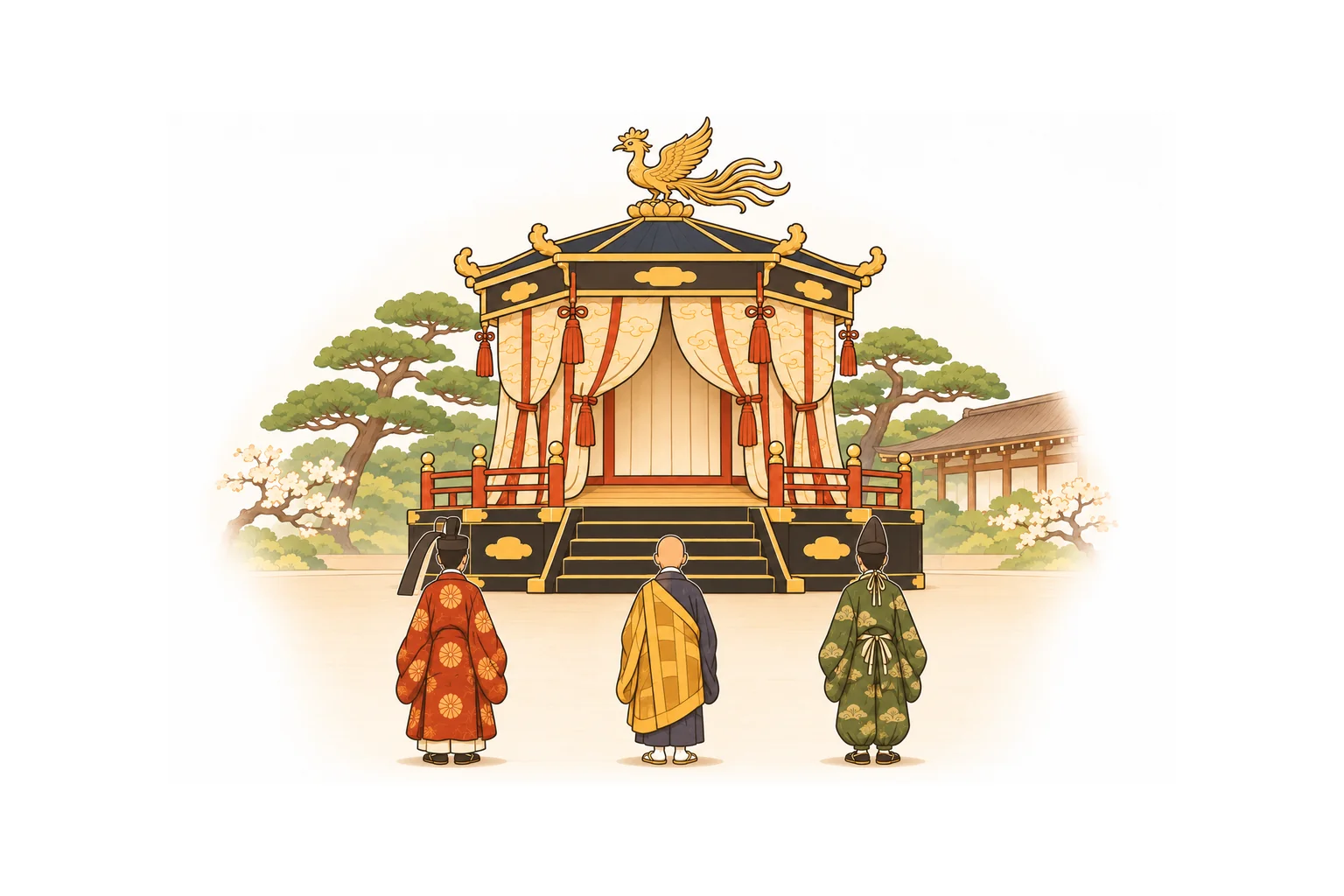
01An Enthronement Twenty-One Years Late
In the autumn of 1500 the body of Emperor Go-Tsuchimikado lay unburied in the palace in Kyoto for more than forty days, because the court could not pay for a funeral. His son succeeded him as Emperor Go-Kashiwabara. Custom required a new emperor to hold an enthronement ceremony, the great public rite that announced his reign to the realm. Go-Kashiwabara waited twenty-one years for his.
The problem was money. Decades of war had cut the court off from the income of its estates. A ceremony was set for the end of 1501, but the funds collected from the provinces fell far short, and it was postponed. In 1502 the shogun, Ashikaga Yoshizumi, offered to pay in return for a promotion at court. The real power in Kyoto, however, was Hosokawa Masamoto, the shogun’s deputy, who a few years earlier had deposed the previous shogun and installed Yoshizumi in his place. Masamoto blocked the gift. According to the diary of Jinson, a Nara abbot who recorded the news from the capital, Masamoto argued that a ceremony could not make a man a real king if the substance was missing, that he himself would accept Go-Kashiwabara as king without one, and that in these degenerate latter days a grand ritual was a waste. The courtiers agreed, and the money never came.
Later attempts failed too. One was called off because the date fell in an unlucky direction by the reckoning of the court diviners. Another collapsed when the money saved for it went to repair the Ise Shrine. Only in the third month of 1521, with donations from Jitsunyo, head of the Hongan-ji temple, and from the shogunate, did Go-Kashiwabara, now fifty-six, finally hold his enthronement. He died five years later.
For those twenty-one years the emperor had no army, no reliable income, and no means of paying for the rite that was supposed to make his reign official. By the logic of most of world history, a ruler like that does not last. Yet in all that time nobody deposed him, nobody set up a rival emperor, and nobody took the throne for himself. Masamoto’s remark sounds like contempt, and it was, but it was also an admission. Whether this man was emperor did not depend on the ceremony, or on his money.
This was not unusual. It was the rule. Between the seventh century, when the Japanese monarchy took the form it would keep, and the Meiji Restoration of 1868, Japan saw regents who controlled emperors through marriage, retired emperors who ran the government from outside the palace, military rulers called shoguns, warlords who barely acknowledged the court, and three great unifiers who conquered the whole country. Many of these men had no personal reverence for the emperor. They deposed emperors, exiled them, forced them to abdicate, and left them to scrape by on handouts. Not one of them replaced the dynasty.
02Why the Question Matters
Seen from China, this is very strange. Chinese history is a history of dynasties replacing one another: Qin, Han, Tang, Song, Yuan, Ming, Qing, each founded by overthrowing the last. Chinese political thought had a doctrine to explain this, the Mandate of Heaven. Heaven granted the right to rule to a virtuous family and withdrew it when the family became corrupt, so rebellion against a failed dynasty could be righteous. A powerful minister who had gathered real power into his hands, like Cao Pi in the third century or Zhao Kuangyin in the tenth, ended by taking the throne and founding a dynasty of his own. Whoever ruled China was expected, sooner or later, to become emperor.
Japan borrowed almost everything else from China: law codes, a bureaucracy, a grid-plan capital, era names, official histories, Buddhism, the writing system. It did not borrow this. In the late nineteenth century, the Meiji government turned that fact into a slogan, bansei ikkei, "a single line for ten thousand generations." It went into the first article of the 1889 constitution and became the heart of the official ideology that carried Japan into the twentieth century and its wars.
So there are really two questions here. The first is factual: how did a family with no army, and often no money, keep its place through more than a thousand years of ruthless politics? The second is about explanations. The answer Japan’s own nationalists gave was that the emperor was sacred and therefore untouchable. Does that answer hold up?
It helps to be precise. Individual emperors were replaced constantly. They were deposed, forced out, exiled, and occasionally killed. For nearly sixty years in the fourteenth century there were two rival courts, each with its own emperor. What survived was the throne itself and the family that occupied it. Power changed hands again and again, and the family was always there.
03What the Emperor Was at the Start
Before the seventh century, the rulers of the Yamato region, around modern Nara, were the leading figures in an alliance of powerful clans. Their standing rested partly on wealth and arms and partly on religion: they performed the rituals that kept the gods favorable. In 663 a Japanese army sent to help the Korean kingdom of Paekche was destroyed at the Battle of Hakusukinoe by Tang Chinese and Silla forces. The fear of invasion that followed drove a generation of rulers, especially Emperor Tenmu and his widow and successor Empress Jitō, to build a centralized state at astonishing speed, with census registers, taxes, ministries, and a capital modeled on the Tang. The title tennō, "heavenly sovereign," which we translate as emperor, came into use around this time.
The new state needed a story explaining why this family should rule. Two official histories supplied it, the Kojiki of 712 and the Nihon shoki of 720. They traced the imperial line back to Amaterasu, the sun goddess, who sent her grandson down from heaven; his great-grandson became the first emperor, Jinmu. The great clans had divine ancestors too, but in this arrangement their ancestors were Amaterasu’s attendants and followers.
One detail matters more than it seems. The Japanese imperial family has no surname. A Chinese emperor belonged to a lineage with a name, Liu or Li or Zhao or Zhu, and changing dynasties meant changing the surname on the throne. In Japan, surnames were things the emperor granted to subjects. The great names of Japanese history, Fujiwara, Taira, Minamoto, were all bestowed by the court; Taira and Minamoto were given to imperial princes when they were dropped from the royal family and made commoners. A powerful man’s very name marked him as a subject. There was no rival surname waiting to replace the imperial one, because the imperial family stood outside the system of names altogether.
Myths and naming customs are not armor, though. China’s dynasties had their ideology too. In the early centuries there were two moments when the line really was in danger, and they show where the system held.
The first came in 769. Empress Shōtoku, who never married, had raised a Buddhist monk named Dōkyō to extraordinary heights, giving him the title of Dharma King. An oracle arrived from the Usa Hachiman shrine in Kyūshū announcing that the realm would be at peace if Dōkyō became emperor. The empress sent a trusted official, Wake no Kiyomaro, to confirm it. He came back with a different oracle: since the country began, the division between sovereign and subject had been fixed, and the throne must go to someone of the imperial line. The furious empress exiled him. But Dōkyō never took the throne, and when she died the next year he was banished to a provincial temple.
The second came around 940, when a warrior in eastern Japan named Taira no Masakado, fighting a feud with his relatives, seized several provincial headquarters and proclaimed himself the "New Emperor," appointing his own ministers. He is the only man in Japanese history to have openly declared himself emperor. Within about two months other eastern warriors had killed him, and his head was displayed in Kyoto.
Both crises came when emperors still held real power. After the tenth century no one tried anything similar again. The reason was not that the emperor grew stronger. It was that he grew weaker.
04The Fujiwara: Owning the Emperor
In the Heian period, roughly 794 to 1185, real power at court passed to the Fujiwara family. Their method was simple. They married their daughters to emperors and waited for grandsons. When a Fujiwara grandson came to the throne as a child, his grandfather governed as regent, sesshō; when the emperor grew up, the grandfather stayed on as chancellor, kanpaku, reviewing every document before the emperor saw it.
The master of this system was Fujiwara no Michinaga. Four of his daughters went to the palace; three became empresses. Three emperors married his daughters as empresses, and two were his grandsons. In 1018, at a banquet celebrating his third daughter’s elevation to empress, Michinaga composed a poem saying, in effect, that this world was his world, like the full moon with nothing missing. We know about the poem because a rival courtier, Fujiwara no Sanesuke, wrote it down in his diary, probably with some disgust.
Why didn’t a man who could say "this world is mine" take the throne?
Because his power came from the emperor. Michinaga commanded the court because he spoke for the emperor, as his grandfather or father-in-law. Remove the emperor and Michinaga became just another senior noble, surrounded by brothers, nephews, and rival families who would have every reason to bring him down. Michinaga himself had reached the top only after a bitter contest with his own nephew. For the Fujiwara, the ideal situation was an emperor who existed, who was young, and who was family. To replace him would have been to destroy their own most valuable asset.
Here we meet the pattern that runs through the rest of Japanese history. The emperor supplied authority: legitimacy, the right to appoint, the final stamp of approval. Someone else supplied power: the capacity to make decisions and enforce them. The two were separated, and each side got what it needed.
05Retired Emperors and the Flexible Throne
In the late eleventh century the imperial family turned the Fujiwara method against the Fujiwara. In 1086 Emperor Shirakawa abdicated in favor of his seven-year-old son and continued to rule from his own palace as retired emperor. This arrangement, called insei, "cloister government," let the head of the imperial family escape the endless ritual duties of the throne and the oversight of Fujiwara regents. As the father or grandfather of the reigning emperor, a retired emperor held a family authority that a maternal grandfather could not match. Shirakawa dominated politics for over forty years. The Tale of the Heike, a later war epic, has him complain that only three things in the world defied his will: the floods of the Kamo River, the dice in a board game, and the warrior monks of Mount Hiei. Whether he said it or not, it captures how contemporaries saw him.
What matters here is that the imperial family itself accepted that the man on the throne did not need to be the man in charge. The throne became a seat to hand on, often to a child, and emperors came and went quickly. That made the dynasty remarkably flexible. It had plenty of princes, and succession rules loose enough to choose among them. Any strongman who found a particular emperor inconvenient could swap him for a cousin or a nephew. Replacing one emperor was cheap. Replacing the family would be expensive. Strongmen chose the cheap option, over and over.
06Shoguns and Borrowed Titles
In the late twelfth century warriors took over. Taira no Kiyomori, the first warrior to dominate the court, simply copied the Fujiwara: he became chief minister, married his daughter to an emperor, and put his infant grandson, Antoku, on the throne. When the Taira were destroyed at the sea battle of Dan-no-ura in 1185, Antoku, aged six by Western reckoning, went into the water in his grandmother’s arms.
The victor, Minamoto no Yoritomo, did something different. He stayed in Kamakura, far from Kyoto, and built his own government based on personal bonds with his warriors: he guaranteed their lands and they served him. In 1192 the court appointed him sei-i taishōgun, "great general who subdues the barbarians," an old title once given to commanders sent against the peoples of the northeast. Yoritomo turned it into the permanent title of the warrior ruler. We know it as shogun.
Why did Yoritomo want anything from the court? Because his warriors were not the only people who mattered. Every piece of land in Japan was tangled in layers of rights belonging to nobles, temples, and provincial governors. To place his own men in charge of those lands, he needed a justification. In 1185 he obtained permission from the retired emperor Go-Shirakawa to appoint military governors and land stewards across the country. Seizure became public service.
That is the basic bargain between warriors and emperors. A sword can make people obey. It cannot make them agree that the obedience is right. The emperor controlled a system of recognition that had been in place for centuries: ranks, offices, names, era names, the calendar, and the final word on what was lawful. A warrior chief needed that system to set himself apart from all the other warriors, who were just as armed as he was.
The Jōkyū War of 1221 fits this pattern exactly. That year the retired emperor Go-Toba called on warriors across the country to destroy Hōjō Yoshitoki, the man who ran the government in Kamakura. Within a month a Kamakura army had marched into Kyoto. The victors were thorough. Go-Toba was shipped to the Oki Islands in the Sea of Japan, his son Juntoku to the island of Sado, and another son, Tsuchimikado, who had taken no part in the plot, went into exile voluntarily on Shikoku. The reigning boy emperor, on the throne for fewer than eighty days, was deposed. A man who could send three retired emperors to three islands could surely have taken the throne himself. Yoshitoki instead found a boy in the imperial family who had nothing to do with the war and made him emperor, and gave the boy’s father the status of retired emperor so he could govern in his son’s name, though the father had never been emperor at all. Rather than abolish the imperial house, the Hōjō invented a new precedent to keep it running.
Yoshitoki was not even shogun. His title was shikken, regent to the shogun. After Yoritomo’s line died out, the Hōjō brought in shoguns from Kyoto, first a Fujiwara child and later imperial princes, and ruled through them. So the Hōjō governed in the name of the shogun, and the shogun held office by appointment from the emperor. Each layer of power sheltered behind the one above it instead of tearing it down. The Hōjō never bothered to become shoguns, and they never thought of becoming emperors either.
07The Closest Call: Ashikaga Yoshimitsu
If anyone in Japanese history might have replaced the emperor, it was Ashikaga Yoshimitsu, the third shogun of the Muromachi shogunate.
By the 1390s he had reached heights no warrior had touched. In 1392 he ended the split between the Northern and Southern Courts, persuading the southern emperor to hand over the sacred regalia. He became chancellor of the realm, the highest office at court, combining the top of the warrior world with the top of the aristocratic one. After taking Buddhist vows he went on ruling from his villa in the northern hills of Kyoto, the place we now know as the Golden Pavilion. His wife was named ceremonial mother of the emperor, and he himself was treated with honors close to those of a retired emperor.
He also reached abroad. In 1401 he sent an embassy to Ming China, and the Ming emperor’s reply addressed him as "King of Japan." Yoshimitsu then wrote to the Ming as their subject, accepted investiture, and opened an official trade. In the diplomatic order of East Asia, the King of Japan was Japan’s sovereign. Abroad, Yoshimitsu had stepped into the emperor’s place.
In the spring of 1408 he hosted Emperor Go-Komatsu at his villa for twenty days of lavish entertainment. Soon afterward his favorite son, Yoshitsugu, celebrated his coming of age at the palace with a ceremony modeled on that of an imperial prince. Within days Yoshimitsu fell ill, and he died shortly after, aged forty-nine.
Historians disagree sharply about what this meant. One influential reading, associated above all with the historian Imatani Akira, holds that Yoshimitsu was steering Yoshitsugu toward the throne, and that only his sudden death stopped the Ashikaga from replacing the imperial house; some have even suggested poison, though there is no evidence for it. The other reading holds that each of these honors made sense within the customs of the day, that Yoshimitsu wanted to stand above the court rather than replace it, and that "King of Japan" was a title for diplomacy and trade, almost never used at home. Recent scholarship, such as Ishihara Hiiro’s re-examination, has moved many historians toward this second view.
I find the second view more convincing, but the first raises the right point. Even if Yoshimitsu did dream of the throne, he did not try to seize it. He tried to slip his son into the imperial family by way of princely ceremony. The strongest warrior in Japanese history, if he had such ambitions, pursued them by joining the dynasty, not by overthrowing it. And what happened after his death settles the practical question. His successor, Yoshimochi, who disliked his father, declined the court’s offer to grant Yoshimitsu the posthumous title of retired emperor and broke off the tributary relationship with China. The great warlords who held the provinces had no interest in an Ashikaga emperor. A distant, harmless emperor in Kyoto, who needed only occasional gestures of respect, suited them much better than a shogun-turned-sovereign they would have to serve.
08The Poorest Emperors, the Most Wanted Titles
In the late fifteenth century the Ōnin War burned much of Kyoto, the shogunate lost its grip, and Japan entered the Warring States period. Regional lords, daimyō, carved out domains by force. The court’s estate income nearly vanished.
The emperors became poor in a way that is hard to picture. Go-Kashiwabara’s twenty-one-year wait for his enthronement was only the best-known case. The next emperor, Go-Nara, also relied on contributions from warlords, and he is said to have sold his calligraphy to raise money. The palace walls were so broken, according to later accounts, that people could see into the grounds.
This was the easiest moment in history to get rid of the emperor. Instead, the warlords lined up to pay him. Ōuchi Yoshitaka in western Japan, Imagawa Yoshimoto in Suruga, Takeda Shingen and Uesugi Kenshin in the mountains, all sought court ranks and titles. Oda Nobunaga’s father made a large donation toward repairing the palace.
Why would a man who had conquered several provinces with his own armies want an empty court title? Because rule by the sword was precarious. A daimyo’s leading retainers were often men who had been his equals a generation earlier, and they could switch sides. His neighbors were men exactly like himself. In a world where everyone had come up by force, force could not tell anyone who deserved to rule. A court title was an outside measure that everyone accepted. It made rebellion look more like treason and gave neighbors one fewer excuse to invade. And the weaker the emperor was, the more neutral his recognition looked. He was nobody’s puppet because he had nothing anyone feared.
09The Three Unifiers
The three men who ended the Warring States, Oda Nobunaga, Toyotomi Hideyoshi, and Tokugawa Ieyasu, each handled the emperor differently, and none stepped outside the old pattern.
Nobunaga is the one most often imagined as a potential usurper. He burned the great monastery on Mount Hiei, drove out the last Ashikaga shogun, and showed little patience for tradition. He urged Emperor Ōgimachi to abdicate; this was long read as bullying, though many recent scholars think the emperor wanted to step down. He also gave up or declined several court offices. In 1582 the court asked whether he would accept the post of chancellor, regent, or shogun; before he answered, he was killed by his general Akechi Mitsuhide at the Honnō-ji temple. Scholars still argue over what he intended for the court. What is clear is that he used the emperor’s name throughout his career. In 1570, when he was trapped between enemies, it was imperial mediation that got him a truce.
Hideyoshi shows the pattern even more plainly. He was born a commoner, the son of a peasant or a low-ranking foot soldier. A later story claims he could not become shogun because he was not a Minamoto, but no contemporary source supports it, and Kamakura had already had shoguns from the Fujiwara and the imperial family. The route he actually took was to have himself adopted by a former regent, Konoe Sakihisa, which made him a Fujiwara on paper. In 1585 he became regent, and the next year the emperor granted him a brand-new surname, Toyotomi. A peasant’s son rose to the highest office at court and received a new family name, all through the emperor. In 1588 Hideyoshi hosted Emperor Go-Yōzei at his Kyoto palace, the Jurakudai, and had the assembled daimyo swear written oaths in the emperor’s presence to honor the throne and obey the regent’s commands. Loyalty to Hideyoshi was dressed up as loyalty to the emperor. Later, planning his invasion of Korea and dreaming of conquering Ming China, he imagined moving Go-Yōzei to Beijing. The emperor would be a grander ornament on a bigger stage, but still the emperor.
Ieyasu turned the arrangement into law. He became shogun in 1603 and set up his government in Edo, modern Tokyo. In 1615, after destroying the Toyotomi at Ōsaka, his shogunate issued a code for the court that told the emperor his first duty was learning and poetry, and put court appointments, era changes, and honors for senior clergy under shogunal oversight. A shogunal deputy in Kyoto watched the palace. The court lived on a modest allowance from Edo.
The friction showed in the reign of Go-Mizunoo. In 1627 the shogunate declared invalid a number of purple robes, a high honor for Buddhist abbots, that the emperor had granted without its approval, and abbots who protested were exiled. In 1629 Go-Mizunoo abdicated without warning the shogunate, passing the throne to his five-year-old daughter, who became Empress Meishō. Her mother was a daughter of the second shogun, so the new empress was a Tokugawa granddaughter, and the first woman on the throne in more than eight hundred years. She never married, and by custom an empress did not pass the throne to her own children. Whatever Tokugawa hopes rested on an emperor of their own blood ended with her.
The Tokugawa shoguns could easily have abolished the court. They never tried. Their rule was explained, when anyone bothered to explain it, as a delegation: the emperor had entrusted the government of the realm to the shogun. For most of the Edo period this was a quiet formula. Two centuries later it would turn out to have a sharp edge.
10When the Name Became Power Again
In the eighteenth and nineteenth centuries, scholars of "national learning" such as Motoori Norinaga studied the Kojiki and argued that Japan’s true spirit predated Chinese and Buddhist influence, with the emperor at its center. Scholars in the Mito domain, working on a vast history of Japan, stressed reverence for the emperor and the proper order between ruler and subject. None of this was originally aimed at the shogunate. Mito was itself a branch of the Tokugawa family. The idea was that the shogun revered the emperor, the lords served the shogun, and everything stayed in its place.
Then Commodore Matthew Perry’s American warships arrived in 1853. The shogunate signed treaties with the Western powers, and in 1858 the shogunate’s chief minister, Ii Naosuke, concluded a commercial treaty without the emperor’s consent. Emperor Kōmei loathed the foreigners, and his opposition handed a banner to everyone who wanted to attack the shogunate. The old delegation formula now cut the other way: if the shogun governed on the emperor’s behalf, then a shogun who defied the emperor had forfeited his commission. "Revere the emperor, expel the barbarians" became the cry of a movement.
For the next decade Kyoto was the center of Japanese politics again, and the great domains of Satsuma and Chōshū competed to get the court on their side. In late 1867 the last shogun, Tokugawa Yoshinobu, formally returned governing authority to the emperor, hoping to stay on as the leading lord in a new order. Satsuma and Chōshū moved first. In the name of the fifteen-year-old Emperor Meiji they proclaimed the "restoration of imperial rule," abolishing the shogunate and the old regency offices alike. At the Battle of Toba-Fushimi in January 1868 their troops carried brocade banners marking them as the imperial army, and many on the shogunate’s side lost heart.
The young emperor did not govern in person. The men who drove the new state, Ōkubo Toshimichi, Kido Takayoshi, Saigō Takamori, Iwakura Tomomi, held the power. But this time they did not set up a new shogun beside the throne. They put the emperor himself at the center of the nation. He moved from Kyoto to Edo, now Tokyo, into the old shogunal castle. He wore a Western military uniform, toured the country, and appeared in photographs and official portraits. Authority and power, separated for close to a thousand years, were tied back together, at least on paper.
11The Answer
So why did no one in more than a thousand years replace the emperor?
The answer most often heard is sanctity. The emperor descended from the sun goddess and was too sacred to touch. There is something to this. The founding myth placed the imperial house above every other family from the start, and the custom of granting surnames left no rival name to take its place. But sanctity alone cannot explain warriors who exiled retired emperors at will, or warlords who let the palace walls crumble. The fourteenth-century war chronicle Taiheiki has the general Kō no Moronao say that if an emperor was needed, one could be carved from wood or cast in metal, and the living ones sent into exile. He may never have said it, but someone thought it worth writing down. The image of a nation united in reverence for an unbroken line was largely built after 1868. It cannot explain the thousand years before.
A second answer is geography. Japan is a group of islands and was never conquered from outside, and many changes of dynasty in China came from invading peoples. This explains why no outsider broke the line. It does not explain why no insider did, and Japan had plenty of insiders strong enough to try.
The most convincing answer is structural. From the tenth century on, emperors gradually stopped commanding armies and running the government. Real power moved to the Fujiwara regents, then to retired emperors, then to shoguns, then to regional lords. As a result, in Japan you did not need the throne to hold power. In China the emperor was the head of the government and the supreme commander, so power and the throne sat in the same chair, and any strongman eventually had to sit in it. In Japan the chair and the power had come apart. A strongman could take all the power and leave the chair to a harmless family.
Keeping the emperor cost little. He had no army and no land of his own, and he lived on what the strongmen gave him. When an emperor did cause trouble, as Go-Toba did in 1221 or Go-Daigo did in the 1330s, he could be removed and replaced from a large pool of relatives. And keeping him paid well, because he controlled the one system of recognition that everyone accepted, which every ruler needed to prove he was more legitimate than his rivals.
Replacing him, by contrast, was dangerous. A usurper would instantly turn every rival into a loyal defender of the throne. If Michinaga had seized it, the rest of the Fujiwara and the other noble houses would have turned on him. If the Hōjō had, Kamakura’s own warriors would have asked why a regent’s family should sit above both the shogun and the emperor. If Yoshimitsu had, the provincial lords had no reason to follow him. In a system where power was spread out and everyone was watching everyone else, the throne was the one position that belonged to no faction. Pulling it down meant pulling out the foundation everyone stood on, and the man who did it would be the first one buried in the rubble.
The emperor survived because he was weak, not because he was strong. The sacred lineage was where the arrangement began, and the arrangement kept reinforcing it: the longer the line lasted, the more irreplaceable it looked, and the more irreplaceable it looked, the less anyone dared touch it. Each new holder of power added another layer around the throne rather than starting over. Regents stood beside the emperor, retired emperors behind him, shoguns outside the court, Hōjō regents beneath the shogun. Power nested inside power, like a set of Russian dolls, and nobody ever took out the smallest doll in the middle.
When Hōjō Yoshitoki sent three retired emperors into exile and then made a new emperor and invented a new retired one, he was not showing reverence. He understood very well how useful an emperor was.