
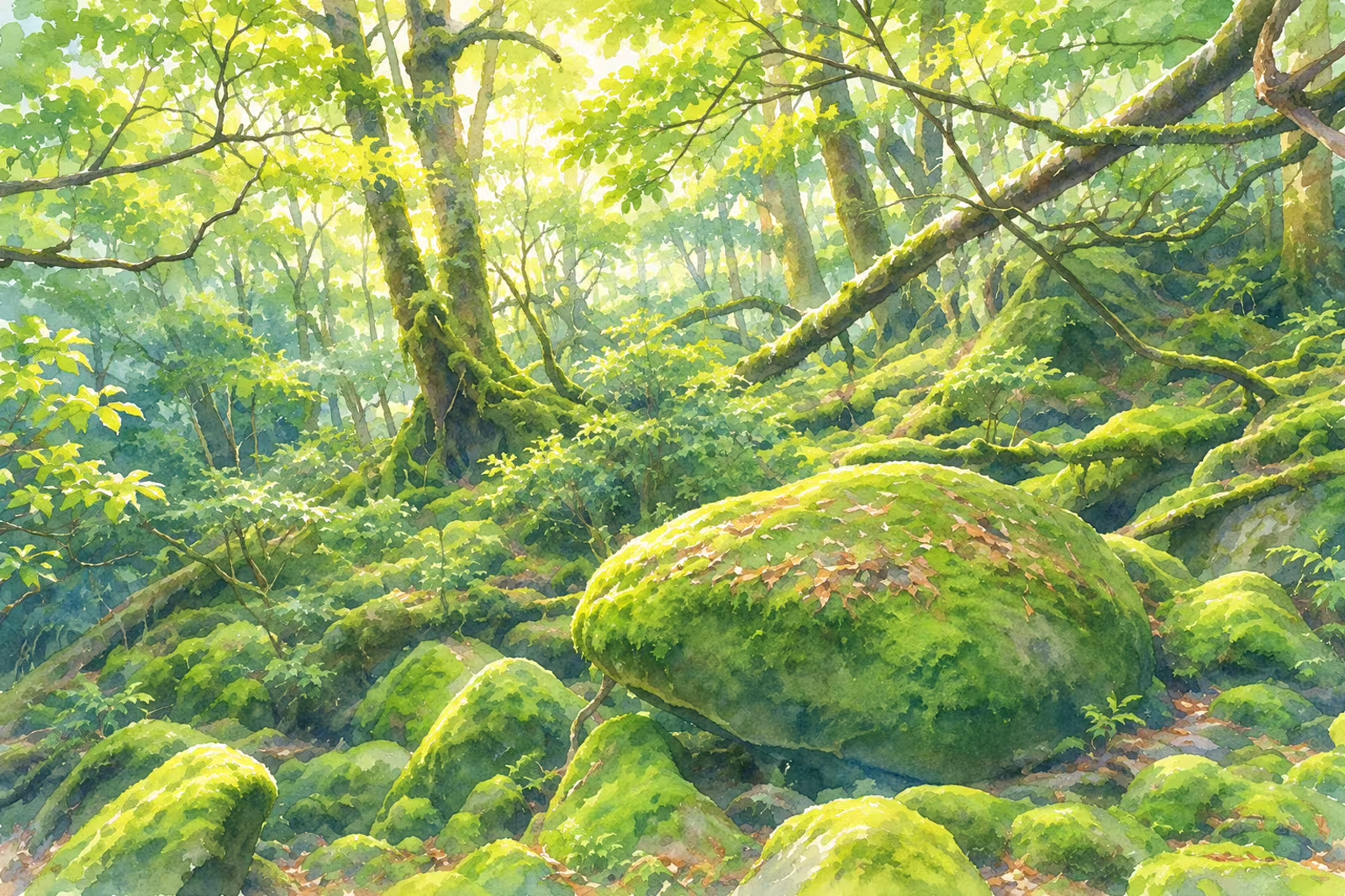
Yakushima lies about 60 kilometers south of the Ōsumi Peninsula in Kagoshima Prefecture and forms the town of Yakushima. At its center rises Mount Miyanoura, the highest peak in Kyūshū, and its rain-soaked mountains are home to yakusugi, cedars more than a thousand years old. This entry is about the relationship between that forest and people: mountain worship, logging from the Edo period on, the rise and fall of a forestry village, and the later turn to protection.
01Worship and Edo-period logging
Islanders long regarded the high mountains as the dwelling place of gods and kept a custom called dake-mairi, climbing to the summits to worship. Small shrines still stand on several peaks. Large-scale cutting of yakusugi began in the Edo period. According to tradition, in the early 17th century Tomari Jochiku, a monk from Anbō, encouraged islanders to fell cedars for a living, and the Satsuma domain then took thin roofing boards split from yakusugi, called hiraki, as the islanders’ annual tax. Yakusugi wood is rich in resin and resists rot, and it was highly prized. The well-known Wilson Stump in the mountains is what remains of a giant cedar. It is generally believed to have been felled in the late 16th century for the Hōkō-ji temple in Kyoto, and it became famous after the British botanist Ernest Wilson surveyed it in 1914.
02Modern forestry and protection
After the Meiji Restoration most of the island’s mountain forest became national forest. In the 1920s a forest railway was built from Anbō into the mountains to carry timber, and parts of it are still in use. Kosugidani, deep in the forest, was a loggers’ village with several hundred residents and a school around 1960. As logging shrank, it was abandoned in 1970. Heavy cutting in the postwar boom years sparked a conservation movement on and off the island, and the felling of yakusugi was gradually brought to an end. The Jōmon Sugi was found in 1966, and estimates of its age range widely, from just over 2,000 years to more than 7,000.
03What can be seen today
The island’s primeval cedar forest is designated a Special Natural Monument. In 1993 Yakushima and the Shirakami Mountains became Japan’s first natural World Heritage Sites, and part of the island lies within Yakushima National Park. Along the hiking trails visitors can still see stumps left by logging, the old forest railway, the site of the Kosugidani settlement, and young cedars growing from old stumps.