
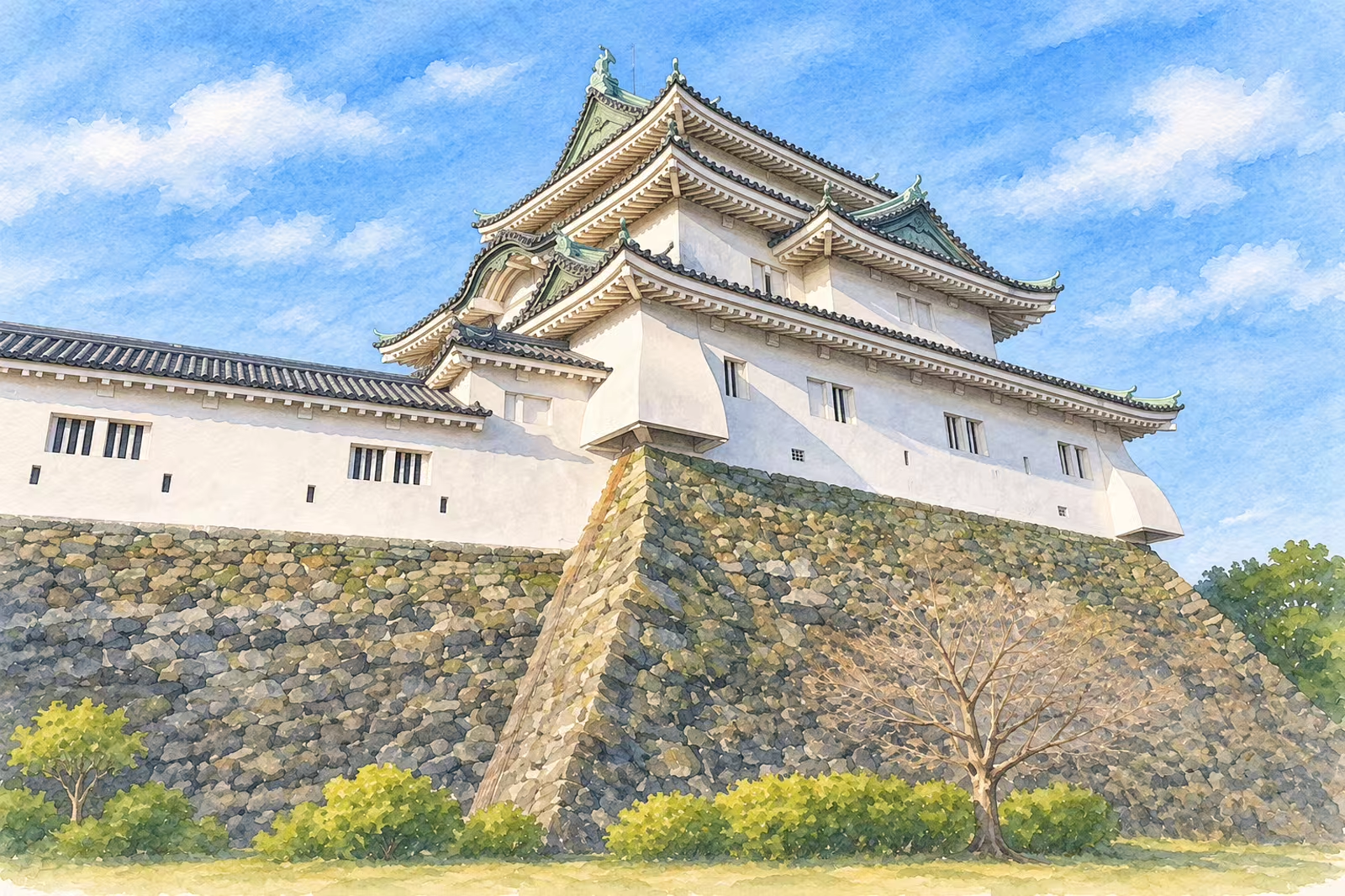
Wakayama Castle stands on Torafusu Hill in the center of Wakayama City, Wakayama Prefecture, close to the mouth of the Kinokawa. From the hilltop it commands the Wakayama plain and the sea route into the Kii Channel. Three successive ruling houses, the Toyotomi, the Asano and the Tokugawa, built and rebuilt it. In the Edo period it was the seat of the Kii Tokugawa, one of the three senior branches of the shogun’s family, which produced the eighth shogun, Yoshimune, and the fourteenth, Iemochi.
01Builders and lords
After Hashiba Hideyoshi conquered Kii in 1585, he ordered his younger brother Hidenaga to build a castle on the hill, then known as Okayama, and Kuwayama Shigeharu was placed in charge as castellan. After the Battle of Sekigahara, Asano Yoshinaga received Kii in 1600. He enlarged the main and second enclosures, built a linked group of a main keep and a smaller keep joined by turrets and corridors, and laid out the castle town. In 1619 Tokugawa Yorinobu, Ieyasu’s tenth son, took over the domain and founded the Kii Tokugawa line. He expanded the castle again, and the lower second enclosure gradually became the center of government and residence.
02Destroyed twice, rebuilt twice
In 1846 lightning struck the keep and it burned down. Because of the Kii house’s senior status, the domain was allowed to rebuild it, and the new keep, completed in 1850, largely followed the old design. It was designated a National Treasure in 1935 and was completely destroyed in the air raid on Wakayama in July 1945. The present keep group is a 1958 reconstruction in reinforced concrete: close to the old buildings on the outside, a museum inside.
03What survives
The castle grounds are a National Historic Site. The hill preserves stone walls from several building phases, from early rough walls of unworked local green schist to later walls of carefully cut stone, and many of the stones carry masons’ marks. The Okaguchi Gate, thought to date from 1621, survived the bombing and is designated an Important Cultural Property together with the adjoining earthen wall. The Nishinomaru Garden, also called the Momijidani Garden, is a national Place of Scenic Beauty. The roofed bridge linking the second and western enclosures, the Ohashi-rōka, was reconstructed in 2006 on the basis of historical records.