
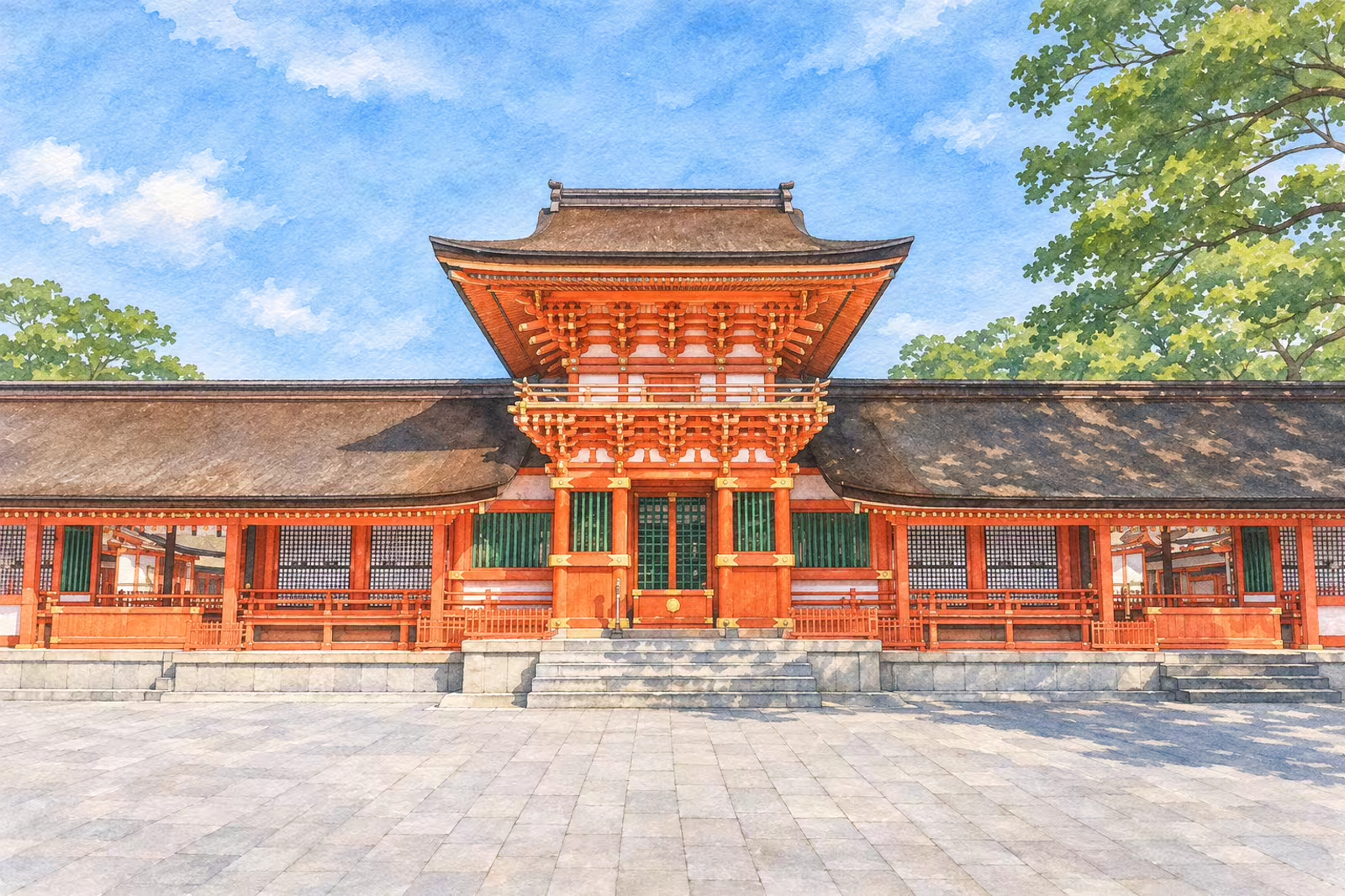
Usa Jingū, in Usa City, Ōita Prefecture, is the head shrine of the Hachiman cult, the parent of what are said to be more than 40,000 Hachiman shrines across Japan. Hachiman began as a regional deity of northern Kyūshū and grew into a protector of the state, honored by the imperial court and later by the warrior class. Two episodes of the Nara period, the building of the Great Buddha at Tōdai-ji and the succession crisis of 769, ran directly through this shrine.
01Foundation and deities
According to shrine tradition, the first hall was built on Mount Ogura (also called Kameyama) in 725 to enshrine Hachiman Ōkami. A second hall for Hime Ōkami followed in 733, and a third, for Empress Jingū, in 823. Hachiman is generally identified with Emperor Ōjin. The three main halls stand side by side, each formed of a front and a rear building under two joined gabled roofs. This arrangement is called Hachiman-zukuri, and Usa is its classic example.
02Court and Buddhism
In 749 Hachiman issued an oracle pledging support for the Great Buddha project at Tōdai-ji, and the deity is recorded as traveling to the capital in a sacred palanquin. From then on Hachiman was closely tied to state Buddhism. In 769 an oracle claimed that the realm would be at peace if the monk Dōkyō took the throne. Empress Shōtoku sent Wake no Kiyomaro to Usa to confirm it, and he returned with a contrary oracle: the throne must go to a member of the imperial line. Dōkyō never became emperor, and the court kept sending envoys to Usa for centuries afterward. Usa was also one of the earliest centers of combined kami and Buddhist worship. A shrine-temple, Miroku-ji, stood beside the sanctuary, and around 781 Hachiman received the Buddhist title Hachiman Daibosatsu, "Great Bodhisattva." Miroku-ji was abolished when the Meiji government separated Shinto and Buddhism, and only its site remains.
03What can be seen today
The three main halls of the upper shrine were rebuilt between the Ansei and Bunkyū eras at the end of the Edo period (the 1850s and 1860s) and are designated a National Treasure. A lower shrine at the foot of the hill also honors the three deities. The grounds include the vermilion Kure Bridge, a treasure hall, and the site of Miroku-ji. Worshippers at Usa still follow a distinctive form of prayer, two bows, four claps and one bow, instead of the usual two claps. The interiors of the main halls are not open to ordinary visitors.