
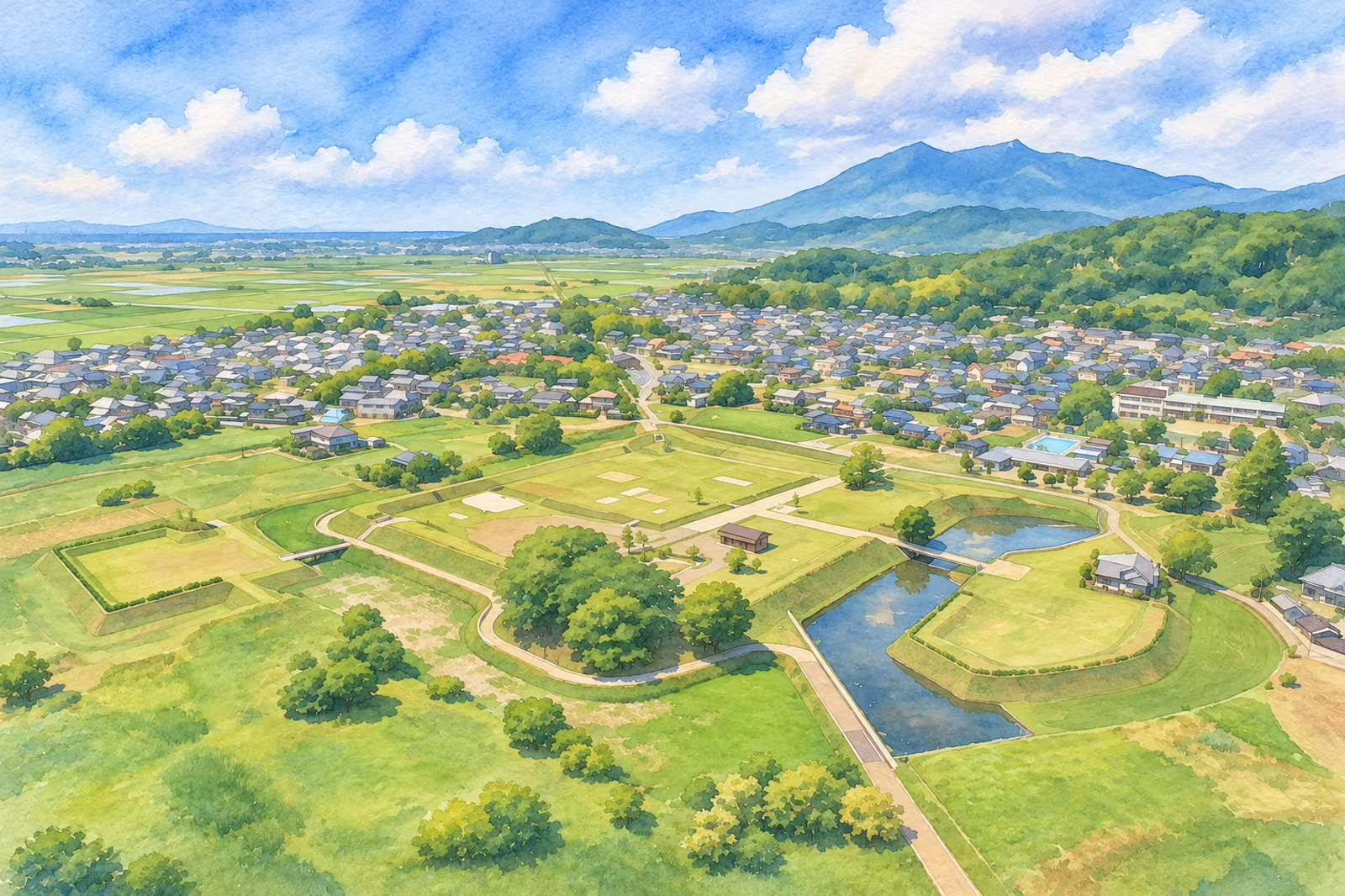
The Oda Castle Ruins lie in the Oda district of Tsukuba, Ibaraki Prefecture, on flat ground at the southern foot of Mount Tsukuba. From the Kamakura period the Oda family ruled southern Hitachi Province from here for nearly 400 years. During the conflict between the Northern and Southern Courts, the Southern Court statesman Kitabatake Chikafusa stayed in the castle, and he is generally thought to have drafted the Jinnō Shōtōki there. The site is a National Historic Site, and its central area has been laid out as a historical park based on excavation results.
01Seat of the Oda Family
The founder of the Oda line was Hatta Tomoie, a Kamakura shogunate retainer from a branch of the Utsunomiya family of Shimotsuke. Rewarded for service under Minamoto no Yoritomo, he gained authority over Hitachi roughly equivalent to that of a provincial constable, and he is generally thought to have built a residence around Oda early in the Kamakura period. His descendants took the place name as their surname. Built on low, wet ground, the castle had no tall stone walls. It relied on earthen ramparts, water-filled moats and a series of linked enclosures. The roughly square main enclosure was surrounded by further rings of enclosures and moats, extended over several centuries.
02Southern Court Base and Sengoku Fortunes
In 1338 Kitabatake Chikafusa set out by sea for eastern Japan on behalf of the Southern Court. His fleet was scattered by a storm, and after landing in Hitachi he eventually entered Oda Castle under the protection of its lord, Oda Haruhisa. From here he tried to rally warriors across the Kantō, and the Jinnō Shōtōki is said to have been written during this stay. Around 1341 a Northern Court army under Kō no Morofuyu attacked; Haruhisa eventually submitted, and Chikafusa moved on to Seki Castle.
In the Sengoku period the lord Oda Ujiharu maneuvered between the Satake, Yūki, Uesugi and Hōjō, losing the castle several times and retaking it again. After the Battle of Tehaizaka around 1569, the castle passed to the Satake, and Ujiharu never held it for long again. When the Satake were transferred to Dewa in 1602, the castle was abandoned.
03What Can Be Seen Today
The site was designated a National Historic Site in 1935. In modern times most outer enclosures became farmland and villages, and the Tsukuba Railway line once ran straight through the main enclosure; after the line closed in 1987 its route became a cycling road. Tsukuba City began systematic excavation in the late 1990s, and as of 2016 the earthen ramparts, moats and bridge remains of the main enclosure had been restored as the Oda Castle Ruins Historical Plaza, with a guidance facility displaying excavated objects and the castle’s development. The restored parts are earthworks rebuilt on the excavated remains; no medieval buildings survive. Beyond the main enclosure, moat lines can still be traced in the pattern of fields and roads.