
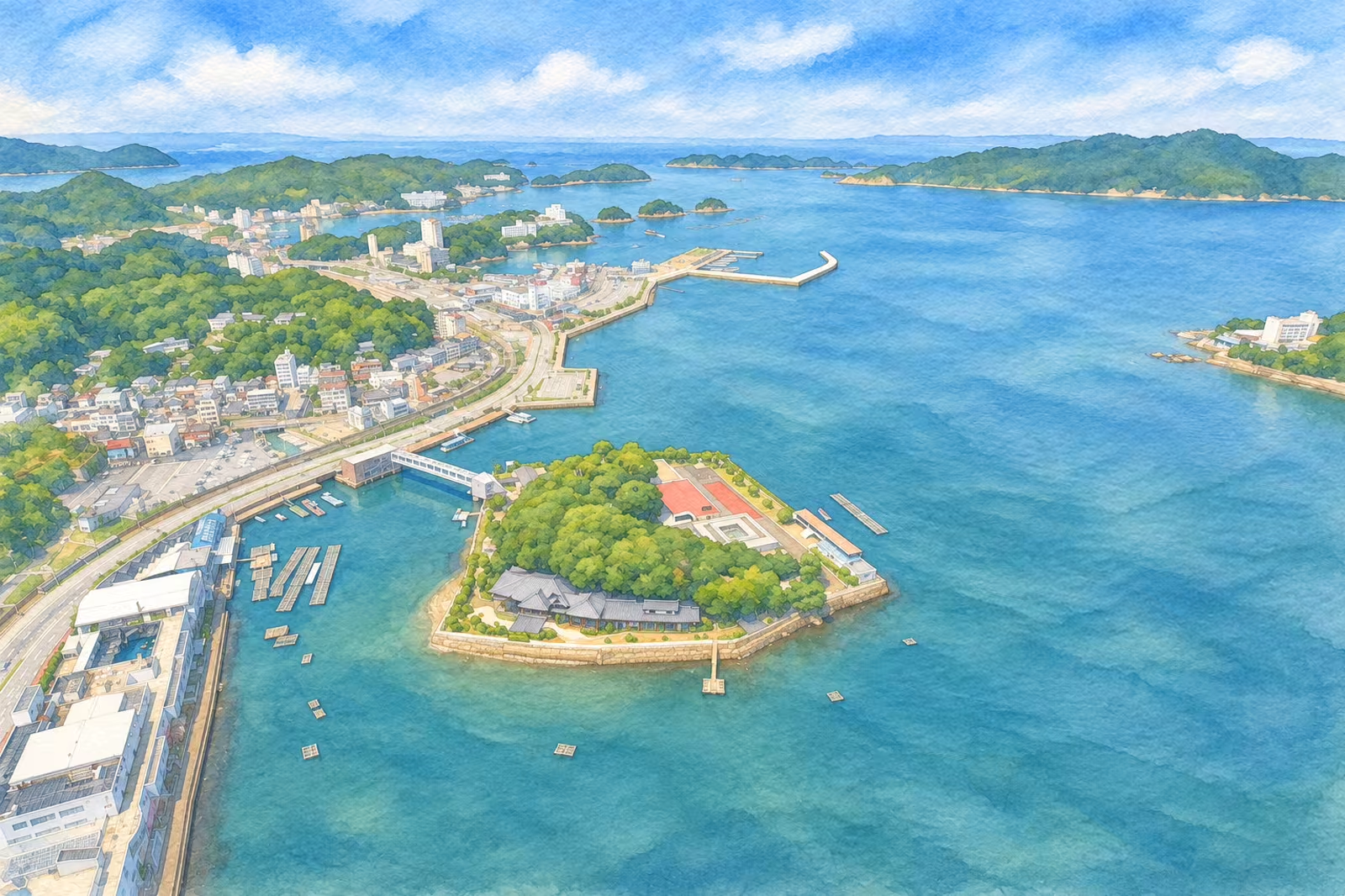
Mikimoto Pearl Island lies in Toba Bay in Toba, Mie Prefecture. Formerly called Ojima, it is where Mikimoto Kōkichi first succeeded in producing cultured pearls. Today the island holds a pearl museum and a memorial hall to Mikimoto, and together with the surrounding waters of Toba Bay and Ago Bay it tells how Japanese pearl farming grew from experiments at sea into a global industry.
01Mikimoto and the half-pearl
Mikimoto Kōkichi was born in Toba in 1858 into a family that ran an udon shop. Natural pearls gathered by the ama divers of Ise-Shima were becoming scarce, and he set out to make Akoya oysters produce pearls by artificial means. From the late 1880s he experimented repeatedly at Shinmei in Ago Bay and around Ojima in Toba, suffering heavy losses from red tides and other setbacks. According to the usual account, in 1893 he succeeded on Ojima in producing semi-spherical pearls. These grew attached to the inside of the shell and were not yet round. He went on to take out a patent and opened a pearl shop in Ginza, Tokyo.
02Round pearls and a new industry
Fully round cultured pearls were achieved in the early twentieth century through the separate work of several people. Mise Tatsuhei and Nishikawa Tōkichi developed methods of implanting a nucleus together with a piece of mantle tissue, and Mikimoto also obtained a patent for round pearl culture in the 1910s. His company combined farming, processing and retail, and promoted cultured pearls in Europe and America. In the 1920s European jewelers questioned whether cultured pearls were "real" pearls; by one account they won acceptance only after scientific examination and a court case. Cultured pearls went on to transform the world pearl trade, and Japan became for a time its largest producer. Mikimoto died in 1954 at the age of 96.
03The island today
After the war Ojima was renamed Pearl Island and opened to visitors in the 1950s; it is linked to central Toba by a bridge. The Pearl Museum uses specimens, models and film to explain how pearls form, how oysters are nucleated and harvested, and how pearls are worked into jewelry, while the memorial hall displays material on Mikimoto’s life. Ama divers give demonstrations on the island, and the diving techniques of the ama of Toba and Shima are designated a national Important Intangible Folk Cultural Property. The nineteenth-century experimental beds do not survive in their original form and the present buildings are all later, but pearl rafts in the bay still show the industry at work.